Opinion: The Mormons – er, Church of Jesus Christ of Latter-day Saints – see themselves as a peculiar people. I know because I am one.
If you’re the Salt Lake Tribune, you never miss a chance to poke a stick in the ribs of the people who built Utah. So the newspaper published this headline over a recent opinion column:
The headline, of course, is asserting that The Trib will call the church whatever it darn well pleases.
Utah could use some grounding now
Salt Lake’s namesake newspaper is to Utah what the dark sheep is to his clean-cut brethren. Yeah, he’s a burn-out, but he still knows them better than anyone outside the family, and he’s gonna remind them every day that their fleecy butts aren’t made of gold.
Devout Mormons don’t appreciate this. They should. The Trib keeps Utah grounded.
And this is one of those moments when Utah definitely needs grounding.
On Thursday, the president of the Church of Jesus Christ of Latter-day Saints, Russell M. Nelson, announced that God had impressed upon him that the time has come again to cast off the nickname “Mormon” and start calling the church by its proper name.
Nelson, a long-time church general authority and respected heart surgeon, was named the prophet in January. When I was visiting Utah a couple of weeks ago, the buzz among my Mormon family members was that this 93-year-old church president is still skiing Utah’s powdered slopes.
Who still skis at age 93?
I’ll tell you who. Teetotaling Mormons who have lived clean and virtuous lives. Have you seen Mitt Romney lately? He’s 71 and looks like he just got his first face stubble and driver’s permit.
I know the Mormons because I am one. I married a Catholic woman, and we tried attending two churches for several years until four children came along and got completely flummoxed. I’ve since attended as many Catholic masses as I did Mormon sacrament meetings.
I love the Mormon Church and its people. I’ve known men like President Nelson, and they are extraordinary human beings – disciplined, faithful, decent in every way. The church has many of these men and women, and I admire them greatly.
But Nelson has put the LDS Juggernaut into reverse with the word “Mormon.” The church had finally come around to embracing and changing a nickname born of ridicule and now a new prophet is saying scratch that, we’re dropping Big M.
I’ve no doubt Nelson is sincere. Men like him are, above all, honest to a fault. And so when he says he was impressed by God to make the changes, I believe him.
This is not a policy for the modern world
Besides, this is not the policy change you order up if you’re conforming to the modern world. The modern world doesn’t like long and gangly names that are confusing and ambiguous. Say “the Mormons” and everyone knows who you’re talking about. Say the now approved “restored Church of Jesus Christ” and everyone says, “What?”
A minor candidate for Utah’s U.S. Senate seat gave voice to this confusion on Twitter on Monday:
“We embraced ‘Mormon,’” wrote Sam Parker.
“Then we shunned ‘Mormon.’
“Then we re-embraced ‘Mormon.’
“Now, we’re shunning it again.
“Probably nothing to get worked up about. Give it 20 years & we’ll be embracing “Mormon” again.”
Confusion or not, I think I know why the church is doing this.
Are the Mormons really Christians?
Even with the acceptance of the word Mormon, many people remain confused about the faith. Are the Mormons truly Christian? A lot of Christians of other faiths say no.
In Arizona, the religious right – the Evangelicals – once protested the inclusion of Mormons at an ecumenical event. They don’t believe the Mormons are Christians and threatened to boycott the event if they attended. The Mormons were eventually barred from the gathering.
The fact is the Mormons are Christian to their very core. Christ is at the center of the church. Their conception of Christ is largely informed by the New Testament and if it requires eschewing the name “Mormons” for “The Church of Jesus Christ of Latter-day Saints” to drive home the point they will do it — no matter the large complications.
Those who would deny the Mormons their claim to Christianity are intolerant of at least of one the world’s great religions and probably feel threatened by a church that proselytes across the globe. They resent Mormon missionaries trying to convert members of their own faith.
When the Evangelicals forced them from the Arizona event, the Mormons didn’t protest or grouse. Not one bit. The Jewish people of the Anti-Defamation League came to their defense, something I personally appreciated and told them so, but they needn’t have bothered.
The Mormons see themselves as a faith apart – a peculiar people who have had revealed to them the restored gospel of Jesus Christ. They’re not alone among religions believing in their own exceptionalism, but to tell them they’re not fit to sit with the ecumenicals is to reinforce their own sense of exclusivity.
If you truly embrace that kind of faith, it can be a heady place. You may lose your humility, a state of being that moves you further from God. The exceptionalists need people around them to keep them grounded.
With our three remaining games on an interval, here’s a reminder of the next round of County Championship fixtures, which begin on Wednesday 29 August.
It will the final round of games with an 11:00 start time this summer. Play in the the final four rounds in September will begin at 10:30.
Donald Trump has finally spoken out about his former lawyer Michael Cohen, and it appears he’s not very pleased with his services.
After Paul Manafort was found guilty on eight counts and Michael Cohen reached a plea deal and implicated Trump of campaign finance crimes, Trump decided Wednesday morning to offer a tongue-in-cheek review of Cohen’s legal services.
The president hopped on his own personal version of Yelp, Twitter, and gave his former lawyer the equivalent of a one-star review.
“If anyone is looking for a good lawyer, I would strongly suggest that you don’t retain the services of Michael Cohen!” Trump tweeted. Ouch. Burn.
If anyone is looking for a good lawyer, I would strongly suggest that you don’t retain the services of Michael Cohen!
Followers were quick to give props to Trump for managing to pull of sarcasm. Many noted the review might be better served on another online platform like Yelp, or Craigslist perhaps.
Next: Trump gives Cohen only one star in scathing Yelp review!
Times are a bit tough for Trump right now, but on the bright site, if the whole president thing doesn’t work out he could try his hand at writing professional Yelp reviews.
Ever wondered where Scooby Doo’s voice came from? You might be surprised to find out the hidden, caffeinated ingredient.
Frank Welker was working doing stand-up at a comedy club when an agent came in and booked him for his first voice acting job — doing dog sounds on a commercial. Luckily for Welker, that gig connected him to an ABC casting agent and it wasn’t long before he was auditioning for Scooby Doo, but didn’t land the part he initially tried out for.
“I wanted to do Shaggy because that was the funny part and Casey Kasem, who was doing Shaggy, he wanted to do Freddie because it was more of a serious an acting part,” explains Welker. “We ended up getting the exact opposite parts; I ended up with Freddie he ended up with shaggy which he was fantastic at.”
So how does one master that high-pitched, slightly frantic voice? “It was basically my own voice with maybe five cups of coffee,” shares Welker.
With the 50th anniversary of Scooby Doo coming up in 2019, Welker can hardly believe his luck to have been part of such a lasting show. “In our business to have a show that goes 50 years, let alone to be part of that in the entertainment business, is kind of unheard of,” he says. “So I feel lucky.”
But Scooby Doo isn’t the only animated show he’s been lucky to be part of, you can also hear his sometimes not-so-dulcet tones in Garfield and Futurama. “Animation really remains a beloved genre in the entertainment business because of the fantasy element and the ease of telling stories through animation,” says Welker. “I mean, you can go anywhere and you can do anything in animation you enter this fantasy world.”
The Iowa Division of Criminal Investigation announces charges related to the Mollie Tibbetts case during a news conference in Montezuma, Iowa. Rodney White, rodwhite@dmreg.com
Cristhian Rivera, the man accused in the death of Mollie Tibbetts, worked for a Brooklyn-area farm owned by the brother of a prominent Iowa Republican.
In a statement Tuesday night, Dane Lang, of Yarrabee Farms, said Rivera was an “employee in good standing” and was “shocked to hear” Rivera was implicated.
Dane Lang is related to Craig Lang, the former president of both the Iowa Farm Bureau Federation and the Iowa Board of Regents and a 2018 Republican candidate for state secretary of agriculture. Documents immediately reviewed by the Des Moines Register listed several owners of Yarrabee Farms, including Dane Lang and Eric Lang, Craig’s brother.
In the statement, Dane Lang said Rivera worked for Yarrabee Farms for four years and passed the government’s vetting process. Investigators visited the farm Monday to speak with employees.
The remains of a young woman believed to be Tibbetts were found Tuesday morning in rural Poweshiek County. The University of Iowa student went missing the night of July 18.
Read the full statement from Yarrabee Farms below:
“First and foremost, our thoughts and prayers are with the family and friends of Mollie Tibbetts. This is a profoundly sad day for our community. All of us at Yarrabee Farms are shocked to hear that one of our employees was involved and is charged in this case.
This individual has worked at our farms for four years, was vetted through the government’s E-Verify system, and was an employee in good standing. On Monday, the authorities visited our farm and talked to our employees. We have cooperated fully with their investigation.
Yarrabee Farms follows all laws related to verifying employees are legal to work in the United States, and we regularly seek outside counsel to ensure we stay up-to-date on employment law matters. We keep records on all employees and have shared that information with authorities.
We appreciate the hard work of law enforcement officials. We will continue to cooperate with authorities as the investigation moves forward.”
WASHINGTON – A day after being accused of illegal conduct, a defiant President Donald Trump denied wrongdoing and mocked his former personal attorney who implicated him in a hush money scheme designed to silence alleged ex-mistresses.
“If anyone is looking for a good lawyer, I would strongly suggest that you don’t retain the services of Michael Cohen!” Trump said during a tweet storm in which he accused Cohen of making up stories.
Meanwhile, the attorney for Cohen said the president’s former lawyer is ready to provide testimony linking Trump to another case: Russian efforts to influence the 2016 election via hacked Democratic emails.
Trump spoke out a day after taking a remarkable one-two legal punch, courtesy of Cohen and his former campaign chairman, Paul Manafort.
If anyone is looking for a good lawyer, I would strongly suggest that you don’t retain the services of Michael Cohen!
While he has not discussed the Cohen allegations in detail, Trump expressed sympathy for Manafort’s plight – and on Wednesday, he praised his former campaign aide for not talking to prosecutors, as Cohen has.
“I feel very badly for Paul Manafort and his wonderful family,” Trump tweeted about his ex-aide’s conviction on bank and tax fraud. “‘Justice’ took a 12 year old tax case, among other things, applied tremendous pressure on him and, unlike Michael Cohen, he refused to ‘break’ – make up stories in order to get a ‘deal.’ Such respect for a brave man!”
I feel very badly for Paul Manafort and his wonderful family. “Justice” took a 12 year old tax case, among other things, applied tremendous pressure on him and, unlike Michael Cohen, he refused to “break” – make up stories in order to get a “deal.” Such respect for a brave man!
In again decrying the alleged “witch hunt,” Trump also pointed out that the jury convicted Manafort on only eight of 18 counts.
As for Cohen, Trump claimed in another tweet that campaign finance violations “are not a crime.” Trump also said that predecessor Barack Obama’s team once settled a campaign finance case – but Obama was not accused of authorizing and seeking to hide a hush money scheme, as Trump now is.
In pleading guilty Tuesday to tax evasion and campaign finance charges, Cohen stated that he made hush payments in 2016 to women who claimed to have had affairs with the Republican presidential nominee, and did so at the “direction of the candidate,” plainly meaning Trump.
Prosecutors said the payments, designed to influence the election by keeping the women’s stories out of the public eye, amounted to an illegal and unreported campaign contribution.
At the same time Cohen was pleading guilty, a federal jury in Virginia convicted Manafort of bank and tax fraud charges, the first conviction for special counsel Robert Mueller. The jury’s decision increases the pressure on Manafort to cooperate as Mueller investigates Russian efforts to interfere in the 2016 presidential election to help Trump.
Trump likely faces more trouble in the coming months.
While placing the president in direct legal jeopardy over the hush money payments, Cohen also served notice he is willing to cooperate with Mueller on the Russia investigation.
Lanny Davis, Cohen’s attorney, told MSNBC that Cohen is “more than happy” to speak with the special counsel about “the obvious possibility of a conspiracy to collude and corrupt the American democracy system in the 2016 election,” as well as other Russia-related subjects.
They include “knowledge about the computer crime of hacking and whether or not Mr. Trump knew ahead of time about that crime and even cheered it on,” Davis told MSNBC’s Rachel Maddow. “And we know he publicly cheered it on, but did he have private information?”
Trump’s attorneys said Cohen is lying in order to get better treatment from prosecutors over his own illegal conduct.
“It is clear that, as the prosecutor noted, Mr. Cohen’s actions reflect a pattern of lies and dishonesty over a significant period of time,” Trump attorney Rudy Giuliani said.
Speaking Wednesday on NBC’s “Today” show, Davis sought to deny Trump a weapon he could use to prevent Cohen from talking to prosecutors: a pardon. Davis said Cohen would not accept a pardon from a president he regards as corrupt.
Congressional Democrats, meanwhile, warned Trump against any efforts to buy the silence of Cohen or Manafort.
“My message to the president: you better not talk about pardons for Michael Cohen or Paul Manafort tonight, or anytime in the future,” Senate Minority Leader Charles Schumer, D-N.Y., tweeted.
The president’s legal difficulties could also have political implications. Republicans already face tough battles as they seek to keep majorities in the House and Senate in the November elections.
Stumping for candidates in West Virginia on Tuesday night, Trump did not mention Cohen or Manafort, but did again attack Mueller’s investigation as “fake news” and a “witch hunt.”
“Where is the collusion?” Trump said at one point. “You know, they’re still looking for collusion. Where is the collusion? Find some collusion.”
Republicans have been near-silent on Trump’s legal travails, but many seemed worried about the impact on the elections.
“The looming threat is that the potential for more days like the one we just endured is high,” GOP strategist Kevin Madden said. “It will get more and more difficult to shift the midterm contests away from being a referendum on the president’s standing.”
Democrats are likely to make corruption a major issue, both before and after the elections, especially if they win control of the House and Senate.
“This is all about impeachment,” GOP strategist Scott Jennings said. “If Democrats take the House, they will impeach the president and this (Cohen allegation) will be article one.”
It all adds up to a “very big deal,” said Neal Katyal, a former U.S. solicitor general.
“The President of the United States has been directly implicated in federal crimes, and implicated not by some enemy, but by his own personal lawyer,” Katyal said. “This is the first time anything like this since Watergate, and it will begin the call for impeachment proceedings.”
Many legal analysts question whether the Constitution permits the indictment of a sitting president, but Katyal said prosecutors within the Department of Justice may be revisiting that question.
In the meantime, Mueller is believed to be preparing a report that Congress could use as the basis for impeachment hearings.
“I see both calls for impeachment proceedings beginning, and internal moves within DOJ to examine the indictment of a sitting President,” Katyal said.
Former midfielder Len Johnrose opens up on BBC Radio Lancashire about being diagnosed with motor neurone disease.
There is no cure for motor neurone disease.
Half of those affected die within two years of being diagnosed with the rapidly progressing illness that can leave people locked in a deteriorating body, unable to move, talk and eventually breathe.
This week, Len Johnrose – a former midfielder who made more than 400 Football League appearances for Blackburn Rovers, Hartlepool, Bury, Burnley and Swansea City – went public for the first time about living with the illness.
Little over a decade since his playing career came to an end, the 48-year-old father-of-three, now a school teacher, admits he has already researched assisted dying as he fears the debilitating impact the illness will have.
Here, he tells BBC Radio Lancashire about the harsh reality of living with motor neurone disease.
‘I’m not angry – who would I be angry at?’
I’ve never thought ‘why me?’ I’ve never particularly even questioned why it’s happened. There are some days where I just think it’s an absolute bag of you know what, but I’m not angry about it. Who would I be angry at?
It is one of those things. I could get run over by a bus one day… life can be very, very cruel. That’s not just me, people’s lives are whisked away from them without warning. But I’m not angry.
The biggest thing is mentally it’s difficult. Some days are better than others, and I’ve had some really, really dark, down days. At the minute I’m just coming out of a really bad phase, post-holiday.
The last week has been absolutely horrendous, but I’m gradually getting out of it. You don’t want to speak to anybody, you don’t want to get out of bed, you have suicidal thoughts, it’s absolutely horrendous.
I was always one of those where if it’s light, I’m getting up. During the close season, if it was light I would go for a run, go to the gym. Now, I just don’t want to get out of bed. Once I’m out of bed and showered, then I’m generally feeling better as the day progresses. But at 8 or 9pm I’m tired.
‘Mentally I was OK, and then it hits you…’
I was diagnosed in March last year.
I initially went to the hospital about a fracture which hadn’t healed. I thought there was a nerve problem, so they did some electrical tests. Whilst there I just asked them to have a look at my other hand, because I had felt a little bit of weakness there months prior.
The consultant dashed out of the room and brought someone else in. That put me on the back foot a little bit, and I was told I had to come in for some more tests.
I had an uneasy feeling about it, but you look on Google and all the stuff you shouldn’t and after about a week I remember ringing up my wife and saying ‘I know what they’re looking for’.
I just laughed about it, I thought ‘it isn’t that. My legs are absolutely fine, it’s not that’. She’d been worried all week because that was the first thing she thought about.
When we went for the second investigation we just asked them outright and said ‘this is what we think it could be’.
It was probably August or September, another six months before I found out. During that six months things were progressing anyway, not at an alarming rate, and every minute of every day it was on my mind.
Motor neurone disease affects four parts: upper limbs, lower limbs, back and throat, which whenever you’ve got a sore throat you worry about, because it stops you swallowing.
When I was tested the first time they said there was an issue with my arms, then they did my legs and said there was something very slight in my legs. If you’ve got two areas affected they say you’ve possibly got it. If you’ve got three, you’ve definitely got it. When I went back, they said ‘you’re affected in three areas now’, and that was that.
When we found out we both broke down, but it wasn’t the world’s biggest surprise. For the next week or so I couldn’t have been more pragmatic. It was ‘right, this is what we’ve got to do…’ Mentally, I was OK, and then it hits you, really. And that’s when it started to be a struggle.
‘Not telling people felt like a guilty secret’
It was some months before we told the children. Things were becoming more obvious. The first thing it affected was my hands, upper limbs. So we’d be going out for family meals with people not knowing, and I’m struggling to cut things.
The children knew there was a problem. We got away with it, if you like, because I’d had issues with my back – unrelated, which I eventually had surgery on last November – so me not walking properly they put down to that.
But it was obvious with my hands. I remember my son saying to me ‘dad, you only broke one hand, why are both hands an issue?’ So they were aware something was wrong, and because of the time element, you don’t know what you’re going to be like from one day to the next, or one month to the next.
So, it was ‘do we protect them? And how long do we protect them for?’ We told them about Easter time I think, which was horrific, it really was. My son has really struggled with it since. My daughter seems to be keeping everything bottled in, seems to be coping really well, but I’m quite worried about her.
That was a bad week, because we ended up telling a lot of family then as well. It was quite a stressful week.
With the children it felt like a guilty secret. I’ve not done anything wrong, I didn’t ask for it.
I speak to the neurological psychologist on a regular basis, you just need an outlet sometimes.
That outlet might not necessarily be the ones closest to you, because they’re living it in their own world anyway and the last thing they want to do is hear it over and over again when they’re trying to keep themselves and the family together.
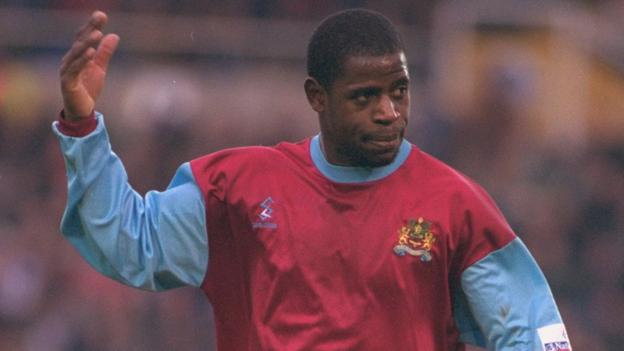
Johnrose was regarded as a tough-tackling midfielder throughout his 16-year professional career
‘50% die within two years’
Planning for the next step was difficult.
The condition doesn’t run linearly – I could be fine for a week, two weeks, whatever, and then suddenly you wake up one morning and can’t move your finger.
There are certain organisations out there, there’s an MND team in Preston who are really helpful, but it’s so difficult to plan.
What they try to do is get you to make the life you’ve got now easier, get you to cope and make adaptations and regards planning – it’s horrific to say, lifespan-wise, 50% die within two years. I think it’s 90 or 95% die within five years.
You’ve not got a long-term goal, but there are examples of people that live beyond that – Stephen Hawking is one.
It is difficult to plan and you’ve got to get things in place – wills, funeral packages and that sort of stuff. A lot of the time I am quite pragmatic about it, but there are a lot of down days.
‘I’m not drunk, I’ve got MND’
I’ve got three children, but two live at home. I spend a lot of time with them and they can see me struggling walking. People don’t know about the disease – I’ve spoken to people at school and they’ve said ‘oh, I don’t really know about it’, which is fine. That’s not a criticism, but people don’t know about it.
I’ve spoken to a friend about things that are starting to affect me and he said he didn’t know about it, and we speak every other day. So people don’t know about the harsh realities. This is not about getting sympathy or anything like that, it is something that needs more exposure for people to understand.
I walk around and I’m staggering. I thought to myself I’m going to get a t-shirt which says ‘I’m not drunk, I’ve got MND’.
I remember going into a supermarket with my daughter a few months ago. Packing’s hard and even lifting, you’ve just no strength in your muscles, so she was packing for me.
I got a bottle of wine and asked her to put it in, and there was a big kick-off about her putting it in the bag – I’m clearly not buying it for her, so there was a stand-off for about 20 minutes and they ended up apologising. It’s things like that.
I have these straps, which give me a little bit of support. Some days you don’t want to wear them, just to free your hands, but if you don’t wear them then there is nothing there to trigger to anyone that there is an issue.
Most days, if I’m busy or talking – which I do a lot – I’m OK. It’s mainly when there’s a lot of time on your hands. When I was off for three months after the back surgery, that was a difficult time.
Having said that, it is progressing and it’s starting to become a little bit difficult really.
Johnrose, seen here playing for Burnley, scored in a win for Swansea on the final day of the 2002-03 season that kept the Welsh side in the Football League
The fear of deteriorating
I said from day one of my clinical psychology meeting ‘at X point, that’s when I want to go’.
Now the parameters change as you get to X point, but I said ‘when I’ve not been able to wipe my own backside, that’s when I want to go’.
I’m not afraid of dying. The thought of hanging around, for want of a better phrase, in a wheelchair, not being able to communicate properly or do anything – your eyesight is great, your mind is still fine, but you actually can’t do anything. No, put me down – and I couldn’t be more serious about that.
I’ve already looked at it, going abroad, and I genuinely wouldn’t want to hang around.
I’ve discussed it very briefly with my wife. It’s not something she wants to talk about. It’s not what you talk about at the table. I’ve certainly explored it. But that’s no fun for me at all, it’s not what I want to do.
Telling people about having motor neurone disease is not a case of trying to move on, it’s just another step forward.
I eventually want to put it out there for people to know how I’m coping or not coping, which might mean something to people as well as trying to make some good out of it.
Typically, people will be older. In that aspect I’m still relatively young and, fitness-wise, I was very fit, so it’s seeing if anyone else can relate to what I’m going through.
‘A very devastating condition’ – what is MND?
Chris James, from the Motor Neurone Disease Association, explains the illness: “Everybody’s journey is different with MND, but Len’s story is fairly typical. The common symptoms are people will lose the ability to walk, to perhaps talk, they lose the use of their arms and ultimately to breathe.
“It’s a very devastating condition. There is no cure for MND. There is a lot of research going into finding a cure and indeed into finding treatment, which we are still struggling to find.
“However, there have been great advances over the past few years in research and there is some hope now we might be moving towards some treatments for the disease.
“Stephen Hawking is very unusual in terms of MND, he lived for a very long time. Half of people die within two years of diagnosis, and a third within a year. It can be a an extremely rapidly progressing condition.”
A full interview with Len Johnrose will be broadcast on BBC Radio Lancashire on Wednesday, 22 August at 18:00 BST and will be available to listen again on the BBC iPlayer for the following 30 days.
If you are affected by the issues in this article, help and support is available via the BBC Action Line http://www.bbc.co.uk/actionline
Markazi Refugee Camp, Djibouti – Hafsa* says she feels trapped.
War forced her to flee her home in Yemen to Djibouti with her husband three years ago.
Little opportunities or hope of returning have left her restless in a remote refugee camp more than 200km from Djibouti’s capital and just 32km from Yemen‘s western coast.
The situation has created tension between 36-year-old Hafsa and her husband. But because she is a woman, she says she has no outlet for sharing her struggles.
“Because of the frustrating mood in the camp and bad circumstances and weather and my jobless husband and lack of income overall it is a dispute,” Hafsa tells Al Jazeera from outside the Markazi refugee camp near the fishing village of Obock.
The mother of three, including a daughter from her current marriage and two older children from her first who still live in Yemen, jabs her hand with frustration in the air as she describes her situation.
Her face, outlined by a pearly pink hijab (headscarf), is fair and unlined, making her look younger than her age, but her voice is strained.
“I cannot talk and express my feelings to others because the problems or the dispute between me and husband might become more complicated,” she says.
She adds other refugee women are abused by their husbands, but fear speaking out due to the stigma associated with domestic abuse.
“We are suffering from tradition,” Hafsa says. “Before the war, we were suffering many troubles, many problems from the society itself in Yemen, the people and the pressure from traditions. The war came just to push us out to come to Djibouti, but it is the wrong place,” she adds.
“We feel weak and vulnerable and attackable.”
Hafsa is one of the thousands of Yemenis who have fled to Djibouti during more than in three years of war between Yemen’s government, supported by a Saudi-led coalition, and the Iranian-backed Houthirebels. To date, more than 40,000 Yemenis have made the treacherous journey across the Bab-El-Mandeb Strait, known as the Gate of Tears because it has claimed so many migrant and refugee lives. It connects the Red Sea and the Gulf of Aden along Djibouti’s eastern coast.
At the peak, there were more than 7,000 Yemenis living in Markazi. As of May 2018, the number had dwindled to just under 2,000, less than half of the total 4,300 Yemenis in Djibouti.
The Markazi refugee camp is located near the fishing village of Obock on Djibouti’s eastern coast [Mallory Moench/Al Jazeera]
The small tent city stained by dust rises from a landscape scorched barren in summer, where temperatures regularly rise to 40 degrees Celcius in summer. UNHCR and Djibouti flags convulse in the hot wind above the gate. Electric spotlights are strung up by rusted wires, but according to those in the camp, the electricity often doesn’t work.
Afraid to report abuse
Refugees tell Al Jazeera the conditions are harsh – with limited money, food, employment or future hope – but for women, they can be even worse.
Aid groups and other NGOs in the camp say women can face economic, physical and even sexual domestic abuse.
There is almost no data on gender-based violence against refugees in Djibouti. UNHCR has no recorded incidents at the camp since it was started in April 2015. The head of the agency in Djibouti said that a recent report from a senior protection officer who interviewed a female resident found there was no sexual gender-based violence except for one instance of sodomy between children.
But professionals and refugees say women must first overcome cultural stigma and fear of repercussions to report violence and abuse.
“There are many cases of violence in the camp that happened, but the women don’t like to complain because they are afraid when they return back to Yemen that nobody would accept them and their children as a divorced woman,” Hafsa says.
A UNHCR report from October 2017 said that despite forming a refugee committee to address gender-based violence, the issue “remains a challenge among the Yemeni refugee community, mainly due to cultural predispositions and frequent appeal to the traditional legal codes instead of civil ones”.
According to Dina Cihimba Rehema, UNHCR’s protection officer in Markazi, the problem lies in the fact that women often feel like they cannot talk about their situations.
“We have to reinforce sensitisation for women to feel free and make it easy for them to talk about what they’re facing,” she says. “We have to try to change the mentality.”
Women taking the lead
Every day, Muna Khalik, another refugee living in Markazi, opens a counselling centre housed in a metal trailer just inside the camp entrance. The centre is run by UNFD, the Djiboutian NGO in charge of women’s protection in the camp. The centre has one staff member and trains and employs refugees like Khalik as counsellors. They intake at least four domestic violence cases each month and report directly to UNFD’s head office.
The organisation said abuse is primarily economic – when the male breadwinner withholds money from his wife and creates tension in the family – but can also be physical or sexual. Their reports are confidential and details about cases could not be shared.
The UNFD-run counselling centre intakes at least four domestic violence cases each month and reports directly to UNFD’s head office [Mallory Moench/Al Jazeera]
Asma Moustapha, Markazi’s director who works for the government refugee agency, said that when the counselling centre first opened three years ago, no women came because of the stigma.
“In their mentality, they think the office is only for divorce matters. They don’t think it can help them and their problems,” Moustapha told Al Jazeera. “Before the husband wouldn’t accept them to go to the office because he thought it will break his marriage and his family.”
Because women feel more comfortable sharing in their own community, UNFD trained refugee women as counsellors.
Khalik has lived in Markazi since she fled her home in the Yemeni city of Taiz, which was destroyed by bombing three years ago. Last year, she began working with UNFD counselling and conducting gender sensitisation activities for men and women.
She sits under a whirring fan inside the community centre where women sew purses to sell and children learn martial arts. Draped in a silken black veil with beaded gloves, Khalik’s sharp eyes emits empathy.
“When we started, especially men, they were not comfortable with those sensitisation activities,” Khalik tells Al Jazeera. “They were feeling that it’s something coming to separate them from their wives because they also think that once women know their rights, they will use it for everything. But with time, they come to understand that it’s something which is helpful for all the community.”
Community workers disseminate national and international text related to sexual violence and conduct outreach awareness sessions with men, women and youth on gender, human rights and sexual violence.
Counsellors at the centre give women options about what to do when facing domestic violence. If the situation is serious and the woman requests more intervention, the counsellor visits the family to talk to the woman’s husband. In the most extreme cases, a counsellor can help a woman go to the justice system – although the management said that no woman has ever requested to do so.
“It was really difficult for women to express and talk about such problems, but it was of culture. But there is a good impact and now they are feeling more free to talk about what is happening,” Khalik says.
She acknowledges, however, that sensitisation is slow and women may still not speak out.
“There are always things that we can’t know about in the families,” she says.
For Markazi’s women, domestic violence is one trouble among many that they say makes life nearly unbearable in the refugee camp.
Many want to resettle in Canada or Sweden or return home to Yemen – even though it is still too dangerous now because of the conflict. As families enter their fourth year in the remote camp with no end in sight, many say they have lost hope.
“We have a vague future here,” Hafsa said. “We feel that we are dying in Djibouti.”
*Name has been changed to protect the individual’s identity.
Anyway, it turns out iguanas are good at photobombing, too. Take a look at this majestic proof, captured recently in San Juan, Puerto Rico, and shared on Instagram by photographer Tammy Ricks.
As parents start back-to-school shopping, basic school supplies are raising their game against gadgets like iPads. Stores are pushing interactive reusable notebooks or pens that make the marks disappear when the paper is heated. (Aug. 8) AP
Lowe’s will close all Orchard Supply Hardware stores nationwide by February 1, the company announced Wednesday.
Orchard Supply Hardware, founded in 1931 in San José and acquired by Lowe’s in 2013, has 99 stores in California, Oregon and Florida. Lowe’s is closing the stores to focus on its core home improvement business, the company said.
Employees were told about the decision Tuesday and all stores will be open Wednesday for normal business hours. Orchard Supply Hardware stores will have store closing sales beginning Thursday with a plan for all stores to be closed by the end of the company’s fiscal year. Lowe’s will also close a distribution center in Tracy, Calif., the company said.
“While it was a necessary business decision to exit Orchard Supply Hardware, decisions that impact our people are never easy,” Lowe’s president and CEO Marvin Ellison said in a statement. “We will be providing outplacement services for impacted associates, and they will be given priority status if they choose to apply for other Lowe’s positions.”
Lowe’s took a $230 million non-cash pre-tax charge during the second quarter based on its “strategic reassessment” of Orchard Supply Hardware, the company said.
The Mooresville, N.C.-based hardware chain is refocusing on “retail fundamentals,” Ellison said, and will tighten its store inventory as Lowe’s foresees a demanding retail environment.
The company lowered its full-year sales forecast to 4.5 percent, down from the previous forecast of 5 percent. Sales at stores open at least one year are expected to increase about 3 percent for the year, down from the previous forecast of 3.5 percent.
Lowe’s posted second-quarter sales of $20.9 billion, up 7 percent from the same period a year ago, surpassing expectations of $20.8 billion, based on analysts polled by S&P Global Market Intelligence.
However, net income fell 7 percent to $1.52 billion, or $1.86 per share, missing expectations of $1.65 billion and $2.01 per share.
Lowe’s shares (LOW) were down 2.25 percent to $97.35 in pre-market trading Wednesday.
Lowe’s acquired Orchard Supply Hardware in 2013 after Orchard Supply, which was spun off from Sears Holdings in 2011, filed for bankruptcy.
The news about the stores’ closing led many longtime customers to reminisce on Twitter about the chain, which remodeled some stores recently and had been expanding in Florida. “Deeply saddened,” one person tweeted.
This makes me sad. I love this store. Their customer service is excellent. They are friendly, helpful & will spend time trying to find exactly what I need. They never act rushed. I am going to miss them big time.
Lowe’s, with 2,155 home improvement and hardware stores in the U.S., Canada and Mexico, also named current CVS Health executive vice president and CFO David Denton as its CFO. Denton will join Lowe’s after CVS closes its acquisition of Aetna, expected later this year.
“I am confident that Dave will play a key role as we accelerate growth, profitability and return on capital at Lowe’s,” Ellison said.
Follow USA TODAY reporter Mike Snider on Twitter: @MikeSnider.



/https%3A%2F%2Fblueprint-api-production.s3.amazonaws.com%2Fuploads%2Fcard%2Fimage%2F832254%2F3a52d13c-39bb-43df-aafd-ce708300d613.jpg)






 trustedenews