US decision to shut PLO office ‘denies Palestinians as people’

news image

Washington, DC – The Trump administration’s decision to shut down the Palestine Liberation Organization’s (PLO) office in Washington, DC is “denying the Palestinians as people” and further jeopardising the peace process, analysts warn.

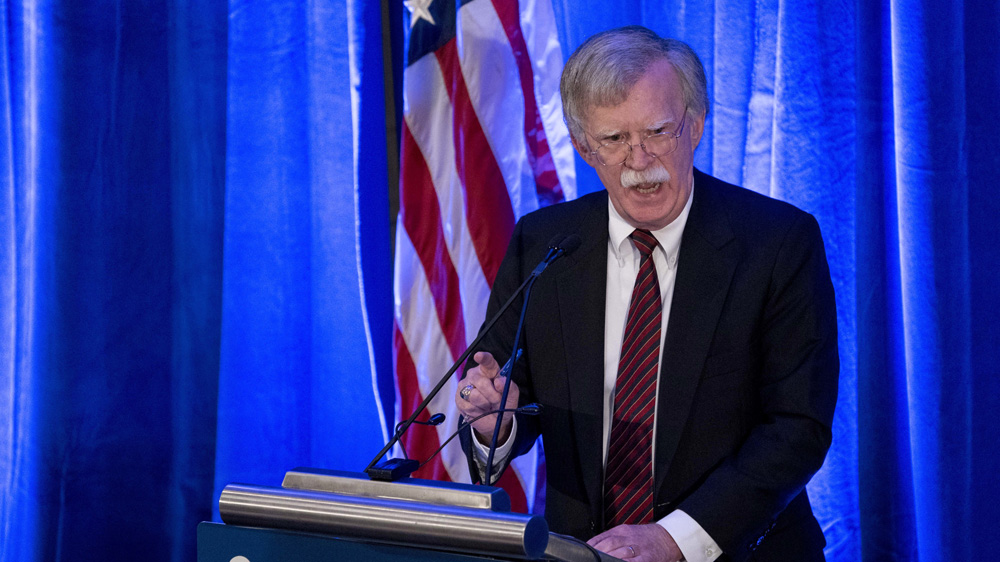
White House National Security Advisor John Bolton announced the administration’s decision in a speech on Monday, saying that the PLO had “not taken steps to advance the start of direct and meaningful negotiations with Israel”.

He said the PLO leadership has instead “condemned a yet-to-be-seen US peace plan and “refused to engage with the US government with respect to peace efforts and otherwise”. The administration has also threatened the International Criminal Court of sanction measures if judges open an investigation on the US or Israel.

Palestinian officials have described the decision as an “declaration of war on efforts to bring peace … to the region”.

PLO Secretary-General Saeb Erekat said the decision was “yet another affirmation of the Trump administration’s policy to collectively punish the Palestinian people”. 

‘Abbas pushed beyond his limits’

The move is being seen by analysts as another blow to the Palestinians in a chain of events that have favoured the Israeli government at the expense of Palestinians, adding to the potential of unrest and violence. 

The administration of US President Donald Trump recently said it was cutting more than $200m in economic aid to the Palestinians. It also recognised Jerusalem as the capital of Israel last year and moved the embassy from Tel Aviv to Jerusalem this year.

Over the past year, Jared Kushner, senior White House adviser and Trump’s son-in-law, has questioned Palestinian leader Mahmoud Abbas’s commitment to peace.

“The [Trump administration] has changed the parameters of how the Israeli-Palestinian conflict has been dealt with in recent years,” said Ian Black, a visiting senior fellow at the Middle East Centre, London School of Economics. 

While the decision carries a multitude of implications for a peace process, Black said the most significant of those has been the weakening of any kind of mechanism to produce a settlement to the conflict or a two state solution.

“It is worth pointing that the Palestinian leader, Mahmoud Abbas, is more likely than any other to come to some kind of two-state solution with Israel,” he said. “But he has been pushed to react furiously to American moves. [There will] no longer be a fair mediator in the conflict. Abbas has been pushed beyond limits on this.”

While a long-term effect of the decision would tinge the international commitment to a two-state solution, he said a risk of instability and violence was possible in the short-term.

“Everyone remembers the split screen of the beautifully orchestrated ceremony at the embassy opening and the 60 people shot dead in Gaza,” he said.

Author Khaled Diab, who has spent the last decade in frequent visits to the Palestinian territories, said the idea of a two-state solution has long diminished in the minds of many.

For the first time, he said, Palestinians are now running in municipal elections after previous boycotts and more are applying for Israeli citizenship.

“Even if there is a two-state solution, it would collapse very quickly,” Diab said.

Although the latest move has angered many Palestinians in the West, those in the occupied Palestinian territories are less likely to react, he said. The cutting of aid, however, was one that could have a knock-on effect leading to unrest.

‘Denying Palestinian’s self-determination’

Although the decision could be an attempt to pressure the Palestinian leadership to accept the yet-to-be-released peace deal, experts have said it was a “foolish” idea. 

“Shutting the office is denying [Palestinian’s] self-determination, denying them as people,” James Zogby, founder and president of the Arab American Institute, said. “It’s more far-reaching decision than closing an office down. We are back to the period of ‘no such thing as Palestinians’ mindset.

“The PLO did not create the Palestinian movement – it embodies the national movement. If Palestinians agree to whatever is offered – which seems to be wholly inadequate, they will no longer be in leadership”. 

Erekat said in a statement on Monday that the PLO will take necessary measures to “protect the rights of our citizens living in the United States to access their consular services”. 

Zogby suggested that a representative from the PLO may be housed by an Arab country mission in the US to continue to offer consular service, operating the same way it did before the PLO had an official office in the US capital. 

‘Resetting relation to pre-Oslo period’

A few analysts also drew comparisons of the office closure to the pre-Oslo period before Israel and the PLO signed an agreement in 1993.

Diab said dealing with the PLO as a pariah and terrorist organisation and not a representative of the people was resetting relations to a pre-Oslo period.

“We can see it in the rhetoric already, the administration saying they are not committed to the peace process,” he said. “We are moving toward a situation the Americans abandoned even the rhetorical commitment to the Oslo process … what they are going to do is present a deal so unacceptable to the Palestinians and use it as a further pretext to shut down any mechanisms for peace negotiations beyond the Oslo lines.”

As Palestinians are forced to accept a halted peace resolution and an unlikely two-state resolution, experts expect a dynamic shift as more Palestinians demand for equal rights on par with their Israeli counterparts and citizenship.

“We are already seeing early signs of this,” Diab said. “Palestinian are disappointed. They have been let down by their occupation, the international community, and their own leaders.”

Read More

from Trusted eNews https://ift.tt/2MjpyUN
via IFTTT

Guy emails 246 Nicoles in search of a girl he met at a bar, and now they’re all friends

news image

Apparently Tinder is just too basic for some people. 

Carlos Zetina only knew a handful of things about the girl he met at a campus bar: her name was Nicole, she was from Holland, she attended the University of Calgary, and she thought Nietzche was depressing.

When the number she gave him ended up being wrong, he decided to pursue the missed connection in the most extra way: He combed through the University of Calgary’s entire email list, and messaged every Nicole he could find in one mass email: 

“Hi, this is a mass e mail to all Nicole’s [sic] if you don’t fit this description then ignore and if you are the one and just don’t want to talk to me that’s ok as well. If you name is Nicole and you’re from Holland and you think Nietzsche is depressing then text me … I’m Carlos btw I’m the guy who took you and your friend home last night.” 

Zetina emailed 246 Nicoles in total, including students, staff, and faculty members. Even associate deans named Nicole were part of his quest to find his dream Nicole. He was thorough, too — according to BuzzFeed, Zetina added variations like Nicolette and Nickie in his search. 

His huge email didn’t find the Nicole he was looking for, but it did unite the Nicoles of the University of Calgary. 

“There’s a researcher in the group, who, she and I have similar research interests, so we’re actually going to collaborate in future,” Nicole Thompson told CBC. “I think it’s fantastic.”

A group of Nicoles even met up at a local pub. 

And they made a Facebook group just for fellow #NicolesFromLastNight.

As word spread, someone added Nicole Toetenel to the Facebook group. She admitted to being the exchange student from Holland that Zetina was searching for, and according to BuzzFeed, hadn’t  memorized her Canadian number. Since she’s an exchange student, she didn’t have a university email address and completely missed the Nicole-fest. 

“But the powerful network of Nicole’s [sic] helped me get in touch,” she tweeted. 

“He had a connection with this woman and I guess she felt it too — so it’s kind of the perfect ending to this,” Thompson told CBC. 

The “real” Nicole told CBC that she and Zetina have coffee plans, but “just as friends.”

If it wasn’t already painfully obvious, he has a thing for Nicoles. 

“My ex-girlfriend’s name was Nicole,” he admitted. 

Https%3a%2f%2fblueprint api production.s3.amazonaws.com%2fuploads%2fvideo uploaders%2fdistribution thumb%2fimage%2f86593%2ff86870c6 d44b 4531 9308 91dcf4115034

Read More

from Trusted eNews https://ift.tt/2wY6mGG
via IFTTT

Nicole Kidman on playing a Pacino-esque detective in Destroyer

news image

In many ways, Karyn Kusama’s Destroyer calls to mind typical Hollywood noir: It centers on a troubled LAPD detective who’s investigating a devastating case that blurs the line between personal and professional.

But although Destroyer has plenty in common with classic crime thrillers, it also stands as the rare film to cast a woman in the lead role. Nicole Kidman plays Erin Bell, a detective who went undercover in her youth to infiltrate a California gang with tragic results. The film finds her still reckoning with the trauma of that assignment years later, and when Kidman stopped by People and EW’s TIFF studio on Monday, she spoke about how thrilled she was to play the kind of damaged anti-hero role that’s usually reserved for men.

“I grew up on these kind of films,” she said. “I watched [Al] Pacino play these roles, I watched all of the men in the ‘70s get the chance to do it, but I don’t have a female [equivalent]. That’s exciting as an actress to get the chance to do that.”

RELATED: 21 movies to watch for at the Toronto Film Festival

The Oscar winner is nearly unrecognizable in the film, and Kidman says she relished the chance to dive into Bell’s complicated psyche.

“This character is also so far removed from me, so that’s part of the appeal as an actor: going to places I haven’t been given the chance to go,” she said. “I’m all about finding characters and stories that [make me] go, ‘This is new, but it’s still emotionally relevant.’”

Watch the full interview with Kidman above. Destroyer is scheduled to open Dec. 25.

Read More

from Trusted eNews https://ift.tt/2Nu0oYx
via IFTTT

Income disparity: US middle class falling farther behind the wealthy, Pew report claims

news image

A slight majority of U.S. adults (52%) lived in middle-class households in 2016, according to a new report from Pew Research Center. That might seem like only a bare improvement from the previous reporting period in 2011, when the figure was 51%, but in one sense, it’s a noteworthy reversal: Based on Pew’s previous studies, the size of America’s middle class had been in a steady decline since 1971, when 61% of U.S. adults fell into that category.

But while this snapshot indicates that the middle class has stabilized after decades of getting smaller, income disparity between classes has grown. On an inflation-adjusted basis, the median middle-class household earned more in 2016 ($78,442) then it did in 2010 ($74,015) — a 6% gain. Upper-income households saw a median increase of 9% during the same time period. Lower-income households saw only a 5% gain. 

A point worth noting: When Pew maps those class borders, it isn’t using a single set of fixed dollar amounts. Its formula factors in the number of people in a household and the cost of living in each area, as well as household income. Broadly, though, “[m]iddle-income households — those with an income that is two-thirds to double the U.S. median household income — had incomes ranging from about $45,200 to $135,600 in 2016,” according to Pew.

A sign says save the middle class.

For the first time in decades, the middle class isn’t shrinking. Image source: Getty Images.

Stuck in the middle?

The number of U.S. adults living in upper-income homes climbed from 14% in 1971 to 19% in 2016, while the percentage living in lower-income households grew similarly from 25% to 29%. So over the past five decades, the middle class has shrunk, while the upper and lower have grown in about equal measure.

Now for the less-good news. Those income gains from 2010 to 2016 are largely an artifact of the Great Recession. Inflation-adjusted median household incomes in 2010 were well below where they stood in 2000 due to the economic downturn, and when comparing 2000 to 2016, middle-class incomes have barely budged. Lower-income families are actually still about 5% behind their 2000 median incomes.

The upper class, by contrast, enjoyed a median income boost of about 2% since 2000 — another data point confirming the growing financial chasm between the upper-income tiers and the rest of the populous.

“The wealth gaps between upper-income families and lower- and middle-income families in 2016 were at the highest levels recorded,” wrote Pew’s Rakesh Kochhar. “Although the wealth of upper-income families has more than recovered from the losses experienced during the Great Recession, the wealth of lower- and middle-income families in 2016 was comparable to 1989 levels. Thus, even as the American middle class appears not to be shrinking (for now), it continues to fall further behind upper-income households financially, mirroring the long-running rise in income inequality in the U.S. overall.”

Holding steady

While the rising gap between upper income households and everyone else is troubling, it’s encouraging that the middle class has stopped shrinking, and that the fraction of America adults living in lower-income homes has stabilized too. There are, of course, still too many families for whom a stable, middle-class lifestyle remains an elusive dream, but there are signs of hope in the overall picture.

Read More

from Trusted eNews https://ift.tt/2x5skYg
via IFTTT

Ban jet air hand dryers? Scientists urge hospitals to avoid them, citing increased germs

news image

CLOSE

Experts now warn against the disease spreading capabilities of hand dryers. Tony Spitz has the details.
Buzz60

Every flush of an uncovered toilet sends fecal matter flying into the air, science tells us, a phenomenon known as “toilet plume.” That makes hand washing in shared restrooms particularly important, especially in hospitals where germs mingle among weakened immune systems.

And if hospitals can’t halt the plumes, their next best step may be to ditch high-powered hand dryers. Bathrooms with jet dryers can host five times more bacteria on their floors than those employing paper towels, a recent study found.

Researchers behind the study, published in the Journal of Hospital Infection, argue that hospitals should avoid such high-powered dryers to combat bacterial spread.

“When people use a jet air dryer, the microbes get blown off and spread around the toilet room,” as Mark Wilcox, a University of Leeds microbiologist who oversaw the study, said in a statement. 

“In effect, the dryer creates an aerosol that contaminates the toilet room, including the dryer itself and potentially the sinks, floor and other surfaces, depending on the dryer design and where it is sited.” 

The problem stems from poor hand washing, Wilcox said, which fails to remove microbes from a person’s hands. But whereas hand dryers can blow any excess germs about, Wilcox said, paper towels can simply absorb them and, if properly disposed, reduce contamination risk.

More: Hand dryers blow fecal bacteria on hands, study finds

More: What happens when you don’t use a toilet seat cover?

The study involved restrooms at three hospitals in England, France and Italy, which alternated between offering either paper towels or jet dryers. Each day, researchers measured the bacteria levels of the air, floor and surfaces, paying special attention to bacteria behind serious infections. 

The short of it: Bathrooms hosting jet dryers contained noticeably more germs than those relying on paper towels.

In restrooms at Yorkshire’s Leeds General Infirmary and Paris’ Saint-Antoine hospital, floors contained five times the bacteria after jet dryers were used versus paper towels, for example.

Fewer differences were found on the floors of a hospital restroom in Udine, Italy, which proved far less contaminated on all counts than the British and French facilities.

The 12-week study was funded by the European Tissue Symposium, a paper product trade group, which the University of Leeds said had no influence on the peer-reviewed research.

Another study this year at the University of Connecticut similarly found hand dryers aided the spread of bacteria throughout on-campus buildings.

Follow Josh Hafner on Twitter: @joshhafner

Read or Share this story: https://usat.ly/2CCoiwF

Read More

from Trusted eNews https://ift.tt/2NyKhJ3
via IFTTT

Alastair Cook’s innings caps ‘amazing’ finale to his Test career – Jonathan Agnew

news image

Highlights: Cook hits final Test century on remarkable day

In 10 years’ time, if you count up everyone who claimed to be at The Oval on the fourth day of the fifth Test between England and India, it will probably be half a million.

During a totally unforgettable day, I received a message from somebody who had never been to a cricket match before.

They took a bit of a punt on coming to the fourth day, and they think it has been amazing. And they’re right.

It was an amazing day to be a cricket fan, an England cricket fan and someone who likes a bit of emotion and passion in sport.

The first people I saw in the morning were Alastair and Alice Cook. I had breakfast with Alice and she was as relaxed, as calm and as unflappable as she always has been.

She and her husband are very similar, because Alastair blocked out everything today. If there’s any cricketer I’ve come across over the years capable of doing that in his last ever Test innings, it’s him.

He blocked out the crowd ovations, the Indian players lining up to pay tribute, the build-up to the Test with all the discussions about his career.

He blocked out the fact that his mum and dad are here, that his heavily pregnant wife is here with their two young children. He blocked out the fact that all of his best mates are here in a box that he’s provided.

Anyone who has played sport to a high level will know that these are things that you can get distracted by. It is easy to be distracted. Cook wasn’t. He just carries on.

I think the fact that he scored 147 – his first century since Melbourne in December 2017 – is more of a surprise because of his recent form than because of the emotion around the Test.

Cook actually played really well. You can score bad hundreds – and this was a really good hundred. It was Cook playing at his best. It had straight drives and cover drives. He played his usual strokes and he batted superbly. His footwork was good, the bat was straight – he was liberated from all the things there have been issues with in recent times.

He cast all that stuff aside, went out and just batted.

Cook reaches century in final Test innings

Anderson poised to enter the record books

When they look back on it, today will be an immense day for both Cook and James Anderson. For Cook, it was the day he made his final Test century in his final innings; for Anderson, it was the day he drew level with Glenn McGrath’s record of 563 Test wickets. One more and he will pass the Australian great and become the leading pace bowler in Test cricket.

Cook and Anderson are such good friends, and the veteran seamer will really miss his former captain a lot. Not just in terms of the presence in the dressing room, but being away on tour – looking after each other when you’re a bit down and homesick, going out and having meals together.

Those two, along with Stuart Broad, are the same sort of age and vintage. Anderson and Broad will miss Cook enormously.

The match is set up perfectly for Cook, standing at first slip, to take the catch that gives Anderson his outright record tally. It would be ridiculous – and yet fitting, wouldn’t it? Although my money is on the catch, if and when it comes, being taken at second slip!

Such was the emotion of the day, I almost feel sorry for current England captain Joe Root because, in a way, his 125 is the most forgotten hundred he will ever make.

It was an important innings for him – he hadn’t passed 50 in eight knocks – and he needed the runs. It was almost like a passing of the baton between him and Cook, the new captain and the departing one, as they batted together for 259 runs.

This Monday was, ultimately, a very happy day. When Cook made the hundred, that was the emotional part – the release of all the tension.

I thought his departure was quite a happy moment too. Everyone was just pleased he had batted so well.

He has chosen his time to go, he’s finished with a huge hundred, and he has underlined once again what an extraordinary player he is.

But I’ll be sorry not to see Cook in an England sweater again – and I will be sad when he walks up those stairs for the final time.

Jonathan Agnew was talking to BBC Sport’s Amy Lofthouse

Read More

from Trusted eNews https://ift.tt/2x3adlV
via IFTTT

John Bolton threatens ICC judges with sanctions

news image

The United States launched a blistering verbal attack on the International Criminal Court (ICC) and threatened sanctions against its judges if they proceed with a probe into alleged war crimes by Americans in Afghanistan.

John Bolton, President Donald Trump‘s national security adviser, made the announcement in a speech to the Federalist Society, a conservative group, in Washington, DC, on Monday.

“Today, on the eve of September 11th, I want to deliver a clear and unambiguous message on behalf of the president. The United States will use any means necessary to protect our citizens and those of our allies from unjust prosecution by this illegitimate court,” Bolton said.

“We will not cooperate with the ICC. We will provide no assistance to the ICC … We will let the ICC die on its own. After all, for all intents and purposes, the ICC is already dead to us.” 

Crimes in Afghanistan?

In 2016, the The Hague-based court said members of the US armed forces and the CIA might have committed war crimes by torturing detainees in Afghanistan. 

Is the war on terror failing?

Established in 2002 under the Rome Statute, the ICC is the world’s first permanent court set up to prosecute war crimes, crimes against humanity, and genocide.

More than 120 countries around the world are members, but superpowers – including the US, Russia and China – have not signed up.

On the ICC, Bolton said if any investigations go ahead on alleged US war crimes, the Trump administration will consider banning judges and prosecutors from entering the country, put sanctions on any funds they have in the US financial system, and prosecute them in US courts.

Bolton said the main objection is the idea the ICC could have higher authority than the US constitution and US sovereignty.

“In secular terms we don’t recognise any higher authority than the US constitution,” he said. “This president will not allow American citizens to be prosecuted by foreign bureaucrats, and he will not allow other nations to dictate our means of self defence.”

‘Proudest achievements’

It was Bolton’s first major address since joining the Trump administration. He was previously the US’ ambassador to the United Nations in the George W Bush government and fought against the ICC in the 2000s. 

“The International Criminal Court constituted an assault on the constitutional rights of the American people and the sovereignty of the United States,” he said.

At President Bush’s direction, we next launched a global diplomatic campaign to protect Americans from being delivered into the ICC’s hands. We negotiated about 100 binding, bilateral agreements to prevent other countries from delivering US personnel to the ICC. It remains one of my proudest achievements.”

Bolton said the US would “not sit quietly” if the ICC came after it, Israel, or other US allies. 

Can the US defeat the Taliban in Afghanistan?

There was no immediate response from ICC officials or member states. 

Bolton also announced the closure of the Palestine Liberation Organization (PLO) office in Washington, DC, because of the Palestinian attempt to get the ICC to investigate Israel for crimes committed during its decades-old occupation of Palestine.

The national security adviser’s announcement drew applause from the conservative crowd, but was sharply criticised by Palestinian leaders and officials.

The action against the PLO is the latest in a series of measures by the Trump administration against the Palestinian leadership.

“It is a declaration of war on efforts to bring peace to our country and the region,” PA spokesman Yousef al-Mahmoud was quoted as saying by Wafa news agency.

PLO Secretary-General Saeb Erekat said in a statement the decision was “yet another affirmation of the Trump administration’s policy to collectively punish the Palestinian people, including by cutting financial support for humanitarian services including health and education”.

SOURCE: Al Jazeera and news agencies

Read More

from Trusted eNews https://ift.tt/2NvNwkr
via IFTTT

Teens know social media is manipulative, but are using it more anyway

news image

Whoa, the teens really are woke.

The organization Common Sense Media released a research report on Monday that aims to paint a picture of the role that social media plays in teens’ lives. Entitled ‘Social Media, Social Life,’ the survey covered topics like how much and what kinds of social media teens use, as well as how they feel about these apps, how social media makes them feel about themselves, how it affects their relationships, and more. 

Teens’ social media use has increased by 36 percentage points since 2012. Unsurprisingly, their favorite apps are Snapchat and Instagram (Facebook is for communicating “with my grandparents” — not even parents, now… ouch). 

<img class="no-microcontent" data-credit-name='common sense media’ data-credit-provider=”custom type” data-caption=”Device use has skyrocketed.” title=”Device use has skyrocketed.” src=”https://i.amz.mshcdn.com/9nWw5XUOvUhv7m39MBA5sP1PVc0=/fit-in/1200×9600/https%3A%2F%2Fblueprint-api-production.s3.amazonaws.com%2Fuploads%2Fcard%2Fimage%2F843094%2F2c893b1d-7a40-4a9c-9aa6-8b7963e3acfe.png&#8221; alt=”Device use has skyrocketed.”>

Device use has skyrocketed.

Image: common sense media

Sorry, Facebook.

Sorry, Facebook.

Image: COMMON SENSE MEDIA

Beyond broad-scale usage, the findings also show that how teenagers conceive of social media, and the role the apps play in their lives, is complicated and sometimes contradictory.

“Kids are much more aware today than they were a few years ago of both the pros and the downsides of social media,” Jim Steyer, Founder and CEO of Common Sense Media said on a call with press. “Basically all of them are engaged whether we like it or not. But they are more aware of some of the hazards on some of their emotional and personal wellbeing.”

Common Sense Media is a non-profit organization dedicated to helping parents navigate raising a family amidst the technological concerns of the 21st century. The organization commissioned the survey from a research group, which surveyed a “nationally representative” sample of 1,141 13- to 17-year-olds in the United States. Additionally, Common Sense conducted a similar survey in 2012, and was therefore able to compare how teens’ attitudes toward and behavior have changed over the tumultuous recent years for social media.

The affects of social media and smartphones on teens have been the focus of many studies and articles in recent years. Much of the discourse has centered around social media addiction, stilted social skills, and, notably, increased feelings of isolation and depression. However, Common Sense’s report does not paint as bleak a picture.

The Common Sense survey showed that social media is playing an increasing, but majority neutral, role in kids’ lives. A majority of teens self-reported that it did not affect their moods, behavior, or relationships positively or negatively — and a greater percentage of teens in the 2018 study said it has positive affect on them than in the 2012 study. 

“Kids are used to social media now,” Steyer said. “That’s why many of them accept it as part of their life, and don’t really feel one way or the other.”

Many more teens say social media affects them positively than negatively. But most say it has no effect.

Many more teens say social media affects them positively than negatively. But most say it has no effect.

Image: COMMON SENSE MEDIA

Have teens really put the social back in social media?

Have teens really put the social back in social media?

Image: COMMON SENSE MEDIA

Other findings show that more mature attitudes don’t necessarily correlate to more intentional behavior. Teens are increasingly aware of the way social media can manipulate them: 72 percent think social media companies intentionally work to keep eyeballs on their platform. Yet 70 percent of teens report that they use social media multiple times a day; 16 percent are on it “almost constantly.” Additionally, teens most prefer communicating via text over all forms of communication — including face to face.

“Kids are finding it difficult to put their devices down, and also being irritated with their friends who can’t put their devices down,” Sierra Filucci, Common Sense’s Executive Editor said. “They’re struggling with it in the same way that we are all struggling with it.”

<img class="no-microcontent" data-credit-name="COMMON SENSE MEDIA
” data-credit-provider=”custom type” data-caption=”Teens are using social media even when they don’t want to be.” title=”Teens are using social media even when they don’t want to be.” src=”https://i.amz.mshcdn.com/N78MKVvYQ6SAeD9c-kf156gpK14=/fit-in/1200×9600/https%3A%2F%2Fblueprint-api-production.s3.amazonaws.com%2Fuploads%2Fcard%2Fimage%2F843113%2Fbbe7cf6c-4f73-48af-8be7-64798a57209f.png&#8221; alt=”Teens are using social media even when they don’t want to be.”>

Teens are using social media even when they don’t want to be.

Image: COMMON SENSE MEDIA

Emoji or bust.

Emoji or bust.

Image: COMMON SENSE MEDIA

One of the report’s authors, Vicky Rideout, attributes what she called the “tremendous” increase of social media use (70 percent up from 34 percent in 2012) to the increasing amount of teens who have a smart phone. She was also encouraged by the increasingly positive impact teens report social media having on their lives, even amongst the most “vulnerable” groups.

“Teens who are already lower in social and emotional wellbeing are the teens who are most likely to have negative responses to social media,” Rideout said. “But even among these more vulnerable teens, they’re still more likely to say that social media is a more positive than negative experience.”

As Steyer pointed out, this report surveyed a generation of true digital natives; the oldest participants were born in the year 2000. The fact that social media and smartphones have been baked into their lives as a given, and not a disruption, might allow for a more nuanced relationship with the platforms. They both and enjoy and rely on them, but understand the pitfalls, and the fact that these companies exist to make money. 

With that attitude, the kids might just be all right.

Https%3a%2f%2fblueprint api production.s3.amazonaws.com%2fuploads%2fvideo uploaders%2fdistribution thumb%2fimage%2f85053%2f83eeb35e a0ca 405a b227 689d637db2f4

Read More

from Trusted eNews https://ift.tt/2Mf91S0
via IFTTT

Why The Deuce creator George Pelecanos is still a killer crime novelist

news image

A version of this story appears in the new issue of Entertainment Weekly, on stands now, or buy it here. Don’t forget to subscribe for more exclusive interviews and photos, only in EW.

George Pelecanos is a busy man. The writer is likely best known to pop-culture fans for his collaborations with David Simon: He served as a writer alongside him on the series Treme and The Wire, having a hand in many of the latter series’ most memorable installments. For his latest TV project, Pelecanos partnered up with Simon as co-creator and co-writer of HBO’s The Deuce, an ambitious exploration of the sex industry in ’70s New York. (Season 2 premiered to strong reviews Sunday.)

In between all that, however, Pelecanos has remained a prolific and acclaimed crime novelist. This month he published his 20th novel, the frequently gripping, surprisingly soulful The Man Who Came Uptown, which traces an incarcerated man’s path to redemption after he’s abruptly released from prison. The book gradually introduces new perspectives and comes together as another satisfying page-turner from Pelecanos.

EW caught up with the author to discuss his many projects, why it was this story that convinced him to return to books, and how writing for TV has (or hasn’t) changed his approach to novels. Read on for more, and purchase your copy of The Man Who Came Uptown here.

ENTERTAINMENT WEEKLY: This is your first standalone novel in a while, the story of a prisoner forced to adjust to life on the outside. What was the inspiration for it?
GEORGE PELECANOS: I’ve been doing reading and writing programs in prisons and jails for many years, so I had plenty of material to draw from in what is, at bottom, a story about personal redemption. I like writing about people who spend their time trying to help others for the greater good. That’s what Americans are supposed to be about, right? Also, this is a pretty hot crime novel. So there’s that.

What kind of research did you do for the book?
My usual street research. I spend my days wandering around the city, talking to people on both sides of the law. Or just hanging out, listening. I try to figure out what’s going on out there. People like to talk to me. I don’t know why.

A love of reading is a key theme in the book. Why did you want to explore that in this particular novel, at this particular time?
Reading opens your mind and helps you understand and empathize with people who are unlike you and outside your breadth of experience. In the book, I quote Steinbeck: “In every bit of honest writing in the world there is a base theme. Knowing a man well never leads to hate and almost always leads to love. Try to understand each other.” We could all take a moment to reclaim that kind of humanity now. I’ve seen firsthand how books can change people’s lives. It happened to me.

You’re running a TV show now, of course. How do you balance novel writing with the demands of scripted TV?
I compartmentalize my various jobs. When I’m running a TV series, that’s all I do. When I write a book, I’m on it seven days a week. I had a window between television seasons, so I used that time to write a novel. I’m very busy, and it’s a blessing. I like to work.

As you’ve worked more in TV, have you found your approach to novels change at all?
The prose has gotten leaner and more economical, I suppose. But you should see my scripts. They’re dense, written like paragraphs in a novel, and very detailed. So I’d say it goes both ways.

What’s the significance of this title for you?
In my neck of the woods, when a prisoner is about to re-enter the world, he says he’s about to “go uptown.” It doesn’t mean that he is going to a high-end neighborhood. But it’s home, and it’s a much better place than where he’s been. It’s a hopeful title. The protagonist in my book, Michael Hudson, means to stay in that better place.

Read More

from Trusted eNews https://ift.tt/2wZGtar
via IFTTT

Russia investigation: Senate probably won’t finish its probe until after election

news image

WASHINGTON – The Senate Intelligence Committee’s investigation of possible collusion between the Trump campaign and the Russians in 2016 is unlikely to be completed until after the Nov. 6 election, according to Vice Chairman Mark Warner.

The committee would be “hard-pressed” to release its findings before the midterm congressional elections, Warner, D-Va., said Sunday on CBS’ “Face the Nation.” Warner said in May that he believed the American people would tire of the Russia investigations if they weren’t completed this year.

The committee has already released some of its preliminary conclusions but has not yet issued key findings on the question of collusion between the Trump campaign and the Kremlin. The panel also is expected to issue findings on Russia’s manipulation of social media to influence American voters and on how the Obama administration responded to initial reports of Russian meddling in 2016.

Warner said the committee’s report “will be fairly harsh on some of the activities from the Obama administration and the FBI.” The Obama administration has been criticized for not doing enough to warn state election officials and the public about Russian meddling.

The committee has already agreed, on a bipartisan basis, with an assessment by U.S. intelligence agencies that Russia interfered in the 2016 presidential race with the intention of helping Donald Trump and hurting Hillary Clinton.

The committee had originally hoped to finish its probe before the elections, but some members have expressed concerns about releasing a report right before the midterms. The issue could have an impact on which party wins control of Congress.

Warner said the committee would still like to interview George Papadopoulos, a former foreign policy adviser to the Trump campaign who has been sentenced to two weeks in prison for lying to the FBI about contacts he had with the Russians.

The senator said the panel also wants to talk to Michael Cohen, who was President Donald Trump’s former personal attorney and “fixer.” Cohen pleaded guilty last month  to eight counts of bank fraud and campaign finance violations – including paying off two women to silence them before the 2016 election at Trump’s “direction.” The women alleged that they had had sexual relationships with Trump.

“We do want to see Papadopoulos,” Warner said on CBS. “We also want to see Michael Cohen, who has indicated that he would come back without any immunity and testify before our committee, and our committee is the last bipartisan effort that’s trying to pursue these facts.”

The Senate Intelligence Committee is viewed as the most serious, bipartisan and credible investigation in Congress. A separate probe by the House Intelligence Committee concluded earlier this year, with the Republican majority finding that there was no collusion between the Trump campaign and the Russians and the Democratic minority alleging that the probe was rigged to protect Trump.

Warner said special counsel Robert Mueller’s ongoing investigation on behalf of the Department of Justice is the “main activity” because Mueller “has a lot more tools in his tool chest than we have at the Senate Intelligence Committee.”

“Donald Trump continues to say he’s done nothing wrong,” Warner said. “Then he should sit down and talk to the Mueller investigation.”

The president has gone back and forth on whether he should talk to Mueller, whose investigation Trump has repeatedly denounced as “a witch hunt.”

Autoplay

Show Thumbnails

Show Captions


Read or Share this story: https://usat.ly/2wZL9w5

Read More

from Trusted eNews https://ift.tt/2wZbwDk
via IFTTT

Design a site like this with WordPress.com
Get started