Turkey’s lira turmoil could herald a global financial crisis

news image

As Greece exits its third bailout and the world commemorates the 10th anniversary of the collapse of Lehman Brothers amid the longest bull run in US stock market history, it may be tempting to think that the global financial crisis is now well and truly behind us.

And yet, in the bewildering world of international finance, as in any ordinary casino, the appearance of an uninterrupted winning streak often turns out to be deceiving. Investors and policymakers learned this the hard way in 2008. But if the recent crash of the Turkish lira is anything to go by, they may be in for another painful reminder.

While jittery foreign exchange markets appear to have stabilised somewhat over the past week, following limited action by the Turkish central bank and a pledge of $15bn in direct investments by Qatar, significant damage has already been done to the Turkish economy. The lira is now down 40 percent to the US dollar this year, raising widespread concerns over the sustainability of the country’s sizeable dollar-denominated debts.

The immediate cause of Turkey’s troubles is clear enough: earlier this month, the US government imposed sanctions against its NATO ally in response to its continued detention of an American evangelical pastor accused of involvement in the attempted coup of 2016. The announcement by the Trump administration of a doubling of steel and aluminium tariffs on August 10 immediately sent the lira into a tailspin.

The crisis has since been aggravated by investors’ fears stemming from Turkish President Recep Tayyip Erdogan‘s aggressive criticism of what he calls the “interest rate lobby” and his long-standing opposition to raising interest rates – a measure Turkey‘s central bank has nevertheless had to press forward with a number of times over the past year.

At first sight, the recent market convulsions would therefore appear to be a uniquely Turkish problem, triggered by an extraordinary standoff between two populist strongmen, Donald Trump and Recep Tayyip Erdogan, and worsened by the eccentric economic world view of the latter.

In truth, however, Turkey’s problems are far from idiosyncratic. Coming on the heels of recent interventions of the International Monetary Fund (IMF) in Argentina and Pakistan, they clearly reflect a set of deeper vulnerabilities in the emerging-market asset class as a whole.

Canary in the coalmine

As a matter of fact, Turkey’s economic troubles have been a long time in the making, and are tightly interwoven with underlying weaknesses in the world economy resulting from the unintended side-effects of the international response to the global financial crisis of 2008.

After Lehman Brothers collapsed, exactly 10 years ago next month, the world’s leading central banks responded by reducing interest rates to historic lows and buying up massive amounts of low-risk assets from private banks, thereby effectively pumping $15 trillion in new money into the global financial system – a policy known as “quantitative easing” (QE).

With financial institutions now bathing in excess liquidity, traders and investors went on a global quest for yield. Some poured their money into the US stock market, feeding the current bull run. Others pumped it into real estate, fuelling the housing boom in global cities like London and San Francisco. Others still used it to buy corporate bonds or speculate on student loans and complex packages of subprime car loans.

A significant share of the money generated by QE, however, found its way abroad – in the form of loans to and direct investments in emerging markets, where profit margins were often considerably higher than in the developed world. For the better part of the past decade, Turkey was one of the main beneficiaries of this tidal wave of cheap money.

As a result, Erdogan’s Justice and Development Party (AKP) ended up presiding over a spectacular credit-fuelled construction boom that, after the violent economic contraction of 2009, rapidly transformed the skyline of Turkey’s main cities and sent its economy soaring to new heights, making it one of the most rapidly expanding emerging markets in the world.

In the process, however, the country piled up large dollar-denominated debts. At the end of 2016, almost 90 percent of loans to Turkish real estate companies – whose activities accounted for as much as 20 percent of the country’s economic growth in recent years – were denominated in foreign currencies. Since the earnings of these firms are mostly in domestic currency, the fall of the lira makes it increasingly difficult for them to service their debts.

All in all, the Institute of International Finance estimates that the foreign-currency debt of Turkish firms, financial institutions and households now stands at 70 percent of annual economic output. Turkey’s banks are in a particularly precarious position: with over $100bn in external debt falling due over the next year, there is a real risk of systemic defaults.

If a large enough number of Turkish banks and businesses were to fold over the next year or two, the economic consequences would quickly spill beyond Turkey’s borders.

First in the line of fire would be the European banks that carry the largest exposures to Turkish borrowers, which happen to be concentrated in Spain ($82bn), France ($38bn) and Italy ($17bn) – three countries whose banking sectors are still reeling from the aftershocks of the global financial crisis and the European sovereign debt crisis. 

The second pathway through which financial contagion would be likely to occur would be through a sudden stop of capital inflows and a run on the currencies of other vulnerable emerging markets like India, Indonesia, Pakistan, Argentina and South Africa.

Some markets in sub-Saharan Africa – like Angola, Ghana, Ethiopia, and Mozambique – have also been identified as highly vulnerable. The same even holds for more developed economies like Chile, Poland and Hungary, all of which carry relatively large foreign-currency debts in excess of 50 percent of GDP.

Turkey, in this respect, appears to be but a canary in the coalmine.

A perfect storm

Indeed, for several years now, a perfect storm has been brewing in the global financial system, centring – as in previous crisis episodes of the 1980s and 1990s – on those emerging markets that are most acutely dependent on foreign capital.

According to the Bank for International Settlements, the amount of dollar-denominated debt in the world has nearly doubled to $11.4 trillion since the start of the recession of 2009, with emerging markets accounting for $3.7 trillion of the total increase. Between now and 2025, governments, companies and financial institutions in these countries will need to find a way to repay or refinance $2.7 trillion of this external debt mountain.

The problem is that these dollar-denominated obligations will become increasingly difficult to service as the US Federal Reserve moves towards a policy of monetary tightening and an unwinding of its QE programme in the face of a relatively buoyant US economy. Officials at the Fed have signalled that they may raise interest rates at least five times in the next 15 months alone.

As a result, a growing number of emerging markets will find themselves squeezed between rising borrowing costs, diminished capital inflows and a stronger US dollar, all of which will conspire to make the servicing of their dollar-denominated debts increasingly expensive – and in some cases outright unaffordable.

Meanwhile, the marked slowdown in China means that the Chinese government is unlikely to come to the rescue of emerging markets this time around – as opposed to 2009, when it flooded its own economy with credit and unleashed a massive construction boom of its own, raising the growth prospects of most commodity-exporting developing countries in the process.

The reason that Turkey now finds itself on the front line of this emerging-market debt crisis is because it happens to suffer from a particularly dangerous combination of high short-term dollar-denominated debt, an overheated economy, and growing geopolitical risks associated with Erdogan’s perceived authoritarian turn – including the crackdown in the aftermath of the 2016 coup attempt, which has increasingly alienated his NATO allies in Europe and North America, and his hostile policies towards the Kurds. 

But if the current trajectory of monetary tightening in the developed countries continues (and there is no reason to believe that it will not), the pain of further currency-and-debt shocks is unlikely to remain confined to Turkey.

Below what appears to be the relatively calm surface of the world economy, the global financial system has been storing up immense vulnerabilities resulting from a decade of speculative investment fuelled by historically low interest rates and the unprecedented monetary experiment of quantitative easing.

With the world’s leading central banks finally unwinding their QE programmes and beginning to raise interest rates, these systemic vulnerabilities are now coming to a head. The tidal wave of cheap money is about to recede. And as American investor Warren Buffett famously put it, it is only when the tide goes out that you discover who has been swimming naked. 

The views expressed in this article are the author’s own and do not necessarily reflect Al Jazeera’s editorial stance. 

Read More

from Trusted eNews https://ift.tt/2wo6M99
via IFTTT

Women’s Equality Day is the anniversary of women getting the right to vote. Here’s how to celebrate.

news image

Women’s Equality Day, celebrated annually on August 26, marks the date the Constitution was amended to include women’s right to vote.  

“The right of citizens of the United States to vote shall not be denied or abridged by the United States or by any state on account of sex,” the 19th amendment read, as of August 26, 1920. 

That sentence, my loves, took almost a century of organizing to achieve.

“Women’s Equality Day reminds all Americans of their power as citizens to create their own unrelenting, brilliant, courageous, political campaign to ensure equal opportunity for all,” says Molly Murphy MacGregor, the executive director and co-founder of Women’s National History Museum.

An abbreviated history of women’s suffrage

Women in the United States were politically active long before they got voting rights. In the 1820s and 1830s, they congregated to discuss issues such as abolition, temperance, and religion. However, the effort to build a national coalition of women dedicated to guaranteeing women’s suffrage did not pick up until after the Civil War.

The Seneca Falls Convention in 1848 gave women’s suffrage a much-needed spotlight. Though it did not bring about any direct political change, the event did solidify suffragists’ goals and purpose.

An excerpt from a local newspaper,  Seneca County Courier, that advertised the 1848 convention.

An excerpt from a local newspaper,  Seneca County Courier, that advertised the 1848 convention.

Image: via library of congress

In the decades that followed, women’s suffrage overlapped with abolition and the Civil War. When the 15th Amendment to the Constitution passed in 1870 and extended the right to vote to black males but said nothing about female citizens, many white women reacted to this exclusion with racist resentment.

In the 1880s, leading black women reformers like Ida B. Wells pointed out that white suffragists could not champion female equality while also turning a blind eye to lynching and racial segregation. Her observations reflected the split in the suffragist movement between those who believed in racial equality and those who did not.

By the turn of the century, women’s suffrage groups came together to plan various demonstrations and marches in the nation’s capital. 

In March of 1913, a parade of 5,000 suffragists marched across the nation’s capital. This parade was strategically planned to coincide with Woodrow Wilson’s inauguration, exploiting the crowd to bring attention to women’s suffrage. Wearing a crown, sporting a white cape, and riding a horse, lawyer Inez Miholland Bolssevain led the march. 

Lawyer Inez Miholland Boissevain leads the charge, looking like a straight-up goddess.

Lawyer Inez Miholland Boissevain leads the charge, looking like a straight-up goddess.

Image: via library of congress

By 1918, more than a dozen states had extended voting rights to women. Between 1918 and 1920, the amendment guaranteeing women the right to vote successfully moved from the House of Representatives to the Senate. Once Congress passed the amendment, it was sent to the states for ratification.

The monumental achievement, however, fell far short of equality for black women (and men) who continued to face barriers to suffrage. Indeed, they were frequently met with violence and intimidation when they tried to vote. It was not until the Voting Rights Act of 1965 that racial discrimination in voting was prohibited by federal law. Yet, black Americans still face significant obstacles when they try to cast a vote. 

Battling Bella: The woman behind Women’s Equality Day

<img class="" data-credit-name='Published by Time via history.house.gov‘ data-credit-provider=”custom type” data-caption=”Bella Abzug on the cover of a 1972 issue of LIFE magazine.” title=”Bella Abzug on the cover of a 1972 issue of LIFE magazine.” src=”https://i.amz.mshcdn.com/Kzy_ll1lRjfUk6CrM2ba2_LJ5Lw=/fit-in/1200×9600/https%3A%2F%2Fblueprint-api-production.s3.amazonaws.com%2Fuploads%2Fcard%2Fimage%2F831368%2Fea2172fe-403d-4403-bbb0-43c63e533aef.png&#8221; alt=”Bella Abzug on the cover of a 1972 issue of LIFE magazine.” data-fragment=”m!fd4f” data-image=”https://ift.tt/2LmUC5P; data-micro=”1″>

Bella Abzug on the cover of a 1972 issue of LIFE magazine.

Bella Savitzky Abzug (July 24, 1920 – March 31, 1998) was a feminist and civil rights advocate who refused to remain on the political sidelines. We have her to thank for Women’s Equality Day. She introduced the bill that would formally establish it as a day of recognition.

MacGregor sees Abzug’s legislation as strategic: “She put it on the federal calendar.”

In addition to general celebration, past presidents like Nixon and Obama have used the day to talk about the continued fight for equality. 

Yet there is far more to this congresswoman than the founding of Women’s Equality Day. 

“A women’s place is in the house – the House of Representatives.”

Abzug ran for elected office with the campaign slogan “A women’s place is in the house — the House of Representatives.” Once in Congress, she was known for proposing unapologetically progressive legislation, including one of the first LGBT civil rights bills in U.S. history.

Men inside Congress clashed with her. Men outside of Congress clashed with her. Abzug could care less.

“There are those who say I’m impatient, impetuous, uppity, rude, profane, brash and overbearing. Whether I’m any of these things or all of them, you can decide for yourself. But whatever I am—and this ought to be made clear from the outset—I am a very serious woman,” Abzug said in response to her critics.

Here’s how to celebrate Women’s Equality Day

While not a federal holiday, Women’s Equality Day can be used as an opportunity to educate yourself about women’s history and learn about new efforts to expand voting rights. Here are some actionable ways to keep the spirit of the suffrage movement alive: 

  • Educate yourself about voting rights. Many Americans’ votes are actually suppressed. That’s because numerous states have passed laws that make it hard for marginalized communities, particularly communities of color, to vote. Whether it be new obstacles to registration, changes in early voting, or stricter voter ID instructions, these laws threaten our democracy.
     

  • Learn about women’s history. There are new efforts to highlight stories about women left out of traditional history books. For example, the New York Times recently started a new column in their obituaries section called “Overlooked.” The section profiles remarkable women the newspaper didn’t previously cover. The Rebel Girls children’s book series tells stories about extraordinary women. Finally, you can also turn to the nonprofit National Women’s History Museum in Washington D.C., which has ample public information on their website.

  • Support women running for office. A record number of women are running for government positions in the midterm elections. If they win at the ballot box, many of these candidates will be shattering their own glass ceilings. Stacey Abrams, for example, is facing an uphill battle to become the first black woman U.S. governor. Christine Hallquist, the first transgender person to win a primary governor election anywhere, might also make history. If you really want to celebrate National Women’s Equality Day, consider voting or otherwise supporting a female candidate whose values you share.

Https%3a%2f%2fvdist.aws.mashable.com%2fcms%2f2018%2f2%2fbb03d693 b9b1 fcf6%2fthumb%2f00001

Read More

from Trusted eNews https://ift.tt/2MQq6G1
via IFTTT

Time for Jacksonville Jaguars to call Dez Bryant in wake of Marqise Lee injury

news image

CLOSE

SportsPulse: NFL reporter Lorenzo Reyes attempts to explain the helmet rule that is causing chaos this preseason and if the NFL plans on making any adjustments to rule ahead of the regular season.
USA TODAY

Dear Tom Coughlin and Dave Caldwell: It’s time to give Dez Bryant a call.

The Jaguars front office apparently hasn’t been willing to seriously entertain a move that has seemingly had merit ever since the Cowboys released Bryant in April. But after Marqise Lee, the Jags’ No. 1 receiver, was carted off the field Saturday night with what appeared to be a gruesome left knee injury, a shotgun marriage with Bryant might now be incumbent upon Jacksonville to keep its Super Bowl hopes on track.

The receiving corps already loomed as the reigning AFC South champions’ weak link. Lee, who signed a four-year, $34 million contract in March, led the club with just 56 catches in 2017. No Jaguar had as many as 750 receiving yards last season. 

More: Jaguars WR Marqise Lee carted off field after suffering gruesome knee injury vs. Falcons

More: Bell Tolls: Saints’ Marcus Williams is determined that rookie gaffe won’t define him

More: Browns move Josh Gordon to active roster, making him eligible to practice, play once hamstring heals

A second-round pick in 2014, Lee had also matured into a leader, a role that expanded in his position room after Allen Robinson and Allen Hurns moved on in free agency this spring. The three players behind Lee on the depth chart — Dede Westbrook, Keelan Cole and second rounder D.J. Chark — have combined for 11 NFL starts, all coming last year when Westbrook and Cole were rookies.

Enter Bryant.

The three-time Pro Bowler is outspoken and occasionally boisterous — perhaps, on the surface, not the kind of player the sometimes dour Coughlin, Jacksonville’s executive vice president of football operations, would gravitate toward. Yet this locker room already accommodates big personalities like Jalen Ramsey and Calais Campbell. And Bryant’s experience would be a boon to such a green group of wideouts after Caldwell, the general manager, tinkered little with it this year aside from drafting Chark and signing oft-injured Donte Moncrief.

The Jags should likewise be a match for Bryant, who’s only 29. Granted, he hasn’t been a 1,000-yard receiver since 2014 and some will suggest his route tree is limited and skill set on the decline. However he’s apparently back to full health and could further benefit from the space Jacksonville’s top-ranked running game (in 2017) would afford him — and running back Leonard Fournette and quarterback Blake Bortles would surely appreciate the red zone threat and chain-moving ability Bryant would bring to the attack.

And how about this: Jacksonville plays at Dallas in Week 6, a golden opportunity for Bryant to prove to Jerry Jones, Sean Lee and anyone else in the Cowboys organization he has a beef with that it was a mistake to cut him loose.

Unless Marqise Lee’s healing powers prove remarkable, the Jaguars will almost certainly require immediate help. Bryant needs a team, and one where he could fill in as the premier target and perhaps parlay a one-year deal into a final free agent payday in 2019 could be the ideal fit.

It’s time for both sides to say, “I do.”

***

Follow Nate Davis on Twitter @ByNateDavis

Autoplay

Show Thumbnails

Show Captions

If you love talking football, we have the perfect spot for you. Join our new Facebook Group, The Ruling Off the Field, to engage in friendly debate and conversation with fellow football fans and our NFL insiders.

Read More

from Trusted eNews https://ift.tt/2NhePfa
via IFTTT

Scottish Premiership: Motherwell v Rangers

news image

Scottish Premiership: Ejaria scores fifth goal of half as Rangers lead Motherwell – Live – BBC Sport


<!–


<!–

<!–
<!–

<!–
<!–

<!–
<!–

<!–
<!–

<!–

<!–

<!–


Summary

  1. Carson fumbles Ejaria shot as Rangers take lead
  2. Lafferty scores two equalisers – one glancing header, one volley
  3. Johnson lobs Motherwelll in front & McHugh restores lead with header
  4. Rangers aiming for 11th game without defeat under Gerrard
  5. Motherwell searching for first Premiership point
  6. Celtic v Hamilton Acad (15:00 BST)
  7. GET INVOLVED #bbcsportscot


Read More

from Trusted eNews https://ift.tt/2PCjKZA
via IFTTT

Zimbabwe: Emmerson Mnangagwa sworn in as new president

news image

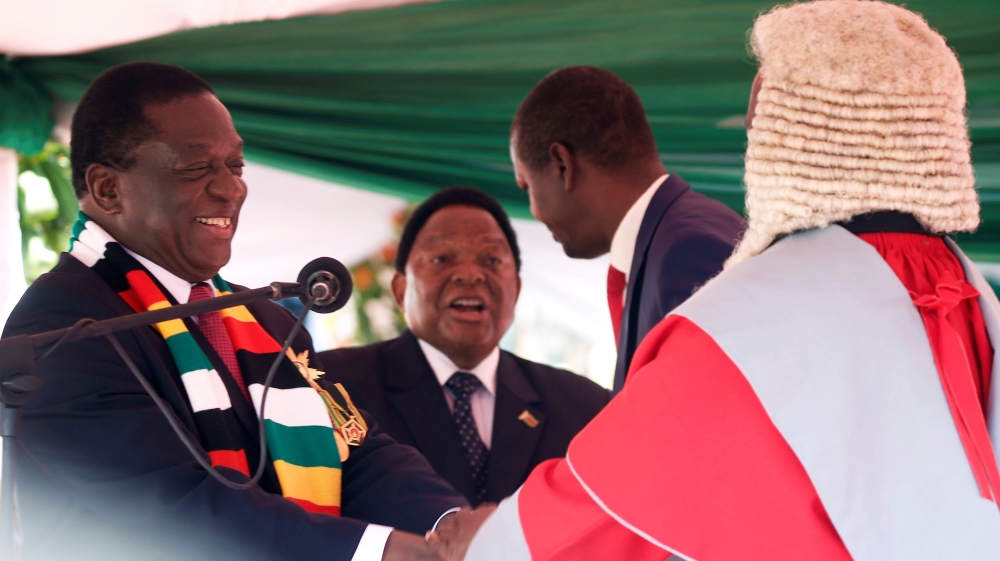
Emmerson Mnangagwa has taken the oath as Zimbabwe‘s president, after winning last month’s bitterly contested election that marked the country’s first vote since Robert Mugabe was removed from power. 

The Constitutional Court confirmed Mnangagwa‘s election victory in a ruling released on Friday, dismissing a challenge by the man he defeated in the July 30 ballot, opposition leader Nelson Chamisa.

Thousands of people, some from outside the capital, and foreign leaders gathered on Sunday at Harare’s national stadium for the swearing-in of Mnangagwa, who just secured the 50 percent of votes needed to avoid a runoff against Chamisa.

Mnangagwa pledged to “protect and promote the rights of Zimbabweans” in his oath.

“I, Emmerson Dambudzo Mnangagwa, swear that as president of the Republic of Zimbabwe I will be faithful to Zimbabwe [and] will obey uphold and defend the constitution of Zimbabwe,” Mnangagwa said.

He took the oath before Chief Justice Luke Malaba who, together with eight other Constitutional Court judges had dismissed Chamisa’s petition.

The election was touted as a crucial step towards shedding the pariah reputation Zimbabwe gained under Mnangagwa’s predecessor Robert Mugabe, and securing international donor funding to revive a crippled economy.

Political tensions

Al Jazeera’s Haru Mutasa, reporting from Harare, said Zimbabweans expected the president to send a message of unity amid political tensions that occurred following the elections.

“He has to convince Zimbabweans that he will be the president for all citizens not only for the ruling ZANU–PF party,” she said.

Hours before Mnangagwa’s inauguration, the International Republican Institute and National Democratic Institute said the country lacked a “tolerant democratic culture” in which political parties were treated equally and citizens allowed to vote freely.

The election was marred by procedural lapses and followed by an army crackdown against opposition supporters, undermining promises that Mnangagwa made during campaigning to break with the corruption and mismanagement that become endemic under Mugabe.

The crackdown, which left six people dead on August 1, recalled the heavy-handed security tactics that marked the 37-year rule of Mugabe, who was removed in a coup in November.

SOURCE: Al Jazeera and news agencies

Read More

from Trusted eNews https://ift.tt/2Lr1PBO
via IFTTT

Michael Owen: Ex-England striker opens up about injuries

news image

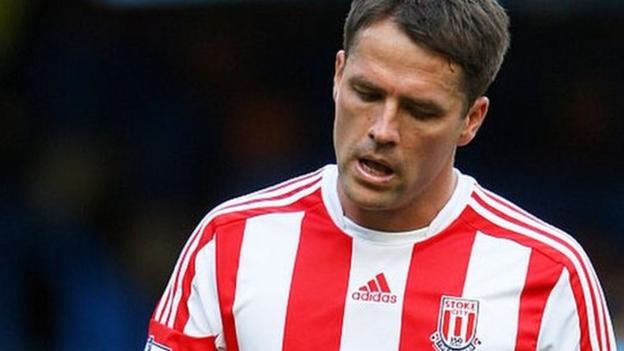
Michael Owen injured his anterior cruciate ligament on England duty in 2006

Former England striker Michael Owen says he “hated” playing football late in his career because injuries had left him “petrified”.

Owen won the Ballon d’Or in 2001 when at Liverpool, and scored 222 goals in a 17-year club career that ended in 2013.

But he says injuries forced him to change his game, a process which began when he tore his hamstring aged 19, leading to five months out.

“Once I did it once I was gone really,” Owen, 38, told BT Sport.

“I was quick, running in channels, beating people. That’s who I was – compared to the last six or so years when I turned into the only thing I could.

“I was petrified of running into a channel. I just knew I was going to tear a muscle. The worst thing about it is your instinct is to do what you have done all your life but you start thinking: ‘Oh no, don’t.’”

He left Liverpool for Real Madrid in 2004, had agreed to return to Anfield a year later but Newcastle trumped the Reds’ bid.

Moves to Manchester United – where he won his only Premier League title in 2011 – and Stoke followed.

Owen – who scored 40 goals in 89 appearances for England and captained his country – says his fear of sprinting led to him taking up positions where team-mates would not play passes which required him to give chase.

“For six or seven years I hated it,” he added. “I couldn’t wait to retire.

“It wasn’t me. All I was doing is coming short, linking play and getting in the box. It ended up with people thinking I was a great goalscorer who didn’t do much else. Mentally I could do it, but physically I couldn’t.”

‘For me, it was turmoil’

Owen also suffered injuries such as a broken metatarsal when playing for Newcastle in 2005, an anterior cruciate ligament tear on England duty a year later, and persistent thigh and groin issues in 2007.

He made his Liverpool debut at 17 and starred at the 1998 World Cup aged 18 – but points to genetics rather than a volume of football as the reason for his problems. He says he was “made to get muscle injuries” because his father and brothers have endured similar problems.

Injuries prompted Owen to consider retirement “loads of times” and he says he offered to end his contract at Stoke in December of 2012, before eventually retiring in May of 2013.

“I admire people who can play for the love of the game,” he added. “They may lose a yard of pace and they can go down a division or play against lesser teams – but, for me, it was turmoil.”

Read More

from Trusted eNews https://ift.tt/2Nh5d44
via IFTTT

From road tax to courts: The Taliban’s attempts at state building

news image

Kabul, Afghanistan – Late in May, 26-year-old truck driver Bilal Hakim was travelling along his regular route through Afghanistan‘s northern province of Baghlan to Kunduz.

He had taken the journey with the same cargo – a 50-tonne tanker of oil – several times in his five-year career.

Oil tankers enter Afghanistan at Hairatan port in Balkh and carry fuel to Mazar, Samangan, Baghlan, Kunduz, Takhar and Badakhshan provinces.

“Somewhere in Baghlan-e-Markazi district, I was stopped along with a few other trucks at a makeshift check post manned by gunmen,” said Hakim*, who did not want to use his real name for security reasons.

Before he pulled over, Hakim had an idea of what was happening.

He had heard about temporary posts popping up close to main motorways when the local Taliban felt emboldened.

“They asked me stop and then they demanded I pay them 25,000 Afghanis ($350) as ‘malia’,” he told Al Jazeera, using the Dari word for tax.

“I didn’t know what I was supposed to do,” he told Al Jazeera.

Hakim said his employers had received threats of extortion from local Taliban groups before, but this was his first incident of this nature with armed group.

“The tanker owners had refused to pay so far, but when they held us captive, we had no choice,” Hakim said, adding that tax rates for smaller trucks was $70.

The Taliban’s “Department of Tax and Revenue” issued the drivers a receipt before releasing them.

We have sent tribal elders and religious leaders to negotiate with the Taliban since we can not afford $350 for every vehicle. It will not only affect our business but will also impact the rate of oil in the region.

Haji Shafiq, union member

Representatives of the Baghlan Oil Tankers’ Union and Kunduz Tankers’ Unions confirmed several instances of the Taliban taxing drivers on northern trade routes.

Haji Farid, a union member and oil tanker company owner from Kunduz, said his drivers have been affected.

“The Taliban stopped about 25 trucks three months ago, which included several of oil tankers in Baghlan, and asked them to pay $350 for each truck. Our drivers negotiated the rate down to $210,” he said. “The Taliban told us that they were formally collecting taxes from the entire north and northeastern region and were planning on expanding closer to Kabul as well.”

Afghan officials are aware of the “tax”.

In June, provincial Baghlan governor Abdul Hai Nemati told Al Jazeera the Taliban was collecting “ransom at gunpoint”, adding he had ordered a security patrol to observe and secure all motorways passing through the province.

Meanwhile, truck owners have taken matters into their own hands by attempting to negotiate with the local fighters.

“We [the union members] have sent tribal elders and religious leaders to negotiate with the Taliban since we can not afford $350 for every vehicle. It will not only affect our business but will also impact the rate of oil in the region,” Haji Shafiq, a union member from Baghlan, told Al Jazeera.

Union members have not considered avoiding the tax entirely, out of fear the Taliban would set tankers alight.

“The Taliban are sometimes as far as 50 metres away from the main road and can shoot at our oil tankers, even if we travel with police escort,” Shafiq explained.

He estimates that between 150 to 200 oil tankers pass through the northern highway each day, many of them carrying fuel for foreign troops.

‘Taxes that Muslims must pay for their community’

Collecting funds is not limited to the road “tax”.

The Taliban’s “Ministry of Finance” has expanded its activities in the region in an apparent effort at state building.

Farmers in Baghlan-e-Markazi have reported the Taliban demanding “zakat”, or charity, that is often paid in kind – such as portions of the harvest.

However, the Taliban have little use for agricultural produce and force farmers to buy back “donated” produce at market rates, issuing them similar attested receipts for payments.

Local Taliban commander Maulawi Abdul Rahman said tax collection was legal and in accordance with Islamic law.

“What we collect is oshr and zakat, Islamic taxes that all Muslims must pay for their community,” he told Al Jazeera, speaking from Dahna-e-Ghori, a district that remains largely under Taliban control.

If the Taliban’s claims are to be believed, the group uses this money to improve local services.

Social media posts by groups associated with Taliban show them engaging in public services such as building roads, bridges and religious schools.

“Fund-raising and state-building go hand in hand; you can’t establish yourself as a system of state without money,” explained Ahmad Shuja Jamal, Afghan political analyst and editor of the Georgetown Public Policy Review.

“You have to be able to show the public projects, you have to show that you – as a state – are able to benefit people in the areas you control. It is a way for them to establish themselves as a viable potential state,” he told Al Jazeera, adding that this approach differed from when the Taliban controlled the Afghan government in the late 1990s.

“All they offered was a draconian system of moral policing; that was the state. Grow your beard, wear your turban, wear your chadori (a headscarf worn by women), don’t get out the house – that was literally what they offered.

“But what they are trying to do now is offer all of that and then some more. Their harsh approach to law and order was not popular, so they learned from it,” Jamal told Al Jazeera.

A report in June by Overseas Development Institute (ODI), “Life Under The Taliban Shadow Government”, explores the lives of millions of Afghans living under the group’s influence.

“Taliban governance is more coherent than ever before; high-level commissions govern sectors such as finance, health, education, justice and taxation, with clear chains of command and policies from the leadership based in Pakistan down to villages in Afghanistan,” the report says, while noting how Taliban taxes “co-opt Islamic finance concepts, such as oshr and zakat, or mimic official state systems.”

The report adds: “[Apart from] reviving and restarting parts of their government, such as justice, the Taliban had to invent other systems through trial and error. Much of the process appears to be bottom-up and demand-led, and influenced by local experience.

The Taliban has attempted to “correct” some of its flaws that undermined its rule in the 1990s, including the ban on girls’ education.

“Though most Taliban officials insist no ban existed in the first place, and the Taliban have publicly stated that all women should have access to education,” says the report, authored by ODI’s Ashley Jackson. 

Taliban’s ‘swift’ justice 

The Taliban are also building a parallel but small-scale justice system within areas they control.

“The Taliban have it in their DNA to be a draconian type of moral purifying force using their brand of religious interpretation, which they are using to dispense arbitration in local disputes,” said Jamal, the political analyst.

Some citizens appreciate the Taliban’s speed in ending legal rows in a society where such disputes can linger for decades.

Mohammad, not his real name, is from Baghlan province and owns about two and half acres of agricultural land.

“For several years, our family land was controlled by a tribal elder. I reported the matter to the governmental officials and approached various departments of the Afghan government to try and get our land back, but no one was willing to help us because the perpetrator was an influential tribal leader,” he told Al Jazeera.

Years later in January 2018, a friend introduced him to the local Taliban district judge.

“With nothing more to lose, I shared my problem with the Taliban judge. After reviewing my problem and having shared documents proving I inherited the land in question from my grandfather, the judge sent out their fighters to find the man occupying my land,” he said.

The accused was presented in a Taliban “court” the next day and asked to produce evidence, but said his documents were lost amid the country’s conflicts.

“The Taliban judge ruled that the land belonged to my family and told the elder to only return if he can find documents to counter claim,” Elham said, as he lauded the group’s “swift justice”.

However, Jamal warned against interpreting the Taliban’s justice system as fair.

“I would call it an attempt at fast, perhaps hasty, resolution of local disputes,” he said. “A lot of what they do doesn’t conform to international norms which why they are able to do this quickly.

“It doesn’t conform to Afghan, global, or Muslim standards of what justice should be – fair and equitable … The Taliban engage in a lot of extrajudicial killing after summary trials.”

The Afghan government, he said, should be concerned.

“It is the constitutional duty of the Afghan government to offer public services, justice and fair representation. And they should be more worried that in their absence, an armed opposition group is trying to fill the void.”

However, the shift in the Taliban’s strategy to present itself as a viable government hasn’t necessarily won them significant support.

“For the Taliban, control of people – rather than control of territory or popular support – is the priority,” the ODI’s Jackson says in her report. “They seek to control the population, mainly to prevent people from informing upon them or acting against them.”

With additional reporting by Ajmal Omari in Kabul.

Read More

from Trusted eNews https://ift.tt/2w9oJZJ
via IFTTT

What I learned about John McCain during 20 years covering him

news image

CLOSE

John Sidney McCain III: A POW in Vietnam for five years, he served as Arizona’s senator from 1987 until his death and twice ran for president.
Nate Kelly, azcentral.com

The famous media faces were gone. The swarm of reporters who followed U.S. Sen. John McCain had scattered, and only a few of us remained.

By July 2007, McCain’s once-impressive presidential campaign was nearly bankrupt. Senior advisers and staff were let go. And the media had written him off.

The torrent of campaign coverage turned to a trickle.

That left plenty of elbow-room on the Straight Talk Express as it rolled through scenic New Hampshire, home to the nation’s first-of-the-season presidential primary.

There still was usually an Associated Press reporter on board with the McCain campaign. Typically, a reporter from the Concord Monitor or some other New Hampshire media organization was there too. And there was me.

I was national political reporter for The Arizona Republic, McCain’s hometown newspaper. And I was on the bus because Republic editors decided to keep covering McCain, even as his campaign appeared to be in free fall.

MORE: John McCain, American ‘maverick’ and Arizona political giant, dies at age 81

I already knew McCain, or thought I did. I had covered him as a reporter, blogger and columnist for The Republic. Before that, I wrote about him for the East Valley Tribune in Mesa. In all, I would follow him for two decades.

But it was traveling New Hampshire on that bus, poised for arguably his finest moment politically, that I truly came to know McCain. 

By the end, I was covering a man with terminal brain cancer and telling the world he did not fear his death, which came Saturday at age 81. As a reporter who covered McCain for Arizona’s paper of record, I had become one of the journalists most closely associated with him.

I didn’t plan it. Things just played out that way. 

McCain as calming force

As a Tribune political reporter, I had written occasional stories about or involving McCain, including a Dec. 30, 1998, front-page story announcing that McCain was set to seek the 2000 GOP presidential nomination.

McCain would lose that race to George W. Bush, who would go on to win the White House. And I would soon be deployed to the Washington, D.C., bureau of Freedom Communications.

Freedom owned the Tribune, the Orange County (California) Register, and the Gazette of Colorado Springs, Colorado.

Thanks to his 2000 presidential run, McCain was growing in clout and stature on Capitol Hill and I closely covered him.

This included his workwith U.S. Sen. Russell Feingold, D-Wis., to reform America’s campaign-finance system. Their bipartisan bill would become law in 2002, among McCain’s biggest legislative achievements.

On the day of the Sept. 11, 2001, terrorist attacks on the World Trade Center and the Pentagon, McCain spoke to 17 reporters, according to Elizabeth Drew’s 2002 book “Citizen McCain.” I was one of them.

McCain was a calming force that day. 

“He phoned his wife a couple of times to assure her that he was all right,” Drew wrote. “He became upset when he learned that the schools in Phoenix had been closed. ‘My God, they’re panicking,’ he said, and so in most of his calls he told people not to panic, that the President would return to Washington, that the government was functioning, and that people were secure.”

Autoplay

Show Thumbnails

Show Captions

It was a nervous time in the nation’s capital. I lived in Arlington, Virginia, near the smoldering Pentagon. I still remember the smell of burning jet fuel and black smoke that hit me as I left my apartment building the next morning. 

Then came the anthrax contamination that temporarily shuttered the Hart Senate Office Building, where McCain’s Arizona colleague, U.S. Sen. Jon Kyl, had his office.

A bittersweet moment came when the Arizona Diamondbacks met the New York Yankees in the 2001 World Series while America was still staggering from the 9/11 attacks.

McCain, a passionate Diamondbacks fan, attended series games with New York City Mayor Rudy Giuliani, who had become something of a national hero after 9/11.

Following the Diamondbacks’ victory — spoiling the prevailing national narrative that New York needed the post-9/11 series victory to heal — I tagged along as McCain led a tour of the U.S. Capitol for the world champion D-Backs.

MORE: Remembering John McCain: Arizona friends, politicians share memories

McCain let the players know how proud they had made Arizona by bringing home the World Series trophy.

“I hadn’t had so much fun since my last interrogation in Hanoi,” McCain, a celebrated former prisoner of war, cracked at a Hill reception for the team ahead of the tour, in which then-Manager Bob Brenly and 2001 standouts such as Randy Johnson, Curt Schilling and Craig Counsell soaked up the history and art of the Capitol Rotunda before heading to the White House for an East Room ceremony with Bush.

On Capitol Hill during this period, a grim Congress was focused on war — first in Afghanistan, then in Iraq.

And later came the Beltway snipers, whose murder spree gripped the greater Washington, D.C., area with fear during October 2002.

Autoplay

Show Thumbnails

Show Captions

McCain as underdog

By the time McCain started to gear up for his second run for president, I had returned to Arizona and moved to The Republic. I was tapped to cover his campaign.

Along the way, I became the cable-TV news channels’ go-to local reporter for all things McCain. I made appearances on PBS’ “NewsHour With Jim Lehrer,” CNN, Fox News Channel, MSNBC and C-SPAN, among others.

I was under no illusion that my rising national exposure was the product of my personality and charisma. Years later, I joked to McCain that my once-promising national television career died along with his White House ambitions in 2008.

Those ambitions would die hard. But not before McCain pulled off one of the most remarkable escape acts from a campaign that was spiraling earthward and almost certain to crash.

Many in media have tried to figure out McCain over the years. They have alternately praised the “maverick” who did things his own way, and condemned him when they saw him behave as an expedient politician.

Which was the real McCain, some wondered.

MORE: Four presidents, nation, world react to John McCain’s death

I would argue he was a combination of the two. But I wouldn’t presume to say I know, despite having written about the Senate lion and master politician in one capacity or another for practically my entire 25-year career in professional journalism.

I do, however, believe I got a glimpse of the real deal when I observed McCain up close on the presidential campaign trail that summer and fall of 2007.

This was the McCain who was out of money and with nothing to lose. The McCain who through grit and determination — a combination of fighting spirit, formidable political skill, a willingness to take chances and dark humor — achieved a comeback that took him from the depths of disaster to a better-than-expected showing in the Iowa caucuses and victories in the New Hampshire and South Carolina primaries on his way to clinching the 2008 Republican presidential nomination.

CLOSE

Arizona Sen. John McCain insisted on the need for campaign-finance reform and spoke out against pork-barrel spending and government waste. His efforts ruffled feathers in the Senate and earned him the nickname of the ‘maverick.’

McCain was under pressure to give up. Instead, he defiantly proclaimed nothing short of “contracting a fatal disease” would get him to drop out of the race before the New Hampshire primary. “It’s always darkest right before it’s totally black,” he joked.

Even at age 71, he was a tireless campaigner.

“We’re going to do the town-hall meetings, we’re going to be on the bus, we’re going to have the direct contact with the people,” McCain told reporters after a July 2007 lunch event in Concord, New Hampshire.

McCain kept his word.

Keeping up with him on the campaign trail was a grind. He sometimes would appear at as many as six or seven events a day. Thanks to McCain, I must have visited every Veterans of Foreign Wars and American Legion hall in Iowa, New Hampshire and South Carolina.

He conducted more than 100 town halls in New Hampshire alone. The town-hall format worked well for McCain. He enjoyed mixing it up with the crowd, particularly critics of the Iraq War that he supported.

McCain already had a connection to the Granite State. It was there that he had upset the front-running Bush in 2000. 

McCain’s now-shoestring operation seemed to make everything more intimate. He was more approachable and often in a good mood. A reporter on the bus observed he seemed like he was enjoying himself more. McCain said he was more relaxed because he didn’t have to worry about raising money all of the time.

“Being an underdog with low expectations can be liberating and fun,” McCain would write in his final memoir, 2018’s “The Restless Wave.”

Autoplay

Show Thumbnails

Show Captions

‘No Surrender’

McCain may have been at his best during his September 2007 “No Surrender Tour” of the three early presidential states that helped him get back in the race.

The tour’s name had a double meaning, reflecting both McCain’s passionate advocacy for U.S. victory in the unpopular Iraq War and his never-say-die attitude toward his own faltering campaign.

It also was an opportunity for McCain to remind voters of his Vietnam War record, which included getting shot down over North Vietnam and spending more than five-and-a-half years as a POW.

The first chapter of “The Restless Wave” is titled “No Surrender.” In the book, he credits campaign adviser Steve Schmidt with the name.

McCain, the former Navy aviator, was joined on the bus in Iowa by two of his fellow POWs, retired Air Force Col. George “Bud” Day and Orson Swindle, a retired Marine aviator. The friends had a great time, laughing and sharing funny stories about their time in captivity in Hanoi.

Autoplay

Show Thumbnails

Show Captions

I asked McCain if he felt like he had missed out on a lot in the United States while he was locked up as a POW.

“No, except that the miniskirt phase had come and gone,” McCain quipped. “I regretted that.”

Before or since, I never personally heard McCain open up that way about the details of his POW experience. I feel lucky to have witnessed it.

This was McCain immersed in his element. A scrappy political pugilist enjoying the fight and taking chances, drawing strength from old comrades from the Hanoi Hilton and energy from town-hall audiences.

The effort paid off with another big win in the New Hampshire primary. And then in South Carolina, Florida and on Super Tuesday.

Those instincts may have betrayed him during the general-election campaign against Democrat Barack Obama, such as his decision to make a risky bet on the then-unknown Alaska Gov. Sarah Palin as a running mate.

For better and worse, those qualities were the essence of McCain.

They are what powered his long political career and, in turn, are why he will be remembered as one of Washington’s most consequential figures.

Autoplay

Show Thumbnails

Show Captions

Short temper not seen firsthand

Years later, it was a column I wrote related to McCain’s POW experience that caused a rare rift in our professional relationship.

McCain and The Republic over the years often had a rocky, even hostile, relationship. But I believe he realized the newspaper had a duty to perform for its readers and his constituents.

I personally found McCain straightforward, helpful and probably more accessible to me than he needed to be.

When I started covering his presidential campaign in 2007, everybody involved was ready to leave behind the bitterness of the past and move forward, but the relationship remained icy. I remember telling McCain’s nascent campaign operation that The Republic just wanted to be treated like any other news organization. They agreed, and the thaw began.

MORE: President Trump offers ‘deepest sympathies’ to family of Sen. John McCain

Over the years, I had countless conversations with McCain about almost every political topic under the sun. He would usually address me as “Danny.” Sometimes, he would call me a “jerk,” but with him, it was a term of affection.

For all the talk about McCain’s alleged short fuse — he had acknowledged having a temper in one of his books, and it had been a political liability — I never saw him explode in a way that was consistent with the legends. I would get the silent treatment from McCain from time to time after writing something he didn’t like, but such reactions are common among politicians.

I did once get a face-to-face dressing down for something that my Republic colleague, E.J. Montini, had written. I think McCain just wanted to vent at someone about it and I happened to have an interview with him scheduled that day.

Painful POW memories

A half-dozen years later, my decision to write a column about tapes of his POW confession became a more serious point of contention.

Not long before Arizona’s Aug. 30, 2016, Senate primary, McCain critics had unearthed long-lost recordings of Radio Hanoi propaganda broadcasts featuring McCain’s coerced confession of “crimes against the Vietnamese country and people.” On the recording, McCain compliments the doctors who treated his injuries after he was shot down on Oct. 26, 1967. At the time, McCain’s father, John S. “Jack” McCain Jr., was an admiral who commanded U.S. forces in the Pacific, and Radio Hanoi’s broadcast of McCain’s confession tape was no doubt hurtful to him.

McCain had long acknowledged, with regret, that he had recorded a confession after sustained beatings and torture from his North Vietnamese captors. But the recording itself had not been heard and it carried historical significance, particularly to someone like me, who had studied his Vietnam experience.

McCain made it clear through his Senate spokeswoman that he didn’t agree it was newsworthy and signaled extreme displeasure with me writing about it. 

I was taken aback by the force of the pushback.

Autoplay

Show Thumbnails

Show Captions

Although fringe right-wing McCain foes were trying to make political hay out of the tapes, I didn’t think they would have any impact on McCain’s 2016 fortunes. If anything, readers would remember the tremendous ordeal that McCain underwent from 1967 to 1973.

But from that pushback, I came to a realization: I was seeing the recordings as an important historical document. But for McCain, revisiting the false confession appeared to trigger painful memories and emotions that were still raw nearly 50 years later.

The column was published over McCain’s objections. The recordings did have news value, particularly since McCain’s Vietnam War record had always been so central to his rise in politics

Eventually, three of McCain’s fellow POWs — Everett Alvarez, Jerry Coffee and Swindle from the 2007 “No Surrender Tour” — issued a joint statement calling the recorded confession “old news” and emphasizing that McCain “fought our captors as hard as any of us” and “did all that could be expected of him.”

As I had predicted, the recordings of the McCain confession had no impact on his re-election, but that column kept me in McCain’s penalty box until primary day. After that, it was forgotten.We both moved on.

Dan Nowicki covered U.S. Sen. John McCain as The Arizona Republic’s national political reporter from 2007 to 2018. Nowicki is The Republic’s national politics and issues editor. Follow him on Twitter, @dannowicki.

READ MORE:

Autoplay

Show Thumbnails

Show Captions


Read or Share this story: https://azc.cc/2NlhrbI

Read More

from Trusted eNews https://ift.tt/2oanox9
via IFTTT

Can Wolves and their ambitious owners eventually emulate Man City’s rise to the top?

news image

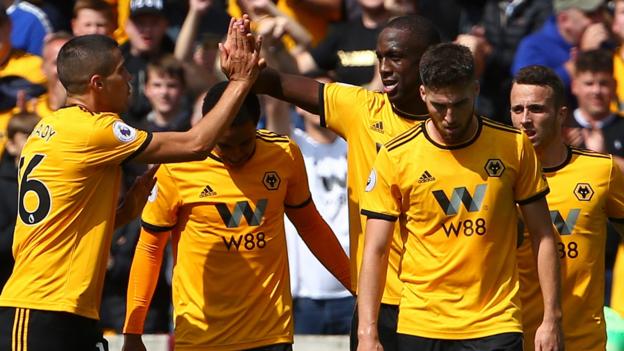
Wolves held champions Manchester City to a 1-1 draw at Molineux

It is almost 10 years since Sheikh Mansour bought Manchester City and transformed the club from noisy neighbours into one of England’s finest.

In their own way, the Chinese Fosun Group are attempting something similar at Wolves.

As they celebrated promotion from the Championship in April, senior executives spoke of their vision to make Wolves “one of the best clubs in the world”.

It was fitting therefore on Saturday that City should visit Molineux so close to their anniversary, offering an opportunity to see how Wolves are doing – and more importantly – just how far they have to go.

Wolves were league champions three times in the 1950s and are ranked inside England’s top 10 most successful clubs, but have spent only four seasons out of the last 34 in the top flight.

With the club’s fans singing an anthem that ends “we’re Wolverhampton, we’re on our way back”, is it realistic to think Wolves can match their owners’ ambitions and get themselves back among the trophy contenders and title challengers?

Having access to a touch of class

Willy Boly opened the scoring for Wolves against Manchester City

Nuno Espirito Santo’s side received a standing ovation from the home supporters after their 1-1 draw with Premier League champions Manchester City.

They got within 21 minutes of a first top -light home win since December 2011, when Steven Fletcher’s second-half double defeated Sunderland.

There was more than a hint of good fortune about Willy Boly’s opener, which clearly went in off his hand.

However, there was nothing lucky about the first-half save goalkeeper Rui Patricio made to turn Raheem Sterling’s long-range shot onto the post, nor the reaction feet-first stop that kept out Sergio Aguero’s close-range header after half-time.

Mind you, it shouldn’t have been that much of a surprise. Patricio has 73 Portugal caps and was in goal when they beat hosts France in extra-time to win Euro 2016.

Patricio signed for Wolves from Sporting Lisbon this summer, thanks to the influence of super agent Jorge Mendes, whose Gestifute agency is part owned by the Fosun group.

Another Euro 2016 winner and summer arrival, Joao Moutinho, started the game. Key men Helder Costa and Ruben Neves are also Mendes clients from Portugal, as is their manager.

Wolves have repeatedly denied Mendes has too much influence at the club and the English Football League cleared them after allegations were made by the Leeds owner Andrea Radrizzani.

Evidently though, the higher Wolves climb, the more Mendes’ elite stable of players, which includes Cristiano Ronaldo and Angel Di Maria, will be needed to reach the next level.

Progress, but not instant success

Wolves’ summer signings
Adama Traore [Middlesbrough] £18m Rui Patricio [Sporting Lisbon] Free
Willy Boly [Porto] £10m Raul Jimenez [Benfica] Loan
Benik Afobe [Bournemouth] £10m Jonny Castro Otto [Atletico Madrid] Loan
Joao Moutinho [Monaco] £5m Leander Dendoncker [Anderlecht] Loan

It has been largely forgotten over the last decade but City won only four of their first 15 Premier League games of the Abu Dhabi era. It was three years before they won their first trophy; the FA Cup.

Despite a net spend of £55m in the summer, the eighth highest in the Premier League, Wolves are still to win a game this season.

They performed superbly against Pep Guardiola’s side, but nevertheless, they have only two points from their opening three games and will end the weekend nearer the bottom of the table than the top.

Few – including Nuno – doubt Wolves’ fortunes will improve significantly over the coming weeks and months.

However, he refuses to look too far ahead, seeing little point in working out what his side needs to match City without first working out the best way of navigating the journey.

He said: “We can’t aim to become something that is further in the future without taking care of our present.

“We cannot be in a rush to compare ourselves with a club the dimensions of Manchester City.

“Of course we have ambitions but we have to be humble and know where we are.”

Nuno urges Wolves to control games better

All in it together

Wolves owners have plans to increase the capacity of Molineux to 50,000. In the short term, it will be around the 31,322 present to see the City game.

Working for TV, former boss Mick McCarthy remarked that “the place is jumping” when Wolves are doing well.

That was certainly the case on this occasion and it is evident Nuno doesn’t view the construction of his football team being purely about his players and their manager.

He said: “Everyone in the club and the city of Wolverhampton must be engaged if we are to create something together.

“We need an identity everyone involved in the club can hold on to.”

Read More

from Trusted eNews https://ift.tt/2BNTPvf
via IFTTT

John McCain: Hero at home, hawk in Middle East

news image

The US has no royalty but the late US Senator John McCain was born into the closest thing the country has to an aristocracy.

He began life in 1936 at a US naval base located next to the Panama canal; the grandson of a four-star US Navy admiral and the son of a naval officer, who would also become an admiral.

A young McCain followed in that family tradition, joining the navy and earning his wings as a naval pilot, who went on to fly a ground-attack jet during the Vietnam War.

His first brush with death came during the war in July 1967 when a missile fired accidentally on board the aircraft carrier, USS Forrestal, sparked a series of explosions and fires that killed 134 sailors.

His second came just three months later when a missile hit the jet he was piloting, forcing him to eject into a lake in the North Vietnamese capital, Hanoi.

McCain narrowly avoided drowning, but his rescuers took him as a prisoner of war at the Hoa Lo Prison, which earned the infamously ironic nickname the ‘Hanoi Hilton’.

The future Republican presidential candidate spent more than five years there, enduring torture but refusing an expedited release on account of his background.

“I just knew it wasn’t the right thing to do,” he is later reported to have said.

“I knew that they wouldn’t have offered it to me if I hadn’t been the son of an admiral.”

The experience in Hanoi instilled in him a lifelong opposition to torture. As a US senator, McCain spoke out against its use against terrorism suspects during the US-declared “War on Terror”, which followed the September 11 attacks. 

John McCain after he was released from North Vietnamese detention [Horst Faas/AP Photo] 

Hawkish stance

But the War in Vietnam did not change his hawkish foreign policy positions.

After his election to the US Senate in 1987, representing the state of Arizona, McCain backed US military intervention from the first Gulf War to the later invasions of Afghanistan and Iraq.

When anti-war protesters stormed a Senate hearing where former US Secretary of State Henry Kissinger was speaking, McCain ordered that they be escorted out of the hall by police and condemned the activists as “low-life scum”.

The senator was also a dedicated supporter of Israel and was quick to back US President Donald Trump’s decision to move the US embassy in Israel from Tel Aviv to Jerusalem. 

“I have long believed that Jerusalem is the true capital of Israel,” he wrote in a statement on his website after the announcement.

The support extended to Israel’s numerous offensives against Palestinians, including the 2014 bombardment of Gaza, which killed more than 2,250 residents of the besieged territory, the vast majority of them civilians.

Sections of the US media labelled him a “maverick” for his seemingly independent streak but he was also noted for his ferocious temper, which spared few, even those close to him.

At a Republican fundraiser in 1998 he joked about the then-US President Bill Clinton’s daughter, Chelsea, calling the teenager “ugly”.

He is also reported to have called one fellow Republican senator a “f***ing jerk” and another an “a**hole”.

None of those purported incidents did much to harm his political career. 

John McCain on the 2008 campaign trail [Brian Snyder/Reuters]

Following an unsuccessful attempt in the 2000 Republican primaries, McCain secured the party’s nomination for the 2008 presidential election.

His choice of running mate, a little known Republican governor from Alaska named Sarah Palin, raised eyebrows within the party’s mainstream.

The pair would lose to former President Barack Obama in a landslide.

Palin went on to break with McCain on many issues, and establish herself as a key figure on the party’s hard-right.

Opposition to Trump

Faced with the party’s accelerating rightward shift, in later years McCain positioned himself as a centrist within the party, and as an opponent of the populist platform that won Trump his nomination for the 2016 election.

Trump sent his “deepest sympathies and respect” to McCain’s family on news of his death but the two had an acrimonious relationship.

The US president was widely condemned for dismissing McCain’s experiences in Vietnam, a war he had himself avoided with educational and medical deferments.

“He’s not a war hero. He was a war hero because he was captured. I like people who weren’t captured,” Trump said of McCain’s service record while on the 2016 campaign trail.

After Trump’s election, McCain continued to oppose Trump policies, such as the travel ban on citizens from several majority Muslim states, and voting against the US president’s attempt to repeal the Affordable Care Act.

When Trump railed against the media, accusing many outlets of spreading “fake news”, McCain hit back.

“When you look at history, the first thing dictators do is shut down the press,” he said.

The US senator’s final chapter began in 2017 with an announcement that he had brain cancer and was going to reduce his duties in the Senate, as he underwent treatment.

On August 24, McCain’s family announced that treatment for his illness would discontinue and a day later, announced his death

Several sources suggest McCain’s widow, Cindy, will take up his seat in the Senate, until the November mid-term elections.

As speculation grows over what his passing means for the Republican party, tributes continued to flow in, including from his 2008 rival.

“Few of us have been tested the way John once was, or required to show the courage that he did,” wrote former President Obama .

“Michelle and I send our most heartfelt condolences to Cindy and their family.” 

McCain opposed Trump on several of his key platform pledges [Reuters]

Read More

from Trusted eNews https://ift.tt/2MWwcom
via IFTTT

Design a site like this with WordPress.com
Get started