Maria Sharapova’s last Grand Slam title was at the French Open in 2014
2018 US Open
Venue: Flushing Meadows, New York Dates: 27 August-9 September Coverage: Live radio coverage on BBC Radio 5 live sports extra; live text commentaries on the BBC Sport website
Maria Sharapova is out of the US Open after she was beaten 6-4 6-3 by Carla Suarez Navarro in the fourth round.
The five-time Grand Slam champion was broken three times in the first set and immediately at the start of the second.
Sharapova broke back in the third but dropped serve again before squandering two break points while trailing 4-2.
The 2006 champion was then broken in the final game of the match as 30th seed Suarez Navarro celebrated her 30th birthday with a shock victory.
“It was was a really good present for me,” said the Spaniard, who will face last year’s runner-up Madison Keys next.
“I want to have a happy birthday, and I have it.”
Russian 22nd seed Sharapova has not gone beyond the quarter-final stage of a Grand Slam since she returned from a 15-month doping ban in April last year.
Her record of 23 successive victories in the night session at the US Open also comes to an end.
Still no way back to the top for Sharapova
Since winning the US Open title in 2006, Sharapova has gone beyond the fourth round just once (in 2012)
Sharapova has not gone beyond the quarter-finals of a Grand Slam since reaching the semi-finals at Wimbledon in 2015.
She was beaten by world number 12 Garbine Muguruza 6-2 6-1 in the last eight at the French Open this year in a one-sided match.
The 31-year-old Russian is also yet to reach a WTA final in 2018 and has defeated only two top-10 seeds at tournaments this year.
Her last major title was in Paris in 2014 and it has been 12 years since she won her second Grand Slam title at the US Open as a 19-year-old in 2006.
With only two top-10 players left in the women’s draw – Czech eighth seed Karolina Pliskova and defending champion Sloane Stephens – another opportunity has passed the Russian.
Defeats by seeded players, including world number one Simon Halep in Italy, have ended her hopes of returning to the top this year and it could still yet be a long way back for Sharapova.
Birthday celebration in ‘amazing night session’
Carla Suarez Navarro has reached two Grand Slam quarter-finals this year
Progression to the quarter-finals at a second Grand Slam means Suarez Navarro makes 2018 her most successful year.
She was beaten by world number two Caroline Wozniacki in the Australian Open last eight in January before losing to Aryna Sabalenka in the final of the Connecticut Open last month.
The Spaniard also reached the quarter-finals of the Madrid Open and the prestigious Indian Wells Masters.
But when the New York crowd wished her a happy birthday following her victory over Sharapova on Monday, Suarez Navarro said she hoped to show more of her ‘character’ in the quarter-finals.
“I’m happy as I played a really good match, I really enjoyed this crowd,” she said.
“I need to be aggressive, I am working on that, I need to try to be solid, run and fight. This is the way that I can play really good tennis. I have the character inside, sometimes I have to show more, I’m working on that.
“It will be a really tough match [against American Keys]. The crowd will be with her. She has a really good forehand and she has played a final here so she has a lot of experience. I will try to enjoy the match like today.”
U.S. Sen. John McCain’s final words to the American people read by spokesman Rick Davis. Rob Schumacher, azcentral.com
WASHINGTON — Sen. John McCain’s life took on a fierce urgency after he was diagnosed with brain cancer in 2017, and he moved quickly to complete his final projects even as his health challenges sequestered him at his family home near Sedona, a close friend told The Arizona Republic.
McCain also never gave up hope that he might someday return to the U.S. Senate and until his April surgery for an intestinal infection related to diverticulitis was plotting a possible Capitol Hill comeback.
Rick Davis, a longtime member of McCain’s inner circle who visited McCain frequently this year at the McCains’ Cornville property, revealed new details about the final months of McCain’s life out of the public eye.
The six-term senator from Arizona and 2008 Republican presidential nominee was battling glioblastoma, a deadly form of brain cancer. He died Aug. 25 in Cornville at age 81.
McCain was determined to plan his own memorial services, write a final book with his longtime collaborator and former chief of staff Mark Salter, participate in an HBO documentary about his career, and clear out a portion of the Cornville property that had been overgrown with brush and trees.
“He initially called Salter and I in shortly after the diagnosis,” Davis recalled in an interview with The Republic. “He said, ‘OK, we’ve got to start planning my funeral.’ We’re like, ‘Uh, can’t it wait? This is depressing.’ He said, ‘No. We’ve got to get it done. We’ve got to get it done right now.’”
McCain’s final goals were accomplished.
His life was celebrated with memorial services in at North Phoenix Baptist Church and Washington National Cathedral. He was eulogized by former Presidents George W. Bush and Barack Obama and by former Vice President Joe Biden. He lay in state at the Arizona State Capitol in Phoenix and in the U.S. Capitol Rotunda in Washington, D.C. After a funeral service at the U.S. Naval Academy Chapel, he was buried Sunday in the U.S. Naval Academy Cemetery.
His and Salter’s book “The Restless Wave: Good Times, Just Causes, Great Fights, and Other Appreciations,” was published May 22.
A 40-page document included details on all the McCain memorial activities and eventually McCain was satisfied that they had gotten “about 80 percent there.”
Davis said, laughing, that it was more like “120 percent” given McCain’s ambitious plans.
He described the Arizona ceremonies as “building blocks” that built to “the big national events, the lying in state and then the cathedral on Saturday and then going back to where it all began, at the very end,” with McCain’s burial at Annapolis.
“It was so nice that he was able to articulate himself what the end was going to look like. It was just amazing,” Davis said. “You look now and you say, ‘Thank God, we got the book done. Thank God, we got the planning for the funeral done. Thank God, we got the HBO thing done. And we got that area cleared, thank God. Because he was going to drive us all nuts with that.
“He was a man in a hurry all the way to the end.”
Davis served as campaign manager for McCain’s 2000 and 2008 presidential campaigns and today is a partner in a private equity fund in New York. He was one of McCain’s closest advisers for years.
Here are some more details from Davis about McCain’s final months while battling brain cancer in Cornville.
“It just depended on what month it was,” Davis said.
He entered the hospital for side effects related to his anti-cancer chemotherapy and radiation treatment and a viral infection. McCain returned to Arizona Dec. 17 and never went back to Washington, D.C.
McCain wound up tearing both of his Achilles’ tendons last year, which was a consequence of the steroids he had been getting in the cancer fight, he said. That hurt McCain’s ability to get around.
“So then he’s in a wheelchair at the very end of the year and I’m very confident that that contributed to him getting some fluid in his chest, because he wasn’t moving around like he always does,” Davis said. “That’s when we pulled him out of D.C. and got him back home. He didn’t look well. And for a lot of people, that’s what gets them: a bout of pneumonia. He fought that off nicely.”
In Cornville, McCain began a regimen of exercise and therapy. He could walk around the grounds of the family property.
McCain’s condition improved, but his April 15 surgery at Mayo Clinic for an intestinal infection related to diverticulitis appeared to mark a turning point.
“That really took it out of him,” Davis said. “He didn’t have a lot of reserves and so the surgery itself really, I think, flattened his physical capability. He never really recovered.”
McCain did work his way back to some mobility and got to the point where “he was sitting in chairs and eating dinner at the table,” he said.
“It was a pretty normal existence, but that was as good as it was going to get,” Davis said. “We realized at that point that we weren’t going to get him up and walking around and back to D.C.
“His thing was always, ‘If I’m in D.C., I’ve got to be able to walk.’”
McCain did not contemplate resigning
McCain kept hoping that he would go back to the Senate at least one more time.
By March, Davis suggested, such a comeback was being discussed in some detail.
“Until his surgery in April, there was a plan to get him back, right? We were actively contemplating like we did for the health-care vote,” Davis said. “What’s the arrival look like? What issue will he take out on? What kind of speech will he give when he gets back? You can imagine what kind of impact that would have had, right, with him actually coming back.”
The bout with diverticulitis essentially put an end to that dream.
“He was getting healthier and then it just took a turn for the worse,” Davis said. “We were optimistic that he could continue to improve. He’d done it before — he’d been through these cycles with the pneumonia, with the Achilles’ tendons, and other stuff — but there was just not enough reserve left for him to really recover properly.”
McCain and Ducey respected each other’s roles, Davis said. That’s why McCain was deferential to Ducey on state issues that fell into his realm of responsibilities and Ducey was deferential to McCain on federal issues.
“In this case, the succession thing, Ducey gets to make that decision,” Davis said. “And honestly, I don’t think there was a single day, that I was around, when John McCain thought he was not still going to be the United States senator from Arizona.”
McCain remained driven to finish as much of his work as possible.
“He was on people 24 hours a day, seven days a week, to get all that stuff done,” Davis said of the various McCain projects that were pending.
“That’s the way he always was,” Davis said. “He never changed his demeanor all the way through his illness.”
Though far from the Senate, McCain continued regularly dealing with his Senate staff and continued to put out written statements as developments warranted.
“He wanted regular reports on how the book was selling,” Davis said. “(His daughter) Meghan had been going around making some speeches on his behalf and he had been getting involved in those. He was very busy. He felt like he was still in the game even if he wasn’t in the arena.”
Eventually, McCain came to terms with his health.
“I think there was a part of him that always knew there was a shot at trying to get back into the arena,” Davis said. “But he knew he was fighting something that was bigger than Congress. He accepted that. He knew the first battle he had to win was the health battle.”
McCain was able to spend time with family members and was entertained by a steady stream of friends coming to visit.
“He was comfortable. Cindy created a wonderful environment for him where he didn’t have to go back and forth to the doctor,” Davis said. “… She had two nurses on duty at all times. She had a therapist there. He got daily massages, daily therapy. It was like going to Mayo for one person. Of course, it’s in this beautiful surrounding. So he was happy.”
What did McCain make of White House aide’s joke about him ‘dying anyway’?
What did McCain think of the insensitive quip and the days-long news coverage of it that followed?
“He didn’t give a s–t. The guy’s got thick skin,” Davis said. “… Stuff like that didn’t get to him.
“When Trump gets with (Russian President Vladimir) Putin and Putin gets the better of him, that’s what got to him. He cared about those type of people, not White House staffers.”
Nowicki is The Republic’s national politics editor. Follow him on Twitter, @dannowicki.
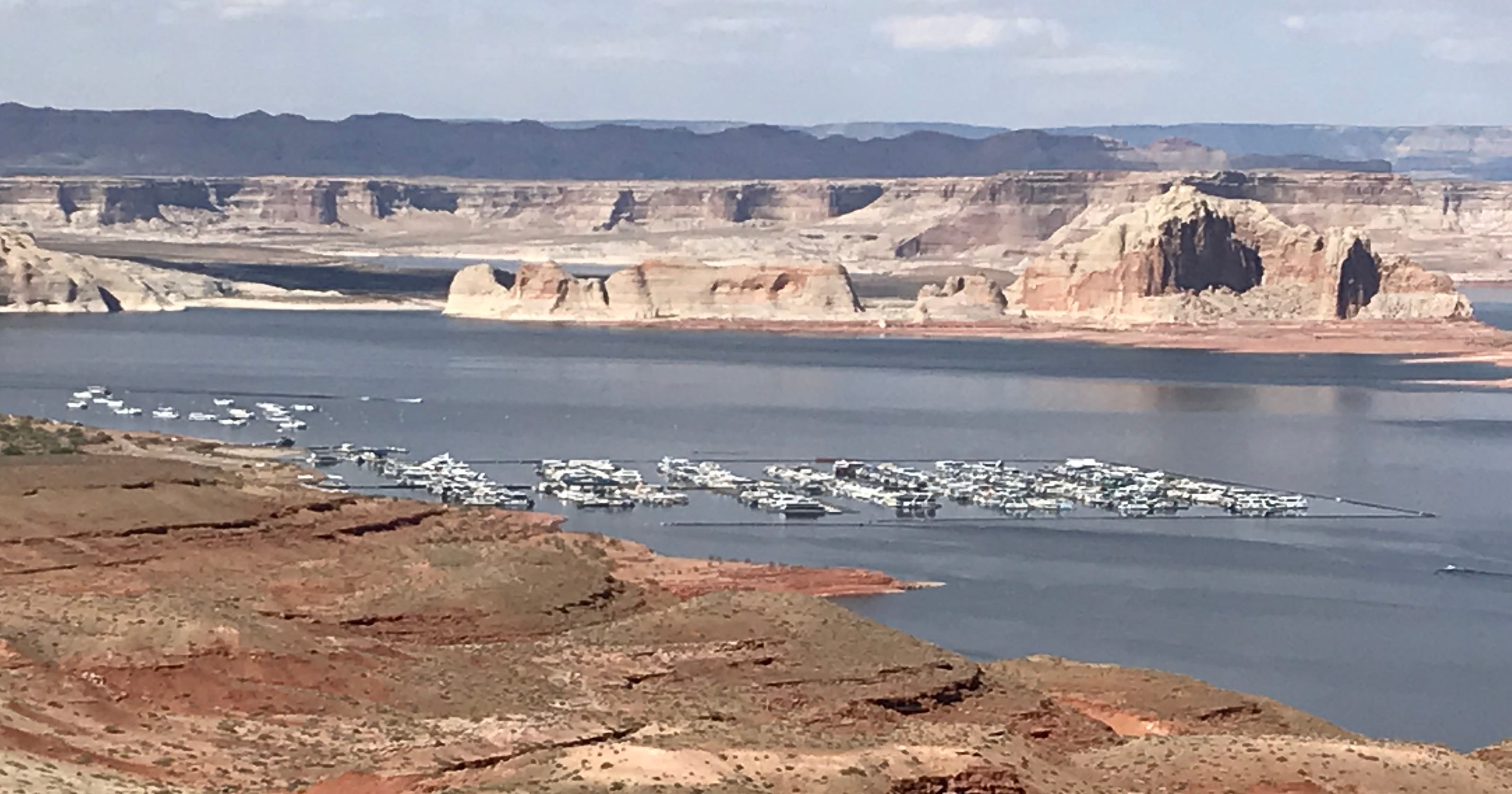
But in a new report, scientists say the situation is just as worrisome upstream at Lake Powell.
The declines there during the past 18 years, they say, also reflect the Colorado River’s worsening “structural deficit.”
The 10 scientists, who make up the Colorado River Research Group, said even though the four Upper Basin states — Colorado, New Mexico, Utah and Wyoming — haven’t been using all the water they’re legally entitled to, Lake Powell has declined due to extra water releases into Mead.
Those releases, they said, are “the only thing that has kept Lake Mead from dropping into shortage conditions.”
“I want people to know that what’s going on at Lake Mead is very, very closely tied to what’s going on Lake Powell,” said Doug Kenney, the group’s chair and a professor at the University of Colorado. “We’re draining Lake Powell to prop it up.”
The scientists titled their report “It’s Hard to Fill a Bathtub When the Drain is Wide Open.”
Lake Powell now sits 48 percent full, and Lake Mead is 38 percent full.
The Colorado River basin, which stretches from Wyoming to Mexico, has been drying out during what scientists say is one of the driest 19-year periods in the past 1,200 years. The river has long been over-allocated, with the demands of farms and cities exceeding the available water supply, and the strains are being compounded by growing population, drought and climate change.
The scientists, who say their group presents an “independent, scientific voice for the future of the Colorado River,” detailed how much Lake Powell has gone down in less than two decades. By the end of this year, Powell’s levels are projected to have dropped 94 feet below where the reservoir stood in 2000, when it was nearly full.
The U.S. Bureau of Reclamation operates Glen Canyon Dam and manages the releases from one reservoir to the other.
“Continuing this operational pattern will further drain Lake Powell and erode the benefits associated with its water storage,” the researchers said in the report. “If storage in Lake Powell cannot rebound in an era where the Upper Basin consumes less than two‐thirds of its legal apportionment, then the crisis is already real.”
The Colorado River and its tributaries provide water for about 40 million people and more than 5 million acres of farmland from Wyoming to California.
The legal framework that divides the Colorado River among seven states and Mexico was established during much wetter times nearly a century ago, starting with the 1922 Colorado River Compact. That and subsequent agreements have allocated more water than what flows in the river in an average year, leading to chronic overuse.
For decades, so much water has been diverted from dams all along the Colorado that the river seldom meets the sea. The river’s delta in Mexico has become a dusty stretch of desert.
The river is managed under a system that firmly delineates between the Upper Basin and the Lower Basin, with the dividing line running through Lees Ferry in northern Arizona.
The treaties that originally divided the river allocated 7.5 million acre-feet of water per year for the four Upper Basin states; 7.5 million acre-feet for the Lower Basin states of Nevada, Arizona and California; and 1.5 million acre-feet for Mexico.
John Fleck, director of the water resources program at the University of New Mexico, recently pointed out in a blog post that the Lower Basin has gotten more water than it is entitled to under the compact — 9.7 million acre-feet of “bonus water” since 2000 — yet Lake Mead is still dropping.
The scientists suggested that Lake Powell could bounce back better in wet years if “new operational rules” are developed.
CLOSE
The snow that falls in the Rocky Mountains provides the majority of the water for the Colorado River. But with warming temperatures, drought and increased dust settling on the snowpack, that water source is diminishing. (David Wallace/The Republic)
“Better options might be found by thinking outside of this familiar framework. Lakes Mead and Powell, after all, are essentially one giant reservoir,” the group said. “Managing — and thinking — of these facilities as two distinct reservoirs, one for the benefit of the Upper Basin and one for the Lower, now seems outdated.”
Under the current rules, if Lake Mead’s water level reaches elevation 1,075 feet above sea level at the end of any year, the federal government will declare a shortage and supplies to Arizona and Nevada will be cut back.
Representatives of Arizona, California and Nevada have been discussing a proposed drought-contingency plan under which each state would take less water from Lake Mead to keep it from falling to even lower levels, which would mean even deeper cuts. The four Upper Basin states have been working separately on a regional drought plan.
The combined amount of water in the two reservoirs has been much smaller since the mid-2000s than in the previous two decades. While the reservoirs’ levels have retreated, heavy pumping of groundwater has also led to declining aquifers in parts of the river basin.
Scientists have found that higher temperatures have contributed significantly to reductions in the river’s flow since 2000. They call it a “temperature-dominated drought.” In one recent study, scientists projected that warming will likely cause the river’s flow to decrease by 35 percent or more this century.
The research group said viewing the river’s serious supply-demand mismatch as a problem of the Lower Basin states is too simplistic.
They acknowledged that many stakeholders aren’t interested in tinkering with the law or administration of the river, but they suggested “it might be worthwhile to think about what could be achieved in terms of water security, Grand Canyon (and perhaps Glen Canyon) restoration, and other objectives if we allowed ourselves more flexibility in managing (and perhaps modifying) the massive infrastructure investments already in place.”
“Long‐term, we may have no choice to consider reform on this scale,” they said.
Some conservationists have long proposed draining Lake Powell and making Lake Mead the primary reservoir.
Jack Schmidt, a professor at Utah State University and one of the group’s 10 members, has studied the so-called “Fill Mead First” proposal, which would involve initially lowering Powell to a minimum level at which Glen Canyon Dam would still generate hydroelectricity, and then in later phases draining the reservoir further and eventually drilling new water tunnels around the dam.
Under the proposal, Lake Powell would become a secondary reservoir to be used only when Mead is full. Lowering the reservoir would reveal the sandstone walls of Glen Canyon and gradually restore a natural river ecosystem in the canyon. Water managers, however, have generally dismissed the idea as unworkable.
In a 2016 study of the proposal, Schmidt said there was insufficient data and recommended gathering more data on the losses to evaporation from Powell. After his study was published, the Bureau of Reclamation began a program to measure how much water is lost to evaporation from Lake Powell.
“I take the position that it does not matter whether water is stored in Powell or Mead,” said Schmidt, Utah State’s Janet Quinney Lawson chair in Colorado River studies. “We should store water in whatever way minimizes total system losses and maximizes environmental benefit to the Grand Canyon.”
Schmidt said Powell and Mead are together “effectively one reservoir” and should be managed as such. “We need to say, ‘How do we effectively operate the Mead/Powell reservoir?’”
The group of scientists noted in their report that negotiations on a drought-contingency plan are already pressing up against 2020, when officials are due to start renegotiating the guidelines for managing the reservoirs and dealing with shortages — which are now governed by a 2007 agreement.
“For many in the basin, the next generation of Guidelines are the place to adopt a comprehensive solution — a sustainable water budget,” the researchers wrote. “The new framework can potentially take many forms, but at a minimum, will need to recognize the linked future of the two basins, and the political necessity of addressing equity concerns among users, sectors, and regions.
“Admittedly, this is a tall order on a tight deadline, but the recent history of Lake Powell shows us that the status quo is untenable.”
Despite the concerns about the declining reservoirs, water agencies in the northern states have been pressing for controversial projects to draw out more water.
In Utah, water districts are proposing to build a 140-mile pipeline to carry water from Lake Powell to growing communities around St. George.
In Colorado, Denver Water is proposing to expand Gross Reservoir. Conservation groups oppose the project and notified the U.S. Fish and Wildlife Service last week that they plan to sue, saying the enlarged dam would harm trout and violate the Endangered Species Act.
The groups said filling the bigger dam would mean diverting more water out of small streams in the Colorado River basin that are home to threatened green-lineage cutthroat trout. They said the federal agency failed to properly analyze the effects of the project and that drawing out the water from the streams could kill thousands of fish.
The groups include Save The Colorado, the Environmental Group, WildEarth Guardians, Waterkeeper Alliance, Living Rivers and the Sierra Club. They notified the Fish and Wildlife Service, the Interior Department, the Army Corps of Engineers and Denver Water that they intend to sue if the agencies don’t act within 60 days.
The environmental groups said if the project goes ahead as proposed, it will further drain the Colorado River.
Jen Pelz of WildEarth Guardians said in a statement: “People don’t love Colorado for our green lawns, but rather our majestic mountains, native trout, and the reinvigorating experiences our wild landscapes and rivers provide.”
CLOSE
Salt River Project announced in June that water use among its users has decreased by one-third since 1980, even though Arizona’s population has doubled since then. Wochit
She said the project would mean “squandering the heritage of our namesake river.”
Steve Segin, a spokesperson for the Fish and Wildlife Service, said the agency can’t comment on the pending litigation.
Jim Lochhead, Denver Water’s CEO and manager, said expanding the Gross Reservoir “will make Colorado’s rivers and environment better off in the future.
“Delaying this project actually delays environmental benefits, including 1,000 acre-feet of water for rivers and streams in Grand County and an environmental pool with 5,000 acre-feet of water for South Boulder Creek,” Lochhead said in an emailed statement.
He said Denver Water is providing more than $20 million as part of water management efforts “that will result in myriad stream health and habitat improvements.”
“We’re proud that this project will help us achieve our goals of providing a secure water supply for our customers in the most environmentally sustainable way possible,” Lochhead said.
Environmental coverage on azcentral.com and in The Arizona Republic is supported by a grant from the Nina Mason Pulliam Charitable Trust. Follow the azcentral and Arizona Republic environmental reporting team at OurGrandAZ on Facebook, Twitter and Instagram.
Andy Murray (second from right) helped Great Britain win the Davis Cup in 2015
Davis Cup World Group play-off
Venue: Emirates Arena, Glasgow Dates: 14-16 September Coverage: Live text commentaries on the BBC Sport website
Andy Murray will not make his Davis Cup return in Great Britain’s tie against Uzbekistan in Glasgow later this month.
Three-time Grand Slam champion Murray, 31, will instead continue his rehabilitation following hip surgery.
“I’m sure it was a difficult decision for Andy but I’m absolutely sure it is the right decision,” said GB captain Leon Smith.
Kyle Edmund, the British number one, also misses out but Dan Evans, Cameron Norrie and Jay Clarke are included.
Jamie Murray and Dom Inglot, specialist doubles players, have also been picked for the World Group play-off tie which starts on 14 September.
For Evans, it is a first return to the Davis Cup team since he was banned for a year in April 2017 after testing positive for cocaine.
“There’s still a lot of quality in the team,” Smith said.
A first-round loss to Spain in February means GB are featuring in the play-offs for the first time since joining the top-level World Group in 2014.
The format of the tournament is changing next year – it is turning into a season-ending 18-team even – so this tie will no longer determine a relegation.
‘Right decision’ for Murray and Edmund
Davis Cup: Great Britain beaten by Spain despite Cameron Norrie effort
Former world number one Murray helped his nation win the Davis Cup for the first time in 79 years when they beat Belgium in 2015.
The Scot has not played in the competition since Britain suffered a semi-final defeat by Argentina in September 2016, missing three matches since through a combination of fatigue and injuries.
After his Grand Slam comeback was ended at the US Open, Murray said he would “love” to make what could have been his last competitive appearance in Scotland.
But he has decided his best long-term option is to continue with rehab work away from the court.
“Everyone agreed in the short term that he should continue the very good rehab work which had put him in the really good situation of being able to compete again,” Smith told BBC Radio 5 live.
“If he played Davis Cup then it would take a week of that away.”
Edmund, meanwhile, has endured a tough year physically, suffering with illness and sickness which has limited his training.
The 23-year-old Yorkshireman, ranked 16th in the world, was hampered by cramp on his way to a first-round defeat by unseeded Italian veteran Paolo Lorenzi at the US Open last week.
“Kyle is not in the physical condition he wants to be in,” Smith added.
“His body is deconditioned and it’s the right decision for him too.”
The inclusion of Evans is recognition of the work the 28-year-old has put in since returning from his ban in April this year to climb up the rankings to 224 in the world.
“History is in the past,” said Smith. “He’s playing well. It’s astonishing how quickly he’s moved up the rankings.
“He’s got good Davis Cup experience and indoor is a good surface for him so I don’t have any reservations about him at all.”
Analysis
BBC tennis correspondent Russell Fuller
Britain will compete at the elite level of the reformed Davis Cup next year, whatever the result of this tie: and they remain strong favourites as Uzbekistan have only one player – world number 76 Denis Istomin – in the world’s top 400.
The outcome will, though, have a bearing on next year’s competition, as GB must win in Glasgow to be seeded in February’s preliminary round.
As Andy Murray told BBC Sport last week, there was “a big part” of him that wanted to play in Scotland – possibly for the last time, given the change in the Davis Cup format. But after discussions with his team, he has decided he needs to prioritise his continuing rehabilitation ahead of a trip to China.
Kyle Edmund is in a similar position. He needs to build up his fitness after recurring bouts of tonsillitis, and is expected to have some medical checks, and train in the UK next week. It will be interesting to see whether he then feels ready to represent Europe in the Laver Cup in Chicago the following week.
While the magazine’s editor, David Remnick, defended the idea of interviewing Bannon at length, he said in a statement Monday, “I’ve thought this through and talked to colleagues — and I’ve reconsidered. I’ve changed my mind. There is a better way to do this. Our writers have interviewed Steve Bannon for The New Yorker before, and if the opportunity presents itself I’ll interview him in a more traditionally journalistic setting as we first discussed, and not on stage.”
Remnick laid out his reasoning for making Bannon a headliner throughout the memo, arguing that “to interview Bannon is not to endorse him,” and that “by conducting an interview with one of Trumpism’s leading creators and organizers, we are hardly pulling him out of obscurity.”
Remnick changed course only after “many of our readers, including some colleagues” pointed out that “the Festival is different, a different kind of forum” than a traditional interview. “It’s also true that we pay an honorarium, that we pay for travel and lodging. (Which does not happen, of course, when we interview someone for an article or for the radio.),” he added. “I don’t want well-meaning readers and staff members to think that I’ve ignored their concerns.”
Remnick’s statement, which was first sent to staffers and then published online, came shortly after some of the festival’s high-profile panelists began to drop out. Mulaney was first to pull the plug, tweeting, “I’m out.” He added, “I genuinely support public intellectual debate, and have paid to see people speak with whom I strongly disagree. But this isn’t James Baldwin vs William F Buckley. This is PT Barnum level horses—. And it was announced on a weekend just before tix went on sale.”
Apatow dropped out next, writing, “If Steve Bannon is at the New Yorker festival I am out. I will not take part in an event that normalizes hate. I hope the @NewYorker will do the right thing and cancel the Steve Bannon event. Maybe they should read their own reporting about his ideology.”
Carrey then confirmed his own exit with, “Bannon? And me? On the same program? Could never happen.” And musician Jack Antonoff wrote, “I’m no longer going to be speaking/performing at the new yorker festival as long as Steve Bannon is there.”
Bannon, a former senior adviser to the president, had been scheduled to sit down with Remnick for a conversation dubbed “The Ideology of Trumpism.”
In further tweets, Antonoff echoed Mulaney’s complaint about Bannon’s last-minute addition. “Found out about Bannon’s inclusion when you did. I would have appreciated to make a decision on this before it was announced. I would ask the New Yorker to consider in the future that participants in the festival deserve to make a choice to appear alongside someone this hateful.”
He added, “I always saw The New Yorker Festival as a wonderful moment to celebrate culture. So when they told me it would Kacey Musgraves, Zadie Smith and Mike Birbiglia etc — I was all in. Steve Bannon — respectfully that’s a full no for me and normalization of white supremacy.”
Apatow later reacted to Carrey’s resignation, writing, “Sounds like @JimCarrey is out too. Maybe they could do an event about child separation and immigration policy and ways to help those poor children.”
After Remnick changed his mind, Apatow celebrated, tweeting, “That is very good news. There is no reason to have a hateful person at this festival. Thank you @NewYorker for listening and making an adjustment.”
The New Yorker’s handling of the controversy has also been criticized. “Either way, huge win for Bannon. Once invited, he’d get either attention and legitimization OR attention and claim to victimization. I’d guess he’d prefer the latter, which is what he now has been gifted,” Turkish writer Zeynep Tufekci tweeted.
Apatow responded to one critic who wrote, “The more I sit with this, the more troubled I am. This is such an important dialogue, one that needs to happen. It’s really upsetting to see so-called ‘progressive’ voices using their platforms to lobby for censorship. You’re way off on this one, Judd.”
The producer replied, “He was on @msnbc a few weeks ago. Go watch it online if you are hungering for Steve Bannon’s POV.” He wrote to another detractor, “You don’t understand Bannon’s perspective by now? This guy hasn’t shut up for a decade. There’s almost nobody who needs the press less. That festival is a celebration. We love it. No one wants to share it with someone who joyfully destroys people’s lives. I’m glad he’s off it.”
The body of a California woman who was among four people missing after two boats crashed on the Colorado River was found Monday, leaving rescuers searching for two other women and a man. They are presumed dead.
The deceased boater, found around 7:30 a.m., was identified as Christine Lewis, 51, a nurse at Kaweah Delta Medical Center in Visalia, California. The Mohave County Sheriff’s Office said she was located downstream of Topock, Arizona, near the California border.
Nine people were injured, two of them critically, when the recreational boats collided head-on and sank around twilight Saturday between Pirates Cove and Topock Marina near Moabi Regional Park.
All 16 passengers, 10 on one boat and six on the other, were either thrown or jumped into the rushing river, which was crowded with holiday weekend boaters. Each of the boats that crashed had a mix of family and friends from out of the area, some of whom were rescued by passing boaters.
Sheriff’s Office spokeswoman Anita Mortensen said Monday that investigators had yet to determine what role speed might have played in the accident.
“We haven’t come up with anything on contributing factors yet,” she said. “Once (the missing) are located, then we can continue pursuing that information.”
Citing an emergency dispatcher whose report was broadcast on local TV stations, the Los Angeles Times reported the boats were traveling at around 50 mph when they collided.
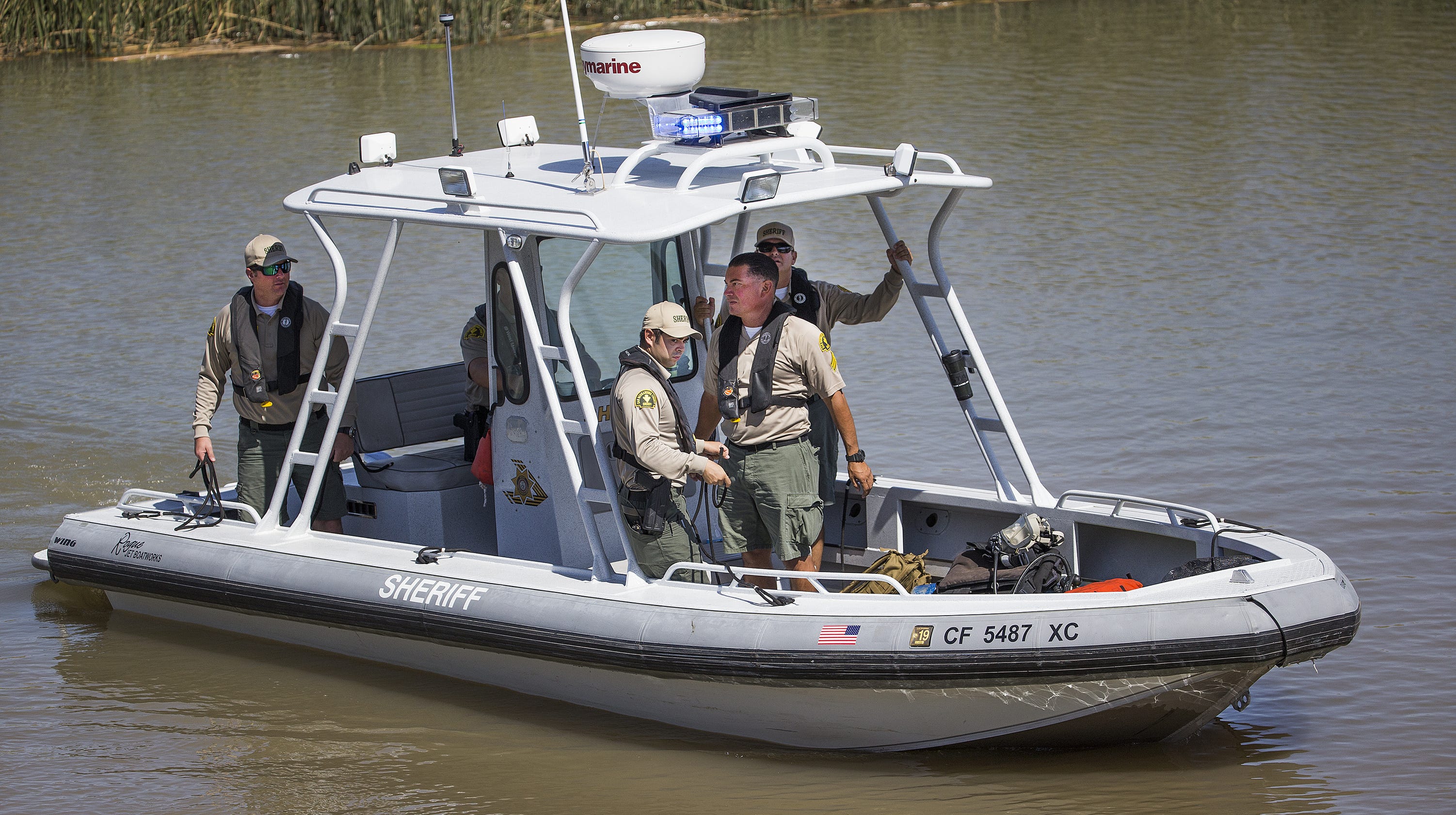
More than 60 crew members from Arizona and California resumed their search on boats at sunrise Monday, tracking their progress with a computer program that mapped the riverbed. They headed out again after lunch and planned to continue their pursuit until it grew dark.
Two helicopters searched by air, and divers were sent out into the river’s waters, which can range from shallow to 30 feet deep.
No one on the boats was wearing a life vest, Mohave County Sheriff Doug Schuster said, adding that use of life vests is not mandatory but is recommended.
The sheriff’s office said it would continue to patrol the river “until all the unaccounted for passengers are located.”
Contributing: The Arizona Republic, The Associated Press.
The family of California police officer Jesse Whitten recently welcomed an adopted member: A baby girl who’s birth mother Whitten met while on the job.
The Santa Rosa Police Department announced the official adoption on Friday, saying that Whitten “opened his heart and his home to this baby” after the birth mother asked him for help.
That woman was homeless and struggling with drug addiction, the Press Democrat reports. Whitten had met the woman several times while on patrol.
The publication traces the relationship between Whitten and the birth mother: He had previously driven her to shelters and a detox centers; he had tried to get her into rehab.
Last year, Whitten’s wife Ashley met the birth mother and they began to from a bond, according to the Press Democrat. Eventually the birth mother showed the Whittens an ultrasound photograph of the unborn child.
While Whitten and his wife were attending a Valentine’s Day party, they received a call with a request from the birth mother: She asked them to adopt her child, Local CBS affiliate KPIX 5 reports.
Ferrari won eight F1 constructors’ championships during Di Montezemolo’s time in charge
Former Ferrari president Luca di Montezemolo says he was “disgusted” by fans who booed Lewis Hamilton after Sunday’s Italian Grand Prix.
Di Montezemolo, who ran Ferrari for 23 years from 1991-2014, said jeering and whistling at the Mercedes driver after his win was “a big mistake”.
“Lewis is a fantastic champion, has always been very correct, and he made a fantastic race. Full stop,” he added.
“What happened was very, very bad and I am really upset.”
Hamilton shrugged off the boos, saying he had “harnessed it and turn it from negative to positive”.
Di Montezemolo, who was speaking to BBC Sport in an exclusive interview at his office in Rome, added that any criticism from Ferrari fans about Mercedes’ decision to use Valtteri Bottas to slow Ferrari’s Kimi Raikkonen for a few laps to aid Hamilton was misguided.
Ferrari had employed similar tactics many times in the past, he said.
“I can tell you we won a few championships [this way] when I was the chairman and CEO – with Kimi and Felipe Massa, with Rubens Barrichello and Michael Schumacher, with Michael and Eddie Irvine,” he said.
“So this is part of the history. And Bottas did not make anything incorrect or a foul. He made his race.
“When I have heard somebody make criticism… This is normal. In life it is difficult to win, but it is more difficult to accept when you don’t win. So, yesterday I was not happy for what I have seen, from the public.
“Mercedes made its job. If I was in charge of Ferrari in the same condition as Mercedes, I would make exactly the same choice. So, finito.”
Montezemolo rebuilt Ferrari from one of its lowest ebbs in the early 1990s and oversaw the dominant Michael Schumacher era of the early 2000s, as well as the team’s last world title with Raikkonen in 2007, and Fernando Alonso’s two near-misses in 2010 and 2012.
The 70-year-old said that he felt it was time for Ferrari to clear up the confusion over which driver will partner Sebastian Vettel in the team next year.
The seat is between Raikkonen and Sauber’s Charles Leclerc, and Ferrari’s new chief executive officer, Louis Carey Camilleri, said at the Italian Grand Prix that no decision had been made.
“When I was in Ferrari, I did not like to have people from the grandstand tell me what to do, so I don’t want to do the same,” Di Montezemolo said.
“But what I can say is that, in my opinion, at a certain point of the season – traditionally it was Monza – it is good to announce… who [will drive next year] because it is possible to avoid psychological attitude of the drivers.”
BBC’s Great British Bake-Off is no more. The show (known as The Great British Baking Show on this side of the Atlantic) has moved to the private station Channel 4 in England and with the transfer, there’s been a major, heartbreaking exit of talent. Gone are Mel and Sue with their innuendo and perfect blazers, and Mary Berry with her high standards and predilection for bakers who use slightly too much alcohol.
With the exception of Paul Hollywood (the only of the original GBBO fab four to stick with the program), the once comfortingly familiar tent is now filled with strangers — new hosts Noel Fielding and Sandi Toksvig, and new judge Prue Leith.
It’s a Twilight Zone version of Baking Show where the tent is the same, and the catchphrases are identical, but the people saying them are unfamiliar. It’s a strange juxtaposition, especially when Paul always came across (at least to me) as the least likable member of the original group. The type of guy who wears too much hair gel and seems like he drives a red sports car (and that was before I saw the photo of him dressed as a Nazi for a costume party in 2003, for which he’s recently apologized).
His remaining with the Great British Baking Show while the other cast members remained loyal to the BBC had a whiff of opportunism.
But now, Paul is the beautiful, blue-eyed lifeline to the old iteration of the show. His familiar face is the bridge that keeps season 8 of The Great British Baking from feeling like it’s entirely through the looking glass.
Fielding and Toksvig are obviously attempting to create a similar feel to the performances of Mel Giedroyc and Sue Perkins: Like Mel and Sue, the new duo opens the show with a cheesy, groan-worthy sketch, and sprinkle the episode with as much innuendo as possible. At times, the effort seems a little self-conscious, as if Sandi knows baking-related innuendo is a necessary part of the job and not her natural sense of humor. “Cheekily, do not worry about leaving a bare bottom,” she said, referring to iced Swiss rolls. Somehow, calling out the line as cheeky in advance negates the cheekiness. Mel and Sue operated their innuendo with a literal or metaphorical eyebrow raise that made their lines feel improvised. For now, Sandi remains a little stiff, and her chemistry with Noel — let’s just say Paul Hollywood might call it under-proved.
Noel, however, is delightful in his own right, able to bring a zaniness that feels like something unique to him and not an imitation of Mel and Sue’s way of behaving. His interactions with the contestants are a bright spot that gives me hope for his future as a host.
As for Prue, well… Prue isn’t Mary Berry. Mary took on a near-mythic persona in her role as the all-knowing matriarch of the tent. In the vein of Ina Garten, Mary Berry has ascended to pop culture icon, the meme-able grandmother we all wish we had. Most importantly, it felt as though she had an unspoken superiority over Paul Hollywood. Her partnership with Paul elevated him beyond the sometimes seemingly overconfident schoolboy who takes bread way too seriously. Their dynamic worked. Now, with Prue, Paul is unquestionably the senior member of the pairing. His handshakes are the coveted reward for a miraculously good bake. There is no icon to impress, even as the show itself necessitates forcing Paul into that role.
In Prue’s first one-on-one introduction for the camera, she mentioned that a cake had to be “worth the calories.” That moment alone, just a few minutes into the season 8 premiere, put a bad taste in my mouth. The Great British Bake Off isn’t about calories; the tent creates a magical world where baking is a pure and friendly thing. All that matters is that something looks good and that it tastes good, and the ultimate purpose of baked goods are to make people happy. Referencing calories breaks the fantasy, ripping the viewer out of the mythical English countryside — where we’d live in a cottage like Kate Winslet in The Holiday and wear galoshes and have a fireplace and drink tea — and drops us right back onto our couches where we’ve been watching Netflix for the past four hours and really need to go to the gym. Prue broke the spell of the Great British Bake Off first by not being Mary Berry, and next by reminding us that cake is a tangible thing, not just a symbol.
But for all of the cast’s shakeups, the show itself is still almost exactly the same. There’s still the signature bake and the technical challenge, and someone always screwing up on the technical challenge, and the improbably beautiful showstoppers. The tent is still bunted with the Union Jack, and the cast is still students and architects and scientists and grandmothers who just love to bake. This show is still delicious, calming comfort food, Xanax in television form, and an escape from a world with much bigger problems than pies with soggy bottoms. Change is always frustrating and scary, especially when that change comes to the one thing that’s supposed to be an institution, the thing that’s never supposed to change. But even on a new network, even with new hosts, even without Mary Berry, this is still the Great British Bake Off.
New Yorker editor David Remnick told the Associated Press in a statement Monday that should he interview Bannon in the future, it would be in “a more traditionally journalistic setting, and not on stage.”
Donald Trump’s former chief strategist was supposed to be a featured guest during the prestigious gathering, which over the years has drawn some of the world’s most prominent artists and public figures. This year’s guests include Emily Blunt, Miguel, Kacey Musgraves, Zadie Smith and Sally Yates, who Trump fired as deputy attorney general after she refused to back his ban on travelers from Muslim countries.
“I’ve re-considered,” Remnick said in his statement. “There is a better way to do this,” noting that Bannon has been interviewed for The New Yorker before by its journalists.
“It’s obvious that no matter how tough the questioning, Bannon is not going to burst into tears and change his view of the world. He believes he is right and that his ideological opponents are mere ‘snowflakes.’ The question is whether an interview has value … to a reader or an audience.”
The announcement of Bannon’s participation was made earlier Monday and quickly denounced. Filmmaker Judd Apatow and comedians Jimmy Fallon, Jim Carrey and Patton Oswalt, among others, tweeted that they would not attend if Bannon was interviewed.
“If Steve Bannon is at the New Yorker festival I am out,” Apatow wrote. “I will not take part in an event that normalizes hate. … Maybe they should read their own reporting about his ideology.”
If Steve Bannon is at the New Yorker festival I am out. I will not take part in an event that normalizes hate. I hope the @NewYorker will do the right thing and cancel the Steve Bannon event. Maybe they should read their own reporting about his ideology.







 trustedenews