Kaepernick led the San Francisco 49ers to the 2013 Super Bowl
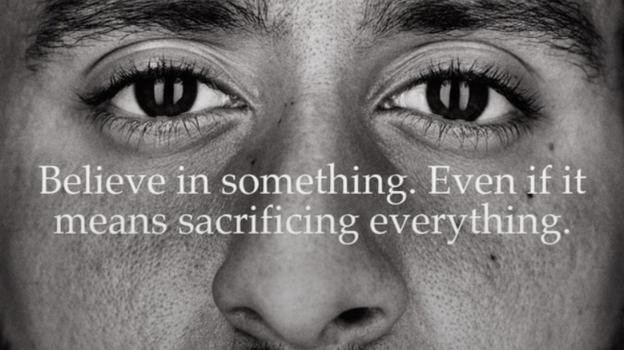
Colin Kaepernick, the quarterback who protested against racial injustice and police brutality by kneeling during the US national anthem, is the face of a new Nike advertising campaign.
Kaepernick, 30, first protested by sitting during the national anthem in August 2016, later opting to kneel.
Other players followed suit, leading to criticism from President Donald Trump.
Nike described him as “one of the most inspirational athletes of this generation”.
Gino Fisanotti, Nike’s vice-president of brand for North America, told ESPN: “He has leveraged the power of sport to help move the world forward.”
Kaepernick, who has received Amnesty International’s highest honour, has been without a team since he opted out of his contract with the San Francisco 49ers in March 2017.
He has filed a grievance against NFL team owners he claims conspired not to hire him because of his protests, and on Thursday it was ruled that case can go to trial.
Nike’s new advertising campaign, celebrating the 30th anniversary of its ‘Just Do It’ slogan, also includes ads featuring tennis star Serena Williams, New York Giants wide receiver Odell Beckham Jr and Seattle Seahawks rookie linebacker Shaquem Griffin.
Britain’s Labour Party is set to vote on the internationally-recognised definitions of anti-Semitism, following a protracted debate that has dogged the party and sparked criticism of the country’s main opposition leader, Jeremy Corbyn.
The vote on Tuesday by Labour’s ruling National Executive Committee (NEC) is seen as a bid to resolve a controversy, which Corbyn supporters said was stirred up by his enemies within and outside of the party to discredit the politician, who is a strong advocate of a Palestinian state.
Ahead of the vote, former Prime Minister Gordon Brown, who served between June 2007 and May 2010, said the issue touched at “the soul of the Labour Party”, and must be dealt with at once.
On Thursday, veteran Labour member Frank Field, who has been in the House of Commons for almost 40 years, announced his resignation in protest of Corbyn’s leadership on the issue.
Corbyn has repeatedly stated that anti-Semitism has no place in the party and the movement.
UK Labour Party dogged by anti-Semitism claims
Al Jazeera’s Laurence Lee, reporting from London, said there has been a long-running split in the Labour Party over the Israeli-Palestinian conflict, with one wing supportive of the Palestinian struggle and another wing supporting Israel.
“But never before has that split come to the surface like this, because never before has there been a Labour Party leader so obviously pro-Palestinian,” he said.
“At a time when the ruling Conservative Party is in a hole over Brexit, Labour is tearing itself apart,” Lee added.
What is the controversy?
The definition of anti-Semitism was set by the International Holocaust Remembrance Alliance (IHRA), which also cited 11 specific examples of racial abuse in public, the media, educational institutions, the workplace and the religious sphere.
“Manifestations might include the targeting of the state of Israel, conceived as a Jewish collectivity.
“However, criticism of Israel similar to that leveled against any other country cannot be regarded as anti-Semitic,” the alliance said.
Jeremy Corbyn apologises for ‘hurt’ caused to Jewish community
– Accusing Jewish citizens of being more loyal to Israel, or to the alleged priorities of Jews worldwide, than to the interests of their own nations.
– Denying the Jewish people their right to self-determination, e.g., by claiming that the existence of a State of Israel is a racist endeavor.
– Applying double standards by requiring of it a behaviour not expected or demanded of any other democratic nation.
– Drawing comparisons of contemporary Israeli policy to that of the Nazis.
What is being done to resolve debate?
The Labour leadership has argued the definition, signed by 31 countries and used by many British institutions, does not allow for criticism of Israel’s treatment of Palestinians.
In an August 3 article for The Guardian, Corbyn wrote that anti-Semitism had no place in the party, but added:
“It is unfortunately the case that this particular example, dealing with Israel and racism, has sometimes been used by those wanting to restrict criticism of Israel that is not anti-Semitic”.
Tuesday’s “compromise plan” is expected to seek to safeguard the rights of members who want to criticise Israel’s treatment of the Palestinians.
However, there are also talks of parliament members walking out if Corbyn does not accept the compromise plan.
Past controversies
Corbyn has acknowledged that in the past, the party was “too slow” to process disciplinary cases over anti-Semitic abuse by party members.
His critics have also questioned Corbyn’s reported hosting of a Holocaust survivor, who compared Israel to Nazism in 2010. Corbyn has apologised for that incident.
Anti-Semitism, anti-Zionism and Israel’s leaders
Corbyn is also accused of appearing during a 2014 ceremony in Tunis, honouring a perpetrator of the 1972 Munich attack that killed 11 Israeli Olympic team members.
Corbyn defended that incident saying he attended the event as part of wider event focused on peace.
Paul Sweeney, a Labour member of parliament and Shadow Scotland Officer Minister, said he has never personally encountered anti-Semitism in the Labour Party.
He said the accusation is being used as a “political weapon” against Corbyn.
Mike Cushman of the Jewish Voice for Labour has said that while the Labour Party is not free of anti-Semites, it is not the main problem confronting the party.
Cushman also said that the main issue is that supporters of Israel “don’t want people in the Labour Party, or anywhere else to talk about Palestinian rights.”
There is also a wing in the Labour Party, who have not reconciled themselves with Corbyn’s leadership, and they want him out, Cushman added.
Al Jazeera’s Lee said suggestions that a veteran anti-racist politician like Corbyn may have a problem in confronting the issue “carries significant electoral risk” for the party.
“Labour remains a party, whose membership love the leader, but whose politicians are deeply divided on him.”
Two more gold-medal winning Olympic gymnasts have come forward to claim they were sexually abused by convicted pedophile Larry Nassar. USA TODAY Sports
Kerry Perry, whose nine-month tenure as USA Gymnastics CEO was marked by heavy criticism and little tangible action in helping the organization recover from the Larry Nassar scandal, has resigned under pressure.
Her resignation, confirmed to USA TODAY Sports by two people with knowledge of the decision, will come Tuesday. It was first reported by the Orange County Register. The two people spoke on the condition of anonymity because of the sensitivity of the matter.
Perry’s departure was seen as inevitable after new U.S. Olympic Committee CEO Sarah Hirshland told USA TODAY Sports on Friday night that it was “time to consider making adjustments in the leadership.” Hirshland’s statement followed a tumultuous week in which USA Gymnastics hired a coach, who had supported Nassar after he’d been indicted, to be the developmental coordinator. USA Gymnastics was ultimately forced to backtrack after the move was strongly denounced by survivors, including Olympic gold medalist Aly Raisman.
But the PR nightmare was just the latest for USA Gymnastics under Perry, whose inconsistency in personnel decisions, inability to articulate a clear vision for the future and low public profile caused chaos for an organization looking for bold leadership. USA Gymnastics has lost all of its key sponsors, and its national championships last month were held without a title sponsor, almost unheard of for one of the marquee Olympic sports in the United States.
“That’s a good question. I’m not so sure yet,” Olympic champion Simone Biles said at last month’s U.S. championships, when she was asked if she thought USA Gymnastics was moving in the right direction.
“Hopefully it’s going in the right direction, but nobody can know until Kerry Perry speaks up. So it’s kind of hard.”
Perry had no experience in gymnastics or the Olympic movement when she took over Dec. 1, tasked with reshaping an organization reeling from revelations that Nassar had sexually abused dozens of young women and girls under the guise of medical treatment. The longtime USA Gymnastics and Michigan State physician is serving an effective life sentence after pleading guilty to federal child pornography charges and state charges of sexual abuse.
Among the more than 350 women who said Nassar abused them are Biles, Raisman and fellow Olympic gold medalists McKayla Maroney, Gabby Douglas, Jordyn Wieber, Kyla Ross and Madison Kocian.
Previous CEO Steve Penny was forced to resign under pressure from the USOC in March 2017 for the way the organization handled sexual abuse complaints. A review of USA Gymnastics’ practices and policies by former federal prosecutor Deborah Daniels found that the governing body needed a “complete cultural change.”
The federation had not done enough to educate staff, members or athletes about protecting children from sexual abuse, Daniels found in her June 2017 report, and the perception was that USA Gymnastics put winning medals ahead of child protection.
Daniels made 70 recommendations, and USA Gymnastics’ then-board of directors adopted all of them unanimously. But almost 15 months later, only 47 percent have been fully implemented, with another 39 percent in progress and 8 percent ongoing.
Of the changes Perry touted that the organization had made, the most notable came at the direction of the USOC after searing testimony by survivors at Nassar’s sentencing hearings highlighted the failures of the organization. The entire board was ordered to resign by the USOC under threat of decertification, and the USOC also dictated what the new board should look like.
Perry has also cited USA Gymnastics’ decision to stop holding monthly training camps at the Karolyi ranch. But that was only done after Biles acknowledged she, too, was a survivor and said having to return to the ranch “breaks my heart even more.”
Perry did create an Athlete Task Force to give current and former athletes a stronger voice in the organization. But its members were not announced until mid-July, and it does not include a single Nassar survivor.
USA Gymnastics remains in mediation with dozens of women who have sued the organization, and it often used that as the reason for Kerry’s low profile. But her lack of interaction with survivors was taken as indifference, further proof that USA Gymnastics was only paying lip service to making substantive changes.
When asked why the federation wasn’t doing something to acknowledge the survivors or promote sexual abuse awareness at the national championships, Perry gave a long-winded response that didn’t address the question.
“In terms of recognition, I hope it’s clear, and we’re going to continue to communicate that it’s clear, that we are all of our athletes’ advocates. That we are here, USA Gymnastics exists, because of our athletes,” Perry said then.
That lack of substance was common from Perry. Though she preached transparency when she began the job, she made very few public statements. After her introductory conference call, she didn’t speak publicly again until May, and most releases during her tenure were “attributable to USA Gymnastics.’’ Whatever statements she did make were sprinkled with clichés and buzzwords like “empowerment” and “path forward.”
Perry fired the head of the women’s program, Rhonda Faehn, without explanation during a training camp, causing such upheaval among the gymnasts the rest of the camp had to be canceled. Yet she has kept on chief operating officer Ron Galimore, who The Indianapolis Star reported in May was part of a coordinated effort between USA Gymnastics and Nassar to provide cover stories for Nassar’s dismissal.
Her interactions with members of Congress were no more informative. Asked to explain USA Gymnastics’ decisions or responses to survivors, Perry would often plead ignorance, saying she had only started in December. When she said that after being asked about a response USA Gymnastics had given in a court filing, it was pointed out that the response had been made just a few days earlier.
Perry also was taken to task by Rep. Debbie Dingell, D-Mich., who said she owed it to everyone to be more open about the changes USA Gymnastics was making and how that was affecting the organization’s culture.
“Ms. Perry, I’m glad that you’re here today,” Dingell said, “but a lot of people have been wanting to hear from you since you took the job. You’ve got to be transparent with everybody.”
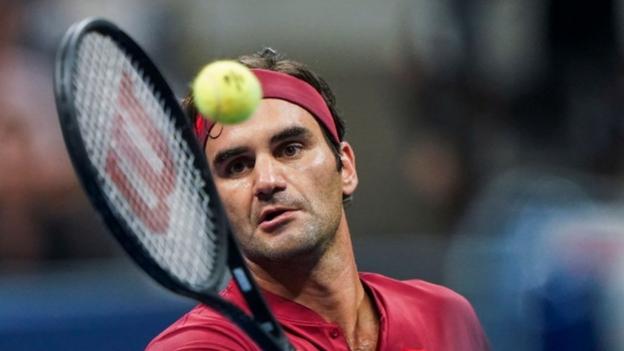
Roger Federer won the US Open title five times in a row between 2004 and 2008
2018 US Open
Venue: Flushing Meadows, New York Dates: 27 August-9 September Coverage: Live radio coverage on BBC Radio 5 live sports extra; live text commentaries on the BBC Sport website
Roger Federer has been knocked out of the US Open in the fourth round by world number 55 John Millman.
The 37-year-old Swiss had prioritised winning a sixth title at Flushing Meadows but was beaten 3-6 7-5 7-6 (9-7) 7-6 (7-3) in three hours 38 minutes.
It is the first time Federer has lost to a player ranked outside of the top 50 at the US Open.
Australian Millman will play two-time champion Novak Djokovic in his first Grand Slam quarter-final on Wednesday,
Second seed Federer, bidding for a record-extending 21st Grand Slam, missed set points in the second and third sets before capitulating in the fourth-set tie-break.
Millman, 29, had never beaten a top-10 player before but suddenly found himself with five match points against arguably the greatest male player of all-time.
After Federer rallied to save two of the them, Millman completed victory at almost 01:00 local time in New York when the out-of-sorts Swiss lumped a forehand long.
It was Federer’s first defeat in 41 matches at the US Open against a player ranked outside the top 50.
Warning signs were clear for Federer
After not dropping a set in his opening three matches, Federer looked on his way to another controlled victory when he eased the opener in 33 minutes.
However, the warning signs were clear from the start of the second set.
Federer’s reliable serve has been the bedrock of his game over the years but an uncharacteristically erratic display allowed Millman to fight back and earn a memorable win.
The world number two produced a contender for one of the ugliest service games of his career, unable to find his timing as he landed just six of his 24 first serves in a 14-minute second game.
He somehow managed to hold after fighting off seven break points, before breaking Millman’s serve himself to lead 3-2.
But, with his first serve percentage down at 31%, Federer still looked uncomfortable.
He blew two set points when serving at 5-4 and a double fault at break point gifted Millman the game and the Australian broke again as he won four games in a row to level the match.
Willed on by a supportive crowd on Arthur Ashe Stadium, Federer managed to steady his service game in a tight third set and missed a set point in the tie-breaker when Millman hit an outrageous 100mph second serve down the middle.
The Australian wasted one of his own with a long return as Federer battled to stay in the set, only to take his second chance and leave Federer facing an uphill task.
The founder of the Haqqani Network, one of Afghanistan’s most effective and feared armed groups, has died after a long illness, their affiliates the Afghan Taliban announced on Tuesday.
The Taliban statement said Jalaluddin Haqqani had been ill and bed-ridden for several years.
“If his excellency Haqqani Sahib has departed us physically, his ideology and methodology continue to endure,” it said.
Haqqani, who founded the network in the 1970s, relinquished operational leadership of the group some years ago to his son Sirajuddin Haqqani, who is now deputy leader of the Afghan Taliban.
Haqqani rose to prominence as a guerrilla leader in the US-backed campaign against Soviet forces occupying Afghanistan but later allied himself with the Taliban, fighting American troops after the Taliban were ousted in 2001.
His group became known for complex, well-organised attacks on both Afghan and US military as well as civilian targets and high-profile kidnappings.
US and Afghan officials have said the group, based in Pakistan’s North Waziristan region, operated with the support of Pakistani intelligence services. That charge is rejected by Pakistan, which has pointed to the network’s early links to the US Central Intelligence Agency.
With Sirajuddin Haqqani in operational charge, it was not immediately clear what direct impact Jalaluddin Haqqani’s death would have on the insurgent movement.
Tony Dungy gives his advice on a better way for NFL players to protest and his thoughts on whether Colin Kaepernick will play in the NFL again. USA TODAY Sports
Decades from now, when Americans look back at the NFL player protests and wonder how anyone could have seen them for anything but the plea for equality they are, Colin Kaepernick’s new Nike ad will be one the enduring images.
For two years now, the NFL and its owners have desperately tried to silence Kaepernick and the movement he began. They blackballed the former San Francisco 49ers quarterback and teammate Eric Reid. They threatened to fine or cut the players who joined them in protest. They created a ridiculous policy that only served to confuse matters more.
And for what? To go down on the wrong side of history? Because that’s how future generations will see it, as the Nike ad released Monday made clear.
“Believe in something,” the tagline reads. “Even if it means sacrificing everything.”
This is not some small, left-leaning company that has decided Kaepernick is on the side of angels in this fight. It is one of the world’s largest conglomerates, a setter of trends and arbiter of what’s cool.
And it is one of the NFL’s biggest partners, the official apparel company of the league.
For Nike to choose Kaepernick sends a message even Dallas Cowboys owner Jerry Jones cannot ignore. This is bigger than a hot-button issue in an election season, bigger than a segment of fans who choose to be angrier at the method of protest than the message behind it.
This is about America, and whether we actually honor the ideals we champion or simply pay lip service to those notions of liberty and justice for all.
MORE NFL:
While the NFL and its owners have been trying to contain the issue, Kaepernick and the other players have been playing the long game. The civil rights protests were wildly unpopular when they were occurring — go back and research the polls and opinions of the time — but are now viewed as righteous and essential to our ongoing struggle for equality. The NFL protests will be viewed much the same way through the lens of history.
Nike has recognized as much, betting a very large and prominent endorsement deal that Kaepernick will one day be seen much like Muhammad Ali. A rabble rouser who outraged the establishment in his heyday, Ali eventually became a widely admired and influential figure once society caught up.
Cynics will say this is simply a marketing ploy for Nike, a way to capitalize on an issue everyone is already talking about. Perhaps. But that doesn’t lessen the burden on the NFL.
Or the stakes.
The league can continue to dither, trying to appease everyone while pleasing no one, and be remembered as an organization that put expedience ahead of equality. Or it can be bold.
By signing Kaepernick — and I mean a team giving him a legitimate chance to compete, not hiding him on the depth chart as a No. 3 quarterback — the NFL can tell the entire country that fighting for a truly equal society is a fight worth having. That while it recognizes the passions the player protests have produced, there is nothing dishonorable about holding our country to account.
There will be some backlash, sure. Just as some folks angered by Nike’s stance will no doubt express their outrage with their wallets, refusing to buy shoes, shirts or anything else with a swoosh on it.
So be it.
Doing the right thing isn’t always easy, especially in the moment. But this moment, and who stood for what during it, will be remembered for generations to come.
It’s time to take a stand, NFL. Go ahead and do it.
Follow USA TODAY Sports’ Nancy Armour on Twitter @nrarmour.
If you love talking football, we have the perfect spot for you. Join our new Facebook Group, The Ruling Off the Field, to engage in friendly debate and conversation with fellow football fans and our NFL insiders.
The Associated Press
Published 11:29 a.m. ET Sept. 3, 2018 | Updated 11:14 p.m. ET Sept. 3, 2018
CLOSE
In his eulogy for Aretha Franklin, Rev. Jasper Williams Jr. of Salem Bible Church in Atlanta said it’s time to “turn Black America around.” USA TODAY
NEW YORK – The late Aretha Franklin’s family said Monday that it found an Atlanta pastor’s eulogy delivered Friday at the Queen of Soul’s funeral to be offensive and distasteful.
The eulogist, the Rev. Jasper Williams Jr., was criticized for a political address that described children being in a home without a father as “abortion after birth” and said black lives do not matter unless blacks stop killing each other.
“He spoke for 50 minutes and at no time did he properly eulogize her,” said Vaughn Franklin, the late singer’s nephew, who said he was delivering a statement for the family.
Franklin said that his aunt never asked Williams to eulogize her, since she didn’t talk about plans for her own funeral. The family selected Williams because he has spoken at other family memorials in the past, most prominently at the funeral for Franklin’s father, minister and civil rights activist C.L. Franklin, 34 years ago.
Williams hasn’t backed down from anything he said at the funeral, and said he respects the family’s opinion. “I understand it,” he said. “I regret it. But I’m sorry they feel that way.”
Besides a social media uproar, Williams heard resistance at the funeral itself. Singer Stevie Wonder yelled out, “Black lives matter!” after the pastor said, “No, black lives do not matter” during his eulogy.
Williams had minimized the Black Lives Matter movement because of black-on-black crime. “Black lives must not matter until black people start respecting black lives and stop killing ourselves.”
He also said that a black woman cannot raise a black boy to be a man. Some people suggested that was disrespectful of Aretha Franklin, a single mother of four boys.
His eulogy “caught the entire family off guard,” Vaughn Franklin said. The family had not discussed what Williams would say in advance.
“It has been very, very distasteful,” he said. He said it was unfortunate because everyone else who participated in the ceremony was very respectful.
Earlier in the weekend, Williams told the Associated Press that his sermon felt right, especially after other speakers spoke on the civil rights movement and President Donald Trump.
“I was trying to show that the movement now is moving and should move in a different direction,” he said by phone on Sunday. “What we need to do is create respect among ourselves. Aretha is the person with that song ‘R-E-S-P-E-C-T’ that is laid out for us and what we need to be as a race within ourselves. We need to show each other that. We need to show each other respect. That was the reason why I did it.”
Even though Williams spoke for nearly 50 minutes of the eight-hour funeral, the pastor said he didn’t have enough time to delve deep into his sermon. He said he will expound more on his sermon and how Franklin was originally named the “Queen of Soul” for the next two Sundays at his church.
“I think if she’s immortalized, she should be immortalized,” he said. “If we can turn black America around, it would be the greatest and best immortalization we could properly give to her for what she did for black America and the world when she lived.”
Warning: This story contains plot details from “Quite a Ride,” Monday’s episode of Better Call Saul.
It. Finally. Happened. The worlds of Better Call Saul and Breaking Bad collided on Monday night, and for a few brief minutes, we were introduced to — or rather reminded of — the slimy legal snake into which Jimmy McGill eventually will devolve.
The opening of “Quite a Ride,” the standout fifth episode of the fourth season of AMC’s Breaking Bad prequel, did not reveal the confluence of events that will prompt the big-dreaming, corner-cutting, currently suspended attorney to fully transform into Saul Goodman, but it gave us a fully realized Saul in a charged, crowd-pleasing scene. There was Saul Goodman (Bob Odenkirk), running around his Greek-columned office, frantically grabbing wads of cash and other essential belongings (the shoebox!) while annoyed assistant Francesca (Tina Parker) followed his orders and shredded documents, agreeing not to cooperate with the authorities. Saul then dialed the mysterious Cleaner, requesting an immediate pick-up. Yes, it was a scene ripped right from Breaking Bad — or rather, from the Breaking Bad era, somewhere between “Ozymandias” and “Granite State” — when the walls came crashing down on Walt’s (Bryan Cranston) criminal enterprise, and the meth king wound up briefly sharing a room with Saul in the Cleaner’s (Robert Forster) basement before being dispatched to New Hampshire, while Saul was bound for Nebraska.
Back in BCS times, a few years earlier: Gus (Giancarlo Esposito) took great pains and Mike (Jonathan Banks) took long car rides to find the perfect engineer to build the super lab; Kim (Rhea Seehorn) seemed to take a page from Jimmy’s book and self-sabotage her legal career by turning her back on Mesa Verde; and a track-suited Jimmy ran a crafty, illicit cellphone business out of the trunk of his car and rang up semi-mad stacks to the sounds of “Street Life” before a trio of hoodlums beat him up and stole his money. In the episode’s final scene, he updated his PPD officer on his employment/activities, telling him of his lofty plans to grandly return to the law after his suspension and make a name for himself as a damn good attorney. Based on everything you know in Breaking Bad — and what was certainly reinforced in this episode’s Saul flash-forward scene — Jimmy had quite a ride, but hardly the one he had imagined for himself.
Even though it’s not yet Nov. 12 at 3 p.m., let’s ring up the man who brings the hammer down to Chinatown — Bob Odenkirk — to reveal what it was like to skip ahead (slip ahead?) and become a shell of his former self once again.
ENTERTAINMENT WEEKLY: What was your immediate reaction when Peter [Gould, who created the show with Vince Gilligan] and Vince told you that you’d be playing Saul in a Breaking Bad-era scene that showed us the moment when it all came crashing down and he decided to flee? BOB ODENKIRK: I was thrilled. Part of me — it really comes from comedy — just really wants to make the audience happy. I was satisfied and pleased at the notion of playing Saul and being back in the office and giving everybody a moment of that character that they love so much and was so entertaining to people. To go there for a few minutes and be that guy and give them that flavor made me really, really happy. Plus, it’s fun to play him. The truth is it’s easier to play Saul than Jimmy. It’s not as rewarding. Jimmy is a rich character with so many angles — there’s so much complexity to the guy that it’s a more rewarding character. But Saul is kind of pure fun.
After playing Jimmy for so long, how did it feel to get back into Saul for that moment? Was it like, “Let me remember how to get in the mindset of this old — and different — character that I used to play”? For sure. Because Saul is pretty much a schemer and he doesn’t have the self-reflection, he’s shut off part of his brain that has self-awareness and thinks about the repercussions and his hopes and dreams. He’s dashed all those and hidden them away and he just looks to the easiest, quickest fix or profit that he can see. He’s simple to play, relative to Jimmy. And it’s a lot of fun. I don’t think a show where you’re just Saul all the time would be great fun to do. Because he’s burned a lot of himself down. Chuck [Michael McKean] burned his whole self down, and Jimmy is burning big parts of his psyche down.
Anything notable about shooting that scene in Saul’s office or just re-entering that world? The giddiness that people felt, the glee that people felt at seeing that office, everyone on set, all the crew were just ecstatic. I think it made everybody even more amazed at the story that Peter and Vince have told, having come out of that character, you know? Because the character was intriguing and fun, but he was not the most — there wasn’t a whole lot going on there. I mean, he’s just a schemer who talked fast and thought pretty fast. And outside of that, there wasn’t much else. And I think now that we know this guy, to go into that office and see him in that version of himself — such a thinned-out version of who he is inside — you can’t help but smile, because you know a secret that he doesn’t know. You know who he is, and you’re like, “Wow, dude. You really went down!” [Laughs.] “You really came way down on the scale of human value.”
Saul’s cutting through the Constitution to get the shoebox was a nice touch. He’s hiding behind the Constitution in a way. And that’s the box of mementos from his previous life that Gene kept as his place, right? Yes, you have seen that stuff. There are videotapes of his commercials and there are passports. I’m sure there’s money in there. And there’s that little Band-Aid box that has the coins that he found in season 2 of Better Call Saul when he had a flashback to his youth and his dad’s store. He told the story of his father and how he perceived his dad as a person who was taken advantage of too easily and he really despised his father for that, which makes him feel bad. I think that has to do with that Neff episode [“Breathe”] when he went to the copy shop and he called them losers because they believed his sales pitch. It made him angry because in his mind, it was such a bald-faced show that he was putting on and how they could not see that just pissed him off. He just couldn’t take it, and I think he’s really talking to his dad there and saying, “You’re a sucker, and I couldn’t stand to be around you.”
NEXT PAGE: Odenkirk on the next Breaking Bad flash-forward — and the “untold heartbreak” to come
Brett Kavanaugh’s seat on the Supreme Court could mean abortion opponents are closer than they’ve been in 45 years to overturning _Roe v. Wade. USA TODAY
WASHINGTON – For eight weeks since President Donald Trump nominated him for the swing seat on the Supreme Court, Brett Kavanaugh’s judicial record and legal philosophy has gotten lost amid disputes over his partisan past and withheld documents.
But when the Senate Judiciary Committee holds four days of hearings this week, those controversies probably will take a back seat to issues affecting millions of Americans: Abortion. Guns. Health care. And, inevitably, the president himself.
Kavanaugh, 53, will be questioned for 17 hours or more about the conservative views he espoused in more than 300 opinions and dissents over 12 years on the U.S. Court of Appeals for the District of Columbia Circuit – a traditional steppingstone to the Supreme Court.
For half that time, Republicans who have fawned over Kavanaugh since his nomination July 9 will call attention to his pedigree and character: Yale University and Yale Law School, three prestigious federal court clerkships, nearly a decade of public service and a reputation for open-mindedness and collegiality.
For the other half, Democrats whose opposition is all but assured will highlight the Washington native’s rulings and writings on controversial issues and seek assurances on how he would rule in future cases – questions Kavanaugh will parry without making any promises.
“There will be sparks at this hearing. Sparks will fly,” said Sen. Richard Blumenthal, D-Conn. “And there will be a lot of heat.”
There already has been a lot of money spent on both sides of the Kavanaugh nomination, nearly all of it in the few states from Maine to Alaska where senators’ votes are in play. Conservative groups including the National Rifle Association have spent more than $4 million on television ads alone, outpacing liberal groups concerned about abortion rights, health care and the financing of election campaigns.
Supreme Court confirmation battles are always controversial, but only in recent years have they become so partisan and the Senate votes razor-thin. The last two justices to leave the court – Antonin Scalia, who died in 2016, and Anthony Kennedy, whose retirement in July created the current vacancy – were confirmed unanimously. The vote in 1991 on Clarence Thomas was 52-48, and the last four justices to be confirmed received 54 to 68 votes.
Justice Neil Gorsuch’s nomination last year was controversial because Senate Republicans refused in 2016 to consider President Barack Obama’s nominee, Merrick Garland. Gorsuch replaced Scalia, a like-minded conservative, 17 months ago.
Not since Justice Samuel Alito replaced Justice Sandra Day O’Connor in 2006 has the ideological balance of power on the court been threatened. Kennedy was the perennial swing vote on social issues ranging from abortion to same-sex marriage. Kavanaugh is likely to align more reliably with the other four conservative justices.
The paper trail from those jobs proved to be too voluminous for the Senate to pile through before the high court’s 2018 term opens in October, or even before the midterm elections in November. So Republicans have released only those documents they consider most relevant – about 440,000 pages for senators to see, and fewer than 300,000 publicly.
That’s far more than for any previous Supreme Court nominee. But Democrats said millions of pages have been withheld. Friday, the Trump administration said it would withhold more than 100,000 pages on the basis of presidential privilege.
“We were not able to get a lot of documents we felt we were entitled to,” said Sen. Dianne Feinstein of California, the top Democrat on the committee. “We’re laboring under this disadvantage.”
Abortion, guns, health care
Trump made clear during the 2016 presidential campaign that he wanted to promote judges who were “pro-life” and who would defend Americans’ gun rights under the Second Amendment. He has sought to overturn Obama’s signature legislative achievement, the Affordable Care Act, through the courts if necessary.
On those issues and more, Kavanaugh passed the test.
“It’s not often that a president states full-out before the nomination is even made that he’s looking for someone who will overturn the ACA and Roe v Wade,” which legalized abortion nationwide, said Nan Aron, president of the liberal Alliance for Justice. “We have to take Donald Trump and the White House and (Senate Republican leader) Mitch McConnell at their word.”
•On abortion, Kavanaugh dissented from his court’s ruling last year that allowed an undocumented teenager in federal custody to get an abortion. He cited Supreme Court precedents under which he said “the government has permissible interests in favoring fetal life, protecting the best interests of a minor, and refraining from facilitating abortion.”
During his confirmation hearing for the circuit court in 2006, Kavanaugh said he would “follow Roe v. Wade faithfully and fully. … It’s been reaffirmed many times.” Two weeks ago, he told Sen. Susan Collins, R-Maine, an abortion rights supporter whose support is crucial, that he considered the 1973 decision “settled law.”
But in a speech last year, Kavanaugh heaped praise on the late Chief Justice William Rehnquist, citing among other things Rehnquist’s dissent in Roe. Rehnquist, he said, “stated that under the court’s precedents, any such unenumerated right had to be rooted in the traditions and conscience of our people.”
•On gun control, Kavanaugh dissented in 2011 from an appeals court ruling that upheld a District of Columbia ban on semiautomatic rifles. Under the Supreme Court’s precedent in District of Columbia v. Heller in 2008 – with Kennedy in the majority – Kavanaugh said the ban was unconstitutional.
As someone who grew up in the District of Columbia when it was plagued by guns, drugs and gang violence, Kavanaugh indicated he was conflicted on a policy basis, but “the law and the Constitution … compel the result.”
•On health care, Kavanaugh dissented in 2011 from an appeals court ruling upholding the Affordable Care Act but only on procedural grounds. He said the law’s mandate that individuals purchase health insurance or pay a tax penalty to the Internal Revenue Service could not be challenged before any payment was made.
“History and precedent counsel caution before reaching out to decide difficult constitutional questions too quickly, especially when the underlying issues are of lasting significance,” he wrote. “After all, what appears to be obviously correct now can look quite different just a few years down the road.”
Though those issues may resonate most with average Americans, Democrats are likely to delve even more deeply into Kavanaugh’s views of presidential power. He has written that Congress should immunize presidents from criminal investigations and personal civil suits while in office.
The question picked up steam last month when Michael Cohen, the president’s personal lawyer and “fixer,” pleaded guilty to violations of campaign finance law and implicated the president in payoffs during the 2016 campaign to a former Playboy model and a porn star. Since then, Democrats have noted the Supreme Court could be called upon to decide a case involving Trump – with Kavanaugh holding a key vote.
‘Trying to score points’
Those who have gotten to know Kavanaugh since his days as a 28-year-old Kennedy law clerk insist he’s nothing like the demon Democrats have painted. They recall him as a generous mentor, a promoter of women and minorities, and a workaholic whose opinions and dissents often went through dozens of drafts.
“The word I would use to describe him is independent,” said Justin Walker, a University of Louisville law professor who was in the first class Kavanaugh taught at Harvard Law School and later clerked for him at the appeals court. “He has a thoughtful approach to the law that views the judge’s role as a limited one.”
Akhil Reed Amar, a liberal law professor at Yale Law School, cited Kavanaugh’s “combination of smarts, constitutional knowledge and openness – and that’s the triple crown.”
On a personal level, Democrats are unlikely to score any points against a regular guy who coaches his daughters’ Catholic Youth Organization basketball teams and briefly went into debt buying Washington Nationals baseball tickets.
“The Democrats know this is lost,” said Curt Levey, president of the conservative Committee for Justice. “They’re just trying to score points with the base and score points against Trump.”
New Yorker writer Ronan Farrow says six women who accuse CBS Corp.’s chief executive officer Les Moonves of sexual misconduct had to overcome their fears of retaliation in order to tell their stories. Farrow says he spent eight months investigating the story published in the New Yorker on Friday. (July 27) AP
Chairman Andy Lack is defending NBC News against allegations that the network tried to hinder Ronan Farrow’s investigation into Harvey Weinstein.
In a staff memo NBC provided to USA TODAY, Lack called the reports that have dominated headlines in The New York Times and CNN this past week “baseless speculations.”
“Contrary to recent allegations, at no point did NBC obstruct Farrow’s reporting or ‘kill’ an interview,” he wrote, denying any wrongdoing.
“For the past nine months, it has been our belief that the ‘story’ here is about Harvey Weinstein’s horrendous behavior and about the suffering and bravery of his victims, rather than a back-and-forth between a reporter and his producer and a news network. However, we’ve watched with disappointment as unfounded intimations and accusations have traveled through media circles.”
Lack, 71, said the network decided not to run Farrow’s story because it wasn’t ready for publication.
“We spent eight months pursuing the story but at the end of that time, NBC News – like many others before us – still did not have a single victim or witness willing to go on the record. … So we had nothing yet fit to broadcast,” Lack said in the memo. “Farrow did not agree with that standard. That’s where we parted ways – agreeing to his request to take his reporting to a print outlet that he said was ready to move forward immediately.”
The NBC chairman said the decision to allow Farrow to publish his work elsewhere was “undertaken honorably” and made with “good intentions toward Farrow and his work,” and was not influenced by Weinstein in any way.
“It will surprise no one that (Weinstein and his attorneys) were dishonest in their dealings with us, often mischaracterizing our brief conversations,” he continued. “But in each instance, their calls were either completely ignored or met with a boilerplate commitment to allow them to comment if and when something was ready for broadcast. None of this was kept secret from Farrow.”
Lack provided a 10-page “fact sheet” to employees that detailed every conversation NBC News executives had with Weinstein and his legal team, which notes most calls and emails weren’t answered or returned.
Former NBC News producer Rich McHugh, who left the network recently, told CNN and The New York Times that the decision not run Farrow’s explosive report came from “the highest levels of NBC,” describing it as “unethical” and “a massive breach of journalistic integrity.”
McHugh said the decision came “at a critical juncture in our reporting on Harvey Weinstein, as we were about to interview a woman with a credible allegation of rape against him. … I was told not to do the interview and ordered to stand down, thus effectively killing the story.”
Noah Oppenheim, NBC News president, denied the accusations in a statement to the Times, saying McHugh “was never told to stop in the way he’s implying.” Lack elaborated on the interview McHugh referenced in his accusations.
“Immediately after Farrow had parted ways with us, he asked for NBC cameras to record another anonymous Weinstein victim,” he wrote in the memo. “Farrow conducted the interview but we declined the request for a crew because we believed filming another anonymous interview would not get us any closer to clearing the threshold to broadcast, and because he had already informed us he was pursuing the story for another outlet.”
Contributing: Bill Keveney, Gary Levin and Sara M. Moniuszko




 trustedenews