Aretha Franklin’s family slams pastor’s ‘very, very distasteful’ funeral eulogy

news image

CLOSE

In his eulogy for Aretha Franklin, Rev. Jasper Williams Jr. of Salem Bible Church in Atlanta said it’s time to “turn Black America around.”
USA TODAY

Aretha Franklin’s family pushed back on the eulogy delivered Friday at the singer’s Detroit funeral, calling it “offensive and distasteful” and saying a longtime family associate “did not properly eulogize her.”

The Rev. Jasper Williams Jr. has caught flak for an address that criticized black-on-black crime and asserted that single mothers are incapable of raising sons by themselves.

Williams also seemed to decry the Black Lives Matter movement in the 50-minute eulogy delivered at Greater Grace Temple.

Williams, pastor of Salem Baptist Church in Atlanta, has stood by his fiery speech. Williams was long associated with the Franklin family, having provided the eulogy at the funeral of Aretha Franklin’s father, the Rev. C.L. Franklin, among others.

Vaughn Franklin, a nephew of the late singer, provided a statement to the Free Press late Monday. He was speaking on behalf of the Franklin family, said publicist Gwendolyn Quinn, who has represented the family since the singer’s Aug. 16 death:

I want to speak on behalf of the Franklin family as it relates to the comments that Rev. Jasper Williams, Jr. made on Friday during my aunt’s Celebration of Life service on Friday, August 31. We found the comments to be offensive and distasteful.

Rev. Jasper Williams spent more than 50 minutes speaking and at no time did he properly eulogize her.

My aunt did not ask Rev. Jasper Williams, Jr. to eulogize her before she passed away because dying is a topic that she never discussed with anyone.

Our family asked Rev. Jasper Williams, Jr. to perform the eulogy because he eulogized our grandfather (Rev. C. L. Franklin), my aunt (Erma Franklin) and my uncle (Cecil Franklin). However, there were several people that my aunt admired that would have been outstanding individuals to deliver her eulogy including Dr. William J. Barber, Rev. Al Sharpton, Dr. Michael Eric Dyson, Rev. James Holley and Pastor E.L. Branch.

We feel that Rev. Jasper Williams, Jr. used this platform to push his negative agenda, which as a family, we do not agree with.

More: Rev. Jasper Williams stands by his Aretha Franklin eulogy

More: Aretha Franklin eulogy raises eyebrows, ire and long-standing debates

Williams said during Friday’s eulogy: “Black lives must not matter until black people start respecting black lives and stop killing ourselves.”

He also said “there are not fathers in the home no more” and said that a black woman cannot raise a black boy to be a man. Some people suggested that was disrespectful of Aretha Franklin, a single mother of four boys.

Inside Greater Grace, reaction to the eulogy was mixed.

Williams drew a smattering of cheers from the audience for remarks about men’s responsibility in the black community, but there also were confused looks and groans as he seemed to decry the Black Lives Matter movement.

Some in the church during Williams’ eulogy seemed frustrated. 

Whispers of “Talk about Aretha!” could be overheard.

Onstage after the eulogy, Stevie Wonder seemed to directly address Williams’ comments about Black Lives Matter, saying to applause: “We need to make love great again because black lives do matter, because all lives do matter.”

Autoplay

Show Thumbnails

Show Captions

More Aretha Franklin coverage:

Aretha Franklin: Laid to rest, made immortal and bound always to Detroit

Aretha Franklin’s funeral powered by music, ministry of the black church

Aretha Franklin funeral: Detroit and world pay respect in 8-hour service

The Associated Press contributed to this report.

Read or Share this story: https://on.freep.com/2PAFlkh

Read More

from Trusted eNews https://ift.tt/2CgSzAX
via IFTTT

England v India 2018: Hosts keep batting line-up for final Test

news image

Keaton Jennings (left) and Alastair Cook have only scored a total of 239 runs between them in the four Test matches against India in this series
England v India
Venue: Kia Oval. Date: Friday, 7 September to Tuesday, 11 September.
Coverage: Live Test Match Special radio and text commentary on every match on BBC Radio 5 live sports extra & BBC Sport website, plus desktop, tablets, mobiles and app.

England have kept faith with the same batsmen for the final Test against India, in what will be Alastair Cook’s last international game.

Cook, 33, who holds the record for the most England Test runs with 12,254, announced his retirement from international cricket on Monday.

James Vince, drafted into the last squad as back-up for Jonny Bairstow, has been released back to Hampshire.

England have already won the series and lead 3-1 after their Southampton win.

Opening batsman Keaton Jennings remains in the squad despite only scoring 130 runs in the series, at an average of 18.57, while Cook has only scored 109 runs, averaging 15.57.

Ollie Pope will play for Surrey in the first two days of their County Championship Division One match against Essex at Chelmsford and will join the rest of the Test squad on Thursday morning.

England will have to decide who bats at number three after captain Joe Root batted there in the first innings of the fourth Test, before Moeen Ali took that position for the second innings.

It also remains to be seen who will keep wicket, with Jos Buttler having stepped into the role in Southampton because Jonny Bairstow was struggling with a fractured finger.

Chris Woakes is included after missing the last Test with tightness in his quad.

England won the opening Test by 31 runs at Edgbaston and then moved into a 2-0 lead with a victory by an innings and 159 runs at Lord’s.

India took the third Test by a 203-run margin before England clinched the series with a 60-run win at Southampton.

England squad

Joe Root (Yorkshire, captain), Moeen Ali (Worcestershire), James Anderson (Lancashire), Jonny Bairstow (Yorkshire), Stuart Broad (Nottinghamshire), Jos Buttler (Lancashire), Alastair Cook (Essex), Sam Curran (Surrey), Keaton Jennings (Lancashire), Ollie Pope (Surrey), Adil Rashid (Yorkshire), Ben Stokes (Durham), Chris Woakes (Warwickshire).

Read More

from Trusted eNews https://ift.tt/2Ci1Atw
via IFTTT

Dissident police in Nicaragua: ‘Prisoners or dead men’

news image

Managua, Nicaragua – A smattering of photos are what’s left of the life of Faber Lopez Vivas.

They show a normal 23 year old fixing motorbikes with his brother in the garage, hugging his nephews, dancing at family Christmas parties and playing frisbee with his beloved dog, Kira.

In one he stands behind his partner with a hand on her expanding belly – he was about to become a father, with a daughter still due to arrive this September.

In others, he wears his uniform, sitting in the undergrowth with his gun resting on his lap.

Faber was an officer in the Nicaraguan police force. One photo shows him with the dogs in his K-9 training programme. He was called away in the middle of the course to deal with the protests rumbling through the country’s streets.

Now Faber is dead. His mother Fatima Vivas Torrez picked up his beaten and stitched-together body on July 9.

Faber (R) was called away in the middle of a training course to deal with the protests 

She claims that he was killed, not by protesters but by his own colleagues in the Nicaraguan police force.

Fatima, other police officers, human rights groups and analysts have told Al Jazeera that dissident law and order officials are among the most vulnerable in the recent government crackdown.

They allege phone hacking, imprisonment, torture and even death can be the fate of officers who voice their disapproval with the government’s violent methods to quell opposition. Even simply asking to be discharged can lead to the same fate.

The Nicaraguan protests began over reforms to the social security system. But they quickly ballooned into calls for the country’s increasing autocratic president Daniel Ortega to step down. Street barricades went up, students occupied the national university. Thousands marched.

When Ortega’s government hit back, the police — together with armed paramilitary groups, were used to violently break up protests and round up suspected opposition supporters.

The United Nations says that in the more than four months since the start of the crisis, the force have been involved in forced disappearances, torture and extrajudicial killings.

Fatima Vivas Torrez claims her son Faber was deeply unhappy with the actions of his fellow officers and wanted to resign but was warned of the consequences. “He said, “mum I’ve already asked to resign, but they tell me if I do they’ll kill me and my family.”

Things began to get tenser when a photo appeared on social media of Fatima with Medardo Mairena, a prominent farmer leader and government critic. Her son told her that it was causing him problems with his superiors.

Fatima was deeply worried. On Sunday, July 8, she went to mass after trying, and failing, to get hold of Faber early that morning.

There was no answer either when she got back from church. Officials wouldn’t take her calls, or evaded her questions. Then, news began circulating on facebook police pages that Faber had been killed.

Finally at around 11pm, she says she reached a sympathetic officer on the emergency line. “I said please don’t keep me hanging on, it’s my son. She said ‘I understand, I’m a mother too.’ She rang me back half an hour later and in a melancholy voice told me my son was dead.”

‘Signs of torture’

The next day, things were about to get even worse. Fatima went to pick up the body. Pablo Cuevas, a lawyer with national rights group the Permanent Human rights Commission (CPDH) went with her.

The forensic doctor in the morgue told Fatima and Cuevas that the cause of death was a shot to the head while dealing with protesters.

But Fatima says that when she later examined the body with forensic doctors whom she knew, they discovered something completely different.

Faber was deeply worried about the actions of his fellow officers and wanted to resign, his mother said

“We started to find the signs of torture; wounds in the arms, fingers broken, nails torn out, bruises on the back, a wound in the left leg, cigarette burns on the arms. His face completely deformed. I said this isn’t a gunshot, this is torture.”

Fatima passed Al Jazeera videos and photos of the body of Faber. They show wounds to both arms and head, along with a mass of stitching on the face. One of the fingers is bloody and hanging as if on a hinge.

A forensic expert to who Al Jazeera showed the video and the pictures confirmed that Faber “suffered great torture before he died” and said that a massive blow to the head eventually killed him — not a gun shot.

Fatima believes that her son was tortured to death for wanting to leave the police, and for the photo that showed her with the farmer’s leader. “What an accident that Friday he says he’s going to resign and then Sunday my son is dead? And they hide his death, they lie to me, and why?”

‘Prisoners or dead men’

Rights groups say that Faber Lopez Vivas is far from the only officer who suffered from speaking out. Cuevas, the CPDH lawyer who went with Fatima to pick up her son’s body, puts it bluntly. Police who ask to be discharged “can wind up prisoners or dead men”, he says.

It’s a stark message, but both Amnesty International and CENIDH, another Nicaraguan human rights group, also told Al Jazeera that officers wishing to leave the force can face threats, jail time or even death.

“What an accident that Friday he says he’s going to resign and then Sunday my son is dead?

Fatima Vivas Torrez, mother of slain police officer 

Back in his fluorescent lit, cell-like office, Cuevas takes a police shield out of his desk draw. He says it is just one of several given to him by officers who have asked the CDPH to process their discharge for them in absentia, while they go into hiding.

It is now the human rights groups’ policy to give them 15 days to go underground or flee the country before they present their resignation. The assumption is that as soon as the police force knows that the officer has quit, it will come after them.

In exile

Later, Al Jazeera tracked down one of the officers who have fled — to Costa Rica. He is young, very young.

He says that he had wanted to join the police force since witnessing his father being robbed of his entire paypacket when he was 14.

“I felt helpless to not be able to do something and that was what motivated me,” he told Al Jazeera. 

But once in the force, he says he realised changing things would be difficult. He found himself empathising with his student friends, angry over the violent excesses of his own force.

He began to speak out to colleagues, but realised he was getting nowhere. Now scared, he wanted out.

WATCH: Nicaragua’s tourism industry crumbles after months of protests

He says he called in sick and shut himself in his house, wondering what to do. Finally he got in touch with the CPDH. He handed them his uniform and badge and they agreed that they would present his resignation once he was safely away. He ran.

The day after the police realised he had gone, he says that they searched his home.

Meanwhile he had already arrived in neighbouring Costa Rica, without a penny.

He had never left Nicaragua before and was reduced to sleeping on the streets for six days, he says, until a family friend took him in. His situation is still desperate. He can’t even tell the many other dissident Nicaraguans who fled the country what he did for a living. He fears they will reject him, too.

In a Skype phone call with Al Jazeera, he broke down in tears. “In the blink of an eye, your life, your illusions are gone” he said.

“You’re suffering because you’re far from your family, your country, and you don’t know where to turn for help. You’re alone.”

In prison

Other police officers have been even less lucky and have been locked up before they could get away, according to human rights groups.

One of them tells his story while sitting in a hotel in the centre of a Nicaraguan city outside of the capital. He is short, stocky and nervous, but as the TV lights for the interview are set up to give him the anonymity that he has asked for, he opens up.

“My biggest fear was to fire on a person who was defenceless. Who was marching peacefully in protests.” he says.

Fresh out of police academy, the officer says he was charged with guarding the home of a public figure. One day, a march began to close in on the residence. “They gave us orders to defend ourselves at all costs. We understood that was an order to fire. We had AK47’s.”

Luckily, the march didn’t come close to where he was stationed. But it was the final straw. He wanted out.

He made his feelings known in a group WhatsApp chat with fellow police officers. That, he subsequently found out, was unwise. One day he says he was called in by the police intelligence unit who showed him already deleted messages from the phone he realised they had hacked.

They told him they would take him for a walk “to refresh his memory” on what else he could have said, or plotted. The next thing he knew, he says, he was in prison.

He was kept there for four days, he says, without his family knowing his whereabouts while police interrogated him. “They said to tell them everything because if they found anything different than what was on my phone then they would have to imprison my parents, my family, my wife.”

The officer says that his brother eventually found out where he was. After pressure from his family, he was released. He’s since been allowed to leave the force.

A once respected police force

It wasn’t always like this for Nicaragua’s police officers. A few years ago, they belonged to a force that was the envy of other Central American countries struggling with sky high crime rates and rampant corruption.

Nicaragua’s model, which focused on close links to local communities and high levels of public trust, earned international plaudits and kept homicide rates relatively low.

But ex-officers and human rights organisations say that over time things started to radically change. The ruling Sandinista National Liberation Front (FSLN) demanded obedience and the country’s law and order institutions began to take a distinctly partisan hue.

WATCH: Nicaraguans marchers call for release of political prisoners

A former federal prosecutor, speaking to Al Jazeera under condition of anonymity, said “The first time I knew it was turning political was in 2015 when we had to go to the official welcome ceremony for Nicolas Maduro. Then in a march against peasant farmers. Then in 2016 we had to go and vote – and they knew who you had voted for.”

She says that in the end she resigned after refusing to take a case against those she considered innocent.

The autonomy of the police force in particular was badly affected says Roberto Orozco, a Nicaraguan security analyst. “It was the litmus test that Ortega never passed. He gave benefits to favourites and undermined the little institutionality that the police had.”

For many, that process reached its conclusion with the recent appointment of Francisco Díaz Madriz as police chief. A relative of President Ortega’s by marriage, he has been sanctioned by the United States for human rights abuses and is believed to have been in charge during the crackdown on protests.

Al Jazeera contacted the Nicaraguan police force multiple times, detailing the accusations against it and requesting comment. There was no reply.

A demonstrator shouts slogans to riot police during a protest against Nicaraguan President Daniel Ortega’s government in Managua [Oswaldo Rivas/Reuters]

Government supporters defend the force, pointing to the 22 officers killed during the protests, and describing demonstrators as “criminals”, and “vandals”. Violence against officials is acknowledged in a new report from the United Nations human rights office describing cases of burning, amputations and desecration of officer’s corpses.

But the UN says that those cases “do not legitimise in any way” the Nicaraguan government’s response and goes on to hold the police responsible for a litany of alleged abuses, including “extrajudicial killings; enforced disappearances; widespread arbitrary detentions; torture and ill-treatment”.

What’s more, the police have acted in tandem with armed extra-official groups says Erika Guevara Rosas, Amnesty International’s Americas Director.

“There’s been more than 300 people killed in the context [of the protests], both by the police and paramilitaries – parapolice as they’re called there,” she told Al Jazeera.

“They operate in collusion with the police and some of these groups are being protected by the police themselves while they commit atrocities against demonstrators.”

No hope of going home

With shadowy, and seemingly ruthless forces arrayed against them, many dissidents believe they simply won’t be able to return home till President Ortega leaves office.

Fatima Vivas Torrez, the mother of murdered police officer Faber Lopez Vivas has fled the country after receiving threats.

Speaking to Al Jazeera via Skype from a location in Central America that she did not want to reveal, she says in tears: “All the time it gets more difficult. Far away from my country. Without money. Without my other children. And I’ll never see Faber again.”

Many former policemen and women, including the young ex-officer who fled to Costa Rica, are facing similar dilemmas.

It’s not known how many have quit the force in the last few months.

But what human rights organisations agree on, is that they are far from safe.

Follow John Holman on Twitter: @johnholman100

Read More

from Trusted eNews https://ift.tt/2wHUkSp
via IFTTT

Trouble for Trump? Poll shows midterm election edge for Democrats and female candidates

news image

WASHINGTON – The political landscape for the midterm elections favors Democrats in general and women candidates in particular, a new USA TODAY/Suffolk University Poll finds, raising the prospect of significant perils for President Trump with the next Congress.

At the traditional Labor Day start of the campaign’s fall sprint, those surveyed said by 50 percent-39 percent that they were more likely to vote for the Democratic congressional candidate in their district, not the Republican one. That double-digit advantage, if it holds, would probably enable Democrats to win control of the House, giving them the power to launch investigations and even consider impeachment of the president.

“I feel that the good people need to have their voices heard in this election,” said Erica May, 34, a political independent and stay-at-home mom from Hood River, Oregon, who was among those polled. Trump “has made it OK to say and do things that were generally felt to be inappropriate or immoral or just rude.”

Both supporters and opponents of Trump called the stakes in November higher than usual.

If the GOP loses power, Gregory Bailey, 58, a Republican from Oklahoma City, warned in a follow-up interview, “The Democrats are just going to stifle getting any positive legislation through by wasting their time trying to impeach Trump.”

Analysts calculate that Democrats need an advantage nationally of about eight percentage points to flip at least the 23 House seats that would bring a majority, David Wasserman of the nonpartisan Cook Political Report said. The 11-point edge in the new poll may understate the risk for Republicans because undecided voters – 10 percent in this survey – historically and in special elections this year have broken against the party in power.

More: ‘Pivot counties’ will be key in fight for Senate control 

More: Trump to focus on Senate races, Pence mostly on the House, aide says

By 58 percent to 34 percent, those surveyed said they wanted to elect a Congress that mostly stands up to Trump rather than one that mostly cooperates with him.

The president’s job-approval rating was 40 percent approve, 56 percent disapprove. Those who “strongly disapprove” of how Trump is handling his job hit the highest level of his presidency in the USA TODAY poll, at 44 percent. That’s more than double the 19 percent who said they “strongly approve.”

The poll of 1,000 registered voters, taken by landline and cell phone Aug. 23-28, has a margin of error of plus or minus three percentage points.

Women candidates shatter records

The number of women candidates on the ballot are shattering records, statistics maintained by the Center for American Women and Politics at Rutgers University show. An unprecedented number of women already have been nominated for the House, for the Senate, for governorships and for state legislatures.

“This year we’re not just breaking records; we’re blowing through them,” said Debbie Walsh, director of the center. In House races, 226 women have won nominations so far, dwarfing the previous record total of 167 women in 2016. Another 251 women are seeking nominations in states that haven’t yet held their primaries.

Opposition to Trump has prompted some women who had never run before to seek office, and they have been more successful than in the past in winning nominations. Fifty percent of the Democratic nominations for the House in open seats, those without an incumbent running, have been won by women, Wasserman said. When at least one man and one woman were seeking the nomination in those contests, women have won 69 percent of the time, a success rate he called “breathtaking.”

“The 2018 midterm elections could be described in one word: R-E-S-P-E-C-T,” said David Paleologos, director of the Suffolk University Political Research Center. He said the #MeToo movement and alarm about Trump’s record and rhetoric have contributed to the sharp rise in women running.

Female candidates are finding friendly terrain.

In the new poll, three of four voters said they had no preference between voting for a male or female candidate for Congress. But those who did have a preference said they would rather vote for a woman than a man, 16 percent to 7 percent. The sentiment is not bipartisan, however, and the female candidates nominated this year have been disproportionately Democrats.

Among Democrats and Democratic-leaning voters, one in three, 29 percent, preferred to vote for a woman, just 5 percent for a man.

Among Republicans and Republican-leaning voters, 10 percent preferred to vote for a man, just 3 percent for a woman.

There’s a gender gap and a generation gap on the issue as well: 21 percent of women but just 9 percent of men would prefer to vote for a female candidate. Those 18 to 24 years old would prefer a female candidate over a male by 24 percent to 7 percent. But those 65 and older would narrowly prefer a male candidate, 11 percent to 9 percent.

Why the preference?

By far the reason most often named by those who prefer a female candidate is the belief that she is “more likely to care about the issues that matter most to me.” Women also were seen as “more likely to shake things up in Washington.”

“As of right now, it’s primarily dominated by males,” said Benjamin Jones, 21, an independent from Queens, N.Y. “It’s good to have a change, get a different perspective.”

By far the reason most often named by those who prefer a male candidate is the belief that men are “less emotional” and that they are “better leaders.”

Diversity on the ballot 

Muslim Americans are seeking elective office this year in the largest numbers since the Sept. 11 terror attacks in 2001. They include two Democratic nominees now favored to become the first female Muslims in the House, from Minnesota and Michigan. In Vermont, Democrat Christine Hallquist is the first openly trans person to win a major party nomination for governor.

The USA TODAY/Suffolk survey found little open bias against African American and female candidates; just 1 percent and 2 percent of those surveyed said they wouldn’t vote for a qualified candidate who was black or female. But 18 percent said they wouldn’t vote for a qualified congressional candidate who was Muslim, and 20 percent wouldn’t vote for a qualified candidate who was transgender.

Mitchell Palm, 31, a Republican from Hollywood, Calif., who works in marketing, said he couldn’t vote for a Muslim. “I’m not a big fan after 9/11, personally,” he said. He said his Catholic upbringing would make it reluctant for him to vote for a trans person. “I wouldn’t want anyone confused about their sexual orientation running part of our government.”

Bonni Davis, 61, a Democrat and an attorney from New York City, said a candidate’s religion and sexual orientation was irrelevant to her vote. “I don’t care what anybody is as long as they represent my values,” she said.

A handful of issues were dominant on voters’ minds. 

Asked to name the most important issue that would affect their vote for Congress, 15 percent cited immigration and border security; 10 percent health care; 10 percent the economy and jobs. No other issue broke into double digits, including issues that routinely command headlines.

Seven percent, a majority of them Democrats, cited impeachment as the most important issue. Less than 1 percent — just four people of the 1,000 surveyed — named the Supreme Court despite the current debate over confirmation of Trump’s nomination of Brett Kavanaugh.

More: Poll: Michael Cohen’s guilty plea raises questions about Trump’s behavior


Read or Share this story: https://usat.ly/2NanaED

Read More

from Trusted eNews https://ift.tt/2Chg78U
via IFTTT

Willie Taggart’s disaster of a debut at Florida State

news image

CLOSE

Recapping the top moments from college football’s Week 1 action, which include Maryland’s upset of Texas and how Ohio State fared without coach Urban Meyer.
USA TODAY

TALLAHASSEE, Fla. — Before Monday night, the benchmark for inauspicious coaching debuts was set by former Oregon coach Chip Kelly, who in his first game as the Ducks’ coach in 2009 oversaw a loss to Boise State capped by an Oregon running back punching a gloating opponent after the final whistle.

Willie Taggart’s debut at Florida State was on another level, sending sportswriters scrambling for the thesaurus to describe a first impression that flew in the face of the optimism that has pervaded this program since his arrival last winter:

Disaster. Fiasco. Catastrophe. Debacle. Tragedy. Farce. Embarrassment. All of the above.

In prime time, Taggart oversaw a Florida State loss to Virginia Tech that will almost undoubtedly make the Seminoles one of college football’s dominant storylines over the coming weeks – for all the wrong reasons.

“We didn’t handle the adversity well,” Taggart said. “We had a lot of adversity tonight. We didn’t handle it the way I thought our team will.”

MORE COLLEGE FOOTBALL:

For the first time in a decade, Florida State was held without a touchdown on its home field. Taggart’s offensive scheme, a tempo-based philosophy described in his words by its “lethal simplicity,” netted just one big play – a long run in the fourth quarter by sophomore running back Cam Akers – and countless errors, with the performance summed up best by the cartoonish play of the Seminoles’ offensive line against Virginia Tech’s almost completely rebuilt defense.

“I knew coming into this there might be some hiccups with this offense,” said senior offensive lineman Alec Eberle.

The coaching staff made a series of confusing choices, several stemming from the desire to push a foreign tempo onto a team and program schooled for years in Jimbo Fisher’s pro-style system.

The costliest mental error came on a goal-line play in the second quarter, when Taggart’s desire to race back to the line of scrimmage resulted in a pre-snap penalty that ruined the Seminoles’ best chance at a touchdown.

There’s more. Down 17-3 late in the second quarter, facing a fourth down at the Hokies’ 21-yard line, Taggart opted to attempt the conversion rather than a field goal. It failed. The Seminoles wasted Akers’ 85-yard scamper with one perplexing play call after another, ending with Akers receiving a shotgun snap, running backwards and eventually fumbling, with the Hokies recovering the loose ball.

“Hadn’t seen this the entire training camp,” said Taggart. “Again, we had a really good training camp. Had a really good week of practice, and I was expecting for us to have a really good ballgame.

“We played a sloppy game and that’s on all of us, starting with me.”

For those keeping track at home: The inaugural chorus of boos to echo through Doak Campbell Stadium during the Taggart era came with six minutes left in the third quarter of the season’s opening game. It was a different story before kickoff.

Boosters, recruits and former players crowded the sidelines, more than a few wearing shirts bearing the phrase “Taggart Time.” Separated from the program during Fisher’s tenure, former Florida State coach Bobby Bowden praised Taggart to a crowd of a reporters, saying that Taggart had “done everything that you need to do to get a program going.”

Asked whether he had any advice for Taggart heading into his debut, Bowden replied, “I don’t give advice to guys like him. They give me advice.”

Said Bowden, “I’m convinced, the more I’m seeing, he is going to win.”

One game doesn’t change that long-term outlook for a program undergoing its starkest change in four decades. A single loss shouldn’t cloud the fact that Taggart resembles a clean fit for a Florida State program looking to escape the cloud that hung over Fisher’s final season. Yes, the nature of the loss – how thoroughly the Seminoles were outplayed by Virginia Tech – extinguishes much of the goodwill accumulated during Taggart’s first nine months in the position. But is it surprising?

Maybe it shouldn’t be. After all, this is a seven-win team from a year ago, with a new coaching staff installing new schemes, taking on one of the most consistent programs in the Atlantic Coast Conference. In that sense, the result wasn’t unexpected: Florida State, a team in flux, lost to a team and program with a clear identity bolstered by coaching continuity.

As several Florida State players noted postgame, last year’s team hit on a similar speedbump in its opener, a loss to Alabama, and immediately wilted. Within weeks, Fisher was eying the exits.

The stiffest challenge Taggart might face in his debut season won’t stem from schematics but simple emotion – ensuring that a repeat of the defeatist mentality doesn’t seep back into the program.

“We refuse to let that happen to this team,” said Eberle. “We refuse to let our heads get down. We refuse to let the blame game start. We’re going to stay together no matter what.”

But Taggart is an expert at reclamation projects. He turned his alma mater, Western Kentucky, from among the weakest programs in the Football Bowl Subdivision into a Conference USA contender. He performed a similar turnaround at South Florida. Taggart added four wins to Oregon’s win total in his single season with the Ducks. Florida State was supposed to be different; the Seminoles were supposed to be more plug-and-play than a teardown job.

That may still be the case, initial impressions to the contrary. Maybe Florida State is a New Year’s Six bowl contender, though that would require another strain in logic – since if Florida State is a contender, Virginia Tech’s destined for the College Football Playoff. It’s too early to tell. Only one thing is sure: After this sort of debut, the only direction Taggart and the Seminoles can go is up.

“I’m upset, too, and I’m upset that we didn’t get it done for our fan base and we didn’t get it done for each other,” he said. “But we’re not going to sit around and blame anyone. We got to get back to work and make it happen, and we will.”

Autoplay

Show Thumbnails

Show Captions


Read More

from Trusted eNews https://ift.tt/2wHq5uR
via IFTTT

US Open 2018: Roger Federer says he ‘couldn’t get air’ during fourth round defeat

news image

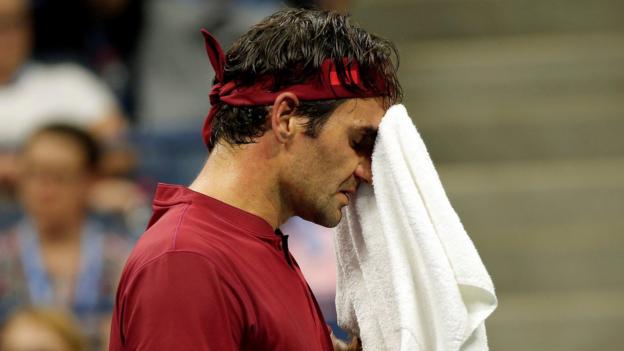
Temperatures topped 30C at the Arthur Ashe Stadium on Monday
2018 US Open
Venue: Flushing Meadows, New York Dates: 27 August-9 September Coverage: Live radio coverage on BBC Radio 5 live sports extra; live text commentaries on the BBC Sport website

Roger Federer said he was “happy the match was over” after playing in “uncomfortable” conditions during his shock fourth round US Open defeat.

The 37-year-old Swiss – a five-time champion at Flushing Meadows – was beaten 3-6 7-5 7-6 (9-7) 7-6 (7-3) by world number 55 John Millman.

Their match finished just before 01:00 local time but temperatures still hit 30C with high humidity levels.

“I felt I couldn’t get air. There was no circulation at all,” Federer said.

“It’s uncomfortable. Clearly you just keep on sweating more and more and more and more as the match goes on. You lose energy as it goes by.

“At some point also I was just happy that the match was over, I guess.”

Tournament organisers kept the roof – which was completed in 2016 – on the Arthur Ashe Stadium open on Monday, but world number two Federer believes its installation has reduced air circulation on the court.

“I think just that makes it a totally different US Open,” said the 20-time Grand Slam champion.

“Plus conditions maybe were playing slower this year on top of it. You have soaking wet pants, soaking wet everything. The balls are in there, too. You try to play. Everything gets slower as you try to hit winners.”

Federer’s defeat to Australian Millman marked the first time he has lost to a player ranked outside of the top 50 at the US Open.

Brisbane-born Millman said he “felt like a deer in the headlights to begin with” and had also struggled in the heat, calling the tournament conditions “pretty brutal”.

“I’m not usually much of a sweater. I mean, I was dripping,” said the 29-year-old. “The conditions for the majority of this tournament have been pretty brutal.

“I found it pretty tough early on to hold onto the racquet. It’s kind of moving around in your hands.”

World number 55 John Millman is through to his first Grand Slam quarter-final in New York

‘Roger is my hero’

Millman – the only unseeded player left in the last eight of the men’s draw – will play two-time champion Novak Djokovic in his first Grand Slam quarter-final on Wednesday.

He admitted to feeling “a bit guilty” after beating Federer, who he described as his “hero”.

“I always was of the opinion that I was in the fourth round for a reason. I’ve never played anyone’s reputation,” said Millman.

“I felt a little bit guilty today because he didn’t have his best day, and that’s for sure.

“I have so much respect for him, what he’s done for the game.”

Millman lost in straight sets to Djokovic at Queen’s in June, but said he has “the belief” he can defeat the Serb in New York on Wednesday.

“I’ll have to improve a lot on the last time I played him. He’s an incredible player. I think he’s in some really good form right now, too,” he said.

“But why not? I think it’s a disservice to who I am if I go out there and don’t have that belief.”

Read More

from Trusted eNews https://ift.tt/2CdIHIj
via IFTTT

Syria’s War: Warplanes hit Idlib targets as fears of battle mount

news image

Activists in Syria say several air strikes have hit a village in the country’s northwestern province of Idlib, killing at least two people, as expectations mount of a government offensive to retake the rebel stronghold.

The bombings occurred on Tuesday in the countryside near the village of Jisr al-Shughour on the western edge of the province.

Idlib is the last major bastion of the rebel groups who have been trying to oust President Bashar al-Assad since the start of Syria’s civil war in 2011. 

At least 23 raids have been witnessed in the area on Tuesday morning, Al Jazeera’s Stefanie Dekker reported from Antakya in neighbouring Turkey.

“Activists are saying they saw Russian and Syrian regime war planes in the sky,” she said.

“Two civilians have been killed, but no major facilities have been hit at the moment. This comes after a hiatus of over three weeks without air strikes in the area. Everyone here is wondering if this is the start of the Syrian government offensive on Idlib,” she added.  

Assad has sworn to recapture every inch of Syria and has made big gains against rebels since Russia joined the war effort in 2015.

His forces are amassing around the province of Idlib, presumably in preparation for the assault.

But Turkey, whose army has a string of observation posts around the edge of the rebel area, has warned against such an offensive.

US President Donald Trump has also warned Syria against “recklessly” attacking Idlib province. 

Russia and Iran, however, have insisted that rebel groups in Idlib must be defeated and are expected to back government forces.

“We know that the Syrian armed forces are getting ready to solve this problem,” President Vladimir Putin’s spokesperson Dmitry Peskov said on Tuesday, calling Idlib a “pocket of terrorism”.

Moscow has been carrying out strikes in Syria since September 2015, using aircraft based at the Hmeimim base in Latakia province.

Russia accuses rebels in Idlib of attacking Hmeimim with weaponised drones and insists armed groups in the province must be eliminated.

The United Nations has warned that a full assault on Idlib could spark a humanitarian catastrophe on a scale not yet seen in Syria’s seven-year-old conflict. 

An estimated three million people – half of them displaced from other parts of Syria – live in the province and adjacent rebel-held areas.

Russian, Turkish and Iranian leaders are due to meet on September 7 in Iran and are expected to discuss the situation in northwestern Syria.

WATCH: As Syria’s Final Battles Looms, What Comes Next? (24:35)

SOURCE: Al Jazeera and news agencies

Read More

from Trusted eNews https://ift.tt/2wDiQEu
via IFTTT

Husband dies after wife allegedly poisons him with eye drops, police say

news image

Share This Story!

Let friends in your social network know what you are reading about

Husband dies after wife allegedly poisons him with eye drops, police say

A South Carolina man died after his wife snuck eye drops into his water over three days, police say.

Loading…Post to Facebook

Posted!

A link has been posted to your Facebook feed.

A South Carolina man died after his wife allegedly poisoned his drinks with eye drops, police say. 

Lana Sue Clayton is charged with murder and unlawful malicious tampering of food after autopsy tests revealed her husband, Stephen, died from poisonous levels of tetrahydrozoline — an ingredient in over-the-counter eye drops.

Clayton, 52, admitted to police she snuck eye drops into her husbands’ water between July 19 and July 21. 

Tetrahydrozoline poisoning can induce comas, stop breathing, blur vision and cause seizures, according to the U.S. National Library of Medicine. Children who swallow even 1 to 2 milliliters can suffer “serious adverse events.” It’s added to eye drops and nasal sprays to reduce redness. 

Stephen Clayton died on July 21 at their home in Clover from the poisoning. A motive for the poisoning wasn’t clear. 

More: German man suspected of killing 21 co-workers by poisoning their food

The Associated Press contributed to this report. Follow Ashley May on Twitter: @AshleyMayTweets

Read or Share this story: https://usat.ly/2MNvg6z

Read More

from Trusted eNews https://ift.tt/2wFPuFn
via IFTTT

Alastair Cook: The winter that defined a great English batsman

news image

Cook hit 235 not out to save the first Test of the 2010-11 Ashes in Brisbane and lay the platform for the series win which followed

Alastair Cook never looked like the sort of man who would scare anyone. Too doe-eyed, too rosy-cheeked. Polite, well-mannered, as intimidating as a Sunday afternoon trip to a garden centre.

For one glorious seven-week spell, however, he frightened Australians rigid. He was a bogey-man, a monster, a man who sacked their sporting cathedrals and then ruined Christmas.

Whatever else he did in his career, for all the other records we might look back on fondly in his retirement, you have to start and finish and wallow in the Ashes of 2010-11.

If you were there you were lucky. If you were waking yourself up early on an English winter’s dark morning to check the scores, you often found yourself making colossal misjudgements. Right, Cook’s batting again, and he was batting when I went to bed, so have we followed on?

The only thing following on was one relentless score after another – 67 in the first innings in Brisbane, a preposterous 235 in the second, 148 in the second Test in Adelaide, 82 at the MCG and a withering 189 in Sydney.

The main reason why he didn’t score more was that his 766 runs kept laying the groundwork for Australian innings defeats. He couldn’t bat again because he had already scored so many runs he didn’t have to.

It was beautiful because it was unprecedented and it was preposterous because of what had come before. In a streak of eight Test innings the previous summer, Cook had scored 7, 23, 29, 8, 12, 17, 4 and 6. He averaged 13.

In 19 previous innings against Australia he had managed only a solitary century. England hadn’t won a Test series down under in almost a quarter of a century.

If you had mentioned a cricketing Don in the same breath as the Essex opener in the summer of 2010 it would have been Topley. By the start of 2011 it could only be Bradman. With respect to the former county seamer, that ranks as quite the sporting metamorphosis.

It hurt the Aussies more because they couldn’t quite work out how Cook could be so destructive. He appeared to have not so much a range of scoring strokes as four of them: a straight push-drive, a cut, a clip off his legs and a rolling wristy pull.

Kevin Pietersen’s threat was obvious. He decapitated bowling attacks. In a world of demolition men Cook was instead an archaeologist, patiently reconstructing an ancient structure for Test innings. Dig in. See off the new ball. See off another new ball.

Pietersen produced the most outrageous single score of that series with his pillaging 227 at the Adelaide Oval. He also scored less than half as many runs as Cook across the series.

If you were shown an over from KP’s double-century you would have a rough idea in which 50-run block it might be taken from. Cook’s first run often looked exactly like his 99th, or his 160th, or 220th.

It drove the Australians slowly mad. This was what they had always done to England in an Ashes series: find someone previously slightly underperforming and turn them into an indomitable destroyer of home dreams.

Steve Waugh in 1989, hitting 177 not out in the first Test and 152 in the second for an average, at one stage, in excess of 250; Mark Taylor, another left-handed opener, scoring 839 runs across the same series; Terry Alderman, trapping Graham Gooch lbw with such predictability that it may as well have been a looped replay of the same delivery; Matthew Elliot in 1997, scoring 556 runs at 55, almost half the runs his entire Test career would produce.

As Cook unobtrusively did the same to Australia that winter he took us with him into some surreal parallel universe where everything was the exact opposite of what you had come to expect.

England were losing the first Test at the Gabba, as they always do, until Cook and Andrew Strauss walked out to bat in their second innings. They trailed by 221 runs on the first innings. By the time Cook called it quits they had scored 517 runs for the loss of a single wicket.

Records were broken and records were reset. Cook first went past Ian Botham’s mark for the highest Test score by an Englishman at the Gabba and then Bradman’s score as the highest by any player in Tests at the ground.

He became only the fourth Englishman to score an Ashes double century in Australia, although that seemed a bit tame compared to some of the other stuff: batting longer – for 630 minutes – than any Englishman in history down under, including those who played in timeless Tests.

It was the first time in Test history England had passed 500 for the loss of only one wicket; his second-wicket stand with Jonathan Trott was highest partnership by any visiting team at the Gabba.

Those were the numbers. The visuals were almost as striking. The Gabbatoir had been heaving across the first three days, a mess of half-cut Queenslanders baying for English blood. By the end it was deserted, save for an occupying army going more barmy with every landmark.

The seats in the ground are green, yellow and purple, designed so that the stands look busier on quiet days than they should do. When Strauss declared – which was probably the only way anyone was going to stop Cook from scoring even more – his opening partner walked off waving to them anyway, as if taunting all those who had left and run for cover.

A Monday morning in a frozen northern hemisphere November had seldom seen so much gleeful pillow-punching or leaping around. And it was to continue across December and January too.

In Adelaide, where Cook notched up a near-comical 1022 minutes without being dismissed, Aussie fast bowler Doug ‘The Rug’ Bollinger might have torn his hair out had he not paid so much for it. Captain Ricky Ponting, gone in his own first dig for a golden duck, lost his rag very visibly as inevitable defeat followed.

The Waca? No Englishman cares to talk about the Waca. But the MCG, that spiritual home of Australian sport, that sacred oval of concrete and grass that has hosted Olympic Games, Grand Finals and Test match triumphs for decade after dominant decade…

It became the scene of a Boxing Day massacre. Australia, bowled out for 98, their lowest first innings score at the MCG in history, even worse than the 104 they posted in the first ever Test back in 1877; Cook – who else – unbeaten at stumps with England 157-0.

Three days later, England wrapping up another innings victory, another bastion had been transformed into a slice of English sporting paradise, the indelible image this time of Cook and his team-mates standing in front of their massed ranks of supporters doing the Sprinkler.

“WHAT A SPRAY” was the banner headline over the photo on the Herald-Sun’s front page the following morning. “Just when you thought the cricket couldn’t get any worse, we had to endure this!”

It did, of course, get worse for Australia, when one more behemoth from Cook’s bat built the foundation for another crushing defeat in the final Test in Sydney. They hadn’t lost three Tests at home in 22 years. They hadn’t lost by an innings on Australian soil for 17, but had now done so three times in four weeks.

Cook was not the only factor in that series. Trott was the number three England had always wanted and still do.

James Anderson took 24 wickets. Ricky Ponting averaged 13, his vice-captain Michael Clarke less than Graeme Swann, England’s number eight. While Swann took 15 wickets, Australia’s three spinners took just four wickets between them for an aggregate 556 runs.

But Cook was the dominant one, man of the series, bashful king of all he surveyed.

“An amazing seven weeks,” he said at the end. “If someone had told me I could do this I’d have laughed in their face. I think it’s going to take me a while to get over this.”

Arguably he never did. What we didn’t realise then was that those Ashes were a peak he would never scale again. While there were brilliant individual innings afterwards, two home Ashes series won as captain, maybe the ultimate record of all as England’s greatest ever run-scorer, it was that winter that will forever define him.

You could find a sadness in that if it hadn’t all been so wonderful. If there was a decline it was only because the summit was so high. The views from the top we will never forget.

Read More

from Trusted eNews https://ift.tt/2CgGjjY
via IFTTT

Trump warns Syria not to ‘recklessly attack’ Idlib province

news image

US President Donald Trump has warned the Syrian government against launching an attack on rebel-held Idlib province amid concerns that the planned offensive will create a new humanitarian crisis.

“President Bashar al-Assad of Syria must not recklessly attack Idlib Province. The Russians and Iranians would be making a grave humanitarian mistake to take part in this potential human tragedy,” Trump said in a tweet on Monday.

“Hundreds of thousands of people could be killed. Don’t let that happen.”

The warning came as Iran’s Foreign Minister Mohammad Javad Zarif met with the Syrian president in a surprise visit to Damascus ahead of an expected government offensive on Idlib.

The northern province is the last major rebel stronghold fighting al-Assad, who is backed by both Russian and Iranian forces.

Moscow and Tehran have insisted on fighting what they say are terrorist groups, with Zarif saying that areas under rebel control must be “cleaned out” and brought back under government authority.

Trump has sought better relations with Russia since taking office in 2017, but the United States has been unable to rein in Moscow’s military and diplomatic support for al-Assad.

US Secretary of State Mike Pompeo on Friday said Washington views any government assault on Idlib as an escalation of Syria’s war, and the State Department warned that Washington would respond to any chemical attack by Damascus.

Nikki Haley, the US ambassador to the United Nations, wrote on Twitter late on Monday: “All eyes on the actions of Assad, Russia, and Iran in Idlib. #NoChemicalWeapons”.

Zarif’s visit to Damascus comes as Tehran prepares to host a summit on September 7 between the leaders of Iran, Russia and Turkey to discuss the situation in Idlib, Fars news agency reported.

Turkey, which has long supported anti-Assad rebels, has cooperated with Russia and Iran on talks over Syria in recent years and has troops in the Idlib region on an observation mission.

Last week, Iran’s defence minister travelled to Damascus and signed an agreement for defence cooperation between the two countries.

Read More

from Trusted eNews https://ift.tt/2wDYP0s
via IFTTT

Design a site like this with WordPress.com
Get started