Why you can stop worrying Yellowstone’s supervolcano is about to end the world

news image

CLOSE

While a potential eruption of the supervolcano that lays beneath this iconic park may garner more alarming headlines, the more likely hazard is a major earthquake.
USA TODAY

YELLOWSTONE NATIONAL PARK, Wyoming – You can’t miss the heat coming from beneath the surface here. It’s visible everywhere you look, from the steaming geysers to the bubbling mud puddles and the colorful hot springs.

All that activity is fueled by a smoldering supervolcano, a heat engine buried deep underground that has produced some of the largest eruptions in the world. The last supereruption about 631,000 years ago spewed 240 cubic miles of pulverized rock and ash into the atmosphere, covering nearly half the country in the powdery residue.

“It’s an active volcano. It will erupt again,” said Michael Poland, scientist-in-charge at the Yellowstone Volcano Observatory, a consortium of eight organizations led by the U.S. Geological Survey.

But don’t go changing your vacation plans just yet – or potentially ever.

Scientists who study Yellowstone’s 45-by-30-mile caldera, roughly the size of Rhode Island, say the underground system probably will give decades of warning before it blows – and that isn’t likely to happen for thousands of years. Despite the seismic orchestra of “snap, crackle and pop” that goes on underground, there are no signs it’s about to become more explosive.

“Geological events are stunning in their power, but they’re infrequent in human terms,” said Jerry Fairley, a professor of geological sciences at the University of Idaho who has studied Yellowstone’s supervolcano for the past nine years. “We live on a very active planet, but it’s rare that we get to see the kind of power from the Earth that it is capable of generating.”

‘It’s the story that never dies’

That long view has been partially drowned out in the past decade by a fever pitch of documentaries, online articles and amateur video clips that point to Yellowstone’s frequent minor earthquakes – it averages 1,500 to 2,500 a year – or blatantly false rumors that the ground is swelling upward as signs the volcano’s time bomb is ticking down. The result, the most extreme of these conspiracy theories say, would  be the end of the world. 

Yellowstone earthquakes: Massive temblor more likely hazard than supervolcano eruption

‘Safety over selfie’: National park visitors can’t seem to stop getting too close to wildlife

Such warnings draw conclusions from the volcano’s past eruptions to model what it could spew next – a faulty connecting of dots that ignores key information on how volcanoes operate, experts say. Yet those theories have continued to pop up over the past decade on Facebook, YouTube and other social media services and often are revived when a new study emerges or a swarm of earthquakes hits the park.

The park service fields calls every year from would-be vacationers who want to know if visiting the national park, which receives more than 4 million people a year, would put them in danger. 

“We see people who are thinking about changing their plans because of the stuff they’re reading,” said Neal Herbert, a spokesman for the park. “It’s the story that never dies.” 

The signs just aren’t there

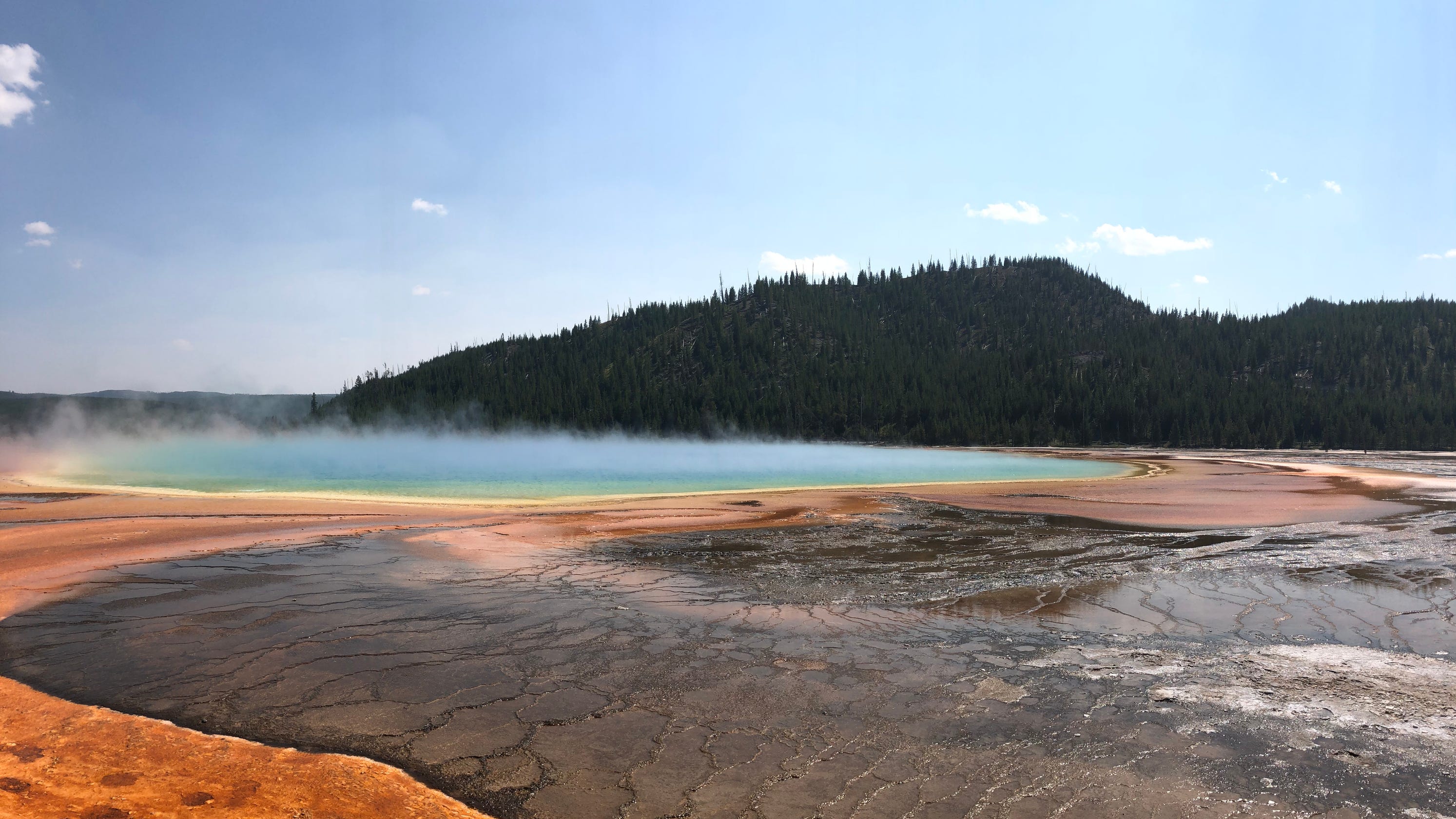
Visitors to the park come for the unusual geological activity: They bustle through the heavy summer crowds to feel the steam coming off the geysers and see the brilliant colors of the hot springs – shades of burnt orange, bright blue and vivid green – created by the microorganisms that thrive in the extreme heat. Regular earthquakes are usually too subtle, at magnitude-2 or far less, to jolt them.
 

Those rumblings are one of the giveaways a giant volcano slumbers below the surface. But the quakes don’t indicate a big eruption is coming soon. In fact, the frequent earthquakes may be acting as a safety valve to release pressure before it builds up, similar to how a pressure cooker releases steam so it remains safe. “They may be a sign of safety rather than a sign of impending doom,” Fairley said. 

Any warning signs would occur well before an eruption, and they just aren’t there right now. Multiple, large earthquakes would rattle the park, the ground would move up or down by tens of feet over months or years as the magma underneath shuffled around, gases would be emitted from the ground, the chemicals in the springs would change, and more heat would be generated, Poland said.

It’s simply business as usual for the park right now, Fairley said. “Yellowstone, in a sense, is breathing,” he said.

When it does erupt, it’s likely to be on a smaller scale that would more closely resemble Hawaii’s Kilauea volcano eruption this summer, which caused a lava flow that forced evacuations and submerged neighborhoods but didn’t result in the cataclysmic destruction of Yellowstone’s past supereruptions. The last time Yellowstone experienced a lava flow was about 70,000 years ago. 

What’s more, we’d probably have decades of warning between the first sign of an eruption and Yellowstone actually blowing its top, said Christy Till, a geologist and assistant professor at Arizona State University who has researched the volcano for the past six years. “That’s the kind of time scale where we think something could happen to trigger an eruption,” she said. “It’s not like it would happen tomorrow.”

Study: Yellowstone’s heat may be coming from deeper underground than thought

Volcanoes: 10 national parks with explosive origins

Steamboat geyser: World’s largest geyser shows strange eruption patterns in Yellowstone

The magma underneath Yellowstone would also need to be heated up – a lot: Right now seismic studies indicate it’s mostly solidified, not the hot liquid required for an eruption.

“You would need to collect a huge volume of magma all in the same place, and then you’d need to generate enough pressure to get it moving up to the surface,” Poland said. “And we see neither of those conditions in place right now.”

It’s entirely possible those conditions may never exist again: The supervolcano may be dying, said Ilya Bindeman, a University of Oregon geology professor who has been working on Yellowstone’s caldera for 20 years. Each supereruption melts part of the crust, hardening it and making it more difficult to generate enough heat to remelt the material.

“After a certain point, you remelt the entire crust and now it’s sturdier,” Bindeman said. The melting temperature rises and the heat below can’t break through the tough outer skin formed by previous eruptions. Essentially: “It just cannot get hot enough to erupt again,” he said.

What would a supereruption at Yellowstone look like?

If the worst-case scenario did happen, it wouldn’t be a pretty day – for decades – in the USA.

“The eruption of Mount St. Helens would be a small firecracker compared to one of the major caldera eruptions of Yellowstone,” Fairley said.

Millions of people would die, in the immediate explosion and in its aftereffects, Fairley predicts. Ash would fall over much of the country, grinding air traffic to a halt. Water would be contaminated, livestock would die, crops would fail and the country’s heartland would be unfarmable for years. The climate would change because ash would filter out the sun’s powerful rays, and it would be several years or even decades before it could bounce back.

During Yellowstone’s supereruption about 631,000 years ago, ash covered North Dakota through most of Texas and from Southern California through most of Missouri and Arkansas.

But a massive eruption at Yellowstone – or another from one of the other dozen or so supervolcanoes in the world – would still not be the mass-extinction-level event some fear. “Humanity would survive, but it would not be a fun time,” Poland said.

Humanity has actually done just that – we were around for two such eruptions in the past 100,000 years, both even larger than the last big one at Yellowstone.

“And we’re obviously still here now. I’m not saying it would be easy, but there’s some evidence to suggest that our cave people ancestors did OK,” Poland said. 

Autoplay

Show Thumbnails

Show Captions


Read or Share this story: https://usat.ly/2BwainH

Read More

from Trusted eNews https://ift.tt/2nXwsFI
via IFTTT

Missing Iowa student Mollie Tibbetts’ body found, authorities say

news image

CLOSE

Never one to seek attention, father Rob Tibbetts says his daughter Mollie Tibbetts has an ability to connect with everyone she meets.
Luke Nozicka, lnozicka@dmreg.com

DES MOINES, Iowa – A body believed to be that of Mollie Tibbetts, the 20-year-old University of Iowa student who went missing July 18, was found Tuesday, authorities said.

Greg Willey, the vice president of Crime Stoppers of Central Iowa, said the body is believed to be Tibbetts but would provide no other details. Her father, Rob Tibbetts, declined to confirm the information.

Tibbetts disappeared while jogging in her hometown of Brooklyn, Iowa. FBI, state and local law enforcement agencies have been working around the clock to find the sophomore psychology major.

Tibbetts was watching dogs at the home of her boyfriend’s brother in Brooklyn, a town of about 1,400, when authorities say they believe she went for a jog and was last seen around 7:30 p.m. local time. 

More: She’s nurturing. She’s a Harry Potter fan. This is Mollie Tibbetts

Later that evening Tibbetts’ boyfriend, Dalton Jack, said he opened a Snapchat message from Tibbetts with a photo that made it appear she was indoors.

A reward fund for information leading to her safe return had grown to more than $400,000, Crime Stoppers of Central Iowa said. Wiley said the money will be used for information that helps authorities track down anyone who might have been responsible for her death.

Bacon reported from McLean, Va. Contributing: The Associated Press

Autoplay

Show Thumbnails

Show Captions

Read or Share this story: https://usat.ly/2w06XYM

Read More

from Trusted eNews https://ift.tt/2LdfSdW
via IFTTT

MTV’s shiny VMAs was heavy on glitz, light on soul: EW review

news image


We gave it a B-

MTV’s tagline for the 2018 Video Music Awards was “Everything might happen.” Hey, they said might. The 35th VMAs had some fiery performances, but the show never quite sparked.

The glam feeling was palpable, no doubt: Nicki in gold, Ariana in gold, JLo in golder gold, Maluma in silver, Rita Ora in the Emperor’s New Clothes. The excess trended mythic. Nicki Minaj performed in downtown Manhattan’s Oculus. The transpo hub already looks like some Kryptonians terraformed a Sam Goody inside a leviathan spinal column. Then Minaj came out looking like a watchable version of Valerian and the City of a Thousand Planets, imperial dresswear, golden wings and golden throne and golden unicorns.

Meanwhile, Ariana Grande’s stunning number restaged an all-female Last Supper. “God is a woman” she sang, and the Leonardo da Vinci homage implied a Jesus-y deity. But then the Greek columns gave strong Athena vibes. Given the context, the swirling black hole in the background looked outright vulvar.

This was a reasonably satisfying awards show, not the boring trainwreck some VMAs have been, not the exciting trainwreck supernova some VMAs dare to be. There was a sprinkling of solid performances, Shawn Mendes getting Flashdanced under indoor rain, Panic! at the Disco floating down to earth, Ja Rule appearing because you whispered his name to the mirror 13 times.

If you were meme-hunting, Pete Davidson and Kylie Jenner gave just-okay cutaway realness, their entire beings bleached blonde, him chewing gum in a post-post-ironic NASA shirt, her in a white blazer dress that looked positively self-made. Meanwhile, Camila Cabello took over as the resident awards-ceremony Audience Dancer. When Bazzi performed “Beautiful,” the camera cut to Cabello mouthing along. Imagine, someone with talent singing a Bazzi song!

Little bits felt amplified. The Radio City Rockettes took the stage as a punchline for some Blake Lively-Anna Kendrick banter. Travis Scott Zardozzed himself during his Astroworld medley, performing in front of a giant replica of His Own Head. Logic had the most timely performance with “One Day,” laundry-listing the latest political catastrophes, families reunited, children demanding you to acknowledge their humanity, the Border Patrol as a looming misery.

Some pulse was missing, though. Maybe a host would’ve helped? The ceremony started strong with Tiffany Haddish and Kevin Hart. “At this game, you guys are allowed to kneel!” said Hart, before just deciding to tell the president to “suck it.” Haddish compared Jersey Shore to herpes, smirkishly shaded the remaining four Fifth Harmonies. Not mind-altering material, but the riffs felt genially improvised, and the rest of the show was wound up tight. Jimmy Fallon made a joke about Post Malone’s face tattoos, so that’s the box marked “topical comedy” checked. Up-and-coming artists gave shortened performances, the live-performance equivalent of when iTunes used to let you hear 30 seconds of a song before buying it. (Ha ha, buy music!) Certain personalities were absent, no Carters, no Childish Gambino. Karlie Kloss but no Taylor Swift, which is how Generation Tide Pod describes sizzle sans steak.

“I grew up on MTV,” said Jennifer Lopez, accepting the career achievement Video Vanguard award. She could’ve meant it either way: Growing up watching MTV, growing up literally on MTV.  “God, I feel like I blinked and 16 years went by” — that was Lopez one day earlier, during the series finale of Shades of Blue, a series that defiantly existed for three whole seasons on NBC. The woman’s got hustle, real longevity. Y’know, just wrapping up my broadcast drama while I’m prepping a career retrospective on my music career: Some of us live whole career lifetimes without 24 hours that active. And 16 actual years ago, Lopez was releasing an album, two movies, a perfume line. We blinked, it was 2018, here she still was.

And Lopez’ presence in the ceremony centered the most intriguing narrative in this year’s show: A diva-centric, future-is-female populism. “I had a baby, I carried a baby, and now I’m still winning awards,” said Cardi B, and the camera cut to Lopez halfway nodding. Cabello danced with her mom offstage, Grande brought mom and grandma onstage: Cool!

RELATED: Best and worst moments from the MTV VMAs

But the big Lopez performance felt listless, especially compared to past Video Vanguard medleys. It was some Vegas-y song and dance, iTunes preview’d into unfulfilling microdoses. At one point, paraphrasing the “Jenny from the Block” phase of her career, the stage turned Bronxward, covered in street art. One line of graffiti just said “SEXISM,” another declared “AGEISM.” You feel relevance grasped towards. Pause to imagine the street artist spraypainting “AGEISM” outside a construction yard. Like, chin stroking, are they saying it’s bad, or good, or is AGEISM the name of the artist collective, or if we really sound it out does it produce some nasty wordplay?

That graffiti summed up the VMAs, actually: Stretching for big moments, imitating provocation. As the VMAs have weathered a few years of declining ratings, this show’s tried hard to leverage itself towards an audience young enough to barely understand cable TV. Because it’s a media event with tweetable cachet, this makes the VMAs an annual ritual for viewers of a certain age, a dangerous drinking game if you’re sipping whenever you have no clue who’s onstage.

This generation gap is funny to talk about — “I’m so old!” is something you hear 24-year-olds saying lately — but it’s starting to go dangerously textual. “The first one is my daughter’s favorite!” said A.J. McLean, beard guy from Backstreet Boys, describing a current nominee. Ken Jeong gave a shout-out to Barenaked Ladies, Smash Mouth, and Chumbawumba. Kevin Hart had a PSA for rappers half his age: “Stop writing on your face. It’s stupid.”

The old ways weren’t necessarily better.  The horrific final performance trotted out Aerosmith. Onstage with Post Malone, they personified an utterly mummified notion of rock. (Any children watching will flee into EDM forevermore.) More horrific, yet freakishly watchable, was the appearance by Madonna. She looked like, well, so much: Let’s go with “Bib Fortuna wearing an entire vintage store teaching yoga in a haunted castle.”

In a demonstrably failed effort to honor Aretha Franklin, she told a very long story. Her rambling suggested a sudden narrative tangent in an art movie you refuse to understand: “I left Detroit when I was 18,” “third-floor walk-up that was also a crackhouse,” “I left for Paris but I came back a few months later,” “Another anecdote I would like to share.” She said “quelle horreur” and “LOL” in consecutive sentences, pretentiously French and then pretentiously millennial. She was bleeped twice. Somewhere past Neptune she told the story of her very first performance at the very first VMAs, 34 years ago.

It was a ludicrous moment that kept going and going. Surely there are a thousand better ways to honor Aretha Franklin. And yet somehow this moment was the first to feel definable VMA-ish. At long last, we had literally no idea what was going to happen next.

Finally, Madonna announced the big prize was going to Camilla Cabello. Cabello came onstage, bowed to Madonna with melodramatic respect, thanked her family as seemed necessary, thanked her fans the way everyone does now. I don’t know. It was very nice, and Cabello’s a star, and you expect a brighter future. Imagine all the crazy stuff Cabello will say when she takes the VMA stage in 2042. God, just blink and the years will go by. B-

Read More

from Trusted eNews https://ift.tt/2PoQJjY
via IFTTT

President Trump: I won’t yank Barack Obama’s security clearance

news image

CLOSE

President Donald Trump is revoking the security clearance of former CIA director John Brennan, who served in the Obama administration. (Aug. 15)
AP

WASHINGTON – While conducting a rhetorical war with members of Barack Obama’s administration, President Donald Trump said Tuesday he is not reviewing the national security clearance of the former president himself.

“Never discusses or thought of,” Trump said in a tweet.

Trump made the claim while decrying a New Yorker article that he said “falsely reported that I was going to take the extraordinary step of denying Intelligence Briefings to President Obama.”

The article focused on the conflict between Trump and former CIA Director John Brennan, who has accused Trump of acting improperly on issues ranging from Russia to his criticism of Obama. Brennan has also accused Trump of colluding with Russians who sought to influence the 2016 election by hacking Democrats.

The White House announced last week it had revoked the national security clearance for Brennan, a professional courtesy extended to former intelligence and law enforcement officials so that successors can consult with them.

Trump also said he is reviewing security clearances for other Obama-era officials, people he has clashed with frequently and has accused of seeking to undermine his presidency.

More: After John Brennan, Donald Trump is prepared to revoke more security clearances

More: President Trump to ex-CIA director John Brennan: Go ahead and sue me over security clearance

The president has publicly attacked Obama directly, accusing him at one point – without evidence – of having Trump Tower bugged during the 2016 presidential campaign.

“As Trump stepped up his public and private attacks on Obama, some of the new President’s advisers thought that he should take the extraordinary step of denying Obama himself access to intelligence briefings that were made available to all of his living predecessors,” The New Yorker reported.

The report said Trump decided against the idea after being told about “the importance of keeping former Presidents, who frequently met with foreign leaders, informed.”

Read or Share this story: https://usat.ly/2MEl3bQ

Read More

from Trusted eNews https://ift.tt/2N4V1LU
via IFTTT

Scientists discover ice on the moon using NASA tool, say it could help future space missions

news image

CLOSE

After years of assumption, a team of scientists has concluded that our moon definitely has water ice at its north and south poles.
USA TODAY

Scientists using a NASA tool discovered evidence of ice on three areas of the moon, a finding that could help future moon landings. 

Using NASA’s Moon Mineralogy Mapper (M3) instrument, the research team identified three areas, mostly within craters at the poles, where water ice lies. M3, which launched in 2008 on the Chandrayaan-1 spacecraft, can directly measure the difference between liquid water, vapor or solid ice. 

The ice exists in cold areas of the moon that don’t see direct sunlight, where warmest temperatures are about negative 260 degrees. Scientists say the ice could serve as a resource to future moon exploration.

The water ice observation is the first directly observed by scientists, according to a press release. But, scientists have longed suspected ice on the moon since NASA spacecraft Clementine gathered data in the 1990s suggesting frost at the south pole. 

The new findings, led by Shuai Li of the University of Hawaii and Brown University, were published in the scientific journal Proceedings of the National Academy of Sciences.

How the ice appeared on the moon is still a mystery. Li told Quartz comets crashing into the moon might be responsible, and hopes to test theories if and when a lander is able to directly capture moon ice samples. 

More: NASA’s Opportunity rover has been in sleep mode for weeks, engineers hope music will help wake it up

More: Radiant Alabama fireball was ’40 times as bright as full moon,’ NASA says

Follow Ashley May on Twitter: @AshleyMayTweets


Read or Share this story: https://usat.ly/2OQxAX8

Read More

from Trusted eNews https://ift.tt/2Ppt0QJ
via IFTTT

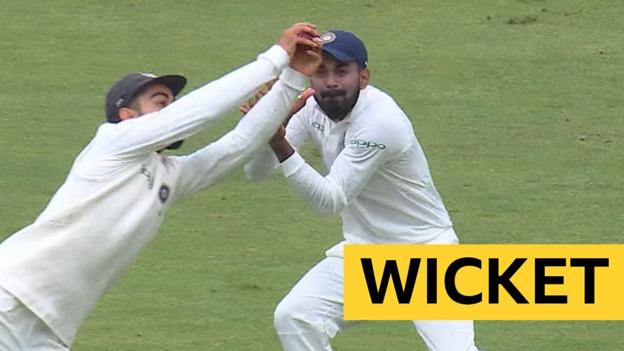
England v India: Virat Kohli takes ‘outstanding’ catch off ‘awful’ Ollie Pope drive

news image

India captain Virat Kohli takes an “outstanding” catch after Ollie Pope plays an “awful” drive to reduce England to 62-4 on day four of the third Test at Trent Bridge.

FOLLOW LIVE: England v India – in-play clips, radio & text

REAM MORE: ‘Tentative’ Jennings falls for 13

Available to UK users only.

Read More

from Trusted eNews https://ift.tt/2OYGCS7
via IFTTT

Someone ordered a massive box of fried food and the internet had a lot to say about it

news image

What will £10 ($12.84) get you in this day and age?

If you live in Scotland and have a rather large appetite, it could get you this staggering amount of fried food plus a large bottle of Scottish soda Irn-Bru. 

Known as a “crunch box” this dish features various fried food items resting on a bed of chips. 

Twitter user @RossMcCaff posted an image of this incredible fried food bargain and people had a lot of questions about it. 

Some people actually complained about the quantity of the fried stuff in the box.

Some made suggestions about what should be included in the box of food.

McCafferty addressed many internetters’ concerns about the contents of the box.

Others viewed the crunch box more as an object worthy of anthropological analysis.

But the crunch box mostly left the Scots proud. Like this user, who was inspired by the box to sing the 1977 song ‘Caledonia,’ one of the Scottish national anthems. 

Take a good look at that crunch box. For as long as you live you’ll surely never see that many calories in one place. 

Https%3a%2f%2fblueprint api production.s3.amazonaws.com%2fuploads%2fvideo uploaders%2fdistribution thumb%2fimage%2f86394%2f8ec864c0 2807 47ef 9aa0 3efab433869c

Read More

from Trusted eNews https://ift.tt/2OTN0K1
via IFTTT

What Urban Meyer’s contract could say about his future at Ohio State

news image

Autoplay

Show Thumbnails

Show Captions

All eyes in the college football world seem to be focused on Urban Meyer as Ohio State nears the conclusion of a two-week investigation into how the championship football coach handled allegations of domestic violence against Zach Smith, his former assistant coach.

Meyer’s future with the Buckeyes has been unclear since he was placed on administrative leave with pay when that probe began. And though it’s unknown what criteria the university’s six-person investigative group will use to decide Meyer’s fate, the language in his contract gives some insight into the university’s power to sever ties with the three-time national champion. 

A USA TODAY Network examination of Big Ten football coaches’ contracts revealed boilerplate language requiring coaches to follow university policies, indirectly subjecting them to the university sexual misconduct policies which are outlined in separate documents. Yet some contracts, like Meyer’s — in addition to that of Illinois coach Lovie Smith and embattled Maryland coach D.J. Durkin — go further by giving specific instructions for how to handle such matters.

More: Ohio State football: What we know as investigation into coach Urban Meyer wraps up

Meyer’s university-policy obligations includes serving as a mandatory reporter of Title IX-related issues, and he also is required to report allegations of sexual misconduct/relationship violence that happen within the university community, which could include Zach Smith’s now ex-wife, Courtney Smith. 

Meyer’s contract was amended in April to include specific guidelines for reporting these types of allegations. And while some of the verbiage may seem redundant to university policy, one legal expert says it follows a recent trend of doubling down on the responsibility that coaches have to report misdeeds within their programs. 

Meyer was thrust into a national firestorm earlier this month after Courtney Smith said she was abused by Zach Smith on multiple occasions, including a 2015 incident that was reported to police and purportedly was known to many inside Ohio State’s athletic department. The investigation centers on what Meyer knew about the 2015 incident and when he knew it. Ohio State’s Board of Trustees is expected to meet Wednesday to discuss Meyer’s future. 

“By including the legal language that’s required, they’re making sure that the coach actually has notice of what that law might be,” said Barbara Osborne, a University of North Carolina law professor specializing in sports administration. “By including it specifically in the contract, you avoid any question of what you knew or should have known, and then it really clearly provides the university with the option for termination for cause.”

What was Meyer required to do?

Meyer’s contract requires him to “promptly report” any known violations of Ohio State’s sexual misconduct policy to the university’s Deputy Title IX Coordinator for Athletics. Intimate violence — such as the allegations against Zach Smith — is included in the policy.

The clause in Meyer’s contract cites violations involving “any student, faculty or staff,” and classifies a “known violation” as a “violation or an allegation of a violation of Title IX that (Meyer) is aware of or has reasonable cause to believe is taking place or may have taken place.” Title IX, according to its website, is the federal civil rights law that protects against discrimination on the basis of sex, including forms of sexual misconduct such as relationship violence. 

More: Reporting obligations for each Big Ten football coach

Ohio State’s university policy also specifies that employees who are considered a supervisor, such as a teacher, coach or president of an organization, will be held to a higher standard to report allegations of misconduct “because of their positions of authority” and “heightened responsibility.”

“Title IX requires everyone to disclose when a student is at risk,” Osborne said. “There’s a little bit more question about when an employee is engaging in the activity and there’s not direct student involvement. Now there’s also some moral and ethical issues, but the language you read to me, in that language or similar languages in Urban Meyer’s contract, then that clearly indicates that it’s a broad mandate and he should’ve reported.”

More: Urban Meyer: A timeline of the college football coach’s career

Meyer lied about what he knew about the 2015 incident when asked about it at Big Ten media days in Chicago on July 24. After Courtney Smith’s accusations surfaced, Meyer apologized for his comments but insisted he followed  protocol by “elevating the issues to the proper channels.” It’s not yet clear when or to whom Meyer reported the allegations.

“I understand that there are more questions to be answered,” Meyer said in a Twitter statement on Aug. 3. “At the appropriate time, I will also address the questions and speculation in a public forum.” 

While the alleged violence in the Ohio State case did not take place against a student, it did take place against the then-wife of a university employee. That leads to a question of whether Courtney Smith is a member of the university “community” — within which Meyer is required by the university’s sexual misconduct policy to report any allegations of sexual misconduct or relationship violence.

“The plain meaning of the word community, relative to a college or university, is probably going to be much broader than students and employees,” Osborne explained.” When you’re talking community, you’re looking at all of those various constituencies that have a vested interest in the university. So the actual people on campus, but it’s also the surrounding area, it might be the entire town or city that that institution is in, it would most likely include alumni. So community is a much broader word than campus, students, employees.”

Does the contract language matter?

The language in Meyer’s contract is far from unique. Some coaches from non-Big Ten schools have similar language in their contracts, including Oregon State’s Jonathan Smith and Arkansas’ Chad Morris. In the case of Smith, Oregon State felt it was important to make the head coach’s duty as a mandatory reporter “abundantly clear.”

“This language is based upon Oregon State University’s commitment to create a university environment free of sexual misconduct, violence, harassment and discrimination,” Oregon State spokesperson Steve Clark said. “OSU requires that all university employees are considered “responsible employees and must contact the OSU’s Title IX coordinator or the Office of Equal Opportunity and Access with knowledge of any form of sexual harassment, sexual violence, domestic violence or stalking.

“We customarily evaluate best practices used at many other universities when considering many Oregon State practices and policies. In the case of writing this new contract, yes, we looked at example head coaching contracts from other universities, including Ohio State.”

And while Arkansas drafted Morris’ contract without consulting Ohio State or examining the language that appears in both Meyer and basketball coach Chris Holtmann’s contracts, senior associate athletic director Kevin Trainor said Arkansas was “familiar with similar provisions” in other contracts around the country.

“It is a statement of the reporting obligation of ‘responsible employees’ on this campus (which includes our athletic coaches) regarding violations of the University of Arkansas’s Sexual Assault and Harassment Policies,” Trainor said when asked about contract language identifying Morris as a mandatory reporter. “It also reflects a recommended practice standard within the industry.”

According to Osborne, contract language that outlines a coach’s responsibility to serve as a mandatory reporter is a “risk management tool.” It also doubles down on the boilerplate language used in many university policies that identifies coaches as mandatory reporters, which means they are required to report knowledge or suspected knowledge of abuse in a timely manner. 

Osborne says this type of language in a contract is a fairly recent trend, within the past five years, and it is essentially an extra level of security for universities in case the coach  breaks university policy or doesn’t adhere to the language in his contract.

“Depending on what the contract language is,” Osborne explained, “if that clause is in the contract and the coach fails to perform, generally a failure to perform duties is cause for termination.”

USA TODAY Sports’ Steve Berkowitz, Amanda Christovich and A.J. Perez contributed to this report. 

Read More

from Trusted eNews https://ift.tt/2nVJfbL
via IFTTT

Prisoners nationwide go on strike to protest ‘modern-day slavery’

news image

Dalvin Brown, USA TODAY
Published 6:57 a.m. ET Aug. 21, 2018 | Updated 7:58 a.m. ET Aug. 21, 2018

CLOSE

Convicted sex abuser and former Team USA gymnastics doctor Larry Nassar is facing 50 new lawsuits since the original settlement, The Detroit Free Press reported.
Time

Prison inmates nationwide plan to put pressure on the country’s penal system by going on a two-week strike beginning Tuesday.

The strike is timed to begin on the anniversary of the killing of jailed African American activist and inmate George Jackson. He was killed by a guard in 1971 after taking guards and two inmates hostage in a bid to escape from San Quentin State Prison in California.  

The final day of the strike — Sept. 9 — also carries symbolism. That’s the day in 1971 that the Attica Prison riots in New York began, eventually leaving over 40 people dead when police stormed in to re-take the facility.

Prisoners leading the protests say the strike is aimed at ending what they call “modern-day slavery.” Inmates complain they are paid pennies on the dollar per hour for labor.

The event is spearheaded by Jailhouse Lawyers Speak, a network of imprisoned prisoner rights advocates based out of Lee Correctional Institution in South Carolina and supported by the Incarcerated Workers Organizing Committee (IWOC), a prisoner-led trade group.

Inmates plan to abstain from reporting to their assigned jobs, halt commissary spending, hold peaceful sit-in protests and refuse to eat during the strike.

“Prisoner participation depends on their location and privilege status,” said Amani Sawari, a prison reform activist and spokesperson for the strike. “If inmates are working they can suffocate the prison industrial complex by reducing their spending. In some detention facilities, prisoners may not be working so they might do a sit-in. It all depends.”

More: Larry Nassar moved from Arizona prison because lawyers say he was assaulted hours after placement in general population

More: Paul Manafort trial by the numbers: 27 witnesses, 18 charges and a potential 305 years in prison

More: Santa Fe High students return to site of deadly Texas shooting with more security

The call for action comes as a response to a prison riot that took place in Lee Correctional Institution in South Carolina in April of this year, resulting in the death of 7 inmates and injuring of over a dozen others. Inmates posted videos on social media showing the aftermath at the budget-strapped prison. 

“Initially a strike was planned for 2019, but the Lee prisoners wanted a now-response. We want to make sure that things like this don’t happen in the future,” said Sawari.

The prisoners released a list of 10 demands on the IWOC website that include, in part, the immediate improvement of prison policies, an increase in prisoner wages and the rescinding of laws that prevent imprisoned persons from having a chance at parole. The inmates also call for more rehabilitation services and voting rights.

Prisons in at least 17 states are expected to participate, according to Sawari, with a majority of them located in the South and West Coast.

On Aug. 21, U.S. cities participating include Seattle, Washington; Portland, Oregon; Sacramento, California; San Jose, California; Corona, California; Los Angeles; Phoenix; Omaha, Nebraska; San Antonio, Texas; Asheville, North Carolina; Black Mountain, North Carolina; Atlanta; Fort Lauderdale, Florida; Des Moines, Iowa; Chicago; Columbus, Ohio; Minneapolis; Philadelphia; Boston; and Brooklyn, New York. 

Experts say that there is a chance that the protest may drive change in some detention centers.

“If the strike is widespread enough, it could be effective,” said Lea Johnson, Professor of Law at the University of Florida Levin College of Law. “These circumstances like poor labor conditions, poor prison conditions, unpaid labor, and lack of access to mental health treatment exist seemingly behind closed doors. By going on a national strike, you pull back the curtain and it can force legislators to act.”

Follow Dalvin Brown on Twitter @Dalvin_Brown

Read or Share this story: https://usat.ly/2w1GABT

Read More

from Trusted eNews https://ift.tt/2OTkDfa
via IFTTT

Design a site like this with WordPress.com
Get started