Big Brother 20 recap: Zingbot’s back and the house gets messy (literally) in a wild episode

news image

From Marcellas not using the veto on himself to Lawon volunteering to be evicted under the belief that he’d receive a special power, there has been a lot of stupidity in Big Brother’s history. But rarely has there been such a consistent record of dumbness from one houseguest or alliance until Faysal and Haleigh. From the consistent blindsides to the pathetic displays of trust to an obviously distrustful Level Six, they’ve proven themselves to be completely oblivious to the way the game has played out. This week was especially messy for the duo. Fessy not believing Scottie is one thing, but setting your last closest ally on the block is damn near fatal as their alliance’s numbers continue to shrink. Scottie has managed to evade the block in the past, but can he sneak his way back to safety tonight?

As we rejoin the house after the nomination ceremony, Level Six seems to be almost in shock as to how well their plan actually worked. “You big buffoon!” Brett yelps in the diary room as he boisterously spells out the stupidity of Faysal putting up Scottie, his own alliance member, next to him. As Fessy explains to Scottie why he was put up for eviction, the lack of logic behind his decision is clear to everyone but him. “I’m not saying you’re lying but somebody’s lying,” is the best explanation he can give, as Haleigh seems to be mid-eye-roll everytime they cut to her. Scottie is simply incredulous as to how this all panned out, telling the diary room Fessy’s either a genius (ha) or really sucks at this game. Either way, Scottie says Fessy better hope he doesn’t win the veto. Haleigh, who believes Scottie was indeed the one vote to keep Rockstar, tries to get Fessy to believe this fact and find a way to undo the whole mess as he’s their one solid number. “We play it safe every freakin’ week and where does that get us? Nowhere!” Fessy retorts, saying that putting up Angela and Kaycee would’ve been a waste of a week, as opposed to putting up Scottie which is a waste of $500,000. Haleigh points out the holes in his logic, namely the whole “Angela and Kaycee being part of an alliance that wants to get them out” thing, and vows to get Scottie off the block if she wins the veto. I’m guessing Haleigh is really starting to regret not leaving Fessy to Kaitlyn right about now.

When the time comes to pick players for the veto competition; Faysal picks Angela, Scottie chooses Haleigh, and Brett lands on the Meryl Streep of vetos, Tyler. Later, Fessy pitches a final four deal to Tyler with the two of them, Angela, and Haleigh as a potential foursome to get the floaters out of the house and make it to the end. The irony of this is not lost on Tyler, who tells the diary room that it’s funny that Fessy’s finally playing the game 60 days in. Tyler indulges this game conversation, as it’s made clear that he’s not getting backdoored this week.

It’s just another morning in the house when Zingbot bursts through the door! Yep, America’s favorite shady robot (sorry, Sam) is back and the comedy writers behind the bot are not holding back. Normally I’d just describe things, but some of these zings are too good not to quote, so here are the best of the night:

  • “People say robots are heartless, emotionless and soulless. Did I say robots? I meant to say … Angela!”
  • “Kaycee, you have all the Big Brother viewers shouting “Let’s go … to another channel!”
  • “Brett, you always seem so fresh and clean, which makes sense because you’re a giant douche!”
  • “Fessy, I was surprised to learn you’re a part-time teacher considering you’re a full-time moron!”
  • “Haleigh, you were so good reading Hamlet, but the real Shakespearean tragedy was your HoH reign!”
  • “Sam, you love to tell everyone how real you are. You are real … real f—ing crazy!”

All that shade, however, was just a prelude to the veto competition. “Zing Force” sees the competitors possess identical folders, each including incriminating photos of themselves and Zingbot. One at a time, they each have three minutes to hide the photo somewhere in the house where it’ll be hard to find. Then they’ll each take turns searching through (and wrecking) the house to find one of these folders. After five of the six are located and placed, the folders will be unlocked and the photos revealed. The houseguest who “hides their photo the best” (a.k.a. the folder that’s not found) wins the veto. Brett cleverly strategizes and uses his runs to create all sorts of chaotic furniture barriers to his folder, making it look like the area’s already been scoped through. With each run, the houseguests completely wreck nearly every room in the house, leaving a concerned Sam (the house’s unofficial den mother) outside to only guess the state of things. Ultimately Brett’s crazed strategy works and he wins the veto, his first competition win of the season (does he get a door prize for this?). Faysal’s unhappy because this means having to choose a replacement nominee; yet another possible enemy at a time when he definitely can’t afford any. Well, when you put up your ally and piss off your showmance, that’s what tends to happen

In the aftermath of the competition, the house looks like all the trucks on the 405 ran through it twice, leaving Sam looking like she’s about to snap (living up to Zingbot’s prophecy already). After Brett shows off where exactly in the have-not room he hid his folder, Fessy and JC discuss who to put up as the replacement nominee. JC, speaking like a man who’s actually a power player in this game (he’s not), insists Fessy not make a stupid move (too late) and put up either Angela and Kaycee as the replacement. Sam, Scottie, and Brett talk in the backyard about how things could pan out post-veto. When Sam asks if Scottie believes Fessy and Haleigh are still in his corner, he says he thinks Haleigh is since she took him off the block when she was the hacker. Sam still doesn’t believe Haleigh was the hacker, and since she had a hand in both Bayleigh and Rockstar’s evictions, this could all be a long game for her. Brett sits silently, taking this all in until the thought of convincing Fessy to put Haleigh as the replacement nominee comes up via Sam. The three have a laugh planning it out and Sam meets with Fessy just before the veto meeting to make her pitch.

“She’s using you as a body double because she can’t win these physical competitions,” Sam says as she makes her hail mary. Things only get more cringe-worthy from here as Sam makes further bizarre statements about Haleigh and wildly begs Fessy for a pinky promise (to very loosely quote Lady Gaga, suddenly the zing is she). When the meeting ends, Scottie makes his own pitch to get Haleigh out, setting her up as “Kaitlyn 2.0.” Scottie says in the diary room he’s all out of options and that this is all he’s got left to stay another week. As Sam giddily hops to the scene, all Fessy can do is laugh and touch his bangs as all this weirdness adds up. He tells the diary room that it’s clear to him that Sam and Scottie are working together to get Haleigh out, but he’s not sure whether to tell her or leave her in the dark. And that’s… the end of the episode? Yep, we don’t even get to the veto meeting tonight. We’ll have to wait until tomorrow night’s eviction episode to find out what exactly Fessy ends up doing, which is almost certain to be the wrong decision if his history repeats itself. The veto meeting is rarely treated as a cliffhanger, so we’re only left to wonder what craziness is ahead.

Read More

from Trusted eNews https://ift.tt/2wk1pI0
via IFTTT

Arrogance and pride helped lead to suspension of Ohio State football coach Urban Meyer

news image

CLOSE

SportsPulse: Urban Meyer’s suspension can be debated, one thing cannot: Ohio State and Meyer botched their reaction and explanation of the decision.
USA TODAY Sports

The formula came from a consultant, but it has become a ubiquitous part of Ohio State football’s brand under Urban Meyer: E+R=O.

It’s short for “event plus response equals outcome.” The Buckeyes wear it on wristbands and swear by its effectiveness. The idea is pretty simple: It’s not so much events in life, but how you respond, that most often determines the outcome.

Ponder that as we observe the mushroom cloud over Columbus, Ohio.

Meyer has been suspended without pay for the first three games of the season, part of the fallout stemming from the scandal involving domestic violence allegations against one of his assistant coaches. Whatever Meyer knew or didn’t know, and whatever he did or didn’t do with that knowledge, the optics for Ohio State – for the football program, its head coach, the athletics department and the university – were unfathomably damaging. 

And that’s even before the day-long deliberations Wednesday, which finally culminated in a late-night news conference filled with long faces and regrets.

“I should have done more,” Meyer said, “and I am sorry about that.”

Which is fine, as far as it goes. But it might be time for an addition to the formula: Let’s go with E+AR=O.

The “A” is for arrogance, which is ultimately why Meyer’s legacy is irrevocably tarnished.

Yes, Meyer is still Ohio State’s coach. Upon his return, he will undoubtedly pile up more wins and more championships. But don’t let the outcome cloud the reality.

We can debate what Meyer should have done in 2009, when as Florida’s head coach he first learned of Zach Smith’s alleged abusive behavior toward his wife. We can argue about how Meyer should have handled the revelation last month of allegations from 2015, when police investigated but didn’t charge Smith.

The investigators concluded Meyer “did not, in our view, deliberately lie” in interviews at Big Ten media days.

“I did a poor job … but there was no intent to mislead,” he insisted Wednesday night.

TIMELINE: Looking back at Urban Meyer’s coaching career

More: Urban Meyer stays as Ohio State football coach, but he is diminished after investigation

That’s debatable. This isn’t: Meyer’s response in July to questions about the 2015 allegations will be viewed as the initial tipping point for how we consider the legacy and accomplishments of a wildly successful head coach today, tomorrow and far into the future.

So will this: Lead investigator Mary Jo White said the panel was impressed with the commitment shown by Meyer and Ohio State athletic director Gene Smith — who was suspended from Aug. 31-Sept. 16 — to the “core value” of “respect for women.” Yet in all of the regrets expressed Wednesday night, no one mentioned the alleged victim by name.

Meyer apologized to “Buckeye Nation.” But asked directly what he would say to Courtney Smith, he said: 

“I have a message for everyone involved in this: I’m sorry we’re in this situation. I’m just sorry we’re in this situation.”

It was a sorry answer, but it might have been the most instructive moment of the entire event.

Meyer also said he’s grown into a different person than he was in 2009 — you know, the answer that might have headed off the controversy if he’d given it back in July. But asked twice if he agreed with or believed he deserved the suspension, Meyer acknowledged he was “ultimately responsible” for behavior of football staff members. But the suspension?

“I trust and support our president,” he said — and the real answer was in what he didn’t say, and perhaps in the 10-12 hours of wrangling it took to come up with a decision Wednesday.

But consider this alternate reality: If at Big Ten media days Meyer had admitted to mishandling Smith’s issues? If in those interview sessions Meyer had sounded chastened, had said he knew about those allegations in 2015, had followed the protocol in reporting it – as he told us all a couple of weeks later – but there’d never been an arrest? If he had showed remorse and said he had learned a lot since then?  

The facts would remain the same. But for Meyer? The situation might be more a footnote than a primary aspect of his legacy.

We’ll never know.

Instead, a guy who is 73-8 in six seasons at Ohio State, with two Big Ten titles and a national championship (to go with two he won at Florida), a coach who is widely considered second only to Nick Saban among college football’s best active coaches, is now in significant part defined by the allegations and revelations of the last few weeks, and his action and inaction of the last few years, when he allowed this situation to develop and mismanaged its outcome.

And make no mistake: Pride led to this fall.

Meyer said he felt a connection to Zach Smith as the grandson of the late Earle Bruce, the former Ohio State coach who was a mentor. There are plenty of very talented coaches who could have filled the very minor role Smith held at Florida in 2009, when the first allegations emerged. But Meyer kept Smith, and then hired him again when he got to Ohio State, and then didn’t fire him until July 23, after more allegations had become public – even though there are plenty of very talented coaches who could have filled the role of receivers coach, too.

“I followed my heart and not my head,” he said. “At each juncture I gave Zach the benefit of the doubt.”

If nothing else, it’s hard to fathom how Meyer apparently never saw this position coach as a liability to the organization.

Like many of his peers, Meyer’s public philosophy has always been he’s building men at least as much as he’s developing football players. Along with treating women with respect, the core values for his program’s culture are: Decisions. Honesty. No Drugs, stealing, weapons.

Those are literally inscribed on a wall at the Woody Hayes Athletic Center, but in Meyer’s football programs, they have never been set in stone. In retrospect, it seems Meyer did more talking about the high road than taking it. But along with the cult of the coach comes the theory that he can do more than develop football players; he can take a sketchy situation and build a solid character. 

And at some point during a reign of almost unquestioned authority, a coach believes his own platitudes. Or he’s so caught up in himself, he might not even recognize that protecting a coach’s wife isn’t only the right thing to do – it’s also the shrewd thing, if only to protect the program.

Apologizing to the alleged victim (and hey, perhaps even using her name) isn’t only the right thing to do – it’s also the smart thing, if only to advance the idea that the remorse is real.

Event plus response equals – for Ohio State, after a two-week investigation, it was an embarrassing circus of a day, followed by a news conference that featured those cringe-worthy moments. For Meyer, it equaled a moment that permanently alters his legacy.

Evenas the coach prepares for his return to the sidelines, where he’ll retake his position at the forefront of a team with realistic designs on a national championship, it’s worth highlighting a phrase that goes along with that ubiquitous formula:

“I own my response.”

Autoplay

Show Thumbnails

Show Captions


Read More

from Trusted eNews https://ift.tt/2PxSk7a
via IFTTT

‘AGT’: Which five acts were eliminated on Wednesday’s show?

news image

Share This Story!

Let friends in your social network know what you are reading about

‘AGT’: Which five acts were eliminated on Wednesday’s show?

Spoiler alert: Seven acts advanced on Wednesday’s ‘America’s Got Talent’ results show. Next week, 12 more acts will try to make the semifinals.

Loading…Post to Facebook

Posted!

A link has been posted to your Facebook feed.

CLOSE

During a pre-show makeup session in his dressing room, “AGT” judge Howie Mandel explains performer pressure, crew precision on the day of a live show.
Dan MacMedan, USA TODAY

Spoiler alert: This story contains significant details from Wednesday’s “America’s Got Talent” live results show.

The field of potential “America’s Got Talent” winners got smaller Wednesday.

Seven of 12 acts that performed on Tuesday’s live show advanced with the support of viewer votes, with one getting a boost from the judges. Five other acts were eliminated.

With the seven acts that already advanced last week, fourteen performing acts have now qualified for the semifinals. And the competition continues: Twelve more will perform in the third and final quarterfinal round of the NBC talent competition (Tuesday, 8 EDT/PDT), which will yield the last seven competitors for the semifinals.

Wednesday’s celebratory winners were: Voices of Hope Children’s Choir; singer Noah Guthrie; comedian Samuel J. Comroe; singer Glennis Grace; trapeze artists Duo Transcend; teen singer Makayla Phillips; and dance group Da Republik.

More: ‘America’s Got Talent’: Makayla Phillips, 15, dedicates emotional performance to ‘hero’ dad

More: Did you see this major glitch on ‘AGT’ Tuesday?

Eliminated acts include: dancers Quin and Misha; illusionist The Sacred Riana; The Savitsky Cats; sound-effects duo Yumbo Dump; and projection act Front Pictures. 

Two of the acts made the cut thanks to the Dunkin’ Save, in which three compete for the last two semifinal slots via viewer vote and judges’ consultation during the live show. The three acts up for the Save were Da Republik, Front Pictures and Phillips. Phillips received the most votes, getting the first save. The judges gave the final save to Da Republik.

Autoplay

Show Thumbnails

Show Captions

Read or Share this story: https://usat.ly/2LlcJc6

Read More

from Trusted eNews https://ift.tt/2wkETyD
via IFTTT

8 Snapchat pranks you can pull off from the comfort of your phone

news image

With Snapchat, you can nail pranking from the comfort of your own phone.

The app, aside from being a great way to transform yourself into a cartoon dog, is a veritable prank playground — and after you pull off the perfect Snapchat prank, the evidence will be gone forever.

Snap away, pranking millennials.

1. Snap a picture of a beach stock photo, then pretend you’re on vacation.

<img class="" data-credit-name='youtube/howtoprankitup‘ data-credit-provider=”custom type” src=”https://i.amz.mshcdn.com/uBVOa7oc7rVGxkTiRYE8xt32MCc=/fit-in/1200×9600/https%3A%2F%2Fblueprint-api-production.s3.amazonaws.com%2Fuploads%2Fcard%2Fimage%2F44138%2FScreen_Shot_2016-03-30_at_10.11.28_PM.png&#8221; alt=”Fake vacation Snapchat prank” data-fragment=”m!7e56″ data-image=”https://ift.tt/2wl6S15; data-micro=”1″>

Your acquaintances will wish they were at the real, not fake beach with you.

2. Confess a “big secret” in a one-second Snap.

Fake secret Snapchat prank

Image: mashable/chloe bryan

They’ll know something happened, but they won’t be sure what.

3. Tell lots of people you’re going to take their photo, then take a video instead.

Then, create the ultimate April Fool’s Day snap story.

4. Take selfies near people so they think you’re photographing them.

Just be prepared for retaliation.

5. Announce a fake engagement in your Snap Story.

Fake engagement prank on Snapchat

Image: snapchat/lira mercer

If you can’t find a ring, just use a celebrity Snap.

6. Announce your fake birthday in your Snap Story.

Fake birthday prank on Snapchat

Image: mashable/jonathan keshishoglou

And rake in the congratulatory Facebook posts.

7. Send a Snap that looks like it’s for someone else.

Snapchat prank: Send a snap that looks like it's for someone else

Image: mashable/chloe bryan

Sit back and wait for the confused responses — or for someone to appear at your home with a bag of fertilizer.

8. Make viewers think their phone volume is broken by mouthing your words.

Tee hee.

Read More

from Trusted eNews https://ift.tt/2MwARhK
via IFTTT

Crazy Rich Asians director and star buy out theater for John Cho’s Searching

news image

The Crazy Rich Asians team is sharing the wealth.

After a banner opening weekend that has already sparked talk of a sequelCrazy Rich Asians leading man Henry Golding and director Jon M. Chu both decided to buy out a theater to promote the release of another Asian-led film on its debut weekend, the John Cho starrer Searching.

“Me and @jonmchu were at the theatre surprising audience members, but had to stop off at a @johnthecho poster for @searchingmovie,” Golding wrote on his Instagram account Wednesday. “We both decided to buy out a cinema when it comes out and spread the support we have been receiving for CRA #GoldOpen… Can’t wait to see it, coming soon!! 🎥❤

Chu shared Golding’s photo on Twitter and added, “@henrygolding and I are Excited to be Buying out a theater for #SearchingMovie starring our brother @JohnTheCho !! Go see this film!!! Fellow Trojan @aneeshchaganty directed it. #GoldOpen #AsianAugust.”

In addition to drawing a connection between Crazy Rich Asians and Searching with the hashtag #AsianAugust, Chu pointed out that he and Searching director Aneesh Chaganty are both alums of USC’s esteemed School of Cinematic Arts.

Chaganty retweeted Chu’s message and thanked him and Golding, adding, “This is super super super awesome.” Cho took note too, tweeting, “Aw, thanks fellas! ❤ you really are crazy and rich!”

In Searching, Cho plays David Kim, a father desperate to find clues to the whereabouts of his 16-year-old daughter when she goes missing. The film is unique in its use of technology, with the entirety of the story being told through computer screens, social media, Skype interactions, and more.

Sitting down with EW for a Facebook Live chat Monday, Cho reflected on the issue of Asian representation in Hollywood.

“One of the things I love about [Searching] is that it’s kind of from the future, in that it behaves as if we’re past this moment where we’re talking about representation, and there is no need to talk anymore about it because it’s normalized,” he said. “It’s an Asian-American family and it’s very specifically a Korean-American family, and yet that doesn’t have any bearing on the story that we’re telling, so in that way I think it’s an example of the endgame for me.”

Searching opens in select theaters Aug. 24 and expands to wide release Aug. 31.

Read More

from Trusted eNews https://ift.tt/2OWwRUg
via IFTTT

As Hurricane Lane approaches Hawaii, Kilauea volcano simmers down

news image

CLOSE

11Alive’s Meteorologist Chris Holcomb breaks down Hurricane Lane.
USA TODAY

As Hawaii braces for the impact of Hurricane Lane, island residents can at least feel comforted they won’t be hit by a double-whammy of natural phenomena.

The Kilauea Volcano in the Big Island has settled down in the last two weeks, and it doesn’t figure to interact much with the approaching storm.

The U.S. Geological Service said in its Wednesday update that “Hurricane Lane is forecast to pass to the west of the (Big Island) and should not have a significant effect on the eruption aside from minor rockfalls at the summit and increased’’ steaming.

That’s good news for the thousands of Hawaiians who were affected in numerous ways by the volcanic eruptions that began on May 3. An estimated 700 homes were destroyed by lava as Kilauea shook with multiple eruptions over several weeks, with a 5.3-magnitude earthquake during one of the bursts further unnerving the locals.

In addition, toxic gas and volcanic smog, or “vog,’’ plagued residents and visitors from islands near and far for weeks. And in mid-July, 23 passengers were injured when a “lava bomb’’ crashed through the roof of a tourist boat off the Big Island.

No one-two punch from Mother Nature is expected to slug the Aloha State this time even if Hurricane Lane makes landfall, which appears unlikely.

Projections call for the storm, which strengthened to Category 5 early Wednesday morning, to dwindle into a Category 2 by the time it gets closest to the islands late Thursday and early Friday.

Volcanoes are notoriously unpredictable, but experts say they don’t get activated by changes in the air pressure from an incoming storm, as has been speculated.

“The forces that drive eruptions aren’t usually at the surface. Eruptions are driven by forces much deeper, whether or not magma is actually moving toward the surface,’’ said Janine Krippner, a volcanologist at Concord University in Athens, West Virginia. “So because those are quite deep, it’s unlikely they’re going to be affected by something above the surface like air pressure.’’

On the other hand, an active volcano could have an impact on a major storm, exacerbating it to a certain extent. That was the case when Tropical Cyclone Flossie slammed into Hawaii in 2013, as particles spewed out by Kilauea contributed to intensify a lightning storm.

More: At least 23 injured as ‘lava bomb’ hits tour boat near Hawaii’s Kilauea volcano

“The physics does allow for more smaller droplets to form and get blown higher in the storm, which promotes lightning as it gets above the freezing level, rather than raining out,’’ said Steven Businger, a professor and chair of the atmospheric sciences department at the University of Hawaii.

The most impactful interaction of volcano and major storm on record came with the 1991 eruption of Mount Pinatubo in the Philippines in 1991. The second largest volcanic explosion of the 20th century coincided with the arrival of Typhoon Yunya, and they combined to bring down a blanket of volcanic ash with heavy rains, killing an estimated 250-300 people.

Krippner said that, in addition to the ash, Pinatubo produced lots of pyroclastic deposits – made of a hot gases and volcanic matter – which led to flooding, but she calls Kilauea’s outburst “such a different case.’’

Nevertheless, major flooding is likely with the amount of rain predicted to get unleashed by Hurricane Lane. Meteorologist Chevy Chevalier with the Central Pacific Hurricane Center in Honolulu said that’s the biggest concern with the approaching storm, unless it changes course and veers closer to land.

“Regardless of the track of the hurricane, there’s a lot of moisture in the air, so we’re expecting a lot of rain for the islands,’’ Chevalier said. “We’re talking many inches, with forecasts of as much as 20 inches-plus in some areas. We’re talking feet of rain instead of inches.’’

But at least no volcanic eruptions.

Read or Share this story: https://usat.ly/2nZgI53

Read More

from Trusted eNews https://ift.tt/2MwAAve
via IFTTT

Verizon throttled ‘unlimited’ data of Calif. fire department during Mendocino wildfire

news image

SAN FRANCISCO – As wildfires burned over a million acres in California this summer, one San Francisco Bay Area fire department used its cellphone network to coordinate trucks and personnel from all over the state – until the department reached its data limit and its service provider slowed down data speeds. 

This week, in documents submitted as evidence in a lawsuit over the Federal Communications Commission’s repeal of net neutrality rules, Santa Clara County Fire Chief Tony Bowden detailed how Verizon’s rules over what happens when customers go over the data limits on its plans disrupted devices essential to his department for coordination of firefighting resources.

Bowden said in the declaration, first reported by “Ars Technica,” that the Santa Clara County Fire Department had an unlimited data plan with Verizon but internet service slowed to 1/200th normal speed after the SCCFD reached 25 gigabytes of data usage. 

Verizon refused to lift the restrictions on data speeds until the fire department upgraded to a more expensive service plan, Bowden said. 

Slowing down data speeds after a customer reaches its monthly data limit is a common practice among internet service providers and cellular carriers that’s known as throttling. Users can still access the cellular network for basic services like email or web browsing, but speeds are often too slow for activities like video streaming.

More: Mendocino Complex Fire, the largest ever in California, is still growing

More: Fireproof homes could be the answer to massive wildfires across the West

During a fire, the SCCFD deploys a vehicle called OES Incident Support Unit 5262, which uses “5-10 gigabytes of data per day via the Internet using a mobile router and wireless connection” to route resources where they’re needed. 

“The internet has become an essential tool in providing fire and emergency response, particularly for events like large fires, which require the rapid deployment and organization of thousands of personnel and hundreds of fire engines, aircraft and bulldozers,” Bowden wrote. 

Bill Murphy, fire captain and public information officer at SCCFD, said firefighters use “what seem like routine internet tools – email and live docs” to communicate resource status and resource commitments among the many different organizations involved in fighting the Mendocino Complex Fire and other large wildfires plaguing California. 

These tools were rendered useless to the SCCFD while data was being throttled. The department was forced to use other agencies’ internet service providers, and some personnel had to use their personal devices for connectivity, Bowden said. 

Verizon continued to slow data after SCCFD officials informed a company representative that the slowdown was impeding the fire department’s ability to provide emergency response. 

Emails included in the declaration show SCCFD staff communicating the issue with Verizon representatives starting June 29 and ending a month later. 

The slowing stopped after the fire department paid Verizon for more data. 

Bowden’s declaration was filed as an addendum to a brief from 22 state attorneys general in a lawsuit seeking to overturn the Federal Communications Commission’s repeal of the 2015 net neutrality rules. 

The brief asserts that when the FCC struck down net neutrality rules, it failed to consider the public’s need to access a free and open internet for government services.

“As with many private-sector services, large portions of critical infrastructure used by governments and utilities have moved to the Internet,” the brief says. “Consumers’ access to the open Internet is essential to the effective provision of these online services.”

When Verizon slowed down the SCCFD’s data speeds, it was evidence that, under new regulations post-net neutrality, internet service providers would prioritize their economic interests, “even in situations that implicate public safety,” the petitioners in the lawsuit claim.  

Verizon spokesperson Heidi Flato said in a statement to USA TODAY that the issue is not related to net neutrality court proceedings. Verizon has a practice for removing data restrictions during emergency situations, but this case was a customer service error, Flato said. 

“In this situation, we should have lifted the speed restriction when our customer reached out to us. This was a customer support mistake,” the statement said.  

The repeal of the Obama-era Open Internet Order ended the previous consumer protections that prevented Internet service providers from blocking or slowing legal traffic, or charging for faster delivery of some content. Under the new law, ISPs are required to disclose any blocking, throttling or prioritization of their own content or from their partners on customers’ broadband connections, and more of the burden falls to the consumer to complain or simply switch providers. Verizon and other major telecom and Internet providers lobbied to overturn the old rules, saying they were unnecessarily burdensome.

Most of the arguments around the repeal have focused on whether the new rules will allow powerful ISPs to slow or cut off access to certain Internet sites — not the industry’s handling of customer data in its new “unlimited” data plans that slow speeds after a certain cap. The telecom carriers had throttled wireless plan users before the repeal of net neutrality rules, though they sometimes ran into opposition from the FCC.

Roger Entner, an analyst at Recon Analytics, said Verizon should’ve realized the fire department was on the wrong plan and upped the department’s data during the wildfires. 

But, he says, the change in rules did not give Verizon more opportunity to slow down individual customers’ access. Verizon has always been able to slow down an individual consumer’s data – because giving everyone unlimited data just isn’t feasible.

The word unlimited has lost its meaning, Entner said. It’s “turned from a word that has value and meaning to an empty shell.”

More: How to tell if net neutrality repeal is why your Internet is slower

More: Net neutrality fight continues for state AGs, other supporters of Obama-era rules

Read or Share this story: https://usat.ly/2o1kavO

Read More

from Trusted eNews https://ift.tt/2OZVxuX
via IFTTT

6 problems with the foster care system — and what you can do to help

news image

When Tenaja Jordan came out to her parents at 17 years old, they kicked her out of their home. As a teenager, she was still considered a child in the eyes of the state, and was immediately placed into New York City’s child welfare system.

Following the trauma of the situation, one question remained on Jordan’s mind: Where was she going to live?

Jordan made her needs clear to child welfare workers: She didn’t want to live on Staten Island or with a homophobic guardian. But that’s exactly where she ended up.

“Her first words to me were, ‘Did any of those lesbians at the children’s center hit on you?’” Jordan tells Mashable about her guardian. “ACS put me exactly where I didn’t want to be.”

Advocates say there’s a lot wrong with a system that desperately needs to get it right.

Jordan, now an adult who has worked in the foster care system herself, isn’t unique in her struggle to navigate child welfare. Foster care has long been criticized for failing to meet the needs of children, from allowing kids to age out of the system without safety nets in place, to struggling to adequately support youth and families.

Advocates like Jordan say there’s a lot wrong with a system that desperately needs to get it right.

According to the latest statistics available, as of September 2014, more than 415,000 children and teens were in the foster care system at any given time. These young people live in temporary housing provided by the state, are cared for by relatives or unrelated foster parents, or are placed in other residential facilities like group homes. And they’re constantly frustrated with a system that feels unmanageable.

But getting to the root of frustration with child welfare systems isn’t easy. Advocates say there are a lot of complicated and intertwining factors that make foster care ultimately unsuccessful for many who enter the system.

Consider this a critical starting point to reframe how we think of child welfare. Here are six problems advocates say hinder foster care in the U.S., and what you can do to make a change.

1. Group homes are too often a go-to.

More than 56,000 children in child welfare systems are living in group settings — and advocates say that number is far too high. Many argue children have more success when placed in family settings from the start, and that defaulting to group settings is a troubling practice.

“We believe that all kids who have to be removed from their families should be placed with other families.”

“We believe all kids who have to be removed from their families should be placed with other families,” Tracey Feild, director of the Child Welfare Strategy Group at the Annie E. Casey Foundation, tells Mashable. “That’s the most important criterion for placement — or it should be.”

Aside lacking in adequate support for children in care, group homes also make little financial sense. Group settings are about seven to 10 times more expensive per child than placement with a family.

But, Feild admits, there’s one major obstacle when it comes to getting children out of group care: There are rarely enough foster families to achieve that goal.

Denise Goodman, a child welfare professional and consultant with the Annie E. Casey Foundation, adds that there’s often a dependency on group homes for teenagers in particular, because “not enough people want to step up for teens.”

What you can do to help: Become a foster parent, if the new role fits your life and your family.

“What we want is to stabilize youth in one family — and have that family understand what they are going through, and address and meet their needs,” Feild says.

To learn more about the process to become a foster parent, state-by-state, visit here.

2. Teens age out of the system without proper support.

When children, especially teens, are placed into group homes, they’re denied the ability to connect with a permanent, adoptive family. Without those connections, they’re likely to age out of the system without a supportive network in place.

“At a certain point, a decision is made that a child is old enough that we can let them age out,” Feild says. “Now, we are realizing that that’s a mistake.”

And the realities of aging out of the system are devastating for youth. One in five young people who age out of the system will become homeless. One in four will be involved in the justice system within two years of leaving foster care. And it’s estimated that more than 40% of youth who age out won’t complete high school.

“The best independent living, transitional support teens in foster care can have is a family.”

“The best independent living, transitional support teens in foster care can have is a family,” Goodman says. “There wasn’t a whole bunch of us who were truly ready to be 100% on our own at 18.”

Goodman adds that many jurisdictions have recently extended foster care beyond age 18 to age 21, because states are starting to understand that young adults are in need of much more support from caregivers and case workers.

“Even kids who have grown up with families and have gone to college — very few can be independent at 21,” Feild says. “And we expect these kids to go off and succeed on their own? It’s unlikely and unfair to think that’s going to happen.”

What you can do to help: Become a mentor for foster youth in your community — and be a vocal advocate for stronger transitional measures for young adults aging out.

“You need a connection to an adult that is going to be there for you,” Jordan says. “Young adults need that kind of mentorship and support.”

To become a mentor, reach out to agencies in your state or local families in your community that could use support. To learn more about the challenges facing young adults aging out of the system, read first-person accounts of the crisis here.

3. Foster parents need more support to achieve success.

Guardians need more support, too, which Feild says is essential for foster parents to work through any difficulties they may experience.

“An entire community needs to have a positive attitude toward people who do this difficult … work of becoming foster parents.”

“They are often taking kids who have experienced trauma in their early years,” she says. “They have to be trained about what’s going on in a child’s life, and how to best address those concerns.”

Though advocates say family placement is ideal over group homes, children and teens in the system — especially those who are LGBTQ — are often reluctant to leave congregate care because many foster care families can’t meet their needs the way group care workers can.

With almost half of all children in the child welfare system living in foster homes with non-relatives, Feild says early support while families are forming relationships is especially key to curbing disruptions in placement. And because it’s common for foster kids to hop from placement to placement, addressing that trend through child and parental support is crucial.

What you can do to help: Support foster families in your community in big and small ways — tutor, babysit or simply ask how you can make their lives a little easier. Goodman says there needs to be an “all hands on deck” mentality to support foster families, especially since not every family can be a foster family.

“An entire community needs to have a positive attitude toward people who do this difficult, challenging but ultimately rewarding work of becoming foster parents,” she says.

Organizations like the National Foster Parent Association recruit, train and support foster parents in a more structured manner. You can donate to its efforts here.

4. There isn’t enough focus on reunification.

We often talk about adoption or aging out as the only two options after foster care, but reunification with a parent is an option often overlooked. It’s actually common, with about half of all youth who leave foster care becoming reunited with their parents.

“We need to be saying, ‘Lend a helping hand to children and their families by becoming a foster parent.’”

But, advocates say, the system as a whole often ignores reunification as a viable option when thinking about a young person’s future. Feild says that’s a major misstep, especially because children who are removed from their families don’t necessarily want to be.

For these youth, Goodman adds, talking about foster care with reunification in mind is essential.

“We aren’t ‘giving this child the gift of a family’; this child has a family,” Goodman says. “Family needs to be part of the conversation. We need to be saying, ‘Lend a helping hand to children and their families by becoming a foster parent.’”

What you can do to help: Reframe how you talk and think about foster care. Don’t assume parents who have children taken away are forever unable to provide for those children.

Abuse or neglect aren’t always the issues at hand. The realities of mass incarceration for minor convictions — especially for black families — may place a child out of parental care, or a family struggling financially may temporarily lose the ability to take care of their children.

There are many reasons for lapses in the ability to care for a child that can be solved, allowing families to move forward. Let reunification become one of the end goals you talk about when speaking about foster care, not just adoption or aging out.

5. Children’s needs often go unheard.

For many children in the foster care system, their frustrations stem from one main source: They feel their voices go unheard.

“I do think that sometimes we aren’t very good at listening to kids or engaging with kids,” Goodman says. “Some people just don’t value the youth voice — and I think we should.”

“Some people just don’t value the youth voice — and I think we should.”

Sometimes, that voice can be angry or frustrated, leading adults to cut off communication and leave a child’s needs unmet, simply because they don’t like how they’re being articulated. But both Goodman and Feild agree that anger, especially when dealing with a complex foster care system and past trauma, is understandable.

“You’ve got kids who have had terrible things happen to them — so bad that they’ve had to be removed from their families,” Feild says. “They have a lot going on and a lot to deal with, along with growing up and becoming independent.”

What you can do to help: Be someone who listens to children and teens in foster care — and encourage others to do the same. An adult advocating for an unheard child acts as an amplifier for that child’s needs.

6. The system is filled with too many rules, regulations, and players.

Some children may feel frustrated with the foster care system because they’re constantly under surveillance. There are often a lot of players in the lives of foster children: guardians, advocates, social workers, courts and more.

“You have to go through 12 layers of people to find the right person to talk to about something,” Feild says. “You are bound by the rules of the system — and they are not the normal rules a parent would have for a child.”

“You are bound by the rules of the system — and they are not the normal rules a parent would have for a child.”

Feild says seemingly normal tasks for foster children and teens, like getting a driver’s license or playing on a sports team, require extensive approval and paperwork. As a result, it’s easy for children to feel like their lives are impossible to navigate.

“That’s a lot of people controlling your life and making decisions for you,” she says. “At least in a biological or adoptive family, you can have a dialogue about that.”

And for young people in foster care to assert themselves against these rules can be especially tricky. It often involves a lot of risk.

“[In the foster care system], there’s no room for error. If I’m a teenager and I make a stupid mistake, my foster parents may say to an agency, ‘Hey, move this kid,’” Feild says.

What you can do to help: Become a court-appointed special advocate for foster youth, if the new role fits your life. A special advocate in the courts ensures foster youth are getting all their legal needs met by getting to know those children and their situations, and then vocalizing their opinions of a positive and sensitive care plan in the courts.

To learn more about how to become a volunteer, visit here

To learn more about youth rights within the system, start with this breakdown.

Read More

from Trusted eNews https://ift.tt/2MM3Kp9
via IFTTT

Kevin Spacey under investigation for new sexual assault case in Los Angeles

news image

Kevin Spacey is once again under investigation for a sexual assault.

The Los Angeles District Attorney’s Office received a new sexual assault case, involving Spacey, from the L.A. County Sheriff’s Department on Tuesday, a spokesperson for the L.A. D.A.’s Office confirmed to PEOPLE.

It remains under review.

PEOPLE is out to Spacey’s attorney and rep for comment.

The new investigation comes nearly a year after the former House of Cards actor, 59, was first publicly accused of sexual misconduct. In October 2017, actor Anthony Rapp claimed Spacey had made inappropriate sexual advances toward him when Rapp was just 14 years old and Spacey was 26.

In response, Spacey issued a statement on Twitter addressing the allegations — and coming out as gay.

“I have a lot of respect and admiration for Anthony Rapp as an actor. I’m beyond horrified to hear his story,” he said. “I honestly do not remember the encounter, it would have been over 30 years ago. But if I did behave as he describes, I owe him the sincerest apology for what would have been deeply inappropriate drunken behavior, and I am sorry for the feelings he describes having carried with him all these years.”

Several more people have accused the actor of sexual harassment or assault since, and in April, one sexual assault case against the star reported to have taken place in October of 1992 in West Hollywood involving a male adult was turned over to the Los Angeles County District Attorney’s Office for further review.

In November, the actor entered a treatment facility. He has not been out in public since and has been written off the final season of House of Cards.

Last month, three more accusers reportedly came forward, accusing former him of sexual assault in England.

London’s Metropolitan Police are investigating the actor after men separately reported him for attacks that respectively occurred Westminster in 1996, in Lambeth in 2008 and in Gloucester in 2013, according to TMZ.

The Met does not identify people who are subject to investigations until charges have been filed and would not confirm Spacey is being investigated. However, a spokesperson confirmed that officers from the Child Abuse and Sexual Offenses Command are investigating six separate, male-on-male alleged sexual assaults that match the dates connected to Spacey.

Spacey’s attorney did not return PEOPLE’s request for comment at the time.

Read More

from Trusted eNews https://ift.tt/2N9YxVh
via IFTTT

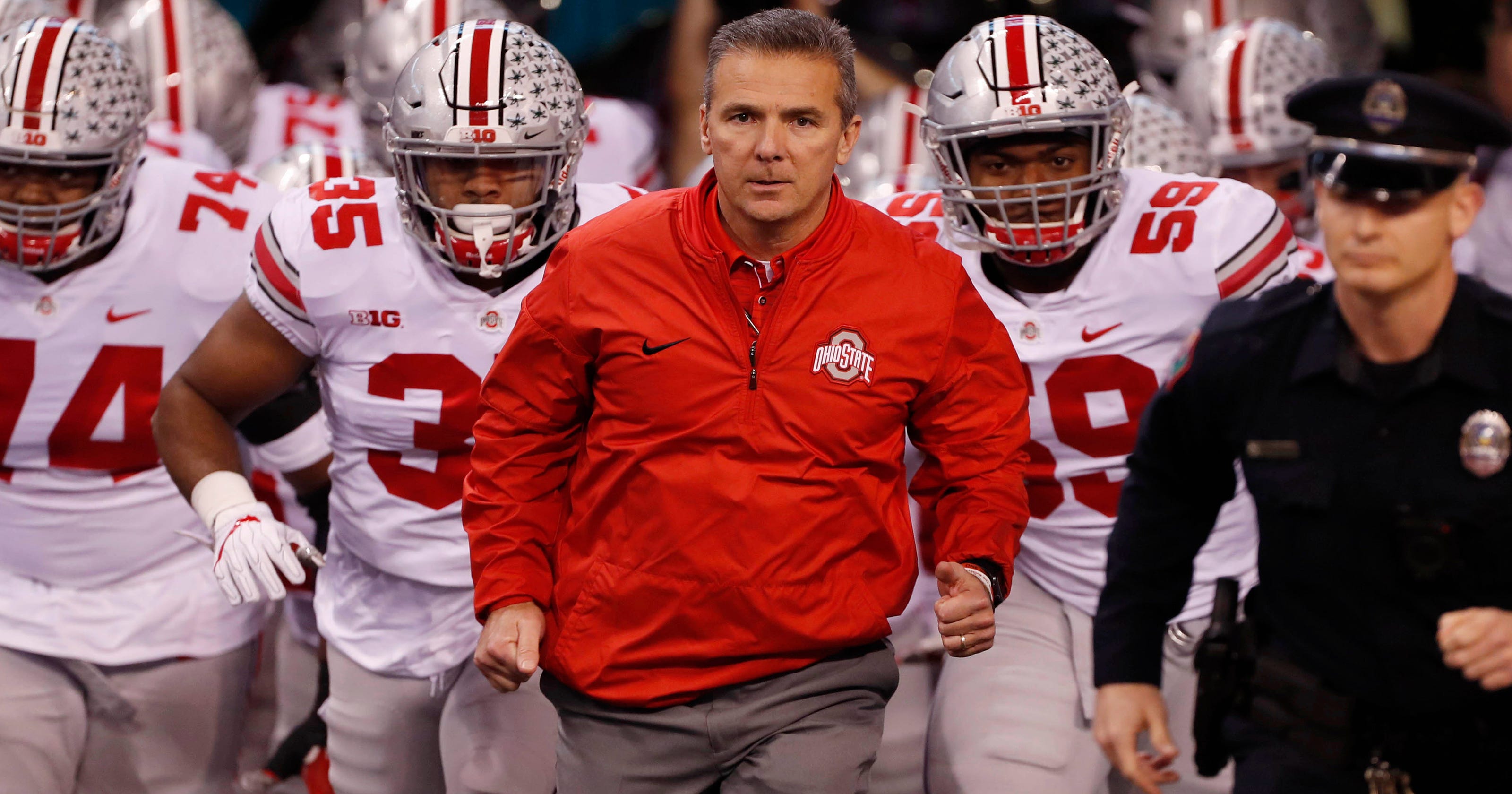
Ohio State suspends football coach Urban Meyer three games: ‘I want to apologize’

news image

CLOSE

Ohio State has announced that Urban Meyer will be suspended for the first three games of the season. Here’s how that will affect the Buckeye’s season.
USA TODAY Sports

COLUMBUS, Ohio — Ohio State suspended its national championship football coach Urban Meyer for three games after the school investigated his handling of allegations of domestic abuse involving one of his former assistant coaches.

The announcement comes after the school’s Board of Trustees appointed an independent panel to oversee a two-week investigation of Meyer and what he knew about domestic abuse allegations against former wide receivers coach Zach Smith. The board reviewed the report and discussed its actions for nearly 11 hours on Wednesday. 

Meyer, who will miss games against Oregon State, Rutgers and TCU, is suspended without pay. He has been on paid leave since Aug. 1.

He cannot work with the team at all through the Oregon State game. After that, he can coach practices but cannot be at the next two games.

“I appreciate the opportunity to learn from a mistake,” Meyer said at a press conference. “There were red flags (with Zach Smith). I wish I did a better job knowing things and finding out things. I wish people told me more things. . . . I wish I had known more.

““I want to apologize to the Buckeye Nation. I followed my heart and not my head. … At each juncture I gave Zach the benefit of the doubt.”

More: Urban Meyer stays as Ohio State football coach, but he is diminished after investigation

More: Urban Meyer: A timeline of the college football coach’s career

Athletic director Gene Smith also was suspended from Aug. 31 to Sept. 16. “I have ultimate authority and oversight and I’m accountable for the athletic department, and in particular, the football program,” Gene Smith said. “I could have done a better job in this particular instance.”

According to the report: “Although neither Urban Meyer nor Gene Smith condoned or covered up the alleged domestic abuse by Zach Smith, they failed to take sufficient management action relating to Zach Smith’s misconduct and retained an Assistant Coach who was not performing as an appropriate role model for OSU student-athletes.  Permitting such misconduct to continue is not consistent with the values of the University and reflects poorly on Coach Meyer, Athletic Director Smith, and the University.  Their handling of this matter did not exhibit the kind of leadership and high standards that we expect of our Athletic Director, Head Coach, Assistant Coaches and all on the football staff.”

During his administrative leave, Meyer was barred from coming on campus. But he was seen entering the building early in the trustees’ session. His wife, Shelley, arrived around 2:30.

Zach Smith was accused of abuse by his ex-wife on several occasions, most recently in 2015. Meyer initially denied knowledge of the alleged 2015 incident during an appearance at Big Ten Conference media days in July. He later he admitted to previously knowing about the matter and said he followed proper reporting protocols and procedures.

In an interview for the web site Stadium, Smith’s ex-wife, Courtney Smith, said she had told Meyer’s wife, Shelley, and Lindsey Voltolini, the wife of Ohio State’s director of football operations, about her ex-husband’s abusive behavior.

Among the correspondences between Smith and Shelley Meyer were photos showing bruises stemming from the 2015 incident. 

Following the interview of Smith, the school’s Board of Trustees appointed an independent panel to oversee the investigation of Meyer. 

Ryan Day, offensive coordinator and quarterbacks coach,is serving as  interim head coach.

Across multiple stops, each more successful than the last, Meyer’s coaching career has been a contradiction of near-unparalleled success marred by bouts of controversy.

At Florida, where Meyer led the Gators to national championships in 2006 and 2008, his program dominated the Southeastern Conference yet too often found itself in the headlines for player misconduct. Off the field, a program that seemed invincible was anything but.

Thirty-one players were arrested during Meyer’s tenure, which spanned from 2005-10. A report by Sporting News detailed an altercation between Florida assistant coach Billy Gonzales and star receiver Percy Harvin, which saw Harvin grab Gonzales by the throat and tackle him to the ground before being separated by two assistants.

Another one of Meyer’s stars at Florida, tight end Aaron Hernandez, was involved in two incidents during his time with the Gators, both in 2007. In one, Hernandez punched a restaurant employee in the side of the head, rupturing the individual’s eardrum. In the other, Hernandez was viewed as a person of interest in a shooting that occurred after a night at a local nightclub.

In 2013, Hernandez was arrested and charged in the murder of an acquaintance in North Attleborough, Mass. Hernandez was found guilty of first-degree murder in 2015.

On the field, on the other hand, Meyer led Florida back to prominence after a brief dip following the retirement of former head coach Steve Spurrier.

Led by quarterback Tim Tebow, the Gators won the national championship in both 2006 and 2008, finished No. 3 in the Amway Coaches Poll in 2009 and finished lower than 16th nationally just once, in Meyer’s final season in 2010.

Meyer nearly retired in the winter of 2009, after a health scare involving chest pains following the recent conference championship game and a desire to spend more time with his family. He officially stepped down on Dec. 9, 2010 with a 65-15 record at the school, and spent the 2011 season as an analyst for ESPN.

“At the end of the day, I’m very convinced that you’re going to be judged on how you are as a husband and as a father and not on how many bowl games we won,” Meyer said at the time.

But it wasn’t long before he returned to coaching. A native of Ashtabula, Ohio, Meyer was hired by Ohio State in late November of 2011, and immediately moved the Buckeyes into elite company: OSU went 12-0 in his debut season, in 2012, though the Buckeyes were ineligible for the postseason due to sanctions stemming from the Jim Tressel era.

Of Meyer’s six teams, just one, in 2013, finished outside the top 10 of the Coaches Poll. The 2014 team claimed the inaugural College Football Playoff national championship. Each of the five Meyer-coached teams eligible for the postseason reached a New Year’s Six bowl; all six combined for just three losses in regular-season Big Ten play.

He always had a reputation for being difficult, addicted to the details, micromanaging every detail of his program, however small. At Ohio State, for instance, the desk in Meyer’s office was angled toward the door leading into the Buckeyes’ main football facility — allowing him to see who was going in and out, and when.

Yet you could never argue with the results. Meyer holds a career record of 177-31, which includes earlier, two-year stints at Bowling Green and Utah. His final team at Utah, in 2004, went 12-0 and won the Fiesta Bowl. In the history of the FBS, just three coaches have done better than Meyer’s 85.1 winning percentage. 

Read More

from Trusted eNews https://ift.tt/2MMHmvO
via IFTTT

Design a site like this with WordPress.com
Get started