Suicide prevention experts: What you say (and don’t say) could save a person’s life

news image

CLOSE

On average, there are 123 suicides per day in the United States. If you or someone you know needs help, call the National Suicide Prevention Lifeline at 1-800-273-TALK.
USA TODAY

Mental health experts say it’s time to normalize conversations about suicide.

For every person who dies by suicide, 280 people think seriously about it but don’t kill themselves, according to the National Suicide Prevention Lifeline. 

There’s not one answer to what makes someone move from thinking about suicide to planning or attempting it, but experts say connectedness can help. 

“Reaching out … can save a life,” said Jill Harkavy-Friedman, a clinical psychologist and vice president of research at the American Foundation for Suicide Prevention. “Everybody can play a role.”

World Suicide Prevention Day on Sept. 10 is of particular note in the United States where suicide rates have increased nearly 30 percent over the past two decades.

Pay attention to risk factors and warning signs

The Suicide Prevention Resource Center reports that these conditions increase a person’s risk:

  • Prior suicide attempt
  • Abuse of alcohol or drugs
  • Mental disorders
  • Access to lethal means
  • Knowing someone who died by suicide
  • Social isolation
  • Chronic disease and disability
  • Lack of access to behavioral health care

These warning signs, whether risk factors are known or not, mean you should take action:

  • Talking about wanting to die or to kill themselves
  • Looking for a way to kill themselves, like searching online or buying a gun
  • Talking about feeling hopeless or having no reason to live
  • Talking about feeling trapped or in unbearable pain
  • Talking about being a burden to others
  • Increasing the use of alcohol or drugs
  • Acting anxious or agitated; behaving recklessly
  • Sleeping too little or too much
  • Withdrawing or isolating themselves
  • Showing rage or talking about seeking revenge
  • Extreme mood swings

You can check in on people based on what you know about them, said John Draper, director of the National Suicide Prevention Lifeline.

“All those warning signs that we’ve listed for what makes a person look suicidal are fairly generic and hard for us to be able to spot unless you’re a diagnostician,” Draper said. “However, you know when a person is having relationship problems or going through a divorce — you know when somebody has serious financial loss. … These are very human recognizable signs that people could be needing help.” 

While experts caution that suicide is never the result of a single cause (bullying, a breakup, job loss), when those events are combined with other health, social and environmental factors they can heighten risk. 

The most important thing you can do is look for a change, said April Foreman, a licensed psychologist who serves on the American Association of Suicidology’s board of directors. 

“Notice when somebody is different,” Foreman said. “Trust your gut. If you’re worried, believe your worry.”

What to do 

It’s important to encourage someone who is having suicidal thoughts to call the Lifeline (800-273-8255), find a support group, or reach out to a therapist, particularly one who specializes in evidence-based suicide prevention techniques such as Dialectical Behavior Therapy and Cognitive Behavior Therapy for Suicide Prevention. However, there are also things you can do.  

The National Action Alliance for Suicide Prevention and the National Suicide Prevention Lifeline have identified these five steps to help reduce deaths by suicide:

1. Ask. In a private setting, ask the person you’re worried about directly if they’re thinking about suicide. Studies have shown that it does not “plant the idea” in someone who is not suicidal but rather reduces risk. It lets the person know you’re open to talking, that there’s no shame in what the person may be feeling. If a person tells you they’re thinking about suicide, actively listen. Don’t act shocked. Don’t minimize their feelings. Don’t debate the value of life itself, but rather focus on their reasons for living. 

2. Keep them safe. Determine the extent of the person’s suicidal thoughts.

“We want to know are you thinking about killing yourself? Do you have a plan? What were you thinking of doing? Do you have the materials to do that? Have you gathered those things? Where are they? What could I do to help you stay around until this passes?” Harkavy-Freidman said.

If a person does have a plan, it’s important to take action to remove the lethal means. (Guns were used in 23,000 of the 45,000 deaths by suicide in 2016, according to the Centers for Disease Control and Prevention.) 

3. Be there. If someone tells you they’re thinking about suicide, continue to support them. Ask them to coffee. Give them a call. Some people will eventually stop having suicidal thoughts and feelings, others will continue to struggle throughout their lives. 

Deena Nyer Mendlowitz, 40, of Cleveland, is a suicide attempt survivor who has had chronic thoughts of suicide since she was 8 years old. Mendlowitz said one of the moments she felt most supported was when she was going through electroconvulsive therapy and a friend brought her a meal.

“I just felt like I had a regular disease at that point, because they were doing an action they would have done for a friend who was going through anything else,” she said. “And I thought, somebody cares about me in the regular way they care about people.”

4. Help them connect. Encourage them to seek additional support. That could mean calling the Suicide Lifeline (800-273-8255), suggesting they see a mental health professional or helping them connect with a support group.

Jennifer Sullivan, a 21-year-old college student at Worcester State University in Massachusetts, struggled with suicidal ideation as an adolescent. It grew worse after she was raped twice, she said. Joining a sexual assault support group made her feel less alone.

“I met a fantastic group of young ladies,” she said. “One became one of my best friends. When I had feelings of wanting to die or cut I would tell her I was having a bad day.”

5. Follow up. Keep checking in. Call them, text them. Ask if there’s anything more you can do to help. 

After a suicide attempt

One of the risk factors for suicide is a prior attempt.

Studies show that suicide survivors often experience discrimination and shame and may struggle to talk about their feelings because they are worried people will judge or avoid them.

“When I started publicly speaking about my experience … people would treat me differently,” said Chief Warrant Officer Cliff Bauman a suicide survivor in the Army National Guard. “Somebody, if he was my friend and we laughed and joked the day before, now suddenly doesn’t know how to approach and talk to me.”

If someone you know is a suicide survivor, in addition to the steps above, the Suicide Lifeline says:

  • Check in with them often and let them know you’ll listen.
  • Don’t make their feelings about you. Don’t make them feel guilty.
  • Do tell them you want them in your life.
  • If they start to show warning signs, ask directly if they’re thinking about suicide. 
  • Call the Lifeline for advice on how to help a loved one.

Resources to get help

Suicide Lifeline: If you or someone you know may be struggling with suicidal thoughts you can call the U.S. National Suicide Prevention Lifeline at 800-273-TALK (8255) any time of day or night or chat online.

For people who identify as LGBTQ, if you or someone you know is feeling hopeless or suicidal, you can also contact The Trevor Project’s TrevorLifeline 24/7/365 at 1-866-488-7386.

The Military Crisis Lineonline chat, and text-messaging service are free to all service members, including members of the National Guard and Reserve, and veterans, even if you are not registered with the U.S. Department of Veterans Affairs (VA) or enrolled in VA health care. Call 1-800-273-8255 and press 1.

Check these out:

Read or Share this story: https://usat.ly/2CFrE20

Read More

from Trusted eNews https://ift.tt/2x1Ibak
via IFTTT
US Open: ‘There’s sexism in tennis but that doesn’t excuse Serena Williams’ behaviour’

news image

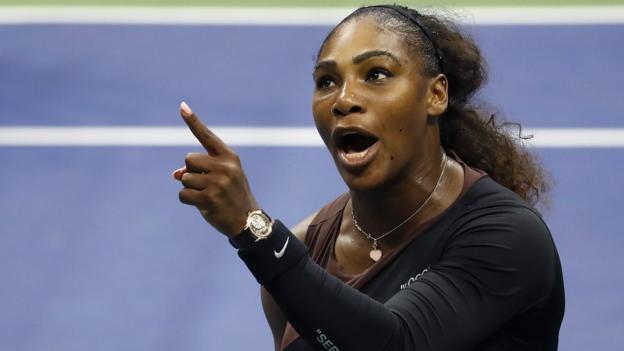
Watch: Serena Williams calls umpire ‘liar’ and ‘thief’

Serena Williams has been the victim of misogyny and racism throughout her life, but that does not make her immune from sanction when she steps out of line.

Williams was fined a total of $17,000 (£13,100) for the three code violations she was issued in the US Open final she lost to Naomi Osaka – a tiny fraction of her winnings, admittedly, but a significant fine nonetheless in the context of the sport.

The accusation of sexism she levelled at umpire Carlos Ramos for docking her a game for verbal abuse – she had called him a “liar” and a “thief” – ensured the story would command headlines for days. The stakes then became even higher when two of the most senior administrators in the sport endorsed Williams’ comments and laid the blame squarely at the umpire’s door.

The chief executive of the Women’s Tennis Association, Steve Simon, issued a statement to say he did not feel Ramos was as tolerant to Williams as he would have been to a man. Earlier in the day, the US Tennis Association president Katrina Adams also accused Ramos, and other umpires, of gender bias in a television interview.

“We watch the guys do this all the time,” she said on the ESPN set at Flushing Meadows.

“They are badgering the umpire on the changeovers, and nothing happens. There’s no equality.”

These comments are made without a moment’s thought for all the umpires who are in the chair this week in Chicago, Quebec City and Hiroshima, and in the weeks and months to come. Their authority is instantly undermined.

Vested interest is rife in tennis. Conflicts of interest abound. Adams has a relationship to protect with Williams. Simon is looking out – in purely business terms – for the WTA’s biggest commercial asset.

He did the same for Maria Sharapova at the time of her positive drugs test. First he offered a glowing character reference before due process had even taken place, and then publicly reprimanded the French Tennis Federation for not offering the Russian a Roland Garros wildcard just after her ban had expired.

There are too many voices, too many governing bodies. The four Grand Slams are the pillars of the sport and they compete for influence along with rule-making body the International Tennis Federation, the WTA, which runs the women’s tour, and the Association of Tennis Professionals (ATP), which runs the men’s. Reform would be welcome, but do not hold your breath.

Ramos is an umpire with a reputation for standing up to star players, which is partly why he has been asked to take charge of singles finals at all of the Grand Slams, as well as the Olympic Games. He would have faced criticism had he not taken action against Williams for calling him a liar and a thief.

There is too much sexism in tennis. But that should not be used as a smokescreen to excuse the behaviour of the 23-time Grand Slam champion.

US Open champion Naomi Osaka was in tears during the post-match ceremony

Do umpires show more leniency to men? There is no strong evidence from this US Open, and the Italian Fabio Fognini was fined $96,000 and given a suspended Grand Slam ban for verbal abuse at last year’s event. His offence was far worse, and his language to umpire Louise Engzell unquestionably misogynistic, but at least strong action was taken.

ATP players should think carefully about whether they address female umpires differently to their male counterparts. And if WTA players do feel strongly that umpires treat them more harshly then men, then this needs to be investigated.

The WTA Tour has been fighting discrimination since its inception. Vast progress has been made, and yet there are too many areas where women seem to come off worst. It is only 11 years since the All England Club offered equal prize money, and there are often locker room complaints about the scheduling at Wimbledon.

And here at the US Open, winner Coco Vandeweghe was unhappy the women’s doubles presentation was cut short to allow the men’s singles final to start on time. There was also widespread unhappiness at the warning Alize Cornet received for changing her top on court after realising she had put it on back to front.

Then there is the issue of mid-match coaching, which takes us back to where this story began. On-court coaching is allowed at certain times on the WTA Tour, but secret signals from the players’ box are never permissible. Coaches do it all the time, but it is impossible for umpires to police consistently.

Bring tennis into the 21st century by allowing coaching on every point, says Billie Jean King (and many others).

Tennis is a sport for individuals, who must problem solve themselves, retort traditionalists.

Once again, tennis is torn.

Read More

from Trusted eNews https://ift.tt/2x8xeVx
via IFTTT

Rebels, Turkey prepared for battle, but assault could be delayed

news image

Antakya, Turkey – In the days that followed last week’s summit in Tehran between Russia, Iran and Turkey on the fate of Syria’s Idlib province, the last rebel bastion in the war-ravaged country, the bombardment of opposition-held areas intensified significantly.

The escalation fuelled speculation of an imminent, full-fledged onslaught by Syrian government forces, backed by their Russian and Iranian allies, against the rebels in Idlib.

But although both sides have stepped up their military preparations, there could still be some time before the start of a major ground and air offensive, according to a current rebel commander and a former one.

“I don’t think there will be a [large-scale] attack on Idlib, in any [point],” said Tariq Sulaq, commander of the Second Coastal Division, part of al-Jabha al-Wataniya lil-Tahrir (NLF), one of the two main armed opposition alliances in Idlib.

“I think we are in a period of [searching for] a solution for Syria,” he told Al Jazeera.

Idlib is the last barrier standing between the government of President Bashar al-Assad and its military victory against a rebellion that began in 2011.

The United Nations and aid groups have repeatedly warned of a major humanitarian disaster if the offensive takes place in the northwestern province, where an estimated three million people reside, half of whom are internally displaced. 

According to Sulaq, the ongoing targeting of sparsely populated rebel-held areas in southern Idlib and northern Hama provinces does not signal the beginning of a ground offensive.

“The military and media pressure [by the Russians and the Syrian government] aims to win the civilians over and damage the morale of the armed factions by trying to convince them that the Turks can’t protect them,” he said.

For Sulaq, the three-way summit in the Iranian capital, during which Russia rejected a Turkish call for a ceasefire, did not have a big impact on the situation on the ground. He said he attended a meeting with Turkish military officers one hour after the end of the September 7 talks in Tehran.

“They told us that … if Russia and Iran take the decision to attack the liberated areas and make even one step, they will intervene and will be at the front line with the Syrian fighters,” he said. “They are serious about this decision and their movements on the ground show that.”

Over the past week, Turkey, which backs certain rebel groups in Idlib, has been sending reinforcements to its 12 observation points inside opposition-held areas, which were set up under a “de-escalation” agreement it reached with Russia and Iran last year.

Sulaq said heavy weapons, including tanks, military carriers and batteries, have already entered Idlib, adding that there is a contingency plan for the deployment of Turkish soldiers on the ground in the event of an offensive on Idlib.

Air raids and shelling targeting rebel-held areas in Idlib have intensified [Omar Haj Kadour/AFP]

Khalid Rahal, a former commander of opposition armed group al-Hijra ila-Allah (Hijra to Allah), who currently resides in Turkey, agreed that an offensive might not start any time soon, with political negotiations still ongoing.

“The Russians and the regime are preparing; there are convoys, they are amassing troops [near the front line], but I think a political solution is still in process,” he told Al Jazeera.

“Turkey got 20 percent guarantees during the [Tehran] summit – that it will control Idlib. The Russians demanded no targeting of Hmeimim airbase and areas loyal to the regime.”

Russia’s military has accused rebels in Idlib of attacking its Hmeimim base in Syria’s Latakia province with weaponised drones.

According to Rahal, Turkey also got an extension on a deadline set by Russia to resolve the issue of Hay’et Tahrir al-Sham’s (HTS)  presence in Idlib. Moscow considers HTS, the other main armed coalition in Idlib, a terrorist organisation and has used it as a justification for the planned offensive on the province.

HTS appeared in 2012 as Nusra Front, the Syrian branch of al-Qaeda, but renounced its affiliation in 2016. Turkey has been trying to dissolve the armed group, and on August 31 it also designated it a terrorist organisation.

Rahal said Turkey’s communication with HTS is continuing, even after Ankara failure’s to come to an agreement with it to disband, while HTS units keep providing security to Turkish convoys entering Idlib.

Yet, if a solution is not reached, Turkey could resort to a military intervention to dissolve HTS by force, added Rahal.

But Ilter Turan, a professor of political science at Istanbul Bilgi University, cast doubt on such a prospect.

“I don’t think Turkey will militarily [eliminate] any group in Idlib, as they [have] all fought in line with its policies up until now,” he told Al Jazeera. “Ankara [hasn’t] signaled a change of heart in this issue.”

Turan also said the latest deployment of Turkish forces “did not please” the Syrian government and its Russian and Iranian allies.

“It is a step that can cause more problems in the trilateral cooperation [between Turkey, Russia and Iran].”

The Turkish foreign ministry did not respond to request for comment on Turkey’s military plans and efforts in Idlib.

Free Syrian Army fighters exit a cave in the outskirts of Jisr al-Shoghur in Idlib province [Ugur Can/DHA via AP) 

Although a ground offensive on Idlib might have been delayed for now, the armed opposition in Idlib is still making extensive preparations for it, both Abu Rahal and Sulaq confirmed.

Fortifications, tunnel digging and defensive works have been carried out from the Turkmen Mountain in northern Latakia province in the west all the way to the town of Khan Sheikhoun in southern Idlib province.

Sulaq said that uniting the armed groups of the moderate opposition under the umbrella of the al-Jabha al-Wataniya lil-Tahrir three months ago was part of the preparations for the battle for Idlib.

Over the past few months, all groups in the coalition have been holding intensive training and boot camps.

Turkey’s diplomatic effort

Taha Ozhan, a former Turkish MP and head of parliament’s foreign affairs committee, told Al Jazeera that he also does not expect a large-scale operation in Idlib for now.

“There are a couple of political processes that need to be done. There is a meeting in Istanbul in the coming days, some other diplomatic efforts. Without [their conclusion], I don’t expect a full-fledged [offensive] to start,” he told Al Jazeera, referring to the recently announced summit between Russia, Turkey, Germany and France scheduled for later in September.

Turkish President Recep Tayyip Erdogan announced the meeting in late July, saying that it will address “what we can do in the region”.

According to Ozhan, given the participation of France and Germany, it is likely that the summit will focus on the issue of refugees and averting a crisis in densely populated Idlib.

Turkey is already hosting more than three million Syrian refugees.

Hundreds of thousands of people have been killed since Syria’s war broke out more than seven years ago, while millions of others have been forced from their homes.

Apart from fearing a humanitarian disaster and a wave of refugees trying to cross into its territory, Turkey also sees Idlib as a big security risk, Ozhan said.

A potential takeover by the Syrian government could give more operational space to Kurdish forces affiliated with the Kurdistan Workers Party (PKK), which Turkey considers a terrorist organisation, but more worryingly, it could set off a period of insecurity and the resurgence of Islamic State of Iraq and the Levant (ISIL, also known as ISIS), Ozhan pointed out.

“If [the Syrian government] destroys Idlib, nobody knows where it will go. [The situation] could go back to 2013-2015.”

Ozhan said that in parallel with the political negotiations, Ankara is also trying to resolve the issue of HTS’ presence in Idlib. Dissolving the group, he argued, is the only way forward for Ankara.

Mariya Petkova (reported from Antakya, Turkey. Umut Uras () reported from Doha, Qatar

Read More

from Trusted eNews https://ift.tt/2x3JjtV
via IFTTT

Apple really needs to refresh the Mac Mini

news image

Please Apple, give us a smaller space gray Mac Mini.

Image: vicky leta/mashable

No joke, its been almost four years since Apple updated the Mac Mini on Oct. 14, 2014. Since then, we’ve gotten new MacBook Pros, iMacs, and several iterations of macOS. But Apple’s entry-level Mac remains the same?

It’s about time for Apple to update the Mac Mini with more powerful hardware, better graphics, and a slimmer design that keeps the ports. Currently, the 2014 model has a slow Intel Haswell processor with integrated graphics, a basic hard drive, and a compact yet boxy design. 

With no monitor or included accessories, the Mini has always been the most affordable Mac. It was the first one I had in my house growing up amongst a sea of PCs. With the tagline “Just connect your own display, keyboard, and mouse,” it’s plug-and-play out of the box, but in 2018 the experience out of that box is an obsolete one.

There’s reason to hope for an upgrade. Last October, Tim Cook replied to a customers email with a hint: 

While it is not time to share any details, we do plan for Mac mini to be an important part of our product line going forward.

He provided hope, and fingers crossed Apple is getting ready to share those details.

Apple is likely announcing new iPhones, Apple Watches, and iPads at its Sept. 12 event, so why not tack on a new Mac Mini as well? A quick mention and a run-through of new specs is all that’s needed. It doesn’t necessarily need the latest and greatest chips — a generation or two back would still be a big improvement. As long as it runs macOS Mojave well, it’ll be fine.

Apple should keep the upgradeable aspect of the Mac Mini, with a simple, pop-out bottom cover. I wouldn’t mind if they no longer solder the RAM — the current model does this, making it hard to upgrade — but at this point users shouldn’t be picky.

The current 2014 Mac Mini has an array of ports that makes 2018 MacBook Pro owners jealous.

The current 2014 Mac Mini has an array of ports that makes 2018 MacBook Pro owners jealous.

Image: JAMES PIKOVER/MASHABLE

I know USB-C is in on Apple computers, but you know what would be really courageous? Keeping the ports. As long as Apple upgrades the USB-A ports to USB 3.0 ports. An SD card reader, Thunderbolt, HDMI, and more would give the folks who haven’t caught up with Apple’s USB-C world a nice, affordable option.

The most recent model from 2014 comes measures just 1.5-inches high but has a large footprint at 7.7-inches diagonally. If Apple keeps the ports, I don’t see a reason to shrink the design, but taking an inch off probably wouldn’t hurt. Silver finish is fine; the space gray is mostly for Apple’s “pro” products anyway.

Most important: The Mac Mini still has a place. It’s a unique device in that works well as an entry-level computer, a media server, or even a device for web hosting. I could see a small businesses could using it as a souped-up cash register.

The time is now for Apple to move the Mac Mini off of life support, give it a proper refresh, and keep it an affordable starting price.

Who knows? It might just inspire the next generation of users to find creative uses for it.

P.S. Apple, it would be nice to offer a bundle option, with a mouse and keyboard in the box. Just saying.

Https%3a%2f%2fvdist.aws.mashable.com%2fcms%2f2018%2f7%2feccecbf0 719f fb87%2fthumb%2f00001

Read More

from Trusted eNews https://ift.tt/2MZtvDz
via IFTTT

Actress Carole Cook jokes ‘Why not?’ about President Trump assassination

news image

Broadway actress Carole Cooke may be making it onto the president’s enemies list.

Cooke, 94, was asked by TMZ for her thoughts on fellow Broadway star Timothy Hughes ripping a Trump banner from an audience member’s hand during a curtain call last week at Broadway’s Frozen.

The actress gave a no holds barred answer, telling TMZ, “I didn’t see it. I didn’t hear that. My answer to that is… Where is John Wilkes Booth when you need him?

Her husband Tom Troupe, who was standing next to her, said, “He killed presidents.”

“Don’t say that. They’ll get me for that. They won’t see,” she told Troupe, before adding, “Where is he when you need him?”

When asked by TMZ, “So, we need to kill President Trump?”

Cooke responded, “Why not?”

“Will that get me in trouble? Will that get me on the enemies list?” she added. “God, I hope so. Just keep me out of jail — or maybe not.”

RELATED: Sean Penn on the political relevance of the mysterious Bob Honey Who Just Do Stuff

Hughes made headlines last week when he ripped a “Trump 2020” flag from an audience member’s hands.

He shared a video of the moment on Instagram in which he addressed his actions.

“What does it say about our country and politics when a man at the show tonight felt the need to protest Disney’s Frozen on Broadway with a pro Trump flag??” he wrote in the caption.

“How frightening is it that our show’s messages of love, acceptance, and diversity have become the opposition to supporting Trump?” Hughes continued. “The curtain call is a thank you between actors and audience, a final connection to end a shared experience.”

“I will not apologize for how I responded to the disrespectful man trying to interrupt this moment with a pathetic political platform,” he added. “Not at our show! Not in front of my beautiful, diverse, talented cast @frozenbroadway. I appreciate everyone’s support. #resist #lovewins #lovetrumpshate.”

This isn’t the first time someone has brought up the topic of assassination when it came to the president.

In March 2018, Sean Penn made similar comments in his novel Bob Honey Who Just Do Stuff, a story about a part-time assassin and septic tank salesman.

RELATED VIDEO: Johnny Depp Gets Heated About Donald Trump: ‘When Was the Last Time an Actor Assassinated a President?’

In one new addition to the story, Honey writes a letter to the book’s fictional president, Mr. Landlord, who seems to be a thinly veiled representation of Donald Trump.

“You are not simply a president in need of impeachment, you are a man in need of an intervention,” Honey writes in the letter. “We are not simply a people in need of an intervention, we are a nation in need of an assassin.

Johnny Depp also ignited controversy in June 2017 when he asked the audience of the Glastonbury Festival in England if someone could bring Trump there.

When the audience began booing he said,  “No, no, no, you misunderstood completely. I think he needs… help.”

He continued, “When was the last time an actor assassinated a president?

The crowd cheered and clapped, but Depp continued speaking, saying, “I want to clarify, I’m not an actor. I lie for a living.”

Depp was no doubt referencing Booth, the actor who assassinated President Abraham Lincoln in 1865.

Read More

from Trusted eNews https://ift.tt/2CNsbia
via IFTTT

Julie Chen skips ‘The Talk’ premiere after husband Leslie Moonves resigns from CBS

news image

CLOSE

Former CBS head Les Moonves has spoken out after being ousted for multiple allegations of sexual misconduct.
Buzz60

Fans who tuned in Monday for the Season 9 premiere of CBS’ “The Talk” saw a teaser that opened with the newest allegations against network CEO Les Moonves. The promo promised, “We’re talking about it.” Well, everyone that is, except for co-host Julie Chen, his wife of nearly 14 years. 

Moonves resigned after Sunday’s report from the New Yorker in which six new women accused him of sexual misconduct and intimidation, in addition to the six whose stories the magazine published on July 27. (When “The Talk” returned on July 30, Chen was present but declined to discuss the scandal on air, referring viewers to a Twitter statement expressing full support for her husband, who has denied the new allegations.


“As you all know, Julie’s husband is in the news, and she’s taking off time to be with her family,” explained “Talk” co-host Sharon Osbourne, who described the premiere as “bittersweet.”

After bringing the audience up to speed on Moonves’ resignation with clips from “CBS This Morning” and “Good Morning America,” Osbourne praised Chen and addressed the awkwardness surrounding the situation.

“First of all, I want to say that whatever times I’ve had of hardship over the last eight years, Julie has always been there for me. She’s been a friend; she’s somebody I admire and respect greatly, and it’s very embarrassing and upsetting to have to talk about her husband, but we do. We feel it’s right.”

Osbourne added that she only knew the former CBS exec in a “superficial” way and that she believes the accusers due to the number and their similar accounts. “The stories are so similar, the pattern is so similar that for me, it’s… (he’s) not been convicted of any crime, but obviously, the man has a problem.”

Becoming unsettled, Osbourne asked for her co-hosts’ input, imploring them to “throw me a bone.”

“I agree, Julie is our friend,” Sara Gilbert concurred. “This is our ninth season, and we’ve been together since the beginning, I love her, I support her always. However, this is an important time in our culture, and just because this hits close to home, it doesn’t change this story.

“All women’s stories matter, and these women’s stories matter,” she added. “This is very serious, and the appropriate actions need to take place. I am happy when women are heard because for a long time, they haven’t been.”

Rapper/actress Eve, who joined the cast in November 2017, chimed in, adding, “I’ve now come to care for everyone woman at this table, and this is ridiculously difficult. I support Julie, and I’m praying for her and praying for her family and just sending her strength, because this is, it’s really really hard. And I can’t wait, and I hope and I that we get to a place where we don’t have to talk about this anymore, where women are equal, where these stories just won’t have to happen anymore.”

Co-host Sheryl Underwood got visibly choked up as she tried to find a silver lining in the cloud: “Julie Chen, I know is very strong – a resilient women, but I think this is a blessing from God to be unburdened from secrets and unchained from lies and that now is the time for everyone to look inside themselves and become better people.” 

She added, “Today, we have got to understand that women are carrying this around. And then you wonder, ‘Why I can’t get a job?’ and say, ‘These things can’t happen.’  But today, we say enough is enough,” she said. “And today, we say, ‘We believe you, we hear you.’ 

“Hopefully, somebody’s gonna ask you for forgiveness and somebody’s going to say, ‘I need to be a better person because God let your eyes open today,’ ” she concluded. “Do better with your life and never come back to this day, ever again.”

For his part, Moonves denied the new allegations and reflected on his CBS career in a statement issued to USA TODAY Sunday night.

“Untrue allegations from decades ago are now being made against me that are not consistent with who I am,” he said, calling his career at CBS “an incredible privilege.”

“I am deeply saddened to be leaving the company,” the statement continued. “I wish nothing but the best for the organization, the newly comprised board of directors and all of its employees.”

Contributing Bill Keveney

More: CBS CEO Les Moonves becomes most powerful media exec to resign in wake of #MeToo

Autoplay

Show Thumbnails

Show Captions


Read or Share this story: https://usat.ly/2N2bcxj

Read More

from Trusted eNews https://ift.tt/2N2qhz6
via IFTTT

More children are dying by suicide. Researchers are asking why

news image

Samantha Kuberski hanged herself with a belt from a crib. She was 6.

Razy Sellars was 11 when he took his life. Gabriel Taye was 8. Jamel Myles was 9.

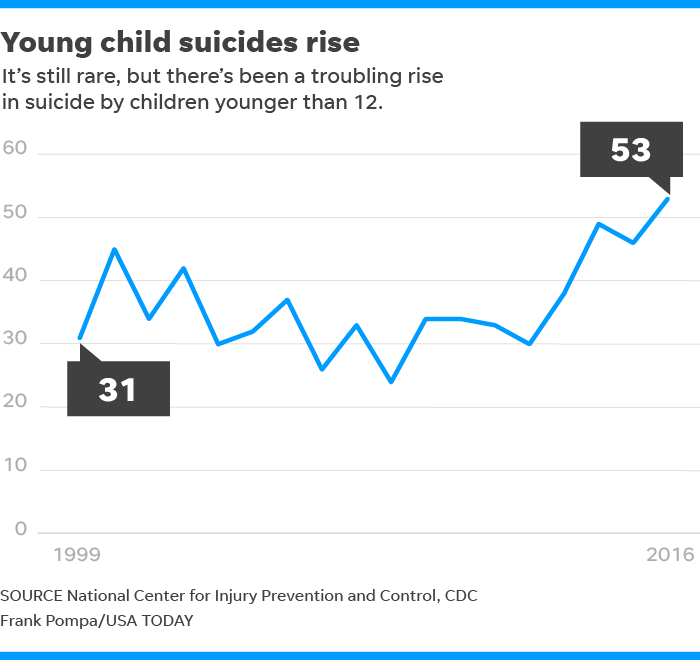
Suicide in elementary school-aged children remains rare: 53 children aged 11 and younger took their lives in 2016, the last year for which the Centers for Disease Control and Prevention has data. But medical professionals and researchers have noted alarming increases in the last decade – deaths more than doubled from 2008 to 2016 – and rising numbers of young children visiting emergency rooms for suicidal thoughts and attempts.

“You hear of all these kids taking their lives and you just don’t understand why it is,” says Christine Sellars, Razy’s grandmother. “I don’t know if it’s the changing times, the way kids are brought up today or the peer pressure.

“It’s just so sad.”

The reasons for the increases are unclear. Few researchers have examined suicide before age 10, so little is known about suicidal thinking and behavior in young children.

But as they look more closely, themes are beginning to emerge. Attention deficit hyperactivity disorder, which can make impulsive youth still more impulsive, was a common characteristic found in a 2016 study by researchers from Nationwide Children’s Hospital in Columbus. So were arguments or disagreements with family members and friends.

Unlikein suicides of adults, depression didn’t appear to be a major factor.

Many of the deaths followed episodes of bullying. Social media can amplify those attacks – and make them impossible to escape.

Among cases that involved bullying:

• Schoolmates called Sellars gay and made fun of his clothes before he took his life in Akron, Ohio, in May, his mother told reporters at the time. After his death, his older brothers were taunted on Snapchat and Twitter. His mother said some suggested they should kill themselves, too. 

• Stormiyah Denson-Jackson, 12, was bullied at her Washington, D.C., boarding school, her mother told a local television station. When the girl reported it to school officials, her mother said, she was herself accused of bullying. She was found dead in her dorm room in January.

• Taye was assaulted by a fellow student in a school bathroom two days before he hanged himself in Cincinnati in 2017, his family said.

While it’s not clear that bullying causes suicide-related behavior, the CDC says it’s among the risk factors that increase the likelihood that a young person will consider and/or attempt to take his or her life.

Children who have disabilities or differences in learning, sexual/gender identity or culture are often most vulnerable to being bullied, according to the CDC. (The federal agency says acknowledging risk factors is not the same as blaming victims.)

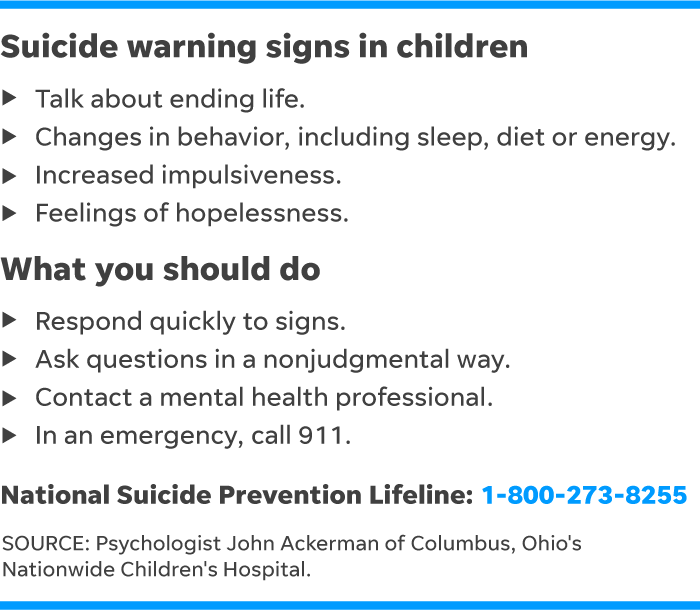
Psychologist John Ackerman is the suicide prevention coordinator at the Center for Suicide Prevention and Research at Nationwide Children’s Hospital. The child psychologist tries to strike a balance of reassurance and alarm.

Only about 10 percent of people of any age who attempt suicide ever end their lives, he notes. But at the same time, he says, “We don’t want to normalize suicidal behavior.”

One question researchers are probing: Do children as young as 6 understand the finality of death? Can those who have died by suicide be said to have been aware of what they were doing?

“I originally had my doubts,” says Arielle Sheftall, lead author of the 2016 study.  “I realized they do know what I’m talking about, and about the concept of death and life.”

That’s borne out in the data, and in reports from concerned parents. The website of the Berkeley Parents Network includes several posts from parents of children aged 5 to 7 who have said they wanted to kill themselves, in some cases with detailed plans.

Ackerman says most youth who attempt suicide have had suicidal ideation or thoughts of killing themselves.

These can escalate to attempts – in some cases within hours, Ackerman says. In other cases, it can take years.

Even when ideation doesn’t lead to attempts, it can indicate problems ahead. Researchers have found that children who considered suicide before adolescence had higher rates of mental health and addiction disorders as adults than those whose first thoughts of suicide came later.

“We want to get the message out and do need to prepare families,” Ackerman says. “We need to ask very targeted questions of young people to get them the support they need.”

Monday is World Suicide Prevention Day. The International Association for Suicide Prevention works with the World Health Organization, the World Federation for Mental Health and local groups around the world to raise awareness and money to fight suicide.

Is hate the reason?

“Hate” is what killed Jamel Myles, his mother says. Myles’ father is of mixed race; his mother is white. The Denver boy recently told his mother he was gay.  

“Hate because people can’t teach or learn to love each other regardless if they’re gay or black or believe in something different.” Leia Pierce says. “Hate took my son because this world lacks acceptance.”

Myles’ father, Kenneth, who is no longer with Pierce, says he doesn’t believe his son was trying to kill himself.

Kenneth Myles believes the boy died while playing the “choking game,” in which participants strangle themselves to induce euphoria through brief hypoxia, a lack of oxygen to the brain.

He cited nail marks he saw on his son’s neck and information about the game on a laptop to which the boy had access.

The medical examiner in Denver has ruled the boy’s death a suicide.

Carl Walker-Hoover was 11 when he wrapped an extension cord around his neck and hanged himself from a rafter in his family’s Springfield, Massachusetts, home in 2009.

His death drew national attention. Brenda Hogan remembers it well. She was teaching Walker-Hoover’s younger sister in preschool at the time.

“It wasn’t heard of back then,” she says. “Now you hear all the time about kids trying to kill themselves.”

She’s thinking in particular of two girls she knows, aged 9 and 12, who have survived abuse. Both have threatened suicide.

Carmen Garner, a cousin of Hogan in Washington, D.C., has a tattoo of a Band-Aid on his left wrist. It’s a reminder of his own suicide attempt in middle school.

Now Garner, 40, teaches art to elementary school students. Often, he says, it’s more like therapy.

One third grader tried to jump out a window, he says. Another threatened suicide after his father was badly injured in a crash. A third said he wanted to die after seeing family members killed in his home.

Garner blames a toxic mix of violent video games, overuse of social media and dangerous neighborhoods. “Everything’s desensitized,” he says. “Death is something these kids know about. They have the resources to get all the negativity” – but not to get help.

“We need to take care of our children,” he says. “Children need time to heal when they have traumatic experiences.”

A link between trauma and suicide seem both logical and likely, Ackerman says, but there is still much researchers don’t know. 

Poverty is probably not driving the increase, he says, but it can be a risk factor for a “younger person feeling worthless and that the future holds very little in store for them.”

“That can happen very early,” he says.

Suicide has run in Razy Sellars’ family. His father, Andrew, hanged himself shortly before Christmas 2011. His mother’s father, Charles Fay, shot himself to death in 1992.

But never had a victim been so young as Razy.

Christine Sellars, Razy’s paternal grandmother, says Andrew’s death hit the boy particularly hard – first, when it happened, and again two years later, when he learned it was suicide.

“Razy just was attached to my son so much,” she says.

Still, she says,”he never seemed to have a problem until things started going haywire at school.”

The boy kept getting into fights. His grandmother says he was bullied. He was moved to a school for children with disciplinary problems, but often refused to go.

On May 24, Razy hanged himself in his home with a belt, just as his dad did.

His brother Riley, 15, found him; their maternal grandmother, Dolores Fay, helped him take Razy down from the bar in the closet.

“He was cremated and buried on top of his dad,” Fay says. 

Fay wishes she had discouraged Razy and his brothers from playing the violent video game Fortnite. She wonders what’s wrong with society that children want to end their own lives. 

 “We all own a piece of this,” Fay says. “It takes a village…and then somehow we failed.”

Read or Share this story: https://usat.ly/2N5eUpY

Read More

from Trusted eNews https://ift.tt/2CNrR2W
via IFTTT

Uefa Nations League: Scotland beat Albania 2-0 in group opener

news image

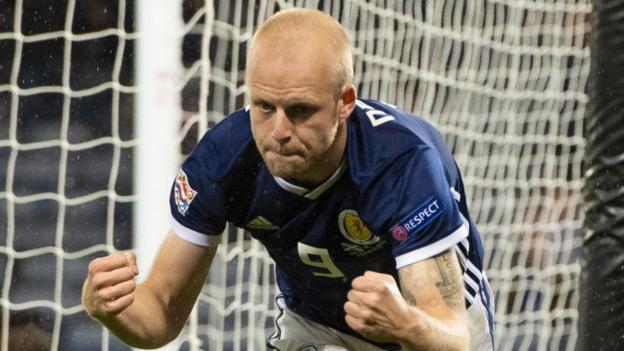
Berat Djimsiti diverted Steven Naismith’s header past his own goalkeeper

Steven Naismith’s persistence paid off as Scotland opened their Nations League campaign with a morale-boosting win against Albania.

Naismith’s header went in off Berat Djimsiti and the Hearts forward nodded the Scots’ second after a dreadful piece of goalkeeping at a corner.

His second-half showing made up for a glaring first-half miss and having a goal chalked off for offside as the home side dominated at a sodden Hampden that was less than half full.

And it was a much more assured performance from Alex McLeish’s side with no repeat of the errors that were so ruthlessly punished by Belgium in Friday’s 4-0 friendly defeat.

Stephen O’Donnell in particular excelled at right wing-back after being a surprise inclusion.

The returning Allan McGregor made a crucial save to deny Bekim Balaj at 1-0, the striker also volleying over as Albania failed to emulate their opening group win against Israel.

Scots’ pressure pays off

In order to quell the rising tide of doubt surrounding McLeish, this was a game that Scotland simply had to win, a first competitive outing for the manager in his second stint at Hampden and the kind of convincing, at times flamboyant, victory that gives him something to build on.

Scotland had an array of chances and bright moments before they finally cracked the Albanians. Johnny Russell, in from the start, had a fresh-air kick when he should have scored, but that was nothing when compared to the one Naismith missed later on. Charlie Mulgrew nutted a John McGinn free-kick to the back post and from three yards Naismith somehow contrived to hit the post.

There were other chances, some slick football and, eventually, a goal to reflect their dominance when Naismith’s header was deflected into his own net by Djimsiti.

One goal was the least Scotland deserved, but they were fortunate it stayed that way when Balaj had two clear-cut chances to equalise and fluffed the pair of them.

McLeish’s team took back control after that. Naismith made it two with a header when keeper Thomas Strakosha was caught in no man’s land at a corner and that was the assurance goal that guaranteed Scotland’s Nations League campaign got off to a winning, and stylish, beginning.

O’Donnell stakes his claim

Stephen O’Donnell had been a late call-up to the squad last week

This was a triumph for McLeish, a manager who was in serious need of a triumph. His team selection raised eyebrows in the preamble, but McLeish got it right against a team that, on paper, looked exactly the type of visiting team that tends to get considerable joy at Hampden.

McLeish’s biggest call was also his best call. In giving a competitive debut to O’Donnell, the 26-year-old darling of Rugby Park, he gave the full-back-cum-wing-back the opportunity to show his stuff and show his stuff O’Donnell did.

O’Donnell was terrific in nearly everything he did in defence and attack. Particularly in attack. The Killie man announced himself as a serious contender for a permanent spot in McLeish’s team.

He brought energy and bite and cleverness and presence. O’Donnell was at the heart of this vibrant Scotland performance on a night that lifted the dark clouds that had gathered above the head of the national team.

Even if only a shade over 17,000 turned up at Hampden – the way things have gone in recent years then that was hardly a shock – this was more like it.

Two goals, three easy points, some stand-up performers and a competitive debut for Scott McTominay, thereby confirming him as a Scotland player. This was the kick-start that McLeish had been waiting for.

What’s next?

Both sides return to Nations League duty away to Israel next month. The Scots visit Haifa on 11 October and Albania travel to Beersheeba three days later, when Scotland host Portugal in a friendly.

Read More

from Trusted eNews https://ift.tt/2N3EhZw
via IFTTT

Over 100 drowned in shipwrecks off Libya in early September

news image

More than 100 people, including 20 children, died in early September when their rubber boats were wrecked off the coast of Libya, according to the aid agency Medecins Sans Frontieres (MSF, also known as Doctors Without Borders.) 

A pair of twins about 17 months old, as well as their parents were among the fatalities, MSF said in a statement on Monday, quoting a survivor.  

The two boats had set out from the Libyan coast early on September 1, each carrying scores of people, mostly from African countries such as Sudan, Mali, Nigeria, Cameroon, Ghana, Libya, Algeria and Egypt.

Migrant detention centres in Libya unable to cope amid fighting

One boat’s engine failed and the other began to deflate, the aid agency quoted a survivor as saying.

Some survived by clinging to floating wreckage. Many people were brought to the Libyan port of Khoms on September 2 by the Libyan coastguard, MSF said.

“While the first boat had stopped due to an engine failure, our boat continued to navigate and began deflating around 1pm. There were 165 adults and 20 children on board,” a survivor told MSF.

The survivor said that at the time of the incident, mobile phone navigation showed the people were not far from the coast of Malta.

They reportedly sought help from the Italian coastguard, but the boat started sinking before assistance arrived.

“We couldn’t swim and only a few people had life jackets. Those among us who could hold on the boat’s floating hood stayed alive,” the survivor said.

Desperate journeys: Arrivals in Spain tripled this year

MSF treated survivors with chemical burns from the engine petrol spills.

“Our medical team worked solidly for several hours to assist survivors with the most serious conditions,” said Jai Defransciscis, an MSF nurse working in Misrata, northwest Libya.

As of July 1, at least 1,000 people drowned at sea while trying to cross to Europe since the beginning of the year, according to the United Nations.

In June, as the Italian government and the Libyan coastguard imposed more restrictions, more than 200 people drowned in the Mediterranean.

In 2017, more than 3,000 people died or went missing.

Arrivals to Italy – and to Europe overall – more than halved in 2017 to just over 172,300.

In February 2017, the previous Italian government signed a memorandum of understanding on migration with Libya’s UN-backed Government of National Accord.

With EU approval, Italy began training and equipping Libya’s coastguard to perform rescues, “pulling back” migrant boats.

SOURCE: Al Jazeera and news agencies

Read More

from Trusted eNews https://ift.tt/2CFvXu1
via IFTTT

Qualcomm announces new chipset for Android smartwatches

news image

It’s no secret that the Apple Watch is a dominant force in the smartwatch market. And it’s likely going to get more popular after its expected refresh on Sept. 12, when it will most likely get a larger screen and haptic feedback sensors. In total, the soon-to-be-released version of the Apple Watch will probably bring more people to buy a smartwatch and increase Apple’s lead over the competition.

But Qualcomm, one of Apple’s biggest rivals, is preempting the iPhone maker just a few days before its big event with the new Snapdragon Wear 3100 platform. The chipset was designed by Qualcomm in tandem with Google’s Wear OS team and promises to bring better battery life to the next-generation of watches. Furthermore, it might be the resurgence that Wear OS needs.

For the uninitiated, Android Wear was renamed Wear OS earlier this year, and it got a revamp in features like the Google Assistant, Google Fit, and a new notifications UX. The 3100 platform works in conjunction with these new Wear OS features to improve battery life and enable new experiences.

Image:  GOOGLE, MASHABLE COMPOSITE

The Wear 3100 platform is built on an ultra-low power system architecture that has a QCC1110  co-processor inside. The co-processor is tiny at ~21mm and supports the central quad-core ARM processor. While it’s small in size, the co-processor can handle keyword search almost entirely on its own, which means it will likely power the Google Assistant and background processes — ultimately making your smartwatch faster and more responsive.

On the battery side, Qualcomm has enabled three different modes that customize the battery life depending on a user’s needs. Enhanced Ambient Mode seems to be the most featured filled, as it doesn’t cut back on display brightness, the number of complications, or with navigating the watch. Traditional Watch Mode will stretch out the battery life for an extended period, which likely results in a slower experience at a lower brightness setting. Lastly, Dedicated Sports Mode allows you to have GPS and heart rate turned on for long periods. Whether it be a triathlon or a marathon, the watch has you covered.

Qualcomm’s magic trick for this to happen is to offload the processes from the central quad-core processor to the QCC1110 co-processor. It seems that these might be modes that Wear OS will have the option to engage, or it might be smart enough to know when to switch the processes over. This ability to stretch out battery life is a core affordance of this platform. In the end, Qualcomm is estimating that this new processor can last 4-12 hours more than the previous Wear 2100 platform.

I’m a bit skeptical for now, especially given the broad range for expected battery improvement, but I’m eager to see this new platform in action on some future Wear OS watches. Also, what is a platform announcement without at least some manufacturers saying that they’ll be building for it?

Well, Fossil Group, Louis Vuitton, and Montblanc are the first launch partners to use the new Snapdragon Wear 3100 Platform (pretty great brands if you ask me). It ends up being a similar story as high-end fashion brands are still the first to flock towards Wear OS. The good news is that this list will likely grow, and while Google doesn’t have a Pixel smartwatch coming this year, who knows in 2019 there could be one with this chip.

Also, consumers should expect a range of watches to arrive as the 3100 platform will come in Bluetooth and WiFi, GPS, and 4G LTE variants. The chips are shipping today, so expect a new wave of Wear OS watches soon.

Https%3a%2f%2fblueprint api production.s3.amazonaws.com%2fuploads%2fvideo uploaders%2fdistribution thumb%2fimage%2f86005%2f8b1c4533 26db 42f0 a795 62568e7e396b

Read More

from Trusted eNews https://ift.tt/2O3EZCj
via IFTTT

Design a site like this with WordPress.com
Get started