US Senator John McCain dies at the age of 81

news image

US Senator John McCain, a former prisoner of war in Vietnam who ran unsuccessfully for US president in 2008 and became a prominent critic of President Donald Trump, died on Saturday, his office said. He was 81.

McCain, a US senator from Arizona for over three decades, had been battling glioblastoma, an aggressive brain cancer, discovered by his doctors in July 2017. He had not been at the US Capitol in 2018. He also had surgery for an intestinal infection in April of this year.

“Senator John Sidney McCain III died at 4:28pm on August 25, 2018,” read a statement from his office. “With the senator when he passed were his wife Cindy and their family,” the statement added.

No further details were immediately provided.

“My heart is broken. I am so lucky to have lived the adventure of loving this incredible man for 38 years,” Cindy McCain wrote on Twitter. “He passed the way he lived, on his own terms, surrounded by the people he loved, in the place he loved best.”

Meghan McCain, one of McCain’s daughters, tweeted a statement, saying: “My father is gone, and I miss him as only an adoring daughter can. But in this loss, and in this sorrow, I take comfort in this: John McCain, hero of the republic and to his little girl, wakes today to something more glorious than anything on this earth.”

McCain had been in the public eye since the 1960s, when as a naval aviator he was shot down during the Vietnam War and tortured by his North Vietnamese captors during the more than five years he was held as a prisoner. 

Held at the notorious “Hanoi Hilton” prison and other sites, McCain was beaten and tortured, suffering broken bones and dysentery. He was released on March 14, 1973, but was left with permanent infirmities [Horst Faas/AP Photo]

He was edged out by George W Bush for the Republican presidential nomination in 2000, but became his party’s White House candidate eight years later. McCain lost in 2008 to Democrat Barack Obama.

William Schneider, a political analyst, told Al Jazeera that McCain will be remembered as a “beloved figure, not primarily for his ideology or his partisanship … but because of his personal qualities”. 

McCain’s Republican and Democratic colleagues gave their condolences, with many calling him a great person and an American hero. 

Democratic Senator Chuck Schumer said he will be introducing a resolution to rename a congressional building in McCain’s honour. 

McCain’s “dedication to his country and the military were unsurpassed, and maybe most of all, he was a truth teller – never afraid to speak truth to power in an ear where that has become all too rare”. 

Mitch McConnell, the Senate majority leader, said in a statement that it “is an understatement to say the Senate will not be the same without our friend John”. 

He added: “The nation mourns the loss of a great American patriot, statesman who put his country first and enriched this institution through many years of service.”

Foreign policy hawk

In the Senate, McCain was a foreign policy hawk with a traditional Republican view of world affairs.

He was a staunch supporter of Israel. In 2016, after the UN Security Council passed a resolution condemning Israel’s illegal settlement expansion in the occupied West Bank, McCain called the decision a “shameful chapter in the bizarre anti-Israel history of the United Nations”.

He specifically called out the United States, who, under Obama, abstained from the vote, saying the abstention “made us complicit in this outrageous attack, and makes a troubling departure from our nation’s long, bipartisan history of defending our ally Israel in the United Nations”.

While his support for Israel almost never wavered, he appeared somewhat reserved in his reaction to Trump’s decision to move the US embassy to Jerusalem.

“I have long believed that Jerusalem is the true capital of Israel,” McCain said at the time.

“However, issues surrounding the final and permanent status of Jerusalem must ultimately be resolved by Israelis and Palestinians as part of an internationally supported peace process.”

McCain also supported Bush’s 2003 invasion of Iraq and criticised Obama for not doing more to intervene in Syria’s civil war.

He was a staunch opponent of Iran, joking in 2017 about bombing the country. He sang “bomb, bomb, bomb, bomb” Iran while on the campaign trail. 

He was also an outspoken critic of the Iran nuclear deal. In 2017, he praised Trump for his Iran goals, saying he agreed with the president “that the [nuclear] deal is not the vital national interests of the United States”.

McCain v Trump

While McCain and Trump found some agreement on certain issues, including Iran, the senator was a frequent critic and target of the president as well.

As the chairman of the Senate Armed Services Committee, McCain denounced Trump for, among other things, his praise of Russian President Vladimir Putin and other leaders the senator described as foreign “tyrants”.

“Flattery secures his friendship, criticism his enmity,” McCain said of Trump in his memoir, “The Restless Wave”, which was released in May.

McCain in July had castigated Trump for his summit with Putin, issuing a statement that called their joint news conference in Helsinki “one of the most disgraceful performances by an American president in memory”. He said Trump was “not only unable but unwilling to stand up to Putin”.

McCain was also the central figure in one of the most dramatic moments in Congress of Trump’s presidency when he returned to Washington, DC shortly after his brain cancer diagnosis for a middle-of-the-night Senate vote in July 2017.

Still bearing a black eye and scar from surgery, McCain gave a thumbs-down signal in a vote to scuttle a Trump-backed bill that would have repealed the Obamacare healthcare law and increased the number of Americans without health insurance by millions.

McCain returned to Washington, DC after just being diagnosed to vote against bill that would have repealed Obamacare healthcare law [J Scott Applewhite/AP Photo]

Trump was furious about McCain’s vote and frequently referred to it at rallies but without mentioning McCain by name.

Even before the president took office, Trump and McCain were often at odds. After Trump in 2015 launched his presidential campaign, McCain condemned his hard-line rhetoric on immigration and said Trump had “fired up the crazies”. Trump retorted that McCain was “not a war hero”, adding: “I like people who weren’t captured.”

After Trump became president, McCain blasted what he called the president’s attempts to undermine the free press and rule of law, and lamented the “half-baked, spurious nationalism” of the Trump era.

Following the news of McCain’s death on Saturday, Trump tweeted: “My deepest sympathies and respect go out to the family of Senator John McCain. Our hearts and prayers are with you.”

Sources close to McCain have said Trump would not be invited to the funeral.

2008 presidential bid

McCain, the son and grandson of US Navy admirals, was elected to the US House of Representatives from Arizona in 1982 after more than two decades of Navy service.

He served four years in the House before Arizona voters elected him to the Senate in 1986 to replace Barry Goldwater, the 1964 Republican presidential nominee revered by conservatives.

In running for president in 2008, McCain tried to succeed an unpopular fellow Republican in Bush, who was leaving office with the country mired in wars in Afghanistan and Iraq and stuck in a financial crisis.

It was a stark contrast between McCain, then a 72-year-old veteran of the Washington establishment, and the 47-year-old Obama, who was offering a “Yes, we can” message of change.

McCain lost the 2008 presidential election alongside Sarah Palin as his vice president pick [Chris Carlson/AP Photo] 

McCain tried to inject some youth and enthusiasm into his campaign with his selection of Sarah Palin, Alaska’s governor, as his running mate. But the choice backfired as her political inexperience and shaky performances in media interviews raised concerns about her qualifications.

In his new book, McCain voiced regret for not choosing then-Senator Joe Lieberman, a Democrat turned independent, as his running mate.

McCain wrote that he had originally settled on Lieberman, Democrat Al Gore’s running mate in the 2000 election, but was warned by Republican leaders that Lieberman’s views on social issues, including support for abortion rights, would “fatally divide” the party.

“It was sound advice that I could reason for myself,” McCain wrote. “But my gut told me to ignore it and I wish I had.”

Obama won 53 percent of the vote to McCain’s 45.6 percent.

On Saturday, Obama released a statement, saying that while he and McCain had their differences they shared “a fidelity to something higher – the ideals for which generations of Americans and immigrants alike have fought, marched, and sacrificed”. 

‘A maverick’

In Congress, McCain built a generally conservative record, opposing abortion and advocating higher defence spending.

Still, he prided himself on his reputation as a maverick and had a history of working across party lines on immigration, climate change and campaign finance reform.

He also spoke out against the Bush administration’s use of waterboarding, a torture technique that simulates drowning, and other harsh interrogation tactics on detainees in the aftermath of the September 11, 2001, attacks.

He urged the closure of the prison for foreign terrorism suspects at the US naval base at Guantanamo Bay, Cuba, and also sponsored an anti-torture measure that passed Congress in 2005.

In a 2002 memoir, McCain wrote, “I’m an independent-minded, well-informed public servant to some. And to others, I’m a self-styled, self-righteous maverick pain in the ass.”

A dark period for McCain came as one of the “Keating Five” group of senators accused of improperly intervening with federal regulators to help political contributor and bank executive Charles Keating, whose Lincoln Savings and Loan failed in 1989 at a cost to taxpayers of $3.4bn.

McCain was cleared of wrongdoing in 1991, but the Senate Ethics Committee rebuked him for poor judgment.

On July 25, 2017, McCain delivered a Senate floor speech not long after his cancer diagnosis that was widely seen as his farewell address. It included a call to fellow Republicans to stand up to Trump and for all politicians to work together to keep America as a “beacon of liberty” in the world.

“That is the cause that binds us and is so much more powerful and worthy than the small differences that divide us,” McCain said.

Read More

from Trusted eNews https://ift.tt/2wbeqo6
via IFTTT

Meghan McCain, Barack Obama, others react to John McCain’s death

news image

Politicians, celebrities, and his daughter Meghan are among those weighing in on the death of Arizona Senator John McCain, who died Saturday at the age of 81 after a battle with brain cancer.

“I was with my father at his end, as he was with me at my beginning,” wrote The View co-host in an emotional statement posted on social media. “In the thirty-three years we shared together, he raised me, taught me, corrected me, comforted me, encouraged me, and supported me in all things. He loved me, and I loved him. He taught me how to live. His love and his care, ever present, always unfailing, took me from a girl to a woman — and he showed me what it is to be a man.”

McCain’s wife, Cindy, also paid tribute to her husband.

Read on for reactions from President Donald Trump, former President Barack Obama, and others who remembered the late 2008 GOP presidential nominee.

Read More

from Trusted eNews https://ift.tt/2MNZF3U
via IFTTT

Trump lowers White House flags to half-staff to honor Sen. John McCain

news image

Share This Story!

Let friends in your social network know what you are reading about

Trump lowers White House flags to half-staff to honor Sen. John McCain

“My deepest sympathies and respect go out to the family of Senator John McCain. Our hearts and prayers are with you!” Trump tweeted.

Loading…Post to Facebook

Posted!

A link has been posted to your Facebook feed.

CLOSE

US Senator John McCain, war hero and presidential candidate died Saturday after battling brain cancer for more than a year. He was 81. McCain had discontinued medical treatment, his family said Friday. (Aug 25)
AP

WASHINGTON – President Donald Trump lowered flags at the White House to half-staff to honor Sen. John McCain Saturday night, a posthumous mark of respect for the former Republican standard-bearer whom Trump had feuded with as president.

Trump expressed his condolences in a tweet shortly after the Arizona senator died of brain cancer Saturday. “My deepest sympathies and respect go out to the family of Senator John McCain. Our hearts and prayers are with you!”

Trump had a long-running beef with McCain dating back to the early days of his presidential campaign – often mocking McCain’s thumbs-down vote against the repeal of Obamacare at rallies around the country.

But as McCain’s health deteriorated in recent weeks, Trump began to ignore the senator completely – even failing to acknowledge the senator even after he signed a defense bill named for McCain into law this month.

Flags are lowered by presidential proclamation, and it’s up to the president to decide who gets that honor. But by executive order and tradition, sitting senators who die in office have flags lowered in their honor from their date of death until their burial.

The White House did not immediately release the text of Trump’s proclamation.

Autoplay

Show Thumbnails

Show Captions


Read or Share this story: https://usat.ly/2NiZE59

Read More

from Trusted eNews https://ift.tt/2LtEpf8
via IFTTT

Schumer — Democratic leader — wants to rename Senate building after John McCain

news image

CLOSE

John McCain chose the United States Naval Academy Cemetery as the place he will lay rest. He’ll lie next to his former classmate and lifelong best friend.
USA TODAY

WASHINGTON — To honor the late Sen. John McCain and his legacy, the Arizona Republican might have a Senate office building in the nation’s capital named after him. 

Top Democrat Chuck Schumer said Saturday evening he would introduce a resolution renaming the Senate’s Russell office building after McCain, a reach across the aisle to remember the respected Republican lawmaker and Vietnam War veteran. 

The building sits on the outskirts of the U.S. Capitol and houses McCain’s office. 

“As you go through life, you meet few truly great people,” Schumer, the Senate minority leader, said in a statement shortly after McCain’s passing. “John McCain was one of them. His dedication to his country and the military were unsurpassed, and maybe most of all, he was a truth teller – never afraid to speak truth to power in an era where that has become all too rare.”

More: Sen. John McCain, American ‘maverick’ and political giant, dies at 81

More: In John McCain’s final resting place, his legacy isn’t politics but a life of service

More: John McCain’s top quotes through the years

Autoplay

Show Thumbnails

Show Captions

He added that the world would be a lesser place with McCain and while nothing can bring him back, he wanted the nation to forever remember him. 

“Nothing will overcome the loss of Senator McCain, but so that generations remember him I will be introducing a resolution to rename the Russell building after him,” Schumer said. 

Richard Russell was a segregationist senator from Georgia. The building was renamed from the Old Senate Office Building to honor Russell in 1972. 

Russell was a Democrat who served from 1933 to 1971. He was known as a “senator’s senator” and chaired the Senate Armed Services Committee and the Appropriations Committee.

A statue of Russell also stands in the building’s rotunda. 

There have been various efforts over the years to rename the building, but the bipartisan support to honor McCain could lead to a success.

Autoplay

Show Thumbnails

Show Captions


Read or Share this story: https://usat.ly/2BJi8u0

Read More

from Trusted eNews https://ift.tt/2MTiz9u
via IFTTT

Cristiano Ronaldo: Juventus forward makes home debut as champions beat Lazio 2-0

news image

Cristiano Ronaldo has scored 658 career goals for club and country

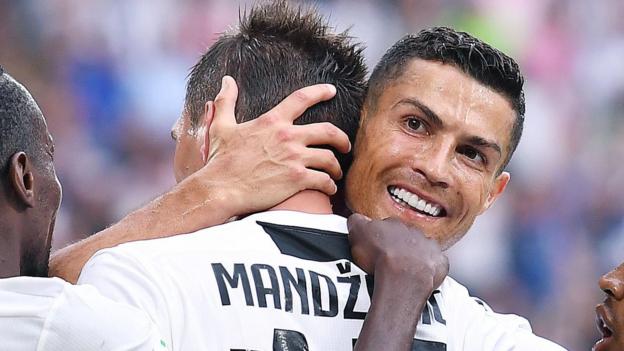
Cristiano Ronaldo made his home debut for Juventus as they beat Lazio to extend their winning start to the season.

Miralem Pjanic’s delightful finish from 25 yards put the Italian champions ahead before Mario Mandzukic struck from close range after half-time.

Ronaldo, a £99.2m summer signing from Real Madrid, has not scored in two Serie A games.

Sami Khedira hit a post for Juve when the game was goalless.

Fans held up banners and posters supporting Portugal forward Ronaldo, making his first competitive appearance for Juve at the Allianz Stadium.

However, he touched the ball only once in the Lazio penalty area in the first half and, shortly before Juve’s second goal, had a dipping shot superbly tipped over by Thomas Strakosha.

Ronaldo also missed inside the six-yard box, Joao Cancelo’s low cross hitting his heel only to rebound to Mandzukic, who doubled Juve’s lead.

Juve have six points from two games, Lazio have lost both their opening games.

Read More

from Trusted eNews https://ift.tt/2obeWxI
via IFTTT

John McCain’s best Saturday Night Live moments

news image


Saturday Night Live

type
TV Show
run date
10/11/75
creator
Lorne Michaels
broadcaster
NBC
seasons
43
Current Status
Off Air
tvpgr
TV-14
Genre
Comedy

Most politicians have a love-hate relationship with Saturday Night Live. The NBC sketch comedy series has been poking fun at elected officials — with various degrees of brutality — since it premiered in 1975, and savvy presidential candidates know that studio 8H is a pivotal stop on the road to the White House. But most of those appearances are dutiful at best (see: Barack Obama in 2013) and disastrous at worst (see, or rather, don’t: Donald Trump in 2015).

RELATED: Celebs and politicians react to John McCain’s death

One notable exception: Senator John McCain. The longtime Arizona senator and two-time presidential candidate — who died on August 25 at age 81 after battling brain cancer since 2017 — took the stage at Saturday Night Live several times over the years, and each time, he looked like he was having a gosh-darned blast. Take a look back at his three most memorable SNL moments.

“To Love, Honor and Stalk” (Oct. 19, 2002)

McCain was the first sitting senator to ever host SNL, and while he played himself (and other politicians, like then-Attorney General John Ashcroft) in several sketches, he also fully committed to some sheer nonsense — with hilarious results. In this Lifetime movie parody, Amy Poehler stars as a woman whose husband, played by McCain, continually invades her personal space — whether she’s in the shower, coming in the front door, or even on the witness stand testifying against him. Simply managing to stand uncomfortably close to Poehler without breaking for the entire length of this sketch would be a victory for most hosts, but McCain drove the jokey melodrama home with his creepy grin and weaselly line-readings. (“Shall I loofah your back?”)

“McCain in One” (May 17, 2008)

Two months after winning the Republican party nomination for president, the 72-year-old Senator addressed the nation from Rockefeller Center. “I ask you, what should we be looking for in our next president? Certainly, someone who is very, very, very old.” He went on to spoof his reputation as a political maverick by boasting about reducing Arizona’s length of paved roadway to less than 900 miles, and forcing residents of the state to drive to New Mexico if they want to mail a letter. McCain delivered the speech with a winning earnestness and subtle comic timing, proving once again that he understood the value of self-parody when it came to winning the hearts and minds of the American people.

“John McCain and Sarah Palin do QVC” (Nov. 1, 2008)

Three days before the presidential election, McCain returned — alongside Tina Fey as his much-mocked running mate, Sarah Palin — for one last SNL hurrah. In a send-up of Barack Obama’s expensive 30-minute campaign ad, which ran on several broadcast and cable networks, McCain and Fey’s Palin talked up their potential administration (and some quality products) for the QVC audience. With his good-natured sales pitches for things like “McCain’s Fine Gold” (featuring a cameo from Cindy McCain) and self-deprecating humor (“I’m a true maverick — a Republican without money”), the Senator held his own with comedy veteran Fey and generated plenty of laughs himself.


Read More

from Trusted eNews https://ift.tt/2PCefdt
via IFTTT

John McCain may have lost the presidency, but still became larger-than-life

news image

CLOSE

John McCain chose the United States Naval Academy Cemetery as the place he will lay rest. He’ll lie next to his former classmate and lifelong best friend.
USA TODAY

John McCain had so perfected the art of the narrow escape, in politics and in life, that it was almost possible to believe he might defy the odds one more time.

During the 2008 campaign, when his bid for the Republican presidential nomination imploded months before any actual voting, the Arizona senator was out of money and on the unpopular side of the day’s big issue, the war in Iraq. But he wasn’t ready to quit.

He decided to make his stand in New Hampshire, a state with politics as iconoclastic as he was. His front-runner entourage was gone, replaced by a single aide and a borrowed SUV. The first event of his stripped-down campaign was at a Chamber of Commerce luncheon in Concord. In his new book, he likened the political reporters gathered in the back of the ballroom to “crows on a wire, watching the unfortunate roadkill breathe its last before they descended to scavenge the remains.”

He wasn’t wrong. I was covering the July 2007 speech for USA TODAY. We were watching to see whether he really planned to stay in the race that he had mismanaged to date — and, if so, how in the world he planned to turn things around.

“Under what scenario would you suspend your campaign?” I asked him during a press scrum that followed his luncheon speech — which had been devoted, of course, to defending his stance on Iraq. He looked at me as though I had asked the dumbest question imaginable. (To be fair, this is a look he often gave reporters, not to mention some fellow senators. The occasional president, too.) “Only if I succumb to a fatal disease before the day of the New Hampshire primary,” he replied.

More: Sen. John McCain, American ‘maverick’ and political giant, dies at 81

More: John McCain’s top quotes through the years

More: John McCain will be buried at Naval Academy Cemetery

He didn’t suspend his campaign, of course. He ended up winning the primary in New Hampshire, which propelled him to win next big contest, in South Carolina. Eventually, he claimed the Republican nomination, the prize that had eluded him eight years earlier. He would lose the general election in November to Barack Obama, but he didn’t quit. Not then. Not ever.

In the end, McCain’s battle with brain cancer was one fight he didn’t win, but then again he saw no shame in losing, just in not trying. In The Restless Wave, the book he co-authored with Mark Salter that was published in May, he praised those who pursued “the hardest causes,” who refused to acknowledge even certain defeat. “They don’t despair,” he said. “They persist.”

The larger-than-life figures in Washington tend to be presidents. There have just been 45 of them in the nation’s history, after all. But there are a handful of others who by dint of character or vision or achievement or personal history become influential beyond the particular job they held, who become iconic. Ted Kennedy, for one. John Lewis. Robert Dole. Eleanor Roosevelt.

And John Sidney McCain III.

Part of that was his story of survival through five years as a prisoner of war in Vietnam, emerging with lifelong physical scars but a spirit that remained remarkably ebullient. That brutal experience gave him the moral authority to speak out when the debate turned to such questions as the use of torture. Part of it were his credentials as a maverick — his willingness to break with his own party, and to forge alliances across partisan lines. He stubbornly stuck with his positions on issues, particularly on national security, even when they became inconvenient.

He was hardly perfect. He could be caustic. His anger could flash, raising questions even among some admirers about whether he had the right temperament to be president. He was one of the so-called Keating Five, senators enmeshed in a savings-and-loan scandal, though the Senate Ethics Committee found him guilty only of poor judgment, not of wrongdoing.

That said, John McCain was almost impossible not to like. He was smart and funny and a master storyteller, and he nursed only a handful of grudges. McCain rarely ducked reporters, even when he knew the questions they were going to ask would be uncomfortable, and even though he thought news coverage in 2008 was tilted to favor Obama. Baltimore Sun reporter Robert Timberg wrote a searingly honest portrait of McCain and four other Naval Academy graduates; McCain was one of just two of the five who showed up for the book party when The Nightingale’s Song was published. Twenty-one years later, the senator spoke at the memorial service for Timberg, himself an Annapolis grad.

During the 2016 campaign, when Donald Trump was on the rise, I interviewed McCain for USA TODAY’s Capital Download newsmaker series. He questioned Trump’s credentials on national security, but refused to say he wouldn’t vote for him over Hillary Clinton. “I vote for the Republican nominee, obviously,” he said, although he didn’t sound happy about it. Trump already had made clear his own disdain for McCain. 

More than a year after President Trump had been inaugurated, I saw McCain again, at an off-the-record dinner with a group of Washington Bureau chiefs. He had just returned from a tour that took him from Australia to Vietnam to Singapore. Leaders from those countries had peppered him with questions about the perplexing new U.S. president. The senator was at a loss to explain Trump’s friendly view of Vladimir Putin, but he had tried to be reassuring, talking about the strength of American institutions.

McCain seemed to be missing a step that night, I thought.  A few days before, he had stumbled in questioning former FBI director James Comey at a Senate Intelligence Committee hearing. At the dinner, he looked exhausted; he repeated a story twice without realizing it. One month later, he was diagnosed with the brain cancer that would take his life.

Even so, Susan Goldberg of National Geographic, who before that evening had never before met with McCain in person, was enchanted. After he left, she said, “Wasn’t he amazing?”

Yes. Yes, he was.


Read or Share this story: https://usat.ly/2oazE0J

Read More

from Trusted eNews https://ift.tt/2wrbe6X
via IFTTT

John McCain’s death is a metaphor for the death of the old Republican Party

news image

The Editorial Board, USA TODAY
Published 9:38 p.m. ET Aug. 25, 2018

Like all heroes, the Arizona senator and ex-POW had his flaws. But the GOP ‘maverick’ served as a beacon in a troubling time: Our view

John McCain, the senator from Arizona who died Saturday of brain cancer, spent a lifetime making his country proud. As a prisoner of war in Vietnam, he endured ongoing torture and confinement rather than accept an offer to be released before his fellow prisoners. As a member of Congress, he unflinchingly stood for a strong military and an America engaged in world affairs.

McCain was principled and dignified. He could fight hard for what he believed in, something that often meant robust troop levels in the world’s hot spots. But he could also form alliances across party lines and forgive old enemies. He was one of the first lawmakers to advocate normalized relations with the same Vietnamese government that had held him captive for more than five years — and for years he worked closely with Democratic Sen. John Kerry, a fellow Vietnam veteran who opposed the war, to achieve the thaw.

More recently, McCain made a name for himself with a new generation of Americans by casting the deciding vote against a cruel and ill-conceived plan to strip tens of millions of Americans of their health coverage. He said at the time that the hasty, partisan process showed his beloved Senate had lost its way. In his last book, he made clear that under President Trump, America, too, has lost its way. 

Like all heroes, McCain had his flaws. He could be temperamental. He reacted erratically to the 2008 financial crisis. His petulant decision to name the utterly unqualified Sarah Palin as his running mate in that year’s presidential race was, he admitted in his book, a mistake. And his 2010 Senate re-election campaign was a demeaning exercise in renouncing previous positions to fend off a primary challenge from the right.

But as both a Navy aviator and lawmaker, he was a survivor and an embodiment of many of the ideals that make America great.

Sadly, his death serves as an almost perfect metaphor for the death of the old Republican Party, the one personified in the past 100-plus years by the likes of Theodore Roosevelt, Dwight Eisenhower and Ronald Reagan. It was a party that believed, like McCain, that the United States should stand for the advance of freedom abroad and the rule of law at home. It was confident that American commerce could compete with anyone, and that immigration was essential to a growing nation.

In remarkably short order, that party has been turned into a Donald Trump cheering section. It has adopted Trump’s previously un-Republican positions on trade, immigration and authoritarianism, while enabling his childish outbursts and ethical outrages.

In short, today’s GOP is woefully lacking in character and pragmatism, the very McCain hallmarks that made him such an invaluable senator and statesman. To say he will be missed hardly conveys the void his passing leaves. He had the gravity to serve as a beacon in a troubling time, to remind his country and his party of genuine American greatness.

We need more leaders to show us true north. McCain left us a shining example worth following.

If you can’t see this reader poll, please refresh your page.

What do you think of our editorial on Sen. McCain?


Read or Share this story: https://usat.ly/2BKrhmn

Read More

from Trusted eNews https://ift.tt/2PAWECu
via IFTTT

Man Utd Women 0-2 Reading Women: Record crowd watch hosts lose

news image

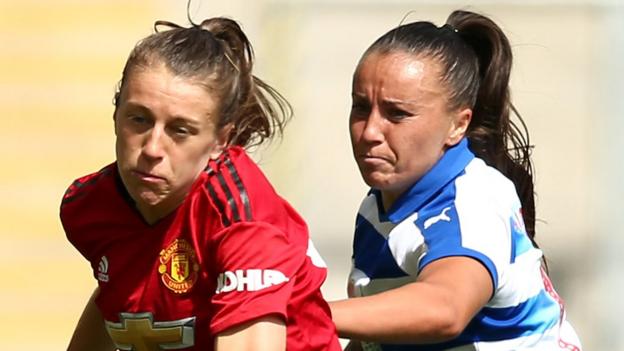
Manchester United are managed by former Arsenal, Chelsea and Lincoln defender Casey Stoney

A record crowd of 4,835 watched Manchester United Women lose 2-0 to Reading Women in their first home game since relaunching this season.

United, returning after the club disbanded their senior female side in 2005, were beaten by goals from Brooke Chaplen and Gemma Davison.

United are second in the five-team Continental Tyres Cup group, with the top two reaching the quarter-finals.

The crowd at Leigh Sports Village was a record for the competition.

It was more than double the attendance for last season’s final between Arsenal and Manchester City.

It also surpassed the 4,096 who watched Manchester City beat Chelsea to seal their first FA WSL Super League 1 title in 2016.

United executive vice-chairman Ed Woodward and former United and England captain Bryan Robson were among the crowd.

Ed Woodward’s (centre) relationship with United men’s manager Jose Mourinho has been under scrutiny this week

United, who beat Liverpool in their first match back last weekend, had the better of the first half with Kirsty Hanson hitting the bar twice in a goalmouth scramble.

The visitors, who play their league football in the tier above United, took the lead 11 minutes into the second half when Chaplen pounced on the loose ball after United goalkeeper Siobhan Chamberlain parried a Davison shot.

Reading, who were reduced to 10 players when defender Molly Bartrip was shown a second yellow card, added a second through Davison in stoppage time.

Read More

from Trusted eNews https://ift.tt/2NotVPK
via IFTTT

Arizona Senator John McCain, 2008 GOP presidential nominee, dies at 81 from brain cancer

news image

John McCain, the feisty Republican senator from Arizona who was the GOP presidential nominee in 2008, died Saturday after a battle with brain cancer, his family announced. He was 81.

News came out in July 2017 that McCain had been diagnosed with a type of brain tumor called primary glioblastoma, which had been discovered when he underwent surgery to remove a blood clot. He subsequently pursued treatment, but his family announced in a statement Friday that he decided to discontinue these efforts due to “the progress of disease and the inexorable advance of age.”

While he will be remembered as a GOP maverick and war hero who spent more than five years as a prisoner during Vietnam, McCain had a lighter side. As evidenced by a 2008 interview with EW, McCain loved pop culture. He was a fan of ABBA, Usher, Batman, Seinfeld, and Curb Your Enthusiasm, and believed that Marlon Brando’s best performance was in 1952’s Viva Zapata!. “Go back and watch the scene of his wedding night, with [Brando] and Jean Peters — the actress who later married Howard Hughes, who made her give up acting — when she teaches him to read by taking out the Bible and reading it with him,” he said. “That’s a poignant scene.”

McCain also made a few memorable entertainment-related appearances of his own. He hosted an episode of Saturday Night Live in October 2002 with musical guests the White Stripes, and he later made two cameo appearances in 2008 opposite hosts Ben Affleck and Steve Carell — one where he featured opposite Tina Fey’s Sarah Palin.

That same year, he released a what some might say odd promo for WWE Raw about taking Osama Bin Laden “to the Undertaker,” and Hillary Clinton and Barack Obama fighting in the ring.

McCain was also involved with a television movie adaption of his Faith of My Fathers book, which chronicled his time as a POW. Fox’s 24 and NBC’s Parks and Recreation are also on his résumé.

“It’s one of my favorite shows… I’m a fan, it’s hilarious,” McCain said of the Amy Poehler-fronted comedy. “The whole schtick about an election, and being elected and now coming to Washington,” he added. “And of course, Amy is such a talented actress. My experience with her goes back to hosting Saturday Night Live a long time ago.”

He was also a fan of his daughter Meghan McCain’s work on The View, where he was frequently a topic of discussion. The conservative commentator broke down during her first day on the job as the show’s new host when her father’s cancer diagnosis came up. “I can’t believe I’m freaking crying already,” she said. “When you hear cancer, a nuclear bomb goes off in your life. No matter who you are. I didn’t realize how intense and disruptive and scary and hopeless and chaotic you would feel all day long.” Her dad was watching and tweeted his support: Congratulations @MeghanMcCain on your first day on @TheView,” he wrote. “Our family couldn’t be prouder of all that you continue to accomplish.”

Meghan also shared an emotional moment with former Vice President Joe Biden on The View, who lost his son, Beau Biden, in 2015 from the same cancer McCain was diagnosed with. When she teared up while discussing her dad’s condition, Biden comforted her, addressed all the scientific advances being made in the fight against cancer, and said, “If anybody can make it,” it would be her father. “Her dad is one of my best friends,” continued Biden. “Her dad goes after me, hammer and tong. We’re like two brothers who were somehow raised by different fathers or something, because of our points of view.” After the sweet exchange, McCain tweeted his thanks to Biden and his family for “serving as an example of source and strength for my own family.”

McCain’s time in the political arena proved controversial at times. He was of the life-begins-at-conception mindset, but in 1999 he said he “would not support the repeal” of Roe v. Wade, citing the “illegal and dangerous operations” women would be exposed to if that happened. He opposed affirmative action, saying he’s always been “against quotas.” He also once called it a “sad day” that LGBTQ servicemen and woman could serve openly in the military, but, as NBC News reported in 2016, he opposed GOP efforts to attack LGBTQ rights.

His most controversial move, arguably, was pursuing the presidency in 2008 with Sarah Palin as his running mate. After losing the race to Obama, he fell back away from the spotlight. Though, he re-emerged over the years and gained more public favor when he became an unexpected opposition to the Trump administration — while the president of the United States continued badmouthing him. The same month McCain was diagnosed with cancer, he helped thwart the GOP’s plans to dismantle the Affordable Care Act.

“I’m very happy with my life,” McCain told CNN’s Jake Tapper after his cancer was made public. “I’m very happy with what I have been able to do,” he said. “And there’s two ways of looking at these things and one of them is to celebrate. I am able to celebrate a wonderful life and I will be grateful for additional time that I have. Every life has to end one way or another… So you’ve got to have joy.”

Read More

from Trusted eNews https://ift.tt/2BNfm7j
via IFTTT

Design a site like this with WordPress.com
Get started