Dear Louis C.K. and his apologists: We do not trust you.

news image

Seemingly from the very first moments of #MeToo, survivors and women were made to answer the same questions, over and over and over again, always asked with an air of accusation.

How long must an accused abuser suffer? What does redemption look like for them? What is the correct punishment? How much time is enough? What does an accused abuser need to do to redeem themselves?

The answers to those questions, which many women gave in abundance, appear to have been irrelevant.

Though it is not our jobs to do the emotional labor of fixing the problems abusers created — though we would rather have focused on what redemption looks like for those who suffered the abuse — we did it anyway.

We answered your questions, even when it wasn’t always clear they were being asked in good faith. We told abusers exactly what not to do, how to apologize better, and gave actionable steps they could take to begin the process of atoning for misconduct and maybe earning back our trust.

They did not listen. They ignored our advice. They made no effort at atonement.

Instead, what it looks like they did was fuck all of nothing, bided their time, planned their return, and most insidiously, distorted allyship into a defense of continued abuse. And the prevailing questions these abusers and their apologists still seem to be asking is: Wasn’t that enough?

No. It sure was not. But that doesn’t seem to matter to them anyway.

Won’t anyone spare a thought for Louis C.K.’s poor movie “I Love You Daddy,”  one of the many victims of his choice to abuse women?

Image: Dia Dipasupil/Getty Images

To the surprise of no one, the Fuck All strategy worked flawlessly for Louis C.K. 

Less than a year after the comedian admitted to sexual misconduct against several women in comedy (some of whom left the field because of his actions), his comeback is underway.

On Sunday night, Aug. 26, C.K. made his triumphant return to stand-up at the Comedy Cellar with a fifteen-minute set that failed to even mention his misconduct. He was rewarded with a standing ovation for bravely ignoring everything and doing the same old shit. 

So I guess this is how an abuser is redeemed: Not with the whimper of even a half-hearted attempt at reconciliation, but with the bang of thunderous applause.

This is how an abuser is redeemed: Not with the whimper of even half-hearted attempts at reconciliation, but with the bang of thunderous applause.

As if that wasn’t insult enough to the comedians who Louis C.K. harmed, his heroic apologists have started coming forward to show how little they, too, have bothered to learn, listen, or care over the past year.

“OMG! Can you believe that guy went on with his life?! Yes, I can,” SNL cast member Michael Che wrote on his Instagram account.

Che lamented that the comedian who pulled out his penis in front of unsuspecting women and ruined many of their careers in the process had been “shamed, humiliated, [lost] millions of dollars, [lost] all of his projects, [lost] the respect of a lot of his fans and peers, and whatever else that comes with what he did.”

Further expressing his sympathies for millionaires who actually experience consequences for their actions, Che continued, “Just because it looks to you like someone is ‘getting off easy’ cause they still have the perks you would kill to have, doesn’t make it so.”

To finish, Che said, “I don’t know any of his accusers. I don’t know what he’s done to right that situation, and it’s none of my business. But I do believe any free person has a right to speak and make a living.”

To be clear, we’re not questioning Louis C.K.’s legal right to attempt a comeback, or speak, or earn a living. That’s a conversation seemingly of Che’s own invention, and an effective way to belittle and delegitimize the actual conversation we’re trying to have about this.

No, what we’re demanding is answers to questions like: What has Louis C.K. done to earn our trust back? What has he done to deserve a comeback? How has he worked to correct the situation he created for himself and the women he abused?

Comedian Michael Ian Black also valiantly declared he’d take the heat for applauding Louis for trying to move on after serving his time.

Let’s make something else clear: Louis C.K. served no time. No one was calling to put him in prison, though it’s worth noting that what he admitted to can arguably fall under the umbrella of indecent exposure — which is, in fact, a crime men who aren’t famous comedians do go to jail for.

No one’s rallying around the rights of those offenders to get a second chance, though.

Louis C.K. temporarily put his career on hold. And frankly, it’s the women of comedy who lived in fear of working with him and had their careers affected by his actions who “did their time” by putting up with his presence in their community in the first place. They are the ones who should be allowed to move on with their lives, without him.

Black followed up his tweets expressing joy at an abusers return to the field with a blog post. Under the declarative headline, “The Way Back,” a man in comedy offered a guide to asking questions that women have already been asking and answering for months now about letting abusers come back.

Once again seeming to not bother asking or even considering the experience of the women C.K. abused, Black deemed C.K.’s misconduct “somewhere in the middle” on the “scale of horribleness.” 

Because, you know, that’s totally his place to determine. 

Presumably lacking access to Google any of the endless thinkpieces and Twitter threads of women discussing these exact topics in granular detail, Black went back to those same old questions:    

No matter what happens from this point forward, each of these men will wear always their scarlet letter. Is that enough, or do we need more? Do we need a better public apology than the one Louis offered? Rehab? Reparations of some sort?

Offering no answers, he continued with more strawman questions already asked by the likes of Matt Damon, Bill Burr, Bryan Cranston, Woody Allen, and countless others:

 But what is the right way [to find redemption]? Maybe you think it’s too soon. When is it long enough? What is the correct penance? What is the way forward? At what point do we show some grace? What do we need for somebody to come back in from the cold and find a little warmth?

It is the privilege of men like Black and Che to not have been part of the on-going conversation where women and survivors litigated these questions. It is the privilege of men like Black and Che to consider Louis C.K.’s return with the distant indifference of men who won’t have to worry about whether his comeback will mean a retaliation against the women who spoke out against him.

It is the privilege of men like Black and Che to give Louis C.K. the benefit of the doubt. And it is the privilege of men like Black and Che to ask these questions without considering the harm they do to the abused and #MeToo movement overall.

But those of us who’ve actually been paying attention to what’s happening do not have the luxury of giving admitted serial abusers our trust and sympathy without question. Because those of us who have been victims to this kind of systemic abuse know better than to assume the consequences will stick.

Did the standing ovation he received not offer a hint at how they won’t? 

While the cries for redemption and forgiveness have grown louder by the day over the past year, we’re still waiting for even a single modicum of evidence that abusers like C.K. and their apologists have learned a goddamn thing.

In fact, we’ve only seen evidence to the contrary.

Instead, we just recently saw CBS boss Les Moonves, who was a vocal champion of the #MeToo movement, get ousted in a New York Times expose — revealing his allyship to be a preemptive defense against his own litany of allegations for enacting and protecting abuses of power in his company. 

Moonves has yet to suffer a single consequence for the mountain of allegations against him.

Again, none of us are surprised that Louis C.K. is trying to come back, and being welcomed with open arms by audiences. And most of us aren’t even arguing that there should never be a way back for certain people who have made mistakes.

What’s more devastating is the unbelievably low bar that has been set for abusive men, who apparently need to do literally nothing to earn back their spot. And amid the endless pleas for us to consider the rights of abusers, none of these apologists have bothering thinking about the rights of the women who risked their careers, reputations, and wellbeing for speaking out against them.

The odd thing is that the person I’m least upset with right now is Louis C.K. It is far more depressing to watch his apologists (Black, by the way, claims his concern for C.K. is actually a concern for the #MeToo movement) prove their inability to comprehend any of what we’ve been fighting for.

Asking rhetorical questions that are all in essence, “Hasn’t he suffered enough?” is only invite the answer of, “Yes, he has.”

What C.K.’s apologists have effectively done is infect the conversations about what to do with abusers by asking questions that do nothing but sow doubt in a public that’s already shown to be more than willing to forgive and forget.

What Che and Black have done by asking rhetorical questions that are all in essence, “Hasn’t he suffered enough?” is only invite the answer of, “Yes, he has. Let him come back.”  

Meanwhile, those questions leave no room to ask if the women he abused and made unlivable working conditions for feel like they’ve healed enough. 

Even then, the onus of reconciliation is not on them. But the total lack of public consideration for them goes to show how ineffective the conversations around #MeToo have been. 

We don’t care how much Louis C.K. has suffered or not. We are not interested in abusers’ suffering. We are demanding change, not blood. We are crying out to be heard, not screaming for execution. 

And the god’s honest, awful truth is that, more and more, it’s starting to look like we won’t be heard. It won’t change.

Because apparently, abusers don’t even need to seek redemption before getting a standing ovation. So why did we even waste our breath telling them how to earn the right to come back? Why would we waste any more of our time trying to explain it again, and again, and again, and again if it always falls on deaf ears? 

Why did we even waste our breath telling them how  to earn the right to come back? Why would we waste any more of our time trying to explain it again? 

Abusers and their apologists do not seem to be interested in listening. Their lip service to those concerns appears to be a roundabout way of reaffirming the status quo. Because whether their intentions were good or bad, the only thing Louis C.K.’s apologists have succeeded in doing is raising the question of whether our culture needs to change at all. 

We are tired of working overtime to answer the questions that they will never seem to understand. We are tired of trying to convince them that victim’s lives and wellbeing matter more than their abusers.

Does Louis C.K. deserve a comeback? Who cares. He’ll get one anyway.

Https%3a%2f%2fvdist.aws.mashable.com%2fcms%2f2018%2f5%2faeda97d0 5662 864e%2fthumb%2f00001

Read More

from Trusted eNews https://ift.tt/2wyRfDv
via IFTTT

40-Year-Old Virgin actor gets parole after stabbing girlfriend 23 times in murder attempt

news image

A former actor who stabbed his girlfriend 23 times in an attempt to murder her will be released from prison after being approved for parole, PEOPLE confirms.

Shelley Malil, 53, who appeared in the film The 40-Year-Old Virgin as well as TV shows Scrubs and NYPD Blue, was given a 12 years-to-life sentence in 2010 after being convicted of premeditated attempted murder.

On Aug. 10, 2008, Kendra Beebe was talking with a friend on her back patio when Malil arrived and immediately stabbed her in her torso, according to a report in the San Diego Union-Tribune.

During his trial, he testified he thought he was stabbing someone else in self-defense on a night that he couldn’t remember clearly. It wasn’t until hearing Beebe shout, “Call 911!” that Malil said he realized she was the one he was stabbing.

“That’s the first time I look and see it’s Kendra I’m fighting with,” he said at trial.

Earlier this year, Malil told the parole board a different story. He said he grabbed a knife from his Sherman Oaks home and drove to Beebe’s San Marcos, California, home with the intent to “annihilate” her because he felt he’d been slighted by her the day before, according to the Union-Tribune.

Malil continued to stab her with a broken wine glass and another knife he took from her kitchen, and attempted to smother her with a pillow. Beebe suffered 23 deep puncture wounds during the attack and the flesh on her chin was nearly sliced off.

On Tuesday, the California Department of Corrections and Rehabilitation approved his parole with a unanimous decision, according to the newspaper, whose reporter attended the hearing.

The panel agreed Malil posed a low risk of committing violence in the future, the paper reported.

After the hearing, Beebe texted the reporter and said she was “shocked” at the panel’s decision.

“Today, these men had a chance to take real action showing that we, as a society, value women and will protect them,” Beebe texted, saying the board failed to take the opportunity.

“For this I am sad,” she texted. “Because of their inaction, I will continue to live in fear.”

Earlier this year, Gov. Jerry Brown argued against Malil’s early release because there was not a sufficient reason as to why Malil’s “rage escalated so far out of control, and resulted in such a prolonged horror,” according to a report in the Los Angeles Times.

San Diego County District Attorney Summer Stephan issued a statement Tuesday saying she is “disappointed” that Malil is being released after serving eight years in prison.

“We agree with the Governor that Malil demonstrated uncontrolled rage and lacks an understanding of his crime,” Stephan wrote. “The victims have endured tremendous physical and emotional pain. To approve this individual for release, given his violent attack, ignores the very real danger he poses to public safety.”

According to the San Diego Union-Tribune, Malil apologized and took full responsibility for his actions. He claimed to have been an “emotional time bomb” at the time of the attack because he was suffering from professional and financial distress.

“I am fully invested in my rehabilitation and I never want to create another victim again,” the paper reported he said at his hearing.

He is expected to be released in the coming weeks and will be on parole supervision for five years, according to a statement from the California Department of Corrections and Rehabilitation obtained by PEOPLE.

Read More

from Trusted eNews https://ift.tt/2oosnud
via IFTTT

Poll: Michael Cohen’s guilty plea raises serious questions about Donald Trump’s behavior

news image

CLOSE

President Donald Trump’s former personal attorney Michael Cohen pleaded guilty to campaign finance and other charges. Deputy U.S. Attorney Robert Khuzami told reporters that Cohen thought “he was above the law.”
USA TODAY

WASHINGTON – The guilty plea by Donald Trump’s former lawyer to campaign-finance and other charges raises serious questions about the president’s behavior, a majority of Americans say in a USA TODAY/Suffolk University Poll.

Nearly two-thirds say the president should agree to be interviewed by special counsel Robert Mueller.

Those surveyed express significantly higher levels of trust in Mueller’s rectitude than in Trump’s denials that his campaign colluded with Russia to interfere in the 2016 election. The poll of 1,000 registered voters was taken Thursday through Tuesday, after former Trump lawyer Michael Cohen pleaded guilty to violating campaign-finance law and other charges and former Trump campaign chairman Paul Manafort was convicted of tax evasion and financial crimes.

The findings underscore the perils for the president as the special counsel moves from an investigation that has been conducted largely behind closed doors to one playing out in the drama of the courtroom. 

“It’s ludicrous that Trump continues to write the tweets that question Mueller’s integrity,” says Richard Dean, 71, a political independent. The retired engineer from Gadsden, Alabama, was among those called in the poll.

“From everything I’ve read, they’ve proven that there were certainly Russian meddling and hacking and hacking attempts, and why Trump won’t admit that is ridiculous,” Dean said. “In my mind, I suspect and I think they’re about to prove that there was certainly collusion.” 

Fifty-five percent say they have a lot or some trust in Mueller’s investigation to be fair and accurate. Thirty-five percent say they have a lot or some trust in Trump’s denials of collusion. The telephone survey has a margin of error of +/-3 percentage points. 

Mueller, a longtime Republican who led the FBI under Presidents George W. Bush and Barack Obama, was appointed in May 2017 by the Justice Department to lead the Russia inquiry after Trump fired FBI Director James Comey. Trump has denied wrongdoing and labeled the inquiry a “witch hunt.” 

Approval rating slips, but not with party faithful

The president’s approval rating edged down to 40 percent, 3 points lower than in the USA TODAY/Suffolk survey taken in June. He retains the approval of a solid 89 percent of Republican and Republican-leaning voters. Fifty-six percent overall disapprove of the job he is doing as president.

Gregory Bailey, 58, dispatcher and driver for an auto parts company in Oklahoma City, is among the Republican faithful, calling Mueller “corrupt” and his inquiry “a farce.” He echoes some of the arguments Trump has made on Twitter against the investigation. Mueller “only hired Democrats for the investigation,” Bailey says. “It doesn’t take a year and a half to find something on Russian collusion, and collusion is not even a crime.”

Most Americans are prepared to be patient: 55 percent say the special counsel should take all the time he needs to finish the investigation, even if it continues into next year; 40 percent say he should wrap it up within weeks, as Trump lawyer Rudy Giuliani has argued.

By 63 percent to 27 percent, those polled say Trump should agree to be interviewed by Mueller. That includes nearly a third of Republicans.

Nation split on question of impeachment

The nation is split on whether the House of Representatives should consider impeaching the president, based on what the voters know: 44 percent say yes, 47 percent say no.

“The man stood up in front of the entire world and said to the Russian government, to Putin, that he should look into Hillary Clinton’s email,” says Bonni Davis, 61, an attorney from New York City who is a Democrat. At a campaign news conference July 27, 2016, Trump encouraged “Russia, if you’re listening,” to try to find missing Clinton emails; an indictment released last month by the special counsel reported that Russian officials began to target Clinton-related email accounts “on or around” that same day.

In Davis’ view, there is enough evidence for Congress to act. “That was beyond disgraceful,” she says. “The fact that Russia meddled is beyond question. The fact that Trump supported Putin is beyond question, and that’s not appropriate behavior for a president.” She calls his actions “a threat to our democracy.”

Carol Schmock, 63, a Republican and retired customer service representative from Auberry, California, sees more wrongdoing by former President Barack Obama and Democratic presidential nominee Clinton than by Trump, an allegation the president repeatedly has made.

“He hasn’t done anything worth impeachment,” she says. “He’s actually a very good president.” She ticks off his initiatives on immigration, North Korea and veterans’ affairs. “It’s just like he’s magic, in a way.”

There is, predictably, a sharp partisan divide on the question of impeachment. Even so, 9% of Republicans say the House should consider impeaching the president, and 18% of Democrats say it shouldn’t. Among independents, 47% support impeachment; 40% oppose.

Some take a wait-and-see attitude.

“Mueller needs to finish his investigation, and whatever he finds, the public should be made aware and then make the decision from there,” says Keith Walker, 59, a political independent and retired educator from Dover, Delaware. 

“For me, it would take actually being shown that he did a crime, especially on the Russian part of it,” says Melinda Strain, 50, a Democrat from Harrisburg, Missouri. “Morally, I think he’s done a bunch of things that are wrong, but they aren’t necessarily illegal.”

What about the swamp?

Fewer than one in four of those surveyed, 23 percent, say Trump has delivered on his campaign promise to “drain the swamp” in Washington. A 57 percent majority, including nearly one in five Republicans, say “the swamp” has gotten worse during his administration.

The Manafort and Cohen cases reinforce the dyspeptic view of some toward the ethics of Washington in general and the president in particular.

“It’s solid evidence of the person he is and the people he’s surrounded himself with,” says Benjamin Jones, 21, an independent who works in retail sales in Queens, New York. “This is real evidence that he is scandalous.”

The turmoil over the Russia investigation may help explain a disparity in Americans’ attitudes about the state of the nation. While nearly six in 10 say the economy is in a recovery, only one-third say the country is headed in the right direction. 

More: Poll: Pardon me? Most say Trump should be impeached if he pardons himself

More: Poll: Voters vow to elect a Congress that stands up to Trump


Read or Share this story: https://usat.ly/2PNu15e

Read More

from Trusted eNews https://ift.tt/2C0z7bA
via IFTTT

Carl’s Jr., Hardee’s add Froot Loops Mini Donuts to menu – and they taste just like the cereal

news image

CLOSE

How did the pink box become synonymous with doughnuts? We’ll have to go back a few decades to answer that.
Eat Sip Trip Editors, Eat Sip Trip


If you follow your nose to a Carl’s Jr., or Hardee’s, you can find a fun new breakfast item: Froot Loops Mini Donuts.

The miniature donuts, inspired by the Kellogg’s cereal, are available at the restaurant chains across the U.S. starting Wednesday. They come in five vibrant colors – red, yellow, purple, green and blue – and taste just like their even smaller cereal counterparts.

A five-pack of the mini-donuts costs $1.99 and they will be available for a limited time. (No word yet on the cut-off date from the chains’ parent company CKE Restaurants.)

We haven’t gotten to taste them yet, but there are some early results from a few Froot Loops mini-donuts tasters. “They smell and taste EXACTLY like real Froot Loops. It’s kind of insane,” said Madison Flager, who wrote about them for food site Delish.com.

Crystal Ro, an editor at BuzzFeed, said once she smelled them, she was transported back to her childhood. “They smell and taste exactly like the real thing — in, like, baked good form — and my elementary-school self would’ve gobbled all of these down in like two seconds,” she said in a BuzzFeed taste test. “But, as an adult who is constantly having teeth problems (don’t @ me, it’s genetic), I had to stop myself after one.”

More: Restaurants compete to have this summer’s coolest and wackiest drinks

In his YouTube review, Peep THIS Out channel host Ian Keiner said, “That familiar strong Front Loop aroma is matched with the exact same type of feeling as having a whole bunch of Froot Loops in your mouth.”

This new breakfast incarnation is just the latest food mash-up in an escalating fast food competition to attract those with the munchies.

Dunkin’ Donuts new $2 Dunkin’ Run menu, announced about a month ago, includes Donut Fries, five slices of slightly, crispy donut dough, served warm sprinkled with cinnamon sugar, and Waffle Breaded Chicken Tenders, two chicken pieces coated with sweet waffle batter.

Cinnabon has created an ice cream sandwich with Carvel ice cream in between two swirled churro swirls (available at select Cinnabon bakeries featuring Carvel).

Breakfast cereals have served as the jumping off point for many concoctions, too. Burger King has served shakes made with Froot Loops and Lucky Charms cereals in the past. And Ben & Jerry’s has previously offered ice creams that taste like the milk leftover in cereals including Froot Loops.

Steak ‘n Shake currently has a Froot Loops specialty milkshake and 7-Eleven has a Cap’n Crunch’s Crunch Berries Slurpee for a limited time.

Want to try the Froot Loops Mini Donuts? To find a location near you visit carlsjr.com and hardees.com.

Follow USA TODAY reporter Mike Snider on Twitter: @MikeSnider.

Read or Share this story: https://usat.ly/2N1EE5Z

Read More

from Trusted eNews https://ift.tt/2PPD0mn
via IFTTT

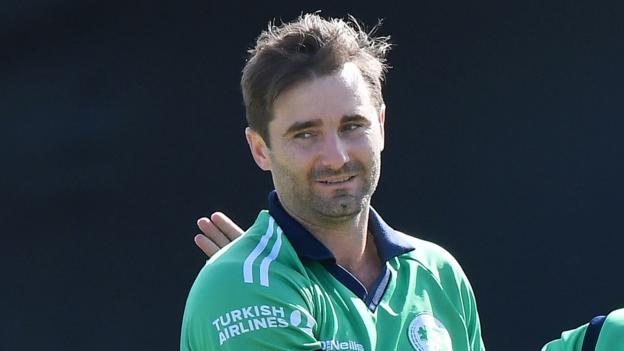
Ireland v Afghanistan: Irish win second Stormont ODI by three wickets

news image

Ireland defeat Afghanistan by three wickets to level ODI series
Second one-day international, Stormont
Afghanistan 182-9 (50 overs): Zadran 42, Afghan 39; Murtagh 4-30
Ireland 183-7 (43.5 overs): Balbirnie 60, Stirling 39, Singh 36*; Rashid 3-37
Ireland won by three wickets
Scorecard

Ireland beat Afghanistan by three wickets in the second ODI at Stormont to set up a series decider on Friday.

Middlesex seam bowler Tim Murtagh took four wickets for the second game in a row as the Afghans were restricted to 182-9 off 50 overs.

Najibullah Zadran top-scored for the tourists with 42 off 52 balls.

A second-wicket partnership of 68 between Andrew Balbirnie (60) and Paul Stirling (39) helped Ireland to 183-7 with 37 balls to spare.

Afghanistan, playing their 100th one-day international, had won the first of the three ODI matches in Belfast by 29 runs on Monday, having also come out on top 2-0 in last week’s Twenty20 series against the Irish at Bready.

Murtagh followed up his figures of 4-31 in Monday’s contest by taking 4-30 on Wednesday, including the wickets of the top three in the Afghanistan batting order.

Ireland’s Balbirnie with superb run-out against Afghanistan

Mohammad Shahzad was lbw for a duck to the second ball of the innings and was quickly followed to the pavilion by Hazrat Zazai, bowled having scored a single run, and Gulbadin Naib, lbw for seven.

When Hashmatullah Shahidi was run out by Balbirnie, Afghanistan were 16-4 but rallied with the help of Zadran’s quick-fire innings, along with 39 from captain Ashgar Afghan and 32 from Rahmat Shah.

Peter Chase, Kevin O’Brien and Simi Singh took one wicket apiece.

Captain William Porterfield fell to the fourth ball of the Ireland innings but Balbirnie and Stirling’s partnership helped see their side home despite the efforts of spinner Rashid Khan (3-37) and Mohammad Nabi (2-38).

Simi Singh ended unbeaten on 36, with Murtagh on four, scoring the winning runs.

William Porterfield failed to score in the second ODI against Afghanistan on Wednesday

Read More

from Trusted eNews https://ift.tt/2wy4V1p
via IFTTT

Tears, anger as Germany returns human remains seized from Namibia

news image

Skulls and other remains of massacred tribespeople used in colonial-era experiments to push claims of European racial superiority were handed over by Germany to Namibia at a church ceremony in Berlin on Wednesday.

In what historians call the first genocide of the 20th century, soldiers of German Kaiser Wilhelm slaughtered some 65,000 Herero and 10,000 Nama tribespeople in a 1904-1908 campaign in retaliation for a revolt against land seizures by German colonists.

Herero chief Vekuii Rukoro said the handover ceremony on Wednesday should have taken place not in a Berlin church, but a German government building.

He also accused Germany of taking too long to formally apologise for what is often called the first genocide of the 20th century.

“By trying not to acknowledge the past, the German government will continue to make serious mistakes as regards present and future policies,” Rukoro told the church audience, which included government officials from both countries.

“We are after all the direct descendants of these remains and we should not be ignored.”

“By trying not to acknowledge the past, the German government will continue to make serious mistakes as regards present and future policies.”

Vekuii Rukoro, the chief of Herero people

A Namibian delegation formally received the remains, including 19 skulls, a scalp and bones, during the church ceremony.

Michelle Muentefering, a minister of state for international cultural policies in the German foreign ministry, asked “for forgiveness from the bottom of my heart” as she handed over the remains to Namibia’s culture minister.

Several Herero women in traditional, cow-horn shaped headdress wiped away tears during the at times emotional proceedings.

“May the remains of our ancestors finally go home to Namibia in peace. May they return to the dust from which they came. May justice be done and faith in humanity be restored,” said Johannes Isaack, Nama chief.

Outside the venue, some two dozen protesters held up signs that read: “Repatriation without an official apology?” and “Reparations Now!”.

The Herero and Nama tribes have filed a class-action lawsuit in a US court over reparations [Reuters]

The German government announced in 2016 that it planned to issue an official apology for the atrocities committed by German imperial troops.

But it remains locked in talks with the Namibian government on a joint declaration on the massacres.

It has also refused to pay direct reparations, arguing instead that German development aid worth hundreds of millions of euros since Namibia’s independence from South Africa in 1990 was “for the benefit of all Namibians”.

Class-action lawsuit

Angered by Berlin’s stance, representatives of the Herero and Nama tribes have filed a class-action lawsuit in a US court demanding reparations.

They also want a seat at the table in the discussions between the German and Namibian governments.

“They are still negotiating on an appropriate text … for an apology. That’s a big joke,” Rukoro said during the service, wearing a red, military-style dress uniform.

He accused both countries of trying to sideline him and others in the handover proceedings, saying he had been told in advance “not to embarrass the two governments”.

Germany killed about 60,000 Herero and 10,000 Nama people [Christian Mang/Reuters]

 Rukoro also blasted the decision to hold the ceremony at the French Church in Berlin.

“We don’t believe that it is bigger and more dignified than all the government buildings of the federal government in Berlin,” he said.

Rukoro and Isaack are both plaintiffs in the US lawsuit.

The New York judge in the case has yet to rule on whether to hear the suit, which Germany wants thrown out on the grounds of state immunity from prosecution.

‘Extermination order’

Incensed by German settlers stealing their land, women and cattle, the Herero revolted in 1904 and killed more than 100 German civilians over several days. The Nama people joined the uprising in 1905.

Determined to crush the rebellion, General Lothar von Trotha signed an “extermination order” that would lead to the deaths of about 60,000 Herero and 10,000 Nama people.

Many were murdered by German imperial troops while others, driven into the desert or rounded up in prison camps, died from thirst, hunger and exposure.

Germany has previously repatriated human remains to Namibia in 2011 and 2014 [Reuters]

Dozens were beheaded after their deaths, their skulls sent to researchers in Germany for discredited “scientific” experiments that purported to prove the racial superiority of white Europeans.

In some instances, captured Herero women were made to boil the decapitated heads and scrape them clean with shards of glass.

Research carried out by German professor Eugen Fischer on the skulls and bones resulted in theories later used by the Nazis to justify the murder of Jews.

Germany has previously repatriated human remains to Namibia in 2011 and 2014.

The remains, many of which were stored on dusty shelves in universities and clinics, were “often stolen … brought to Germany without respect for human dignity”, according to the German foreign ministry.

Read More

from Trusted eNews https://ift.tt/2olsg2T
via IFTTT

The complete guide to the iPhone’s Bedtime mode

news image

Disclosure

Every product here is independently selected by Mashable journalists. If you buy something featured, we may earn an affiliate commission which helps support our work.

A complete guide to using iPhone Bedtime, your first step to 8 hours of sleep.

Image: Midnight Oil Enterprises/YouTube

The iPhone’s “Bedtime” functionality within the alarm clock app is an innovative and interesting feature. 

Working on the basis that being consistent with the amount of sleep you get (i.e. going to bed and waking up at the same time every day) is better for your health, this useful tool makes it easier to achieve this goal.

But how do you get the most out of the iPhone Bedtime feature? Here’s everything you need to know about the iPhone’s Bedtime mode, from getting started to analyzing your results. 

So, how much sleep do you need?

If you’ve never really thought about it before, it can be hard to guesstimate exactly how much sleep your body needs. 

While everyone is different, there are some general guidelines, based on age, to help you come up with a figure. The guidelines, published in Sleep Health: Journal of the National Sleep Foundation, were penned by a panel of experts that looked at 320 studies on the matter.

  • Teenagers (ages 14-17): 8-10 hours

  • Young adults (ages 18-25): 7-9 hours 

  • Adults (ages 26-64): 7-9 hours

  • Older adults (ages 65-plus): 7-8 hours

It’s worth taking these guidelines seriously. Getting yourself into long-term “sleep debt” has been linked to obesity, diabetes and cardiovascular disease. 

Getting started with Bedtime 

The setup process the first time you use Bedtime is pretty simple. Your iPhone will guide you through as soon as you hit the “Get Started” button. 

First, you set the time you’d like to wake in the morning, then hit Next. 

Then tell your iPhone which days of the week you’d like to be woken at that time. For the sake of consistency, it recommends you wake at the same time every day, even on days off. 

Next is the setting to say how many hours sleep a night you need. 

In the next screen you get to set up a “bedtime reminder,” an alarm that goes off right when you should be heading to bed, or with a few minutes’ notice.

You can now select the sound your phone will play to wake you. A far cry from alarm clocks of yore, the options are really quite pleasant, from birdsong to gentle piano, all of which gradually build in volume for a more civilised wake-up experience.  

Once, you’ve gone through the process, click Save at the top right of your screen to complete the setup. 

When you go into the Bedtime screen in your alarm clock app, you’ll now see your sleep time plotted in a graph. You can toggle Bedtime on and off by tapping the green sliding icon at the top right of the screen. 

Viewing your sleep stats 

You can view your most recent sleep stats by going into the alarm clock app and looking at the Bedtime screen. 

The at-a-glance way to read your analysis is to see if all your “Sleep History bars” are aligned. To see more in-depth data, tap the option to view “More history” at the bottom of the screen. 

This then opens your iPhone’s Health app, which is where your sleep history is stored. 

From Health, you can view your data on a daily, weekly, monthly and yearly basis in graph format. Tapping on the graph will bring up your data in a list format. 

Changing your settings 

To adjust your settings at any time, simply go into the Bedtime screen of your alarm clock app and tap “Options” at the top left of your screen. 

From here you can change the days you want Bedtime enabled, your reminder time, what sound you wake to and the volume. 

Read More

from Trusted eNews https://ift.tt/2MXPvhc
via IFTTT

First Man Venice reviews hail Ryan Gosling’s ‘turbulently spectacular’ Oscar hopeful biopic

news image

Ryan Gosling’s Neil Armstrong biopic First Man has launched with glowing reviews at the Venice International Film Festival.

Previously announced as the Oscar-positioning event’s opening night selection, the film sees Gosling reuniting with his La La Land helmer Damien Chazelle for a dramatic retelling of the pioneering astronaut’s life, and the first reactions from movie critics have provided a crucial, sturdy foundation for the film’s impending awards season run.

“This is a strikingly intelligent treatment of a defining moment for America that broadens the tonal range of Chazelle, clearly a versatile talent, after Whiplash and La La Land,” writes The Hollywood Reporter‘s David Rooney, further praising the film’s “refusal to engage in the expected jingoistic self-celebration” that celebrating Armstrong’s first-man-on-the-moon milestone could have registered.

“Gosling downplays his natural charisma here to portray a man simply intent on doing a job, approaching it with the utmost seriousness and without ego. Armstrong shows zero willingness to consider what he’s doing in any self-aggrandizing historical context, his taciturn demeanor proving frustrating to the press, who want uplifting soundbites. That makes the characterization almost antithetical to the standard Hollywood conception of a historically significant figure of this type,” he continues. “Instead, Gosling pulls you in on an intimate level, whether Neil is tackling life-or-death situations mid-mission or simply staring at the moon from his backyard, as if the distant image somehow holds the secret to a successful landing. It’s a subdued, almost self-effacing performance that nonetheless provides the drama with a commanding center.”

The Guardian‘s Peter Bradshaw similarly heralds Gosling’s work, calling his lead performance one of “muscular intelligence and decency,” while pegging the film as a “mostly soaring” effort overall, and Variety‘s Owen Gleiberman similarly heralds the project as “turbulently spectacular” and a “docudrama in the most authentic and exciting sense of the word” through Chazelle’s “audacious strategy…. to make a movie so revelatory in its realism, so gritty in its physicality, that it becomes a drama of thrillingly hellbent danger and obsession.”

“Wisely, Chazelle has opted to leave spectacle to the blockbusters and instead aims for awe – which is related, but different, and harder to pull off. The former shows you something you haven’t seen before. The latter involves showing you something you see every day from a perspective that makes it newly strange. First Man chases awe from its 1961-set opening sequence, in which Armstrong, then a government test pilot, flies an experimental X-15 aircraft high enough for the ship to “bounce off the atmosphere” on its descent,” The Telegraph‘s Robbie Collin adds. “Chazelle has always specialised in virtuoso endings, and his sure hand and sharp eye brings this ambitious character study smoothly into land.”

Also starring Claire Foy, Corey Stoll, Cory Michael Smith, and Jason Clarke, the film follows Armstrong’s career through to his groundbreaking July 20, 1969 mission which led him to become the first man to walk on the moon. The project has long been considered a potential awards contender, given the pedigree of those working on the film. Gosling of course has two Oscar nods to his name, while Chazelle and screenwriter Josh Singer both have Academy Award statuettes under their belt.

Chazelle previously told EW he shot the earth-based scenes for the film before moving on to the complex, orchestrated flight sequences featuring Gosling inside full-scale replicas of Armstrong’s space capsules. To further immerse his cast, Chazelle even mounted LED screens outside the structures that played footage of what the trio of astronauts would have seen along their journey.

“Even though they were the three selected to be on this historic mission, there were 400,000 people who had made this possible,” Gosling added. “They were the final ones to execute it, but you get a sense from the astronauts that no one wanted to be the one that was the weak link.”

Pending the reception of Peter Farrelly’s Green BookFirst Man is shaping up to be Universal’s only major awards bid this year. It is next scheduled to screen at the Toronto International Film Festival in September, with a potential Telluride screening on the table for Labor Day weekend (that festival does not make its official lineup announcement until the day before it kicks off).

First Man opens Oct. 12 in theaters. Read on for more reviews from Venice, which runs now through Sept. 8, and is set to include screenings of other high profile productions like Bradley Cooper’s A Star Is Born, Luca Guadagnino’s Suspiria, the Coens’ The Ballad of Buster Scruggs, Yorgos Lanthimos’ The Favourite, and Roma, Alfonso Cuarón’s semi-autobiographical return to directing since 2013’s Gravity.

Owen Gleiberman (Variety)
“Gosling gives a tricky, compelling performance that grows on you. He plays Armstrong as a brainy go-getter who has learned to hold most of what he feels inside (he wrote musicals in college, and is now ashamed of it). Yet he lets out just enough emotion, especially when someone crosses him, to exude a quiet command…. Gosling makes Armstrong a figure of intensely contained devotion and can-do moxie whose ability to guide a ship, especially when it’s at death’s door, is the essence of grace under pressure.”

Jessica Kiang (The Playlist)
“Steering an astonishingly accomplished path between the small steps and the giant leaps of the Apollo 11 mission, reigning Best Director Damien Chazelle opens the 75th Venice Film Festival with First Man, an immersive, immaculately crafted, often spectacular and satisfyingly old-fashioned epic that may well become the definitive moon-landing movie.”

Robbie Collin (The Telegraph)
“It also gives an emotional undertow to the moon landing finale itself – which, it is implied, gives Armstrong the literally unearthly perspective required to process his heartbreaking loss. The less said in advance about this staggering sequence the better, other than that it crackles with eeriness and wonder, looks utterly real, and is the reason to see First Man on the biggest cinema screen you can find.”

Peter Bradshaw (The Guardian)
“A more questioning or nuanced movie might have placed the moon landing halfway through the story and then focused on the long, mysterious and anti-climactic nature of Armstrong’s life on earth. Chazelle – understandably – makes the moon landing the climax and the glorious main event. It is a movie packed with wonderful vehemence and rapture: it has a yearning to do justice to this existential adventure and to the head-spinning experience of looking back on Earth from another planet. There is a great shot of Armstrong looking down, stupefied, at the sight of his first boot-print on the moon dust, realising what that represents.”

Michael Nordine (IndieWire)
“You already know how First Man ends. It’s been nearly half a century since man walked on the moon, and nearly as long since space exploration was at the forefront of America’s collective imagination, which is to say that Damien Chazelle’s follow-up to La La Land has more challenges to contend with than it might initially appear. They’re easily overcome: First Man is an anti-thriller of rare intensity, with lived-in performances from Ryan Gosling and Claire Foy heightening the sky-high drama at every turn. It’s not a comprehensive look at the Apollo 11 mission, but revisits that famous story from a more intimate angle, even as it delivers a satisfying ride.”

David Rooney (The Hollywood Reporter)
“There can be no doubt concerning the ultimate outcome of Damien Chazelle’s drama about NASA’s 1969 Apollo 11 mission, which made history by putting astronauts on the Moon after a series of trial-and-error attempts. It’s implicit in the title, First Man. So it’s a credit to the filmmakers and to lead actor Ryan Gosling’s thoughtfully internalized performance as Neil Armstrong that this sober, contemplative picture has emotional involvement, visceral tension, and yes, even suspense, in addition to stunning technical craft.”

Read More

from Trusted eNews https://ift.tt/2LyZrJm
via IFTTT

Aaron Rodgers agrees to record four-year, $134 million extension with Packers

news image

Share This Story!

Let friends in your social network know what you are reading about

Aaron Rodgers agrees to record four-year, $134 million extension with Packers

Aaron Rodgers’ four-year, $134 million extension includes an $80 million payout between now and next March.

Loading…Post to Facebook

Posted!

A link has been posted to your Facebook feed.

CLOSE

SportsPulse: Trysta Krick goes one-on-one with Tony Romo and discusses what happened with Dez Bryant and the Cowboys, why the preseason will be shortened and if he would ever consider getting back into the game as a coach.
USA TODAY

Aaron Rodgers is back on top as the NFL’s highest-paid player.

The Green Bay Packers quarterback and two-time MVP agreed Wednesday to a four-year, $134 million extension with a maximum potential value of $180 million, a person with knowledge of the deal told USA TODAY Sports’ Mike Jones. The person spoke on condition of anonymity because they were not authorized to disclose details of the deal.

NFL Network’s James Jones  was the first to report the agreement.

The deal includes $103 million guaranteed and $67 million before the end of the calendar year.

Atlanta Falcons quarterback Matt Ryan previously set the high for average annual salary with a five-year, $150 million deal reached in March.

Rodgers, 34, still had two years remaining on the five-year, $110 million contract he signed in 2013, which at the time made him the league’s highest-paid player. He was set to earn a base salary of $19.8 million this year and $20 million in 2019.

Rodgers missed nine games last year after suffering a broken collarbone against the Minnesota Vikings. But his 103.8 passer rating is the highest of any player in league history, and he has thrown 313 touchdowns against just 78 interceptions.

Autoplay

Show Thumbnails

Show Captions


Read More

from Trusted eNews https://ift.tt/2MWiJ03
via IFTTT

Someone renamed a Senate office building for John McCain on Google Maps

news image

CLOSE

A proposal to rename the Russell Senate office building for John McCain has received bipartisan support, but the effort appeared to slow as Senate Majority Leader Mitch McConnell announced he will form a bipartisan panel to solicit ideas. (Aug. 28)
AP

Some U.S. senators wanted to honor Sen. John McCain’s by renaming the Russell Senate Office Building after him.

Well, that digital epitaph for the late Arizona senator and Vietnam War veteran has already been instituted on Google Maps – if only for a short time.

Earlier Wednesday you could call up Washington, D.C., on Google Maps and zoom in on the U.S. Capitol. Just to the north you would will see “McCain Senate Office Building.”

Google is in the process of re-instituting the Russell Office Building to its original name, which suggests that a user had edited the location’s name.

“We empower people to contribute their local knowledge to the map, but we recognize that there may be occasional inaccuracies or premature changes suggested by users,” Google said in a statement to USA TODAY. “When this happens, we work to address as quickly as possible. We have implemented a fix for this issue that is rolling out now.”

For now in the real bricks-and-mortar world that building, one of three large structures housing Senate offices – including McCain’s office – near the U.S. Capitol, remains named for Richard Russell, a Democratic senator who served from 1933 until to 1971, the year he died.


There have been various efforts over the years to rename the building, but the bipartisan support to honor McCain could lead to a success. The effort would likely be lumped into the contentious nationwide effort to remove Confederate-era memorabilia and statues.

Russell was a segregationistfrom Georgia who led in supporting racial segregation and white supremacy. He was known as a “senator’s senator” and chaired the Senate Armed Services Committee and the Appropriations Committee. The building, which opened in 1909, was renamed from the Old Senate Office Building to honor Russell in 1972.

Sen. Chuck Schumer, the Senate’s Democratic leader, proposed renaming the Russell building after McCain just hours after the Arizona Republican’s death. “Nothing will overcome the loss of Senator McCain, but so that generations remember him I will be introducing a resolution to rename the Russell building after him,” Schumer said.

While the aim of honoring McCain is bipartisan, some Republican senators have expressed caution and displayed a reluctance to back erasing Sen. Russell’s name from the building.

Senate Majority Leader Mitch McConnell, R-Ky., on Tuesday suggested a bipartisan committee be formed to explore a range of options to commemorate McCain, who died Saturday from brain cancer.

McConnell said he was “not notified in advance” of Schumer’s proposal, made Monday, to rename the building. Instead, he said the Senate usually does not move so quickly to honor deceased colleagues and that there should be deliberation “after proper recognition of the person we’ve lost” and “in a calmer environment.”

A slow approach to honoring his name might have set better with McCain anyway, Sen. Roy Blunt, R-Mo., said Monday. “While John McCain always wanted to get things done, he also always wanted to get things done in a regular order,” Blunt said.

Follow USA TODAY reporter Mike Snider on Twitter: @MikeSnider.


Read or Share this story: https://usat.ly/2BZ8T9h

Read More

from Trusted eNews https://ift.tt/2N5Hkja
via IFTTT

Design a site like this with WordPress.com
Get started