Turkey has accused Western credit-rating agencies of deliberately attempting to undermine the banking sector amid attacks on its currency, the lira.
Friday’s scathing comments from Turkish President Recep Tayyip Erdogan and his son-in-law, Finance Minister Berat Albayrak, came after two agencies, Moody’s and Fitch, sounded more alarm this week about the state of Turkey‘s banks, citing impact of the currency sell-off.
“These rating agencies – in a way that has no precedent in the world – right after every forex attack, have weighed in and made intensive efforts to create a pessimistic view of our banks,” Albayrak said in a speech in Istanbul.
He said banks’ balance sheets were stronger than most of their global rivals.
Erdogan, characteristically, was more scathing.
“If they have their dollars, we have our God. They can’t topple Turkey with dollars,” he told supporters in the northwestern province of Balikesir.
“Put this aside, leave those impostors, those racketeers. They have said a lot of things about us.”
The lira has lost 42 percent of its value against the dollar this year, deepening concern about lenders’ asset quality and their ability to ride out the crisis.
Drawn by lower interest rates, Turkish firms have borrowed in dollars and euros for years.
The currency slump has driven up the cost of servicing that debt and investors fear that banks could be hit by a wave of rising bad debt.
Around $179bn of Turkey‘s external debt matures in the year to July 2019, according to New York-based financial institution JPMorgan’s estimates.
Majority of that – around $146bn – is owed by the private sector, according to Reuters news agency.
Erdogan added that Turkey was taking steps to help the currency, and was seeing concrete results.
Earlier on Friday, the government said it would lower the level of withholding tax on lira bank deposits, while raising it on foreign currency deposits.
The lira firmed some one percent after the move. It was at 6.54 on Saturday morning, rebounding strongly from an overnight low of 6.8994.
Erdogan’s call to sell dollars
President Erdogan has repeatedly called on Turks to sell their dollars and euros to buy lira.
Friday’s move by the government was aimed at making it less attractive for investors to hold foreign-currency deposits, although it was unclear if it would work.
Data released by the central bank on Friday showed foreign exchange held by Turks fell to $152.8bn as of August 24, down from $159.9bn on August 10, suggesting people were heeding Erdogan’s call, or cashing in from the crisis.
Meanwhile, Turkey’s energy regulator will raise electricity prices by 14 percent for industrial use and nine percent for residential use from September 1, according to figures published in the government’s Official Gazette on Friday.
The rate hikes, which will further feed double-digit inflation, highlight another impact of Turkey’s on-going currency crisis.
Initially sparked by worries about Erdogan’s influence on the central bank, the lira crisis has worsened over a rift with Washington over an US evangelical Christian pastor detained inTurkey on “terrorism” charges.
Erdogan, a self-described “enemy of interest rates”, wants to see lower borrowing costs to keep credit flowing, particularly to the construction sector.
Investors, who see the economy heading for a hard landing, want to see decisive interest rate hikes.
Other data showed that the central bank’s gross foreign exchange reserves fell to $72.9bn as of August 20, from $79.1bn on August 10.
The central bank is due to hold its next rate-setting meeting on September 13. Sources told Reuters on Thursday that one of its deputy governors, Erkan Kilimci, is leaving the bank.
The main BIST 100 share index dipped 0.44 percent on Friday to 92,867 points.
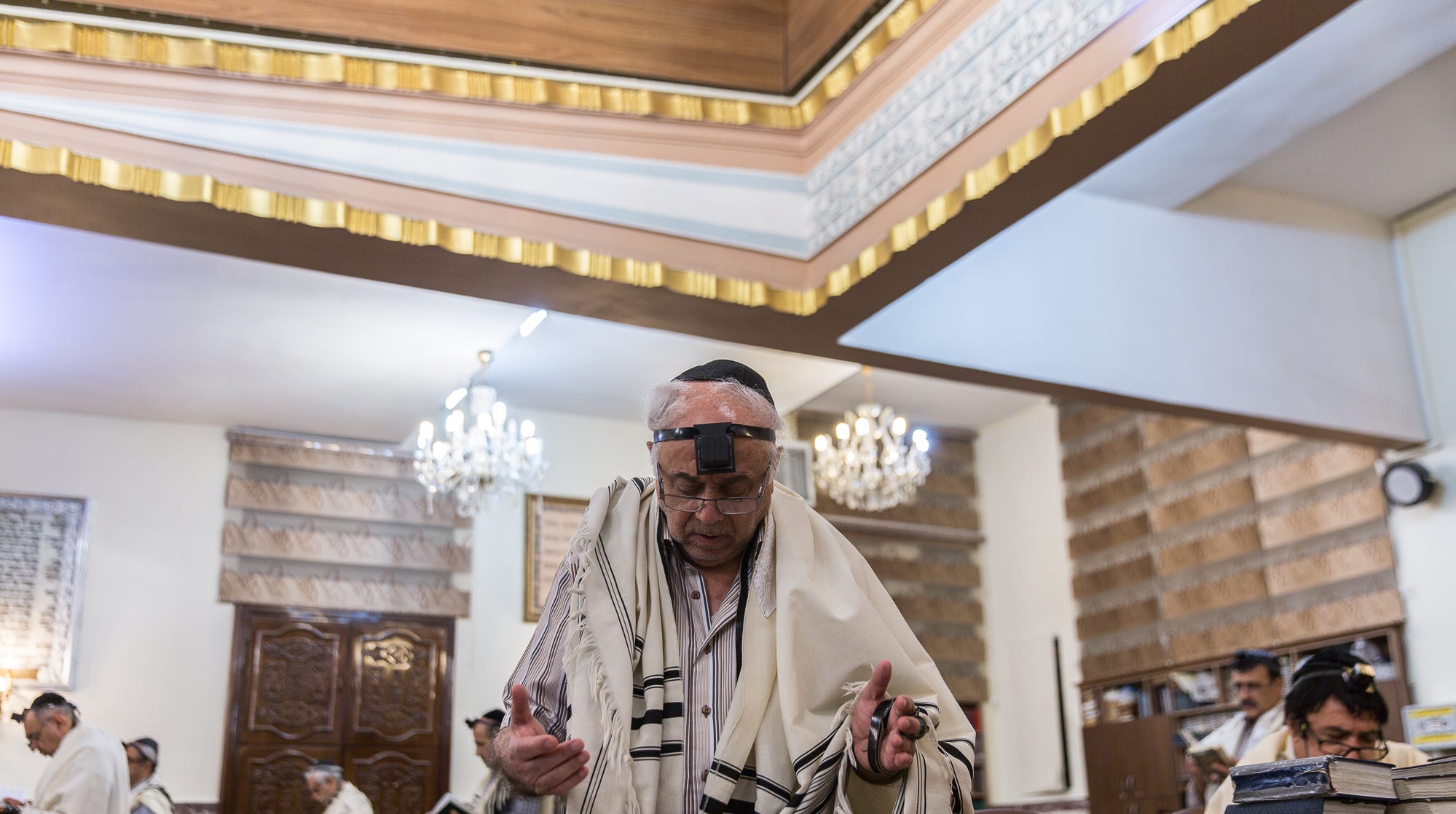
TEHRAN, Iran – In a large room off a courtyard decorated in places with Islamic calligraphy and patterned tiles featuring intricate geometric shapes and patterns, men wearing tunics, cloaks and sandals recite morning prayers.
At the back of the room, three women sit together on a bench, hunched over ancient texts. Scarves cover their hair, as required by Iran’s religious law. Birdsong floats into the cavernous space as the incantations grow louder and more insistent.
This is a synagogue. In Iran.
In a nation that has called for Israel to be wiped off the face of the Earth, the Iranian government allows thousands of Jews to worship in peace and continue their association with the country founded more than 2,500 years ago.
“We have all the facilities we need for our rituals, and we can say our prayers very freely. We never have any problems. I can even tell you that, in many cases, we are more respected than Muslims,” said Nejat Golshirazi, 60, rabbi of the synagogue USA TODAY visited one morning last month. “You saw for yourself we don’t even have any security guards here.”
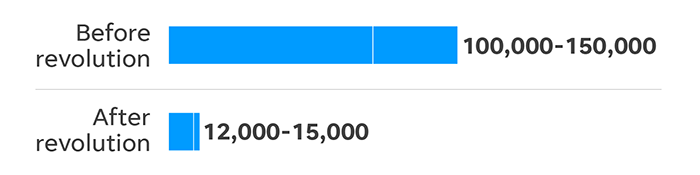
At its peak in the decades before Iran’s Islamic Revolution in 1979, 100,000 to 150,000 Jews lived here, according to the Tehran Jewish Committee, a group that lobbies for the interests of Iranian Jews. In the months following the fall of Mohammad Reza Shah Pahlavi, Iran’s second and last monarch, many fled for Israel and the United States.
It was a dispersion precipitated in part by the execution of Habib Elghanian, who was then one of Iran’s leading Jewish businessmen and philanthropists. Elghanian also headed the Tehran Jewish Committee and had ties to the deposed shah. He was killed by firing squad after being accused by Iran’s Islamic revolutionaries of spying and fundraising for Israel.
Few Jews remain
Today, 12,000 to 15,000 Jews remain in Iran, according to the committee.
It’s a small minority in a nation of 80 million people. But consider: Iran is home to the Middle East’s largest Jewish population outside Israel.
And, according to Golshirazi and other senior members of Iran’s Jewish community, they mostly enjoy good relations with Iran’s hard-line, theocratic government despite perceptions abroad that Iran’s Islamic rulers might subject them to harsh treatment.
“The Muslim majority in Iran has accepted us,” said Homayoun Sameyah Najafabadi, 53, who holds the role once held by Elghanian, chairman of the Tehran Jewish Committee.
“We are respected and trusted for our expertise and fair dealings in business, and we never feel threatened,” he said. “Many years ago, before the royal regime of Pahlavi, by contrast, if it was raining in Iran, Jews were not allowed to go outside of their houses because it was believed that if a non-Muslim got wet and touched a Muslim it would make them dirty.”
Najafabadi said it may be difficult for Jews and others outside the country suspicious of Iran’s treatment of religious minorities or its views on Israel to accept, but after the execution of Elghanian, Ayatollah Khomeini, Iran’s first supreme leader, deliberately sought to improve relations between Jews and Muslims in the country for the nation’s long-term stability.
He added that Jews, who have been in Iran since about the eighth century B.C., used to be scattered all over the country but are now largely concentrated in Tehran and other big cities such as Isfahan and Shiraz. In all, he said, Iran is home to about 35 synagogues.
Najafabadi said most Jews in Iran are shopkeepers, although he said others work as doctors, engineers and in other highly skilled professions.
There are no Jews, however, in senior government positions. There’s only one Jewish representative in the country’s 290-member Parliament. His name is Siamak Moreh Sedgh.
Sedgh, 53, said one of the reasons Jews in Iran are able to live peacefully is that they consider themselves Iranians first – and Jews second.
“We’re not an entity outside of the Iranian nation. We are part of it. Our past and our future. I may pray in Hebrew, but I can only think in Persian (Farsi, Iran’s language),” said Sedgh, who is also a surgeon at a hospital in central Tehran, where USA TODAY spoke with him.
Crucially, that affinity extends to the question of Israel.
“I don’t think Israel is a Jewish state because not everyone in Israel lives according to the teachings of the Torah. This is what Jews in Iran believe,” Sedgh insisted.
He acknowledged that it was somewhat ironic that Iran, arguably the biggest foe of Israel, was also the “biggest friend of the Jewish people.”
Sounding more Iranian than Jewish, Sedgh said he disagreed with President Donald Trump’s decision this year to move the U.S. Embassy in Israel to Jerusalem from Tel Aviv because “Trump can’t just change a capital city that according to international law and the United Nations is an occupied city.”
The final status of Jerusalem has long been disputed. Palestinians want a capital of an independent Palestinian state in East Jerusalem; Israel views the city as its true capital.
“Trump is a coward who has lost his humanity and forgotten about spirituality. He wants to destroy large parts of the world only for the benefit of a small group of capitalists,” Sedgh said.
On Tehran’s bustling streets, Jews are not very visible, partly because there are so few of them. USA TODAY did, however, spot a few men wearing kippahs as they hurried off to work in the morning. They did not appear to attract any second glances from Iranian men in business suits, others in traditional Muslim dress or women sporting hijabs and chadors.
Other minority groups in Iran include Arabs, Armenians, Baloch people (who live near Pakistan, in Iran’s southeast), Christians and Kurds. Open Doors USA, an organization that tracks persecuted Christians worldwide, estimates there could be as many as 800,000 Christians secretly living in Iran. It says Christians in Iran are routinely subject to imprisonment, harassment and physical abuse for seeking to convert Muslims. USA TODAY did not encounter any Christians in Iran.
Outside the Yousef Abad Synagogue, the entrance via the courtyard was unprotected, and it was easy to walk straight in. That’s unheard-of for Jews in Europe, where Jewish schools, institutions and places of worship receive extra security amid a spate of attacks.
“What you see there (for Iran’s Jews) is a very vibrant community,” said Lior Sternfeld, a Middle East historian who in November will publish a book on modern Jewish life in Iran. “A community that faces problems – but it’s Iran, so problems are a given.”
Difficulties and discrimination
Still, rights groups and experts believe Jews in Iran do face discrimination. Najafabadi, the committee chief, conceded that in some instances, Iranian Jews have had trouble getting access to the best schools with their Muslim peers.
In other cases, treatment of Jews has ended in brutal violence.
In 1998, Ruhollah Kadkhodah Zadeh, a Jewish businessman in Iran, was hanged by the authorities after being accused of helping Iranians Jews emigrate. Two years later, 10 Jews in the southern city of Shiraz were jailed after they were accused of spying for Israel.
Then there’s Mahmoud Ahmadinejad, Iran’s former president, who drew international attention when he repeatedly denied the Holocaust in which 6 million Jews were murdered.
Meir Javedanfar, an Iranian Jew, says life has improved for Jews under Iranian President Hassan Rouhani. Javedanfar left the country for Israel in 1987 as a teenager and now teaches classes on Iranian politics at the Interdisciplinary Center Herzliya, north of Tel Aviv.
Javedanfar said, for example, that Jewish children in Iran are no longer required to attend school on the Sabbath, the traditional day of rest and religious observance among Jews that falls on a Saturday but is a regular workday in Iran.
“At the same time, the regime continues to hold Holocaust cartoon contests that are pretty anti-Semitic,” he noted, referring to a provocative annual exhibition in Iran that mocks Jewish suffering while claiming to challenge Western ideas about free speech and Holocaust taboos.
He quickly pointed out: “The regime is not too concerned about its Jews as long as they don’t become involved in politics and don’t say anything positive about Israel.”
Golshirazi the rabbi, Najafabadi of the committee and Sedgh the parliamentarian all stressed they were speaking truthfully and not trying to distort their views of life in Iran for Jews out of fear of government persecution. They also said Jews in Iran often enjoy extra social freedoms that Muslims do not, such as the ability to consume alcohol in a private setting.
The few Jews in Iran are unlikely to leave.
In 2007, the Tehran Jewish Committee rejected an offer by Israel’s government to pay each family of remaining Jews in Iran up to $60,000 to help them leave the country.
“I can tell, you are thinking I am afraid,” Golshirazi said when USA TODAY pressed him on that point. “But I have been many places visiting Jewish communities. Iran is the best for us.”
IRAN FAQ: “What’s the food like? Do any Iranians like Trump? Those and other questions answered.” Read FAQ here.
Stevie Gerrard has learned the hard way about derbies.
He was sent off in just his second Liverpool v Everton contest for a stoppage-time, thigh-high lunge on Kevin Campbell. I was at Liverpool at that time – 19 years ago – and it was the first red card of his Anfield career.
In the 31 Merseyside derbies he played subsequently – and likewise the numerous grudge matches with Manchester United – he learned how to control his emotions. How to channel them into affecting what happened on the pitch. Mostly, anyway.
So when he steps out of the tunnel at Celtic Park for his first Old Firm derby on Sunday, he’ll know exactly how he should behave.
He’ll also know the man just along the touchline – his former Liverpool manager Brendan Rodgers.
And he’ll know how big a marker he can set down by leading Rangers to their first 90-minute win over Celtic in six years.
‘I hope it’s not like Lennon v McCoist’
It’s been nine matches since the Ibrox club have beaten Celtic in the league so, although he might not show it, Stevie will be desperate to win.
He’ll be very wary of conducting himself the right way amid the passion and madness that will be swirling around him.
When we played Everton or Manchester United under Gerard Houllier, he was obsessed with our temperament and discipline. Houllier used to say if we kept calm at Goodison, we’d win. And we always did.
Stevie will remember that; how important it was for us as young players to look over and see a manager who stayed calm in the middle of a game of that magnitude.
What he’ll want to avoid is what happened between Ally McCoist and Neil Lennon a few years back. They are both top blokes who care about their clubs but their passion spilled over the top. It was too showy and that is not how you should conduct yourself as a manager.
‘Stevie will want to get one over on Brendan’
There’s no chance of that kind of thing happening between Stevie and Brendan. Brendan is not the type to get carried away, either, and he is very aware of his role and the influence he has on his players.
Towards the end at Liverpool, there was a perception that they didn’t get on because Stevie didn’t play that much in his final season. But any animosity that might have been there is well in the past and I know they speak to each other now.
There will be a respect. After all, Brendan nearly made history at Liverpool by winning that league and was a game or two away from becoming a legend.
But there will also be a determination from Stevie to get one over him. Not because there is any niggle there, but because Stevie knows he is the underdog. Brendan is the more experienced guy and the one everyone expects to come out on top and that makes Stevie dangerous. It always has.
Watch: Best and worst Old Firm debuts
‘Stevie is empathetic. He cares about players’
Stevie is a leader, but he wasn’t that way when we were kids and room-mates at Liverpool. It was only when he became captain that it was kind of forced upon him.
The Rangers squad will automatically respect him because of what he’s done in the game, but they will have also seen that he has the ability to be empathetic and care about players. He won’t fly off the handle quickly, but he’s got a ruthless side and when he does lose it, they’ll know about it.
I remember giving the ball away in a game at Leeds once, and we ended up in a horrendous row – throwing all sorts of insults at each other – and it was only once I’d settled down that I realised he was right. That made me think “if he can do that to me, his friend, a guy who is a little older… wow, this guy is a winner”.
The best managers all have that balance of talking to you with respect, giving you encouragement, but putting you back behind the line if you ever cross it. And I think Stevie has that in his armoury and has the personality to learn as he goes on. I might be biased, but I think Sunday’s Old Firm game will tell us a lot.
Danny Murphy was speaking to BBC Sport’s Mike Henson.
Lansing State Journal columnist Graham Couch give his initial thoughts on the Spartans’ win over Utah State Friday night at Spartan Stadium.
1. That push up front simply won’t do
Forget the Big Ten race or the College Football Playoff conversation, if the Spartans simply hope to finish better than fourth in the East Division, Friday’s push by the offensive line won’t cut it. LJ Scott didn’t have a carry for more than 4 yards until his 10th carry. He didn’t have a rush of more than 7 yards until his 16th attempt — and, for the most part, he had nowhere to go.
MSU shuffled its line, moving Matt Allen to center, Tyler Higby to left tackle and freshman Blake Bueter to left guard as it searched for a surge. In short-yardage situations MSU used Brian Lewerke on sneaks rather than let the play unfold with Scott, and on third down on the goal line in the fourth quarter, MSU threw the ball rather than taking a third shot with Scott.
MSU’s per-carry average was bolstered a tad by big runs by Connor Heyward and Brian Lewerke in the second half — and oddly abandoned Heyward until the last drive. Big gainers on the ground are important. It can’t all be a grind. But more important is the ability to reel off 5-,6-, and 7-yard runs with consistency. Especially against a Mountain West opponent that, no matter its experiences on the defensive front, offered less resistance than MSU will see against much of its Big Ten slate. It’s those regular chunks that wear down defenses and create a demoralizing pick-your-poison situation for opponents, considering MSU’s more-than-capable passing attack.
MSU struggled to move the pile with consistency a year ago against Bowling Green and Western Michigan and it foreshadowed a season where the ground game labored too often. Improvement can happen. But this was a rough start.
2. MSU’s passing game will do just fine – if protection improves
Brian Lewerke made mistakes. He overthrew a would-be touchdown pass to Cody White on MSU’s first possession, settling for a 40-yard gain. His pick-six interception late in the third quarter made it the outcome dicey for a long while. But MSU’s passing game is in good shape — made plainly clear by the playmaking and gumption on the final drive.
There is a clear chemistry between Lewerke and his three wideouts — Cody White, Darrell Stewart Jr. and Felton Davis III. Each of those guys made notable plays Friday night, none better than White’s third-down vise-grip grab, followed by Davis’ lay-out deep catch on the game-winning drive. This wasn’t midseason form for Lewerke and Co., but it was plenty effective.
That crew will become what it hopes to become, I think, if the ground game gets going and Lewerke is protected. He saw a fair amount of pressure from Utah State, which sacked him three times and hurried him at least four more.
Some of this falls on the offensive line that also struggled in the running game — sophomore Jordan Reid was beaten badly off the right edge leading to one sack. Some of it was blitz protections.
Lewerke is the franchise, even more so with MSU’s ground game not bearing much fruit. MSU protected him well last year, allowing just 1.8 sacks per game. The protection has to be better than it was Friday for several reasons, including giving Lewerke a chance to last the season.
3. MSU’s defense found its footing and then lost it, then survived
Utah State’s Jordan Love turned out to be a decent QB, with mobility, running a tempo offense, with a veteran offensive line in front of him. That’s a pain to defend. And after rough start, MSU’s defense got a handle on things for a while. Pressure from Jacub Panasiuk created a Khari Willis interception that soon after put the Spartans out in front.
But while Utah State couldn’t run the football effectively in the traditional sense, it moved it. And moved it when MSU need a stop to win the game. MSU’s defense showed flashes of a group that could be really good. But this ain’t the “No Fly Zone” or a crew that looks capable right now of demoralizing an offense.
The Spartans will see tempo again — at least as soon as Indiana on Sept. 22. Probably more often given what transpired Friday.
That the final tip by and pick by Joe Bachie averted disaster — a loss that would have changed this season. There’s plenty to shore up.
Contact Graham Couch at gcouch@lsj.com. Follow him on Twitter @Graham_Couch.
Manchester City were almost out of business – former chief executive
It was the deal that changed Manchester City, the Premier League and the football landscape forever.
On 1 September 2008, Sheikh Mansour Bin Zayed Al Nahyan’s Abu Dhabi United Group agreed a deal to take over City.
Ten years earlier they had been in the third tier of English football. With that deal, City became the richest club in the world and had the money to buy the very best footballing talent on the planet. A decade on they have spent more than £1.4bn on players, won three Premier League titles and become established as one of Europe’s superpowers.
This is the story, from those who were there, of the most significant summer in English football…
Summer 2008 – ‘Chaos’
In August 2008, after his wife Pojaman’s conviction for fraud, Thaksin Shinawatra jumped bail in his native Thailand and fled to Britain. At the time it was estimated Shinawatra had £1bn-worth of assets frozen, plunging his ownership of Manchester City into chaos. City had finished the previous season with an 8-1 defeat at Middlesbrough, with manager Sven-Goran Eriksson replaced by Mark Hughes. Chief executive Garry Cook led the search for a solution.
Garry Cook, who was appointed chief executive in May 2008: “There was chaos. Everybody was clinging to the wreckage. There wasn’t a lot of hope and it was born out of the fact that financially, we were almost out of business.
“We couldn’t pay the bills. We couldn’t pay the wages. Money was frozen. It was a desperate situation and faced with that, you borrow money from wherever you can. We were borrowing from board members. It was not a plan to run a football club. It was one of survival.
“Finding partial investment was not an option. Someone had to take over the club 100%. Good fortune is always a major factor in situations like these and Abu Dhabi United Group were in the market for a football club.
“The dream we sold to them was more than just buying 24 footballers. It was about buying the opportunity to create something rather special.
“We didn’t realise, as a group, the gravity of what was about to happen and the levels it would go to.”
22 August 2008
Kompany with Hughes in 2008
Belgium international Vincent Kompany signs from Hamburg, originally joining as a midfielder, he has gone on to establish himself as one of the Premier League’s greatest defenders and to this day he remains the club’s captain.
Vincent Kompany: “I wasn’t aware [of the planned takeover when I joined]. Like every player who signs for a new club I was told about big plans and big projects and them needing me to complete the project. You listen and you never believe. I was lucky, the guys came in, took over the club and held onto every single promise.”
1 September 2008 – ‘Complete relief’
Manchester City’s Thai owner Thaksin Shinawatra (L) stands with new chairman Khaldoon Al Mubarak
Cook: “The feeling we had when we knew there was a deal was one of complete relief. Relief that we were going to go through change, relief that we wouldn’t have to look back to where we were, relief that we were going to be able to maintain our financial well-being.
“At that stage, the agreement was all on one piece of paper. The irony was that as part of it we took a loan from the prospective owners to allow us to buy a single player in order to state the ambition of what was coming. That was Robinho.”
Former defender Nedum Onuoha: “The takeover was a shock in itself, it was insane. Out of nowhere, we were getting called the richest club in football. It was a shock not just to the players, but the whole football world, it was such a big statement at that time.”
Kompany: “There were a lot of east Asian people at the club. From one day to another, no-one was there anymore. You wonder who is going to be running the club. Next thing it is transfer deadline day, talk of transfers and Robinho coming in. Before you know it, he is sat next to us in the dressing room. Then we knew ‘this is serious’.
1 September 2008 – ‘I couldn’t believe Robinho was my new team-mate’
Robinho joined for a British transfer record of £32.5m
City are linked to Tottenham striker Dimitar Berbatov, but he joins Manchester United. But in the final hours of deadline day on 1 September, City break the British transfer record by signing Brazilian forward Robinho from Real Madrid for £32.5m.
Cook: “We had the capital to go out and get a player, but we only had 24 hours. We had to really go through this ridiculous facade because if we didn’t get the player, the ownership might not take over. It was all very precarious. All a little bit storybook.
“We were making offers for players that were outrageous, unbelievable and made no sense. But we had to try and fulfil the obligation of the incoming owner, which was, get me a marquee player. Robinho was that guy.
“One thing I do remember about that day was the reaction of the fans. It was like they had this weight lifted off their shoulders.”
Onuoha: “I will never forget being in my house watching deadline day on TV and there was breaking news that Robinho had signed for City – it felt like an out of body experience. I looked at it and thought ‘there is no way Robinho has signed’ and then I realised ‘I play for City and Robinho is a new team-mate’.
“I thought ‘wow I will go into work tomorrow and someone who I just watched play for Real Madrid, is now going to be put on the blue of Manchester City and that is incredible.’
“That transfer took the club to a whole new level that they had not been at in Premier League history. This is someone who has now made the step from Real to come to the Premier League, at this club. It was totally surreal, the first sort of big statement.
“Of course he is just a human being, but he was the first real Galactico at the club, as much as didn’t want to, we looked at him differently to everybody else. Not know which direction the club was going in, but knew if people like him were at the front, it would be a very serious place to be.
“The atmosphere and vibe completely changed in the team. It had always been a good place to be, but now it became exciting. The squad had a jewel added to it, that you’d never thought you’d see.”
Kompany: “It was surreal because it was so out of proportion. A superstar was landing at a club where they didn’t see a superstar at their prime for a long time. It hit home to everyone that the pressure was on to do well and succeed.”
Groundsman Lee Jackson: “Someone came knocking on my office door and said we had bid £30m for Berbatov, I thought hold on, we have just paid £6m for Vincent Kompany, we have not got £30m. All of a sudden Garry Cook is in Madrid signing someone called Robinho, being a City fan, I had no knowledge of European football for obvious reasons, so I had to look up who he was.”
A Manchester City supporter dons a traditional Middle Eastern headress to celebrate the buyout of the club by the Abu Dhabi United Group
‘I wonder if Kaka has any regrets?’
In January 2009, the first transfer window after the takeover, City failed in a £100m move for Brazil and AC Milan star Kaka. But later that year they would sign Carlos Tevez from Manchester United. City erected a blue ‘Welcome to Manchester’ sign featuring Tevez , which prompted Ferguson to brand them United’s ‘noisy neighbour.’ The summer after they signed Yaya Toure and David Silva and in 2011 Sergio Aguero arrived.
Cook: “All of a sudden, people were paying attention to Manchester City. Everybody wanted to hear about it. We weren’t used to that. Initially, we were voicing our intentions a bit too loudly. We needed to calm ourselves down.
“But there is a pace at which you should normally proceed and we did not have that luxury. The ambition that needed to be executed quickly. We wanted the best football team on the pitch and executive team off it. We wanted the best facilities and infrastructure.
“[In January 2009], we went for Kaka, which was another declaration of our ambition. But our audacity made people sit up and think ‘that’s not right’. We started to be used as a tool players could use to renegotiate their own contracts. I wonder if Kaka took the time back, whether he would look at the situation differently and joined Manchester City?
“Robinho was a moment. Carlos Tevez was a moment. But we changed the face of the football club when we signed David Silva and Yaya Toure in 2010.”
A decade later – ‘Kids wear City shirts with pride’
City, boasting some of the world’s best players, have won three Premier League titles, the FA Cup and three League Cups and reached the semi-finals of the Champions League. In 2017-18, Pep Guardiola’s side set a Premier League record number of goals, point and wins. A £200m state-of-the-art academy has been built and the owners have invested millions in the surrounding areas of the stadium.
Cook: “There is pride in the knowledge we never forgot where we came from. As Ferguson said, we were a little noisy in our ambition. But we were a club rooted in our community.
“The employees were rooted in the football club. Mike Summerbee, Colin Bell and Francis Lee were ambassadors. You want to take the history and heritage of 100 years, keep it, cherish it and hold on to it. But you also want to look forward and make change with the aim of being successful and sustainable over the long term.
“The thing is, there is no finish line in football club ownership. Ten years ago, kids wouldn’t wear the City shirt amongst their peers because they didn’t feel proud. Now people around the world wear the City shirt with a lot of pride.”
Kompany: “It is easy to track it [the differences from before the takeover] with the programme and the infrastructure. We already had a state-of-the-art stadium. It was a club with a lot of history – it was a big club already, but it did not have a big club mentality. It had lost it somewhere along the road.
“The progress was tremendous. We always had the basics, but from one day to the other we had a ‘no excuse’ environment. Everything was there to allow us to focus on our football and to be successful.”
Onuoha: “Only a year or two years after [the takeover] we started talking about Champions League. When I made my debut we finished in the top 10 and that was a good season, the next year we only just stayed up. This was a change in mindset and direction.
“It was about 10 years before, I was at Wembley when we beat Gillingham in the old Division Two play-off final, I was one of those watching who walked out when we were losing. Then 10 years later we get bought and 10 years later than that, we set a record points haul in the Premier League.
“It is ridiculous when you think about it like that, credit to those who had the vision of turning the club into what it is today.”
Further coverage on the takeover across the BBC
Radio 5 live from 11:00 BST on Saturday, 1 September
Football Focus, BBC One, 12:00-13:00 BST Saturday, 1 September
BBC Radio Manchester, Monday, 3 September, 18:00 BST
He called himself one of the worst Big Brother players ever, and many fans agreed after Faysal Shafaat was tricked into targeting one his own alliance members for eviction while serving as Head of Household. But now Fessy will have to be content with making sure he is not one of the worst Big Brother jury members ever. That’s because the 26-year-old substitute teacher (and “full-time moron” according to the Zingbot) was evicted from the house and then lost to Scottie in the Battle Back competition that allowed one jury member to re-enter the game.
What’s the real reason Faysal wanted Scottie out? Why did he light into Angela in his final speech? What does the future hold for him and Haleigh? We asked Fessy all that and more after he was eliminated from the game.
ENTERTAINMENT WEEKLY: You kept saying in the past few days how dumb you were in the game and how you and Haleigh were the worst Big Brother players ever. What are you most upset at yourself about in terms of gameplay? FAYSAL SHAFAAT: I guess the fact that if Haleigh is my ride or die and she takes a shot at Tyler and Angela and she misses both of them. Then I somehow win HOH right after, that the smartest most logical move would have been to put them right back up on the block but I chose to put up Scottie, someone that was close to us.
So what’s the real reason you wanted to get Scottie out? Is it because you didn’t trust him in the game or because he had a crush on Haleigh? The crush on Haleigh didn’t really bother me. It was because of the top three comments he made to Haleigh and I thought he was the one flipping the votes to keep Brett. He told Haleigh that me and Bayleigh made a top three with him. I thought Scottie did that to pin me against Haleigh. He was so comfortable talking game with Haleigh for hours but not me. That was a red flag. I just thought he should have felt comfortable with both of us.
You tried to blow up Angela’s game in your final speech. Was that a strategic move, a personal one, or both? It was kind of both, I guess. It was strategic in the fact that I wanted her to not have an easy ride the final four and I wanted to take some pressure off of Haleigh. It was personal because I didn’t put her on the block. I kept my word with her and then she went and put me on the block. I just felt like she thought she was better than everyone else so I thought I am going to call your ass out on national television. I blew it up because I didn’t want her feeling comfortable in the game moving forward.
How do you feel about Scottie going back in the house after winning the Battle Back competition? Is that sweet justice for him after you ended up getting him out to begin with? Haha. Obviously, I wanted to be the one going back in but I felt like after I got put on the block by Angela it was the wrong move to put him up. He deserves another shot because if I wrongly evicted him it is only right that he goes back into the house and gets another shot.
How difficult was it to be voted out, find out you had a chance to get back in the house, and then miss out? That seems like an emotional rollercoaster. Yeah. It was definitely a very emotional day because I knew I was getting voted out and then to hear Julie say there is a chance. Then it was a ball comp and hand-eye coordination and to just drop the ball on it… I was picturing walking right back into the house and to not be able to do that, it really hurt.
What would you like to see happen with you and Haleigh outside of the house? I wanna be with Haleigh outside of the house. I think being trapped in a house every day you really get to know someone. That is why I have such strong feelings for her. We see each other at our best and at our worst. If we can make it in the crazy ass game together then we should be just fine in the real world.
Plenty can change between now and the end of the season, but who do you think that is still in the house has been playing the best game so far? I would say between Brett or Tyler. I think Tyler is sitting pretty because he has won a bunch of comps and he still had people backing him up. Brett has survived the block three times and he is a really good social player.
Let friends in your social network know what you are reading about
Serena Williams applauds work being done by Colin Kaepernick and Eric Reid
Serena Williams was not aware that Colin Kaepernick and Eric Reid were in the crowd for her match, but she saluted the pair in her press conference.
Post to Facebook
Sent!
A link has been sent to your friend’s email address.
Posted!
A link has been posted to your Facebook feed.
Sandra Harwitt, Special to USA TODAY
Published 12:01 a.m. ET Sept. 1, 2018 | Updated 12:05 a.m. ET Sept. 1, 2018
NEW YORK — Although Serena Williams was too busy playing her older sister Friday night to notice that Colin Kaepernick and Eric Reid were in the crowd, she did give a shout-out afterward to their efforts to draw attention to racial injustice and inequality.
“I think every athlete, every human, and definitely every African American should be completely grateful and honored how Colin and Eric are doing so much more for the greater good, so to say,” Serena said in her news conference after she defeated Venus 6-1, 6-2 to advance to the fourth round. “They really use their platform in ways that is really unfathomable.”
Kaepernick, then with the San Francisco 49ers, protested by sitting, and later kneeling, during the national anthem. Teammate Reid joined him, as did other NFL players around the league. That has drawn criticism from President Trump and from police.
Both players have filed a grievance against the NFL, claiming the league has colluded to not sign them because of their protests. An arbitrator this week rejected an NFL motion to dismiss Kaepernick’s grievance.
“I feel like they obviously have great respect from a lot of their peers, especially other athletes, people that really are looking for social change,” Serena said of the pair.
She and her sister are minority owners of the Miami Dolphins.
Susan Blum of New Freedom, talks about discovering her abuser on a list of other priests who molested children. Jason Plotkin, York Daily Record
When Nancy Worley closed on a house on a rural road in Adams County, Pennsylvania, on Friday, July 13, she hoped she’d be able to renovate and get it on the market to rent in a matter of months.
A mother to three sons, Worley wanted to create a home suitable for a family, a place where her future tenants could live comfortably and peacefully.
But even two weeks after that priest’s name was published as part of the report, Worley still had no idea he lived across the street from her new property in Conewago Township, a rural area not far from Hanover and Gettysburg.
Worley wasn’t the only neighbor who didn’t know.
The recent grand jury report has called into question how communities can keep children safe when there are accused or even admitted child predators living in their midst. These people haven’t been convicted, so Megan’s Law does not apply.
And most of their crimes are unable to be prosecuted because the statute of limitations has expired.
From the front porch of Worley’s new property in the 700 block of Edgegrove Road, there’s a clear view of the house across the street with an old Buick parked in the driveway.
Worley had met the man who lives in that house across the street one day when she was outside. They exchanged brief neighborly pleasantries. He told her something about the trash hauler. He seemed like a nice old man.
Worley didn’t think anymore of him until she was in the middle of a handful of renovation projects inside her new house. She was getting ready to grout tile she had laid for what she planned would be a nice, large laundry room, on Aug. 28.
It was unusually sweltering for late-August, and the air conditioner unit inside the house was pumping out cool air. A reporter knocked on her door.
Worley said she had heard about the recent grand jury presentment, and she was familiar with the atrocities it described.
But she didn’t know the name Herbert Shank, which appears on pages 153 and 575 to 577 of the grand jury report. He’s the man who lives across the street. Worley was stunned when she read the report.
“Just because somebody’s accused, you could have accused somebody of anything,” Worley said. “In this case, I think this guy should definitely be on a list somewhere.”
Shank, who did not answer his door on several occasions and who could not be reached for comment, is accused of molesting multiple children. Several victims contacted the Diocese of Harrisburg years ago to say Shank molested them, according to the report. One said Shank showed him a box full of half-naked photos of other boys his age.
Another, who was in the sixth grade and acting as an altar boy when he met Shank, said the priest molested him between 1971 and 1974. Initially, the victim said, Shank took him and other boys to drive-in movies, swimming and on field trips to other states.
That led to Shank taking him to different places alone, and eventually to the boy being sexually abused by Shank, which the priest sometimes photographed.
Worley said she cannot grasp why no charges were filed if there was evidence decades ago.
“The police have video evidence provided to them by the diocese … of a priest assaulting children, and they didn’t do squat about it?” she said. “Those poor kids. That’s just horrible to me.”
Limitations of Megan’s Law
Megan’s Law, which is a federal law that requires the reporting of certain information about sex offenders, is one tool that can enhance public safety, said Cpl. Adam Reed, a public information officer with the Pennsylvania State Police.
The Megan’s Law website allows a user to search for convicted offenders near their home or workplace, and users can sign up to be notified when there are updates on people in their area “almost in real time as these offenders are processed,” Reed said. “It’s for the public to use to really keep tabs on these folks.”
One of the limitations of Megan’s Law is that it only applies to people who have been convicted of sex offenses, like unlawful contact with a minor, rape, kidnapping, etc., Reed said. “It’s nobody who has charges pending.”
It also doesn’t apply to those who have admitted to such offenses, much like many of the priests named in the grand jury report, but who cannot be charged because the statute of limitations on the offenses has expired.
The priests named in the report who are still alive have not been passed on to other parishes, Harrisburg diocese spokesman Joe Aponick said. The diocese does “keep track of where they are and make that information available to law enforcement.”
But Reed said he was unfamiliar with state police having been notified of any such priests who live in the jurisdictions state police cover.
Conewago Township, Adams County, Police Chief Curtis A. McCoy also has not been notified about priests in his area from the diocese, or anyone else, he said.
Robert Martin, director of public safety in Susquehanna Township, Dauphin County, where at least one other accused priest named in the grand jury report lives, said he doesn’t recall his department ever being notified by the Harrisburg diocese.
Guy Marsico, lives in the 1900 block of Daybreak Circle, in a town home community in Susquehanna Township, just outside of Harrisburg.
Marsico, whose name appears on pages 152 and 559-560 of the state report, testified before the grand jury in November 2016, and “confessed to molesting children.”
One of his neighbors, who did not want to be named, has several children. She said she had known Marsico on a neighborly basis for years, and he seemed to be a nice old man. She didn’t want to say anything more about him without knowing more.
Attempts to reach Marsico have been unsuccessful. He did not answer his door and did not return several phone calls.
CLOSE
Todd Frey said he was sexually abused by a priest at St. Rose of Lima Church in York in the 1980s when he was 13. Here’s why he’s speaking out now. Anthony J. Machcinski, amachcinski@ydr.com
A bigger danger to children
Kristen Houser, chief public affairs officer for the Pennsylvania Coalition Against Rape, said it’s important for the community to know about offenders in their communities, and so naming priests like Marsico and Shank can be helpful.
But listing offenders is not going to solve the problem of childhood sexual abuse or sexual violence as a whole, she said.
“The vast majority of people who are perpetrating sex crimes are not on Megan’s Law and never will be,” Houser said. That’s because sex crimes are often unreported, and the statute of limitations renders many cases unprosecutable by the time they are reported.
Since Megan’s Law is only for people who have been convicted, by the time those people end up on a list they’ve already done harm, Houser said. Her goal is to prevent sexual violence, which can’t be done by relying on a list.
“We have an over reliance of thinking that list is there to keep us safe,” Houser said. “That list is one tool to keep us safe. … If we are depending on the sex offender registry to keep our neighborhoods safe, then we are going to fail.”
Houser supports abolishing the statutes of limitations for civil and criminal cases of sex crimes, and adopting a retroactive window for civil cases.
But even that isn’t going to stop sexual violence against children, she said. “If we want to be serious about ending sexual assault and protecting each other, we have to think bigger,” she said. “We have to get comfortable about learning about things that make us uncomfortable.”
We have to recognize the bigger danger to our children is the person who already has our trust — whether a family member, a friend of the family or a caregiver like a coach or teacher — and whom our children trust, who are grooming children for sexual abuse or are already sexually abusing them, Houser said.
“We have to stop saying ‘John wouldn’t do that. Mary wouldn’t do that,’” Houser said. “John and Mary do do that, that’s how you end up with a grand jury report.”
Instead, we have to get comfortable talking to our children in age-appropriate ways, about sexual violence. We have to know where our children are and with whom, and ensure they aren’t in situations that would allow them to be violated, and if such a situation arises, we need to disrupt that, Houser said.
We need to hold our schools and youth organizations accountable for their policies and practices that could leave children at risk.
The last thing Houser wants people to do, is use the list of names provided in the grand jury report or those offenders listed by Megan’s Law to give them a false sense of security. The people who are listed are the “low-risk category,” Houser said.
“You don’t want to go through life paranoid,” she said, but you also can’t go through life with blinders on. “The reality is this stuff happens, and it happens close to home.”
An ethical obligation
After Worley learned her neighbor has been accused of molesting children, she called her real estate agent and her property manager.
She needs the income the rental property is supposed to bring, but she acknowledged what she said was her ethical obligation to notify any potential tenants, especially those with children, about who lives nearby.
“I’m the mother of three boys, and that is really the basis for a lot of this,” Worley said. “I would never have moved my kids into a house across the street from somebody like this guy, and I don’t feel comfortable being responsible for somebody else doing it either.”
She said she plans to tell any potential tenant whatever she legally can about her neighbor, so they can be informed if they decide to rent from her.
“I would never be able to forgive myself if I didn’t say something, somebody moved in with young boys and something happened to one of them,” Worley said. “Nothing else matters more than our children. They’re our most precious thing.”
Txiki Begiristain welcomes £60m Riyad Mahrez from Leicester in the summer, taking Pep Guardiola’s spending to £536m since he joined the club in 2016
During All Or Nothing, Manchester City’s recent documentary, there was a revealing contrast between the intensity of manager Pep Guardiola on the training pitch and the coolness of the club’s boardroom, where Txiki Begiristain plotted his next move in the transfer market.
Swivelling in his white leather chair, City’s director of football gave the impression that he was several moves ahead of his opponents.
Having Abu Dhabi owners, who have spent approximately £1.4bn on players alone during their 10-year reign clearly helps, but the former Barcelona director is keen to impress that it’s money spent well.
In a rare interview, he tells BBC Sport why some people cannot be trusted to spend money wisely, why City won’t tear up the team if they don’t succeed and why they are not yet feared in Europe.
‘We want to win this race. We need to do it fast’
“You can give money to all kinds of people.
“There are people who work and they do well and they spend all the money, and for nothing. They enjoy life for three or four years.
“Then you give money to people who want to do well. Of course, they have to run and do it quick – but they spend the money and it stays there. Then you see the project, the philosophy, the way to work, a way to play. Once we get success doing it this way, we know that it is going to stay here forever.
“It is true that we have spent a lot of money – that is because we want to move fast. We want to win this race. We need to do it fast. We need to spend the money.
“The other clubs got there because they have been spending money for 50-60 years. They have been signing the best players in the world, spending a lot of money that Manchester City could not spend.”
City won the 2017-18 Premier League title by a 19-point margin over Manchester United
‘You don’t need to change 11 players every year’
“I know we cannot win all the time but that is the target. Everyone coming to this club has to know that we are here to win.
“Not winning is a failure. Of course, it is going to happen. We are not here to think: ‘We won the league last year, we will win it again in three years.’
“The club stays; the people do not. People need to be successful, otherwise others will come. They are not coming here just to enjoy life – they are coming to fight to win.
“We know if we don’t win, it doesn’t mean everyone will be out. If you fight, if you play well, if people are happy, if the idea is good and the idea works, then you change a couple of pieces in the squad and you are back again.
“You don’t need to change 11 players every year. You need to change two or three.
“If you win, you need to bring someone in to create competition. If not, you have to improve some pieces, but the idea stays and the work is there to try and win again.”
Despite their outlay, Manchester City are yet to make it past the quarter-finals of the Champions League
Are European clubs intimidated by coming to the Etihad?
“Not yet. We need to face those kinds of games. Getting to the semi-finals of the Champions League is the main target. Having the experience of playing in semi-finals helps you get to the finals.
“We have to become a winning club. It doesn’t mean we have to win the Premier League for the next 10 years. It means we have to fight for the title – really fight, be there.
“If you do that, you know you are going to fight for the Champions League. It is a matter of getting the experience to play in those games: that game to win the league; that game to win the semi-final of the Champions League. You need time for this.
“We are getting there. It is closer than we think. What happened last season helps now to become one of the favourites for everything. This is the pressure.
“It is not only about the players you have. It is also what the club means for the opponent. If you go to [Real Madrid’s stadium] the Bernabeu, you are playing against 11 players but you are also playing against the stadium, the history, everything. That history, that stadium, those players, affects everything – the opponent, the referee.
“The only way to become one of them is to always be a winning club.”
Stockport-born Phil Foden has broken into the City team in the last two seasons
Do you plan to get more young Mancunians in the team?
“We are already working on it.
“The City Football Academy is a signal from the owners that they are going to be here for a long time, that they believe in this city and this club, and that project has a long life.
“There are two ways of finding talent. One is to look in the elite development squad and find who is coming through, who are the big names for the under-16s and under-18s. The other is when scouts come with names but they need to see the level we have here at home.
“If someone is coming they have to be better than what we have in the under-16s. One of the key things in our strategy, in all ages, is to try to bring in the best talent in the world.
“We start with English players, but then at 16 we can bring some talent in from Europe, so they have to compete with the English talent. Then when they are 18, we can bring players in from all over the world.
“I have to work for the next two seasons. You see the squad – who is coming down, who is coming up, which positions. We have very good people but you have to be ready.
“Some of the young players can get unbelievable offers from other clubs. You have to understand who wants to move, who wants to stay and what the risk is of losing players.
“You always have to be working on new talent coming. See the market – who is finishing his contract, who is not.
“There are three months [in the transfer window] that are unbelievable. Everyone is working, trying to find new talent.”
Watch the full interview with Txiki Begiristain on Football Focus at 12:00 BST on Saturday, 1 September on BBC One.





 trustedenews