United States’ decision to cut funding for the UN Palestine refugee agency (UNRWA) is “an evident politicization of humanitarian aid”, according to the organisation’s commissioner-general.
UNRWA, which says it provides services to more than five million Palestinian refugees in the occupied territories as well as Jordan, Syria and Lebanon, currently faces a budget deficit of $270m for the remainder of the year after the US government slashed its budget by $300m.
In an open letter to the agency’s staff, Pierre Krahenbul dismissed claims made by US State Department that it was an “irredeemably flawed operation” and prolonged the status of refugees.
“The responsibility for the protracted nature of the Palestine refugee-hood, the growing number of refugees and the growth in needs, lies squarely with the parties and in the international community’s lack of will or utter inability to bring about a negotiated and peaceful resolution of the conflict between Israel and Palestine,” wrote Krahenbul in the letter.
“The attempt to make UNRWAsomehow responsible for perpetuating the crisis is disingenuous at best. At no time over the past eight months were we notified of the specific reasons for the dramatic cut.”
Dangerous consequences after US cuts funding for Palestinian refugees
Krahenbul went on to say that the decision taken by the US, which has been its most generous and consistent donor since 1974, will not have any bearing on UNRWA’s responsibility towards Palestine refugees or affect the “energy and passion” it carries out.
EU pledges further support to UNRWA
UNRWA was formed in 1949 following the forced displacement of 700,000 Palestinians by Zionist paramilitaries in the run-up to the establishment of the state of Israel.
Over the past year, more than 50 countries have contributed to the agency.
In recent years, the European Union has been the second largest contributor. It pledged more than $142m in 2017.
In a statement published on Saturday, the EU termed the US decision “regrettable”, one that will leave a “substantial gap” in the agency’s funding.
“The EU is committed to secure the continuation and sustainability of the agency’s work which is vital for stability and security in the region,” the statement said.
“The EU and its member states, and many others in the international community, including many Arab states, have pledged their support to the continuity of the work that UNRWA is doing.”
In the run-up to the UN General Assembly session later this month, EU foreign ministers, along with their international and regional partners, will discuss how to guarantee sustainable and effective aid to Palestinians, the statement added.
Countries rally to raise funds
Following the US announcement, Germany announced it will increase funding for the UNRWA, its foreign minister said.
“The loss of this organisation could unleash an uncontrollable chain reaction,” Heiko Maas said on Saturday before adding that while Germany contributed $94m to UNRWA this year, it was prepared to increase its financial aid.
Maas also urged the EU and member states to work towards “a sustainable finance basis for the organization”.
His statement was echoed by Ireland’s Deputy Prime Minister Simon Coveney, who called the US decision “heartless and dangerous”.
“Ireland is a long-standing supporter of UNRWA,” said Coveney. “We will continue that assistance and discuss with our EU and other partners what more can be done to support its work.”
UNRWA to cut jobs after US axes $300m in funding
On the same day, Jordan’s Foreign Minister Ayman al-Safadi said his country will rally donor support to ease UNRAW’s financial crisis.
“Disruption of UNRWA services will have extremely dangerous humanitarian, political and security implications for refugees and for the whole region,” Safadi told Reuters news agency.
Jordan hosts more than two million registered Palestinian refugees. Safadi warned that shutting down UNRWA would create “fertile grounds for further tensions”.
‘Most vulnerable targeted’
Meanwhile, Israeli media reported on Sunday that funding by the Arab Gulf states to the refugee agency would be condition-based on a revised definition and number of Palestinian refugees.
According to Israeli Channel 2, the US will allow the Gulf states to fund UNRWA this year to ensure continuation of the organisation’s immediate activities.
Funding for next year, however, will be subject to agreeing with the US demand to count only 500,000 refugees out of the five million, the report said.
In March, Qatar announced to pledge $50m, its largest sum to UNRWA to date, saying that the importance of the agency’s sustainable funding, which provides food provisions, schooling, healthcare, and relief and social services, was crucial to the improvement of the lives of Palestinian refugees.
Hanan Ashrawi, an executive committee member of the Palestinian Liberation Organisation, denounced the US decision to end all funding to the agency as “a cruel and irresponsible move targeting the most vulnerable segment of Palestinian society”.
“With such a decision, the US is doing Israel’s bidding and destroying the very foundations of peace and stability by taking all permanent status issues ‘off the table’, including the right of return for refugees and occupied Jerusalem,” she said.
TEHRAN, Iran – Now that President Donald Trump has chosen to withdraw the United States from the 2015 nuclear deal between Iran and world powers, and reimpose sanctions, one industry in Iran is preparing for the worst: the ancient and acclaimed carpet business.
The year before the nuclear agreement was signed, Iran exported none of its traditional hand-woven carpets to the United States, according to Iran’s National Carpet Center, a state-affiliated organization. That is because the United States imposed a ban on rug imports from Iran in 2010 as part of Washington’s efforts to pressure the nation over its nuclear weapons program.
Last year, nearly $100 million worth of Persian carpets were exported to the USA after the lifting of international sanctions tied to the nuclear accord negotiated under President Barack Obama’s administration.
Millions of Iranian carpet makers and merchants are distraught over an industry that dates to the founding of the Persian Empire more than 2,500 years ago, in which master weavers (mostly men) have passed down their skills for generations.
“It’s the livelihood of hardworking Iranian villagers who make our rugs who will suffer the most under new sanctions,” said Fereshteh Dastpak, the head of Iran’s National Carpet Center. The group promotes trade, works to preserve Iran’s carpet heritage and lobbies for the rights of the 1.5 million people who earn their living in Iran’s rug industry.
“I hope Trump realizes the carpet under his feet when he met with (North Korea’s Kim Jong Un in a Singapore hotel) and signed a peace protocol was from Iranian Azerbaijan (a region in northwest Iran bordering Iraq). Trump is hurting the Iranian people by targeting our carpets,” she saidin Tehran this summer. “He is also oppressing his own people by denying them access to something they love: our carpets.”
That love is undeniable. The iconic Persian rug has infatuated Westerners for decades.
It has been celebrated in popular culture by a vast number of luminaries from the father of psychoanalysis, Sigmund Freud, to rock stars such as Tom Petty, who once brought one on stage while he performed. In “One Thousand and One Nights,” a collection of Middle Eastern folk tales, a Persian rug is given magical properties that enable it to fly.
Art of the Persian rug
The Persian rug is big business inside Iran.
More than 32 million square feet of Iranian carpets are woven annually, and rugs are one of Iran’s top exports alongside oil, natural gas, fruits and a variety of plastics and raw materials.
Last year, there was almost $1 billion worth of carpets made and sold in Iran.
In a reflection of how serious Persian rugs are taken in Iran, two dozen universities teach carpet design. Some of the more intricate rugs featuring birds, flowers, leaves, palmettes and rosettes can take years to make and require millions of hand-tied knots.
In Iran, Persian rugs are viewed not just as family heirlooms or a way to make your home more comfortable and beautiful. They are also seen as lifelong investments.
The more you walk on a carpet in Iran – the more worn it becomes as its exposed knots reveal the intricacy of the design – the more it increases in value.
In 2013, an antique Persian rug sold at a Sotheby’s auction in New York City for nearly $36 million. It was the highest price for a rug and a reflection of the Persian rug’s enduring appeal as an artform, according to Jason Nazmiyal, a prominent Iranian-born, New York-based carpet dealer. Nazmiyal has a collection of 4,000 antique and vintage carpets.
He left Iran for the USA in 1978, a year before the Islamic revolution swept the country.
“The art of the Persian rug should have nothing to do with political embargoes,” he said. “Sanctions hurt ordinary Iranians who work every day, 10 hours a day – the weavers, the dyers, those simply trying to sustain their families and make a living.”
Since the nuclear accord, Iran has exported approximately $428 million worth of carpets, according to Dastpak of the state-affiliated National Carpet Center.
About 30 percent went to buyers in the USA and 12 percent to Germany. The remainder were split among buyers in more than 80 countries.
Dastpak said neither the National Carpet Center nor any Iranian government industry groups have produced specific forecasts for how the sanctions might affect Iran’s carpet industry, but the prevailing assumption is that they will be a major setback for an industry that was starting to find its feet.
Washington insists the sanctions are targeted at Iran’s regime, not ordinary Iranians.
Changing tastes among Iranians
Beyond the foreign market, Iran’s carpet industry struggles with sales at home amid changing tastes and social mores among younger generations.
“Young, wealthy Iranians will happily pay $1,500 for the latest Apple iPhone, but they certainly wouldn’t pay that amount for a carpet,” said a carpet seller at Tehran’s Grand Bazaar, where there are about 2,000 carpet merchants plying their trade in the 6 miles of lanes and warrens of people and goods at the historical marketplace.
The carpet seller did not want his name published in a U.S. media outlet because the bazaar, long a center of conservatism in Iranian politics, has recently been the site of anti-government protests over Iran’s increasingly troubled economy.
Iran is plagued by high unemployment and inflation that has led to a currency crisis.
“It used to be that Iranian fathers and grandfathers knew about carpets and they would pick and choose what they wanted with exceptional expertise and care, but for young people, carpets are not so important any longer,” the carpet seller said. “They would rather spend their money on an expensive pair of sneakers.”
Still, Parisa Beyzaei, the director of Iran’s National Carpet Museum, an institution that is home to thousands of Persian rugs that date from the 16th century to the present day, said carpets remain one of the most popular and respected art forms in Iran.
They showcase “all our emotions, feelings, rituals, beliefs, faiths and traditions. It’s all reflected in the carpets, whether you are from a city or a rural area, from a rich house or a poor house,” Beyzaei said. “Iran is not a very green country because of the heat and dry climate, so we use rugs to bring the idea of gardens into our homes. Maybe we can say they are the second flag of Iran.”
Beyzaei acknowledged that Iranians are less tempted by Persian rugs than they used to be and that the industry will need to navigate the latest challenge of sanctions.
“People want to be more trendy and chic and buy items that reflect this aspiration,” she said. “They think carpets are too traditional. They also can’t afford to buy handmade rugs. I am in touch with many of our exporters, and they tell me the market is not as good as it once was.”
Nazmiyal, the rug dealer, said the sanctions are ineffective.
“It has not stopped smugglers bringing Persian rugs into the U.S. They get them in through Canada, or they pretend they are rugs from India or Pakistan. I promise you, smugglers have made more money bringing Persian rugs to this country than Iran’s government ever has,” he said.
“And it’s not just the Trump people who don’t seem to understand this,” he said. “(Presidents Bill) Clinton, (George W.) Bush and Obama, they didn’t get it either. The sanctions have been on and off for decades. It’s the little guy that always loses out.”
If you’re thinking of buying an all-electric or hybrid car, here are a few things to consider. USA TODAY
Gasoline prices could tick higher heading into the Labor Day weekend, but motorists are expected to get a reprieve this fall.
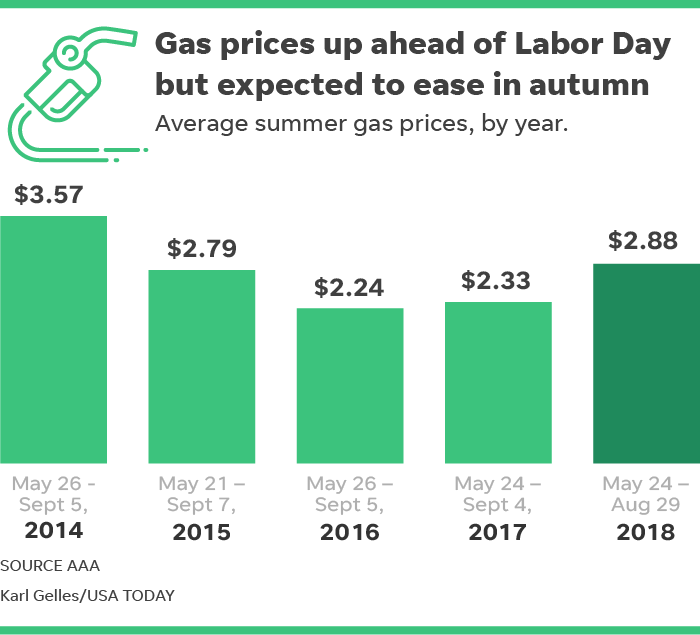
The coming relief would be welcomed by travelers and commuters, who endured the most expensive summer at the pump since 2014, according to AAA.
As the final busy travel weekend of the summer approaches, Americans are paying about $2.84 a gallon, 43 cents more than a year ago. That amounts to $6.45 extra per 15-gallon tank.
But barring a disruptive hurricane or international incident that could push up energy prices, drivers are likely to pay less at the pump this fall.
AAA is forecasting that prices this autumn could average $2.70, down from a 2018 high of $2.97 around Memorial Day.
“Any increases we see through the holiday weekend will definitely come down following Labor Day,” said Jeanette Casselano, a spokeswoman for AAA.
Lower prices
Patrick DeHaan, senior petroleum analyst for GasBuddy, an app that provides fuel station prices and location information, predicted prices would fall anywhere from 10 to 25 cents a gallon by Thanksgiving.
Prices averaged $2.88 for the summer through Wednesday, according to AAA. That’s the highest since they averaged $3.57 in summer 2014. Higher oil prices primarily drove the increased fuel prices this year.
But Americans haven’t been scared off the road. In fact, gasoline demand remains high.
“A lot of people out there have been taking road trips because gas prices in most areas of the country haven’t hit that magical $3 mark that would start to disincentivize people from taking some of those trips,” DeHaan said.
Even so, 10 states were averaging more than $3 a gallon as of Thursday, according to AAA. California had the most expensive gas in the continental U.S. at $3.60. Alabama was the cheapest at $2.53.
Lower prices are normal in the fall, when stations switch to a cheaper winter blend of gasoline that can evaporate at low temperatures to enable proper engine performance.
Another factor driving prices lower this time of year: Many motorists stop hitting the road, so overall demand drops.
In general, national gas prices have been relatively stable this summer, fluctuating by only about 13 cents a gallon, according to GasBuddy.
One key reason is that prices for U.S. oil have largely stayed within a range of $65 to $75 a barrel, and the refineries that process the crude into gasoline have been able to keep pace with demand.
What could spike prices again?
But there’s risk on the horizon. The Trump administration is expected to impose a new round of sanctions on Iran with a focus on energy.
If that significantly disrupts the flow of oil in the Middle East, analysts warn that oil prices could spike and lead to an increase in gasoline costs for Americans.
The other big risk: Mother Nature.
“The most immediate threat to gas prices would be a hurricane,” Casselano said.
Unlike 2017, when Hurricane Harvey temporarily ravaged gasoline refineries along the Gulf Coast, there has been no major weather disruption to output so far this year.
Follow USA TODAY reporter Nathan Bomey on Twitter @NathanBomey.
The Human Rights Watch (HRW) has called for an end to all weapons sales to Saudi Arabia following the bombing of a school bus last month that killed 51 people, including 40 children.
The rights group called the attack an apparent war crime and said it places arms suppliers at “risk of complicity in war crimes”.
HRW’s statement, released on Sunday, came just hours after Saudi Arabia and the United Arab Emirates admitted the bombing was “unjustified”.
A probe, conducted by the Saudi-led coalition fighting Yemen’s Houthi rebels, concluded on Saturday that “mistakes” were made in the August 9 air raid in Saada province.
The coalition, which initially defended the bombing as a “legitimate military operation” has now pledged to hold to account those responsible for the attack.
HRW said it received photographs and videos of munition fragments that a lawyer based in Sanaa, about 235km south of Saada, said were at the site.
Markings visible on photos and videos of one of the remnants – a guidance fin for a GBU-12 Paveway II bomb, an aerial laser-guided bomb – show it was produced by Pentagon’s top weapons supplier Lockheed Martin, according to the rights group.
HRW also said that while it could not confirm the remnants were found at the site of the attack, images of damage from the scene are consistent with the detonation of a large, impact-fused aerial bomb.
Al Jazeera could not immediately reach Lockheed Martin for a comment.
“The Saudi-led coalition’s attack on a bus full of young boys adds to its already gruesome track record of killing civilians at weddings, funerals, hospitals, and schools in Yemen,” saidBill Van Esveld, senior children’s rights researcher at HRW.
“Countries with knowledge of this record that are supplying more bombs to the Saudis will be complicit in future deadly attacks on civilians.”
Saudi Arabia, along with theUAE, has been bombing Yemen since March 2015 after the Houthis swept across the country. The coalition’s stated aim is to restore the government of PresidentAbd-Rabbu Mansour Hadito power.
Out of the 16,000-plus raids they have launched since the start of the conflict, only a handful have been investigated, despite nearly a third of all bombs hitting civilian targets.
Al Jazeera’s Alan Fisher, reporting from neighbouring Djibouti, said the report added to mounting pressure on the US to end its support for the Saudi-led coalition.
“In the US, there’s a growing movement urging the government to pull back support for the coalition, particularly when rights groups are saying that if the Saudis commit a war crime, and they use a US weapon, then the US could be complicit in that,” he said.
The international outcry over the Saada attack also put pressure on the warring sides in Yemen to reach an agreement when they meet for UN-sponsored peace talks in Geneva later this month, Fisher added.
HRW said it has identified US-origin munitions at the sites of at least 24 other coalition attacks in Yemen.
In November 2015, the US approved the sale of 4,020 GBU-12 Paveway II bombs as part of a $1.3bn arms sale to Saudi Arabia, but halted parts of the sale in December 2016.
President Donald Trump’s administration, however, has reversed that decision.
The UK and France remain major arms sellers to Saudi Arabia, HRW said. Germany and Norway have suspended arms sales to the Kingdom, while the Netherlands and Sweden have limited weapons sales.
Last year, the UN blacklisted the Saudi-UAE alliance for causing the majority of reported child deaths and injuries inYemen. It also described the situation in Yemen as the world’s worst humanitarian crisis.
At least 10,000 people have been killed since the start of the conflict, the UN said.
This post is part ofScience of Sci-Fi, Mashable’s ongoing series dissecting the science (or lack of science) in our favorite sci-fi movies, TV shows, and books.
At more than 60 years into the Space Age, fictional spaceships appear on our screens at a far greater frequency than the real things launch in real life.
But that doesn’t mean they’ll actually fly.
When it comes to imagining interstellar travel, the history of spaceflight up until now hasn’t given science-fiction designers a whole lot to work with. All we’ve seen are basic rockets (useful for escaping Earth’s gravity well), plane-like space shuttles (useful for re-entering it), Moon modules (the lunar lander), and modular orbital tubes (the International Space Station).
On the uncrewed side, we’ve got satellites, deep space probes and Martian rovers — all designed for a very narrow range of jobs just within our solar system.
When that job is transporting humans between stars, in theory, spacecraft will have fewer design constraints. But does that mean they’ll appear in all the weird and wonderful shapes and styles we’ve seen in on-screen science fiction?
Here’s what he had to say on a variety of well-known spacecraft — starting with the most famous fictional spaceship of all.
The USS Enterprise (original vs. Next Generation models)
Smart move: keeping the crew far away from the warp drive.
Ferdowsi grew up on the original Star Trek. It served both as a way to bond with his Iranian-American family and a vision of future space that would contain people from a diverse array of backgrounds. It’s no exaggeration to say that Trek led him directly to launching real-life space missions.
“I wanted to make that version of the future a reality,” he said in an interview.
He loves Next Generation too, but the upgraded 1990s version of the Enterprise interior strikes Ferdowsi as less realistic than the original. Why? One word: carpets.
“If you look at spacecraft today, there’s a bare bones aesthetic,” he said.
Every gram of extraneous equipment is another gram of mass you’re going to have to spend fuel to lift off a planet — or turn on a dime in the middle of a space battle, say.
“And you’re going to add another 10 kilograms of carpeting?”
Maybe the 23rd century’s bountiful energy supply, in the form of dilithium crystals, has made spacecraft designers careless about how much mass they need to move around. Maybe all that corridor carpeting is just part of a ploy by Big Dilithium to get Starfleet to use more of its product.
Still, the original Star Trek — and the 2000s prequel series Enterprise — offered a more believable bare-bones aesthetic.
“That’s probably the reality of where we’re going,” Ferdowsi says. “The more it looks like [1980s submarine movie] Das Boot, the more it looks like space exploration.”
Which isn’t to say the original series Enterprise interior had it all right. For one thing, there were all those computer banks full of blinking lights surrounding the crew at all times.
“Practically, visually, it’s a terrible choice,” Ferdowsi says. “Look at the way cockpits of modern aircraft go dark” — which means that if a blinking light needs your attention, you see it instantly. The Next Generation‘s LCD panels and smoother, more neutral colors seem less likely to make a crew crazy.
Stay cool, Captain Kirk
As for the outside of the ship, that classic design seems very much a product of the 1960s to Ferdowsi — the flying saucer married to a Coke bottle with tail fins straight out of Detroit. Still, it does a few very smart things, spacecraft design-wise.
First of all, it’s all one color — meaning you don’t have potentially disastrous thermal problems where one part of the ship takes on more heat than another. Secondly, it’s white, but not so white that it reflects every photon, which would put too much pressure on the vessel. “If you’re in the black of space, it’s good to be a light color,” Ferdowsi says — which is why you see probes, landers and the sun-facing side of the Shuttle decked out in gold or white.
Not only does that help you avoid taking on too much heat from a nearby star, but you can also use a reflective surface as free propulsion. All those bouncing photons can help you move all those extra grams of carpeting.
The other smart thing the Enterprise design does? It puts the warp nacelles — those propulsion fins — on stalks, far away from the areas the crew lives within. That’s a useful safety feature in case your futuristic energy resource should start to backfire. “We don’t want the humans near the dilithium crystal chambers,” Ferdowsi insists.
As he points out, there are plenty of ships in the Trek universe with a one-piece design, sticking their warp nacelles way too close to the main bulk of the vessel. Whoever designed the Enterprise clearly had safety in mind.
The Death Star vs. the Borg Cube
For the most part, Ferdowsi is more of a Star Trek than a Star Wars fan. Star Wars is a fantasy that flagrantly ignores physics, which was kind of the idea. George Lucas wanted “spaceships you could get into and drive around as easily as cars.”
The kind of turns the Millennium Falcon makes in space are impossible without an atmosphere.
The Last Jedi’s bombing run is impossible without gravity (“maybe the bombs were spring-loaded,” suggests Ferdowsi). There’s no reason for X-Wings to change their wing alignment like that, other than the fact that it looks cool. And TIE fighters don’t even have a visible system of propulsion.
But that’s not to say Ferdowsi rejects Star Wars completely. Like many of us he was awed by that silent moment in The Last Jedi where a vast Star Destroyer is ripped in two by a rebel ship performing a suicidal lightspeed maneuver.
And then there’s the Death Star.
“The Death Star would be a very efficient design because it’s a perfect sphere,” Ferdowsi points out. Of any spacecraft shape, a sphere has the lowest possible ratio of surface area to volume, requiring the least possible amount of energy and material to build and maintain. “Ideally, you’d also curve the interior,” he says.
The same is not true for the Borg Cube of Star Trek fame. For all the villainous Borg’s supposed efficiency, their vast six-sided planet-threatening vessel is a massive waste of space. The Death Star may cost an estimated $852 quadrillion in steel alone, but that figure would be far higher if it employed any other shape.
That’s no moon — it’s a highly efficient use of surface area.
Red Dwarf
Boys from the Dwarf.
For a sitcom, Red Dwarf paid a surprising amount of attention to science.
The 1990s show explores what happens when the mining vessel Red Dwarf accelerates for millions of years; it doesn’t break the laws of physics by going faster than the speed of light, unlike most sci-fi ships. But it gets close, creating appropriately weird time dilation effects.
Not only that, the Dwarf was on the cutting edge of future spacecraft design. That radio mast-like scaffolding on the front of the ship, to the right of the picture?
That’s a Bussard ramjet, a theoretical means of powering a ship using nothing but the stuff of space itself. Free-floating hydrogen atoms are compressed in an electromagnetic field until they create a fusion reaction.
Bussard ramjets have fallen out of favor these days, since we don’t think there’s enough hydrogen out there to compress. Still, points for the attempt!
Then there’s the body of the ship itself, partially constructed from an asteroid the crew mined. Companies are looking at mining asteroids in the near future.
“They have a ton of resources, you can hollow them out, it’s really practical and it’s already in space,” with no energy required to get it there, Ferdowsi said.
The Arboghast (from The Expanse)
It may not be the best-known ship in the history of science fiction.
But the science vessel Arboghast, which probes the mysteries of Venus in season 2 of Syfy’s The Expanse, does something novel and highly useful in spacecraft design: It expands with a large inflatable ring when coming in for landing.
“That’s exactly what you want,” Ferdowsi said enthusiastically.
“Leaving the atmosphere, you want to be as small as possible, to save on fuel. On the way in, you want to be big and wide as possible” — to increase drag and slow the ship down, Ferdowsi added.
Serenity (from Firefly)
You can’t take the sky from this ship
That bare-bones submarine aesthetic Ferdowsi favors is also present in the Serenity, the janky trading ship from cult favorite sci-fi series Firefly.
The ship’s aerodynamic bird-like design is appropriate given that it has to enter atmospheres on multiple planets. “Very utilitarian” is Ferdowsi’s verdict.
Furthermore, Ferdowsi applauds the use of retro rockets on the side of the wings — particularly as they flip upwards during landing. This is reminiscent of the design of SpaceShipOne, a private, suborbital spacecraft, which won the X-Prize in 2004, a year after Firefly went off the air.
SpaceShipOne (and its successor SpaceShipTwo, now being developed for space tourism by Virgin Galactic) flips its wings upwards to increase drag and slow itself down in the upper atmosphere, like a shuttlecock.
Serenity’s controlled rocket landing also looks a lot like the most amazing real-life spacecraft images of recent years: the SpaceX and Blue Origin boosters that can land themselves after delivering their payloads to orbit, saving millions of dollars in the process. That’s a level of thriftiness the Firefly crew would certainly appreciate.
Battlestar Galactica
Like Firefly, Battlestar Galactica (the 2004 miniseries, that is) had one big realistic thing going for it out of the gate: Both shows represented space as utterly silent.
Galactica also takes the submarine aesthetic and upgrades it to that of a battleship or aircraft carrier.
“It’s practical,” says Ferdowsi. “There’s a logic to it. You don’t have a lot of big open spaces, other than the hangars. Nothing in space is going to be ornate or over-the-top.”
Galactica boasts ribs along the length of the frame that act as shock absorbers, helping to explain why it could take such a beating over four seasons of war. It also has a rusted, broken-down feel — appropriate for a ship that was about to be decommissioned and turned into a museum when the Cylons attack at the beginning of the show.
Galactica’s need to repair and replenish — a constant background plot point — makes it unique among on-screen spaceships. Ferdowsi compares it to an old Volkswagen, known for being relatively easy to fix. Less software, more mechanics.
The ship was saved from a Cylon computer virus because it was old and non-networked, largely driven by analog technology and wired phone lines. Which brings up the interesting question of whether future spacecraft will need to be similarly “air-gapped” to prevent any kind of malicious infection.
Currently the International Space Station does have an internet connection, but Ferdowsi points out that the station mostly relies on older, more reliable telemetry systems.
Sometimes, even in the future, old school is the way to go.
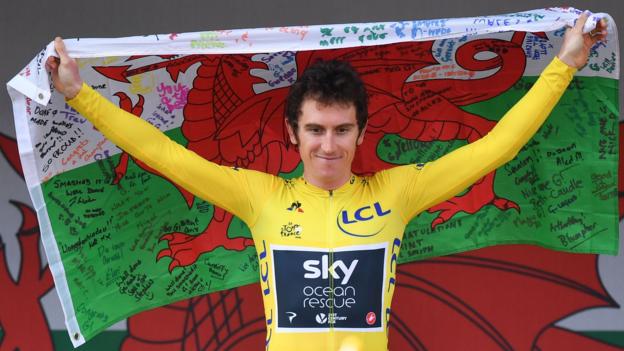
Tour de France winner Geraint Thomas is riding the Tour of Britain for the ninth time
Tour de France winner Geraint Thomas says he is looking forward to a “special eight days of racing” in front of home crowds at the Tour of Britain.
Thomas and Team Sky team-mate Chris Froome opted against riding the Vuelta a Espana to race the Tour of Britain, which starts in Wales on Sunday.
More than 8,000 fans lined Cardiff’s streets earlier this month for Thomas’ homecoming parade to mark his Tour win.
“After the support I had, it’ll be nice to race on home roads,” said Thomas.
“The homecoming was insane, I didn’t know what to expect, I was fearing it just being my wife and the dog,” the Welshman, 32, told BBC Radio 5 live’s BeSpoke show.
“But it was just phenomenal – if the support at the Tour of Britain is anything like that, it’s going to be a pretty special eight days of racing.”
He added the first stage has particular significance, starting in Pembrey Country Park, Carmarthenshire, near where Thomas’ dad is from, and ending in Newport, the site of Wales’ National Velodrome, which will be renamed in Thomas’ honour.
However, Thomas said he expects to be riding mainly in a support role after “not the most professional” spell since his Tour victory in July.
“There has been a lot of travelling and a few nights out as well so my form is certainly not what it was in France but I still should have decent enough legs to be in the race and hopefully at the front doing something,” he said.
Alongside Thomas and six-time Grand Tour winner Froome, Team Sky’s line-up is made up of fellow Briton Ian Stannard, Dutchman Wout Poels, Belarus’ Vasil Kiryienka and Poland’s Lukasz Wisniowski.
Both Thomas and Froome have been included in Great Britain’s longlist for the road race and time trial at the UCI Road World Championships in Austria from 23-30 September, though Thomas is still unsure if he will compete.
“I’m leaning towards my season finishing after the Tour of Britain but I’m just keeping my options open at the moment,” he said.
“If I feel like I’ve got good enough form to help at the worlds then I’d go but I don’t want to go just to purely make up the numbers because that would be pointless.”
Teams and riders
The 2018 Tour of Britain features 20 teams of six riders, including 11 outfits from the top level of the sport, the UCI World Tour, while there are also five British UCI continental teams and a Great Britain national squad.
There are no former winners in this year’s edition, but plenty of pedigree alongside Froome and Thomas, such as LottoNL-Jumbo’s Primoz Roglic, who finished fourth at the Tour in July, and Quick-Step Floors’ Julian Alaphilippe, who won two stages and the king of the mountains classification at the Tour.
Many of the climbers will be looking to use the Tour of Britain to build their form for the World Championship road race on 30 September, which takes place on a hilly course.
With at least three and potentially up to five stages set to end in a bunch sprint finish, there are several star sprinters riding, including 11-time Tour de France stage winner Andre Greipel, Colombia’s Fernando Gaviria, who won two Tour stages on debut this year, and Australian Caleb Ewan, while Britons Dan McLay and Ben Swift could also contend.
There are 39 Britons riding in total, with junior world time trial champion Tom Pidcock, 19, leading Team Wiggins, who were added to the line-up on Tuesday after folding Irish outfit Aqua Blue Sport pulled out.
The overall leader wears the green jersey, with jerseys also on offer for the points classification (most consistent finisher), king of the mountains (best climber) and sprints classification (most points won in intermediate sprints).
Stage-by-stage guide
Stage one: Sunday, 2 September – Pembrey Country Park to Newport – 174.8km
Despite climbs throughout the stage, a reduced bunch sprint finish should decide the first leader’s jersey, although a 9% average gradient climb in the final 10km could split the race.
Stage two: Monday, 3 September – Cranbrook to Barnstaple – 174.9km
A tough stage with plenty of climbs and descents. A flatter ending could see the race come back together for a sprint, though the short, sharp climb of Challacombe is close enough to the finish that riders could try to attack and stay away.
Stage three: Tuesday, 4 September – Bristol to Bristol – 128km
A short but difficult loop that includes an ascent of Cheddar Gorge and finishes atop Clifton Down, which could split the general classification contenders.
Stage four: Wednesday, 5 September – Nuneaton to Leamington Spa – 183.5km
After two tough days, this relatively easy route should end in a bunch sprint, though a strong breakaway group could stay clear.
Stage five: Thursday, 6 September – team time trial – Cockermouth to Whinlatter Pass – 14km
An uphill team time trial that is likely to be decisive for the general classification.
Stage six: Friday, 7 September – Barrow-in-Furness to Whinlatter Pass – 168.3km
Another key battle for the overall contenders, featuring two ascents of Whinlatter Pass from its harder eastern side, with the finish at its summit.
Stage seven: Saturday, 8 September – West Bridgford to Mansfield – 215.6km
The longest stage of the race should end in a bunch sprint finish, despite the exertions of the previous days.
Stage eight: Sunday, 9 September – London – 77km
The general classification should be decided by now, with the final stage consisting of 14 laps of a central London circuit, ending in a bunch sprint finish on Regent Street.
Athens, Greece – Each morning, Dimitris Chalkitos wakes up, scans the internet for job openings and sends his resume to potential employers. He then walks around Sourmena, the beachside Athens suburb where he lives, and searches for “help wanted” signs at restaurants and retail stores.
The 22-year-old engineering student has repeated this daily routine for more than a year, hoping to find work and help his debt-saddled family.
Sitting in cafe near a main square, he tensed his face while recalling printing his resume, handing it in to a nearby department store and receiving a familiar response: He didn’t have enough work experience, the manager told him.
“The biggest problem is work experience,” Chalkitos told Al Jazeera. “Most of my friends are in the same situation.”
But work experience is hard to come by in a country where four out of 10 young people are unemployed and where the economy is still in shambles after nearly a decade of financial trauma, austerity measures, tax hikes, pension cuts and massive bailout packages.
On August 20, the Greek government and its European partners celebrated the end of Greece’s catastrophic crisis.
The following day, Prime Minister Alexis Tsipras applauded a “day of redemption” and “the start of a new era”.
Greek Prime Minister Alexis Tsipras at a swearing in ceremony [File: Alkis Konstantinidis/Reuters]
“The bailouts of recession, austerity and social desertification are finally over,” he declared.
The overall unemployment rate sunk below 20 percent last month for the first time in seven years, down from its climactic peak of 27 percent in July 2013.
And although youth unemployment is far below the 60 percent it reached in February 2013, few job opportunities and meagre wages have left many young people with little cause to rejoice.
“When the country doesn’t give you anything, you can’t give anything back to it,” Chalkitos said.
“Young people believe the state should care more about them.”
Graduates without ‘decent job prospects’
Chalkitos was 13 years old when the global economic crisis first reached Greece in December 2009, when the downgrading of the country’s credit rating led to public spending cuts.
As fears that Greece would default on its debt swelled, the centre-left Pasok-led government implemented more austerity measures in 2010, sparking protests in the streets of Athens, Thessaloniki and other cities.
In the years that followed, the crisis deepened, and Chalkitos’s parents, both public school teachers, were forced to scrabble together what they could and tighten their belts where possible: worries about bills seeped into every dinner-table conversation, going out to restaurants was no longer affordable and holidays were rare.
“All of these small things had an impact on our family psychology,” he said, redirecting his stare to his lap. “My parents were miserable.”
In January 2015, the left-wing Syriza party came to power after campaigning on promises to do away with austerity. But those measures continued largely unabated.
Nikos Xydakis, a Syriza parliamentarian, acknowledges the challenges ahead, but maintains that the government has made progress since his party’s ascent three and a half years ago.
“There are hundreds of thousands of young people in their early thirties without decent job [prospects] since graduating school or university,” he told Al Jazeera.
“The promising fact is that every month the number of people finding jobs rises.”
Pointing to an increase in exports, Xydakis said: “Both obviously reflect an improvement in the situation of the working class of the population, but this is not enough.”
Unemployment is a ‘Greek reality’
Formally exiting the crisis is one thing, but the impact of the last nine years will be long lasting, according to several politicians and analysts.
The financial meltdown decimated a quarter of the country’s economy, minimum wage shrank, tens of thousands of businesses closed, thousands of factories shut down and more than 300,000 people emigrated to find work abroad.
Xydakis explained that the government is now considering a series of measures to lighten the burden on working-class Greeks. The exit “won’t be easy”, he said.
“On the contrary, it will need a lot of effort and hard work, imagination and innovative ideas from every one of us if we want to rebuild an economically stable country… capable of responding to the challenges of the global market.”
Pedestrians wait for the bus in central Athens [File: Alkis Konstantinidis/Reuters]
Twenty-four-year-old Yiannis Pappas, who three years ago graduated with a degree in 3D animation, has bounced from one short-term job to the next.
Currently unemployed, he was laid off several times and has had little luck finding employment in his field. “It’s a Greek reality,” he told Al Jazeera.
Like others before him, he moved to Sweden for work, but returned seven months later after struggling to find sustainable employment.
Many of his friends are searching for opportunities elsewhere in Europe, Pappas said, explaining that he, too, is now exploring the possibility of moving to Germany to continue his education and find work.
Just 15 when the crisis started, Pappas says many young Greeks have abandoned their hopes of finding the jobs they once aspired to.
“A lot of young people don’t understand where we are now,” he said, insisting nontheless: “I’m not giving up yet … Greeks are a tough crowd.”
Back in the Sourmena cafe, Dimitris Chalkitos sums up his feelings.
“This situation isn’t my generation’s fault,” he said. “We didn’t vote for the politicians who created it.”
With politicians lauding a new era, Chalkitos sees more hardship ahead.
“The crisis isn’t over. It just became our routine, our lives.”
Michigan coach Jim Harbaugh discusses opening loss to Notre Dame, 24-17, on Sept. 1, 2018. What was the difference in the game? Nick Baumgardner, Freep
SOUTH BEND, Ind. — For all the talk about Michigan’s “new” offense under quarterback Shea Patterson, it looked awfully familiar and weak.
For all the talk about all the changes — the new coaches and new strength coach — the Wolverines had more cramps than touchdowns.
For all the talk about Michigan’s “great” and “feared” defense — yikes, Notre Dame just scored again.
For all the talk about Michigan’s “improved” offensive line — uh, no. Don’t even go there.
The Wolverines came out and fizzled Saturday night, cramping up with fatigue and mistakes, mounting a late charge but losing against Notre Dame, 24-17.
Once again, the Wolverines couldn’t run the ball.
Once again, the Wolverines couldn’t find a spark. Not until a late fourth-quarter push.
Once again, the Wolverines couldn’t find enough big plays when it mattered the most.
And once again, Michigan couldn’t beat a ranked team on the road. Stop me if that sounds like a broken record — that’s 17 straight road losses against ranked opponents.
This, obviously, is on Michigan coach Jim Harbaugh. His preparation failed. His changes have yet to work. And Michigan isn’t new and improved. It looked beaten and broken for most of the game, until a late push in the fourth quarter.
“It’s not the end,” Harbaugh said. “It’s the beginning for us.”
Actually, it felt like a continuation.
The story of this game wasn’t Patterson.
The story of this game was Notre Dame quarterback Brandon Wimbush.
A year ago, Wimbush completed less than half of his passes, but he came out firing against the Wolverines. Wimbush, who is known as a running quarterback, hit five of his first seven passes for 115 yards and a touchdown.
Just when you thought the Wolverines had him sacked, he would slip away and hit somebody for a first down.
Just when you thought the Wolverines had the Irish in third-and-long, he sneaked up the middle and picked up another first down.
“He played a heck of a ball game,” Harbaugh said. “I thought we limited that in the second half.”
Notre Dame scored two touchdowns on its first two possessions and it was like a gut punch that left the Wolverines looking stunned and gasping for air.
Wait a second.
The Irish did that to Michigan’s vaunted defense?
The Wolverines had the third-ranked defense in the entire nation last season, allowing just 27 touchdowns in 13 games.
And Michigan returned nine starters.
But the Irish gashed the Wolverines quickly.
“I didn’t feel they dominated us,” Michigan captain Chase Winovich said. “They made plays.”
Meanwhile, Michigan didn’t.
That’s the story of this team in the Harbaugh era.
And Winovich, a fifth-year senior, made a costly play with four minutes left in the second quarter. On third down, he lowered his helmet and hit Wimbush late and in the back.
On the next play, Notre Dame scored a touchdown, taking a 21-3 lead.
It was a four-point blunder. Add in a botched field goal, and the Wolverines hurt themselves.
“There are improvements to be made,” Harbaugh said. “Mistakes were made.”
He did some good things — hitting nine of his first 11 passes. And he did some bad things — like, forcing an interception, and taking a sack to get out of field-goal range, and losing the ball when they had a chance late.
To his credit, Patterson was quick to blame himself.
“I thought he competed well,” Harbaugh said. “I thought he was doing the things we were asking him to do. For a first time out, with his new team, I thought he did a good job.”
At times, Patterson looked smooth, rolling out and hitting receivers in rhythm. He spread the ball around, hitting five different receivers in the first quarter.
Then, he overthrew a receiver while under pressure.
He showed off his arm strength, hitting Nico Collins on a 52-yard heave, which set up a field-goal attempt. But the Wolverines mishandled the snap, which would have made it a one-possession game.
“There’s a lot of room to grow,” Patterson said. “We have so many weapons.”
Late in the second quarter, Michigan looked dead. The Irish had a 21-3 lead. And if it weren’t for an Ambry Thomas kickoff return for a touchdown, it would have been far worse.
Overall, Michigan made mistakes that it can, presumably, clean up. My gut says the defense will play better. After the early miscues, it played better.
And Michigan showed some life late.
But that offensive line is beyond troubling.
And the lack of explosive plays is beyond concerning.
Download our Wolverines Xtra app for free on Apple and Android devices!
CLOSE
Free Press sports writer Nick Baumgardner and columnists Jeff Seidel and Shawn Windsor dissect Michigan’s 24-17 loss at Notre Dame on Sept. 1, 2018. Nick Baumgardner, Detroit Free Press









 trustedenews