UN admits failing to educate Koreans on Yemeni refugee crisis

news image

Seoul, South Korea – More than 500 Yemenis have applied for refugee status on South Korea’s Jeju island.

The arrival of these Yemenis influx has caused provoked debate over how the country handles refugees, including an online backlash as well as petition for the government to take action as well as protests in Jeju and the capital Seoul.

This also prompted the government to remove Yemen from the list of countries whose citizens are allowed visa-free entry to Jeju and a tweak in its refugee policy.


A strong anti-refugee sentiment has also been seen in South Korea, driven largely by Islamophobia, that analysts say is caused mostly by ignorance among the population and the prevalence of fake news stories that is being spread.

Al Jazeera spoke to Heinn Shin, Korea spokesperson for the UN’s refugee agency (UNHCR), about the causes of xenophobia, the government’s role in calming fears and rooting out fake news and why the agency is not at the forefront of helping these refugees.


Al Jazeera: What role is UNHCR Korea playing in this current refugee crisis? Why is it not actively involved in assisting and helping these refugees on Jeju island?

Heinn Shin: Different UNHCR offices have different roles. For a place like Korea, which is an advanced country with its own refugee system, we play a supporting role. We don’t directly help out in supporting refugees. We can’t do anything that the government didn’t ask us to. If we don’t like something, we can release a statement but we can’t go out and action anything.

Al Jazeera: So does the Korean government have that ability?

Shin: Of course. It has its own refugee system.

Al Jazeera: But why are there so many protests, discrimination and harassment of the refugees? Is the government playing an active role?

Shin: Comparatively speaking, Korea has a very young refugee history. It’s traditionally a very homogenous country so it’s not just about refugees or migrants. It’s about outsiders, non-Koreans in general. Korea is in a developing stage and UNHCR is supporting the government to play that role better.

Al Jazeera: Are you happy with the role the government is playing? It seems to have listened to the protesters?

Shin: We have to give credit to the Korean government. It already knew the public wouldn’t be open to the idea of receiving more refugees, but despite that, it went ahead and enacted a stand-alone refugee act.

Al Jazeera: What do you mean the government knew the public wouldn’t be open to refugees? Isn’t that an obvious case of xenophobia? 

The Yemenis have limited job opportunities and are generally restricted to working in restaurants or the fishing sector [Faras Ghani/Al Jazeera]

Shin: Korea is geographically at a long distance from refugee hotspots. Decades ago, we had a system to bring in migrant labour from different Asian countries and there was huge public backlash. As a Korean, I can say that Koreans are not open to the idea of opening up.

Al Jazeera: Is that a cultural thing? Or a lack of knowledge?

Shin: It’s a mixture of everything. But one unique thing about the Yemeni refugee situation is that it’s the first time Koreans got to think about Islam. In a way that’s a good thing. This will serve as a great chance for the public to understand Islam better.

It’s also very important that UNHCR plays a balanced role. There are certain things that the government can do better but it also has to reflect what the public wants. And for us to criticise what the government does could cause backlash, not against the government, but against the refugees. We provide support where necessary.

Al Jazeera: So the government’s decision to take Yemen, and other countries where refugees might come from, off the visa-free list, is reflecting public opinion then?

Shin: Yes, definitely. The Jeju government did that. There were concerns among the public, albeit based on wrong information. There were concerns not just about employment but also about security. There were lots of females talking about it so I do think the government had to take that into account.

Al Jazeera: These Yemenis were also branded fake refugees. What is a fake refugee?

Shin: There’s a refugee and not a refugee. There are no fake refugees. That’s our message. This phrase stems from the fact that these Yemenis are male, young, flew to Jeju and carry iPhones. So it’s ignorance on the Koreans’ part. They don’t understand these people are fleeing persecution. You can be rich or poor but when a war breaks out, that doesn’t matter. There’s xenophobia, not against refugees but against Muslims. They also don’t understand Islamic culture. And the fake news about extremism fuels these fears. 

Gatherings for refugees, such as this dinner at a church, are mostly organised by the private sector on Jeju island [Faras Ghani/Al Jazeera]

I don’t think any Korean who has ever met a refugee or a Muslim would be against them. UNHCR’s role should be trying to explain to the general public who these refugees are. And I’m afraid, UNHCR has failed in that role for many years.

And we’ve only just realised that. Because we had no idea, despite the country having 150,000 Muslims, that the public would be so cautious and concerned. And telling the government to choose between their rights or the refugees’ rights. 

Al Jazeera: Since UNHCR has not been playing an active role, what does it need to do more of?

Shin: We need to support the government. We also need to continue persuading the public. As the refugee and asylum seekers’ population grows in Korea, it can’t be the government’s role to do everything. We and the civil society would need to help out.

It’s our message to the public as well as that if you’re happy to help out that Syrian kid in the TV ad through donations, would you receive him if he was to come to Korea? It’s that message we’re trying to deliver. In a country like Korea, it’s strange to see someone who doesn’t look like you and speak the same language. It’ll take us time to solve this but I’m sure it can be solved.

This interview has been edited for length and clarity.

Read More

from Trusted eNews https://ift.tt/2NPeaBQ
via IFTTT

Mayans M.C. series premiere recap: Violent twists at the border

news image

Mayans MC

type
TV Show
Genre
Drama
run date
09/04/18
creator
Kurt Sutter, Elgin James
performer
J.D. Pardo, Clayton Cardenas, Edward James Olmos
broadcaster
FX
seasons
1

Four years after Sons of Anarchy rode off into the sunset, series creator Kurt Sutter is returning to the world of motorcycle gangs with the highly anticipated spin-off Mayans MC.

This time, we’re moving south from the fictional town of Charming to the U.S.-Mexico border, where the Mayans rule the roads. Our new hero is Ezekiel “EZ” Reyes (played by JD Pardo), who, unlike his protagonist predecessor Jax Teller, does not come from gang royalty. In fact, he hasn’t even gotten his training wheels off yet.

We open the episode as EZ rides along a border wall spraypainted with the not-so-subtle phrase “Divided We Fall.” On the road ahead, a wild dog is eating a dead crow, which just might be a metaphor. We know which animal symbolizes EZ when he drives his bike right over the dead bird.

Meanwhile, Mayan president Bishop (Michael Irby), clad in the gang’s matchy leather vests, struts into a dress manufacturer’s warehouse, where tailors are busy sewing kilos of drugs into colorful quinceañera gowns. The drugs need to be transported to Las Vegas, and Bishop decides the transport crew could use some extra muscle. After a brief powwow with some subordinates, it’s agreed that EZ, whom everyone agrees is very smart, will get his first real gang task. It’s during this conversation that we learn the new guy was in jail for killing a cop, but was released early when the cop was revealed to have been dirty. After getting out, he teamed up with his older brother, Angel, already a member of the Mayans. Still not officially a member, EZ wears a leather vest that reads “Prospect,” which is like the biker version of a trainee.

While riding around looking tough on his motorcycle, he stops by a high school, where we get our first flashback. Eight years earlier, he was still enrolled at Stanford (he’s smart, remember?). On a break from college, he returned to visit his girlfriend, who was still in high school at the time. They both can’t wait for her to graduate so they can be together again. More on that later…

Jolted back to the present by a car horn, EZ continues on his way and stops by his dad’s butcher’s shop. The elder Reyes (played by Edward James Olmos) seems like a standup guy and gives his son a book of poetry to read on his breaks from gangbanging. Before leaving the shop, EZ hands his pops a mysterious package. Pops asks if his brother knows anything, and EZ assures him he doesn’t. (More on that later too.) Outside the store, Angel is waiting and asks if their dad spoke about their mom. Apparently, something bad happened to her eight years ago, around the same time EZ went to jail for killing the cop.

Later that night, a group of Mayans ride alongside a van containing the dresses. As the convoy drives through the desert, they’re ambushed in what looks to be an inside job. EZ saves the life of a Mayan trapped inside the burning van, but all the drugs are taken. Returning home empty-handed, the Mayans explain the situation to cartel boss (and series bad guy) Miguel Galindo, an impeccably dressed young kingpin who uses the Mayans to smuggle his drugs. As they try to figure out who jacked the cargo, EZ reveals that he has a photographic memory and observed a tattoo on the wrist of one of the hijackers. They trace the ink to a Samoan gang, but Galindo thinks they were probably just hired guns. To make sure, he asks the Mayans to bring him the gang’s shot caller for an interrogation. Bishop pushes back on the demand but is quickly put in his place by Galindo. It seems like the Mayans aren’t thrilled to be under the cartel’s thumb.

A few gang members, including Angel and EZ, cross the border through a handy hidden tunnel to get some off-the-books medical help for a Mayan who was injured in the robbery. While in Mexico, Angel and some other Mayans duck into a building, leaving EZ as a lookout. Sitting alone reading his poetry book, he sees a child getting chased by a street vendor for stealing some food. EZ comes to the boy’s defense, and when a woman arrives to claim him, she thanks EZ for his protection. The duo share a moment, and we know she’ll be coming back into the story.

When Angel and the rest return, EZ notices they’re carrying a package. When he asks what’s going on, they react with extreme caginess. Before heading back to the states, EZ coincidentally sees his high school girlfriend, Emily (Sarah Bolger), getting out of a fancy chauffeured car with a child. Through another flashback, we learn that EZ ended their relationship when Emily came to visit him in jail. Upset with his decision, she stormed out of the visitor’s room after telling EZ that she was pregnant with their child. (SOA fans will notice Katey Sagal’s Gemma Teller Morrow watching the breakup in the background.)

Back in the present, “El Padrino,” whom SOA fans will recognize as Marcus Alvarez (Emilio Rivera), arrives at Mayan headquarters to dish out some advice on the cartel problem. Padrino asks EZ to stay outside and wash his bike while the grownups talk. Inside the meeting, the Mayans make a strategy for confronting the Samoans and decide to get some backup from their friends in the Sons of Anarchy. Padrino concludes the summit with a pound of a gavel.

Back at the Reyes butcher shop, a man picks up the package EZ had dropped earlier, and in return hands Reyes a note saying that he needs to make contact with EZ that night.

Next comes our second big action sequence, as the Mayans roll up to where the Samoans hang out (which is apparently a graveyard) and, in broad daylight, get into a shootout with semiautomatic weapons. Outnumbered, the Mayans still manage to kill nearly all their rivals, even blasting the ear off the Samoan leader, who flees the gunfight in a van. Unfortunately for him, he’s cut off on his way out of the cemetery by the Sons of Anarchy, who arrive just in time to cover the exit.

Things get worse for the Samoan leader as he’s dragged back to Mayan headquarters and interrogated by Galindo, who’s ominously sporting a sharp yellow raincoat. The Samoan admits to stealing the drugs but swears he doesn’t know who hired him. His memory is triggered, however, when Galindo orders his arm be chopped off with a machete. Now missing an ear and an arm, the Samoan provides some details that help crack the mystery. We learn that a group of rebels, made up of cartel victims, are probably to blame. Galindo demands the Mayans find the snitch in their ranks and help get the drugs back somehow. He then strolls off to dinner with his family. EZ is left to roll up the dead Samoan in plastic wrap as another fun hazing ritual. Before he can start, he gets a call from his dad, who needs to speak with him in person.

We then get the episode’s three biggest twists, back to back to back. First, as we see Galindo sitting down for dinner, we learn that he’s married to Emily and they have a child together. But could the boy belong to EZ? We then cut back to EZ, who sneaks into his father’s closed store. In the meat locker, he meets with an FBI agent. That’s right, EZ is a government witness. The FBI agent knows all about the robbery and the shootout with the Samoans and wants to make sure EZ hasn’t forgotten his mission. EZ reminds the agent that his agreement was to help bring down the cartel, not the Mayans.

The final twist comes as EZ, Angel, and the other Mayans who accompanied them to Mexico earlier in the episode cross the border again under the pretense of dumping the Samoan’s body. But when they drive into the desert, Angel introduces EZ to a familiar face: the woman who thanked him for saving the boy. She introduces herself as Adelita. Behind her, a camp is set up that seems to be crawling with children wearing strange animal masks. The Mayans deliver her the package they retrieved earlier in Mexico, which is filled with drugs.

We soon learn that Adelita is the head of the rebels, the Olvidados, or forgotten ones. She and her group of cartel orphans have been launching guerrilla-style attacks on the cartel, costing the gangsters a lot of money. She’s not afraid of retribution and swears she’ll make the cartel fear for their own families.

Angel then takes EZ aside, telling him that the cartel is suffering and the rebels are the future. Sensing the sea change, he and some Mayan friends have decided to secretly align themselves with the rebels. EZ then realizes that his brother is the rat Galindo and the rest of the Mayans are looking for. Still, he decides to keep Angel’s secret and pledges to help him continue sabotaging the cartel.

As the episode ends, we see Adelita making good on her promise. When Galindo leaves the restaurant with Emily, they get into separate cars. We then see children wearing the rebel animal masks sitting in a car nearby, preparing to follow Emily and her child as they drive away.

Read More

from Trusted eNews https://ift.tt/2LXm2iN
via IFTTT

Donald Trump maintains attacks on Bob Woodward, calls for changes in libel laws

news image

WASHINGTON – Stung by the latest tell-all book to hit his White House, President Donald Trump renewed his attacks on author Bob Woodward by suggesting Wednesday that the government tighten libel laws.

“Isn’t it a shame that someone can write an article or book, totally make up stories and form a picture of a person that is literally the exact opposite of the fact, and get away with it without retribution or cost,” Trump tweeted. “Don’t know why Washington politicians don’t change libel laws?”

Trump also suggested changing the libel laws back during his presidential campaign – in response to news stories he didn’t like – but has made no specific proposals in that area since moving into the White House in January of 2017. And Supreme Court rulings give speakers wide latitude to criticize and report on public officials.

More: The 5 most explosive claims in new Bob Woodward book

The catalyst this time is Woodward’s new book – Fear: Trump in the White House – in which aides describe the president as an unhinged “liar” who does not seem interested in learning the details of the issues he has to face.

More: Trump calls Woodward’s book ‘a con on the public’; Kelly denies calling president an ‘idiot’

White House Chief of Staff John Kelly reportedly described Trump as an “idiot” who is running “Crazytown,” while Defense Secretary James Mattis is quoted as saying Trump acted like a “fifth- or sixth-grader” at one meeting.

According to the book, aides have colluded to sideline off-the-cuff presidential ideas that ranged from pulling U.S. troops out of South Korea to assassinating Syrian leader Bashar al Assad.

“Members of his staff had joined to purposefully block some of what they believed were the president’s most dangerous impulses,” Woodward writes, according to a leaked excerpt. “It was a nervous breakdown of the executive power of the most powerful country in the world.”

The book is scheduled for public release on Tuesday.

Trump is seeking to undermine Woodward even though he has praised the author in the past, and told him in a phone conversation just last month that he has always been fair.

Back in 2013, as members of the Barack Obama administration criticized a Woodward book about them, Trump tweeted out: ““Only the Obama WH can get away with attacking Bob Woodward.”

As details of the book began to leak out Tuesday, the White House hastily put together  a series of responses.

Kelly denied calling Trump an “idiot,” while Mattis denied uttering “the contemptuous words” attributed to him by Woodward.

The White House denials echoed those made about previous critical books, particularly those by journalist Michael Wolff and former White House aide Omarosa Manigault Newman.

Trump tweeted out the statements by Kelly and Mattis on Tuesday night, while adding some denials of his own.

While Trump has frequently attacked Attorney General Jeff Sessions, he denied Woodward’s reporting that he has called the former Alabama senator “mentally retarded” and “a dumb southerner.”

“I said NEITHER, never used those terms on anyone, including Jeff, and being a southerner is a GREAT thing,” Trump tweeted, claiming that Woodward “made this up to divide!”

Read or Share this story: https://usat.ly/2NjhQP5

Read More

from Trusted eNews https://ift.tt/2NiiAEo
via IFTTT

Social media hearings: Five things to watch as Facebook and Twitter executives get grilled by Congress

news image

WASHINGTON – Leaders of the nation’s largest technology firms are expected to tell lawmakers in a series of high-profile hearings Wednesday that politics don’t factor into their content decisions, pushing back on assertions made in recent days by President Donald Trump.

The one company that won’t be making that argument also happens to be at the center of the president’s attention: Google.

Twitter CEO Jack Dorsey and Facebook COO Sheryl Sandberg will appear before the Senate Intelligence Committee at 9:30 a.m. ET for a hearing focused on the potential for foreign influence on their platforms, but the executives have already been girding for questions about perceived bias leveled by Trump and other Republicans.

“Twitter does not use political ideology to make any decisions, whether related to ranking content on our service or how we enforce our rules,” Dorsey will tell the House Committee on Energy and Commerce in a separate hearing set for 1:30 p.m. Wednesday, according to prepared testimony.

The remarks were made public a week after Trump, without evidence, accused Google of offering users “rigged” results when his name is plugged into the company’s search engine. A top White House aide later said that the administration is considering regulations for the company.

But the president’s threats apparently have not fazed Google. When senators asked its top leaders to attend, the company instead offered a senior vice president. Lawmakers balked, and committee aides said on Tuesday they did not expect anyone from Google to testify.

Here are five things to watch for in the hearings:

How hard will lawmakers come down on Google for not sending their CEO?

Senators wanted Google chief executive Larry Page to testify, but the company offered instead Kent Walker, senior vice president of global affairs and chief legal officer. The result? Google will be represented with an empty chair at the witness table. Although senators rejected the substitute, Walker still submitted written testimony. In it, Walker says Google has fulfilled its commitments to be more transparent about election advertising and is improving interference protections around candidates and campaigns.

“Google knows that there is no reasonable regulatory intervention that is likely to affect Google. Google is deeply imbedded in our daily lives and habits,” said Siva Vaidhyanathan, a professor of media studies at the University of Virginia who has written books on Facebook and Google. “I think the folks who run Google are too arrogant to stoop to answering to the American people.”

Will Trump tweet?

While Facebook, Google and Twitter were crucial tools in Trump’s ascension to the Oval Office, he’s recently attacked social media companies. At a recent campaign rally in Indiana, Trump called out Google, Facebook and Twitter by name.

“We will not let large corporations silence conservative voices,” he said.

His remarks came after he accused Google of ignoring his State of the Union address and said its search engine is “rigged.” He also attacked Twitter and Facebook as unfair but did not offer specifics about his concerns. 

Will lawmakers call for more transparency or regulation?

There are a growing number of proposals to regulate big tech making the rounds in Washington, among them a proposal to audit algorithms used by tech companies to determine what content users see, but there’s not much the White House could do without the cooperation of Congress. That’s despite the fact that Trump economic adviser Larry Kudlow recently said the administration is “taking a look” at federal regulations for Google.

“It’s an election year, so inevitably you’re going to hear more about regulation,” said Paul A. Argenti, a professor of corporate communications at the Tuck School of Business at Dartmouth.

Ajit Pai, the Trump-backed chairman of the Federal Communications Commission, said he hopes the hearings will shed light on whether social media companies should be more transparent about their business practices, including how content is managed and how users’ privacy is protected.

“The issues of online transparency, privacy, and free expression raise the question of public oversight,” Pai wrote in a blog posted Tuesday.

How will social media companies respond to charges of anti-conservative bias?

House Republicans are expected to ask Twitter about actions like its treatment of a campaign announcement posted by Rep. Marsha Blackburn, a Republican member of the House Energy and Commerce Committee who is running for the Senate from Tennessee. Blackburn’s online video announcement was blocked in any Twitter advertisements last year because Twitter objected to Blackburn’s reference to having stopped the “sale of baby body parts.” After initially determining that “a small portion of the video used potentially inflammatory language,” Twitter said it reconsidered the ad in the context of the entire message and allowed it to be promoted in her ads.

In his submitted written testimony, Dorsey says he wants to be clear that political ideology is not behind any decisions it makes. Both to “serve the public conversation” as well as “from a simple business perspective,” Dorsey says, Twitter is “incentivized to keep all voices on the platform.”

His testimony notes that #MAGA was the third most tweeted hashtag in 2017. And he shares the results of Twitter’s analysis of a month’s worth of tweets from members of Congress this summer.

Democratic lawmakers sent more tweets and had more followers than Republicans. Still, Dorsey said that after controlling for factors like the number of followers, Twitter found no statistically significant difference between the number of times a tweet by a Democrat was viewed versus a tweet by a Republican.

Will we learn anything new about foreign interference?

The purpose of the Senate hearing, in particular, is to assess how well social media companies are confronting foreign influence on their platforms. Top intelligence officials in the Trump administration have said Russia and other countries are working to sway voters ahead of this year’s midterm elections. Facebook said in July that it had detected a covert campaign to influence the November elections through the use of posts on hot-button social issues, and it deleted hundreds of pages and accounts.

Facebook is expected to lay out the steps it has taken to address the problem, and is just as certain to face tough questions from lawmakers about whether they’ve gone far enough. Part of that effort includes a new “paid for” line that Facebook will require on political advertising.

“The meat will be a quantification of what Facebook is doing about fake sites,” Vaidhyanathan said. “But I’m pretty sure that most of our attention will go right past that and go to the non-issue of political bias.”


Read or Share this story: https://usat.ly/2NfKkt8

Read More

from Trusted eNews https://ift.tt/2LXlI3z
via IFTTT

Ryder Cup: Bjorn to announce Europe wildcards

news image

Ryder Cup: Europe captain Thomas Bjorn announces wildcards – BBC Sport


<!–


<!–

<!–
<!–

<!–
<!–

<!–

<!–

<!–


Summary

  1. Bjorn to announce four wildcard picks at 14:00 BST
  2. Eight players have already qualified for the Europe team
  3. Who will join Francesco Molinari, Justin Rose, Tyrrell Hatton, Tommy Fleetwood, Jon Rahm, Rory McIlroy, Alex Noren and Thorbjorn Olesen?
  4. 2018 Ryder Cup will take place at Le Golf National in Paris, 28-30 September
  5. Get involved: #bbcgolf or 81111 (standard message rate)


Read More

from Trusted eNews https://ift.tt/2Ni98AR
via IFTTT

UK charges two Russians over Skripal Novichok nerve agent attack

news image

British prosecutors have charged two Russian men for a nerve agent attack on a former double agent Sergei Skripal and his daughter Yulia in the city of Salisbury earlier this year.

A European arrest warrant was issued on Wednesday for the Russian nationals, identified as Alexander Petrov and Ruslan Boshirov, the prosecutors said, charging the two of conspiracy to murder, attempted murder and use of the nerve agent Novichok.

“We will not be applying to Russia for the extradition of these men as the Russian constitution does not permit extradition of its own nationals,” Sue Hemming, director of legal services at the Crown Prosecution Service, said.

Russia reiterated concerns that there has been a lack of evidence to implicate the Russian nationals.

“The names published by the media, like their photographs, mean nothing to us,” Maria Zakharova, the Russian foreign ministry’s spokeswoman, told the TASS news agency. “The Russian side has numerous questions for London.”

Zakharova demanded that British authorities work with Russia on the case: “Once again, we call on the British side to move away from public accusations and informational manipulations, towards practical collaboration of law enforcement agencies.”

Triggered diplomatic crisis

The poisoning of the Skripals earlier in March triggered a major diplomatic crisis between the UK and Russia, with the British government alleging that Moscow was responsible for their attempted murder.

Police had earlier said that the men, both about 40, flew from Moscow to London on Russian passports two days before the Skripals were poisoned on March 4.

Al Jazeera’s Laurence Lee, reporting from the British capital, London, said the announcement by the UK officials “comes as no surprise”.

“A couple of weeks ago, the police here announced that they had identified two people who they had thought had come in from Russia and were travelling on Russian passports and they were putting a case against them,” he said.

“Prosecutors think there would be sufficient evidence to mount a criminal case against them and get that passed through the Crown Prosecuting Service and into a court of law.

Britain has blamed Russia for poisoning the Skripals and identified the poison as Novichok, a deadly group of nerve agents developed by the Soviet military in the 1970s and 1980s. Moscow has repeatedly denied any involvement in the attack.

Both father and daughter were hospitalised for days before being discharged.

“This announcement will further worsen relations between the UK and Russia,” said Al Jazeera’s Lee.

SOURCE: Al Jazeera and news agencies

Read More

from Trusted eNews https://ift.tt/2LYtdaG
via IFTTT

Serial sets season 3 return with look inside the criminal justice system

news image


Serial

type
Web Series
Current Status
In Season

The investigative podcast that became a cultural phenomenon is finally coming back with a brand new season.

Serial initially explored the 1999 murder of Hae Min Lee and the subsequent imprisonment of her ex-boyfriend Adnan Syed. Its sophomore season followed American Army soldier Sergeant Bowe Bergdahl, who was held for five years by the Taliban and later charged with desertion. Now, the series is set to tackle the entire criminal justice system by illustrating a year inside Cleveland criminal courts for season 3.

Hosted by journalist Sarah Koenig, the Peabody Award-winning Serial has more than 16 million downloads per episode, making it the most popular podcast ever released. With such a wide reach, Koenig chose to use the show’s tremendous platform to expose shocking behind the scenes details of criminal court procedures. The radio personality and reporter Emmanuel Dzotsi spent a year working on the forthcoming season, for which they were given permission to record inside courtrooms, judges’ chambers, back hallways, and attorneys’ offices. The show will take listeners through the sometimes unsettling ways in which crimes are investigated and tried.

“Every case Emmanuel and I followed, there came a point where we thought: No, this can’t be how it works,” said Koenig in a press release. “And then we were like, Oh! Oh my god. This is how it works! This is how it happens! People who work in the system, or have been through the system, they know this. But millions more people do not. And for the past year I’ve had this urgent feeling of wanting to kind of hold open the courthouse door, and wave people inside. Because things are happening — shocking things, fascinating things — in plain sight.”

The first two episodes will debut on Sep 20, with each additional episode premiering weekly on Thursdays. Several stories will be highlighted over the course of the season, with some being wrapped into a single episode and others unveiled over multiple installments.

Get a sneak peek of the new season at the link above. Listeners can hear Serial for free via podcast apps such as Apple Podcasts, Google Podcasts, and Pandora.

Read More

from Trusted eNews https://ift.tt/2CjPu3d
via IFTTT

Trump’s use of Google, Facebook questioned as tech executives head to Capitol Hill

news image

CLOSE

Senate Democrats sounded the alarms Tuesday at the confirmation hearing of President Donald Trump’s Supreme Court nominee, Brett Kavanaugh, over his views on presidential power and executive privilege. (Sept. 4)
AP

WASHINGTON – As President Donald Trump increasingly criticizes social media companies and Google’s treatment of him, former aides said they never saw him use many of the web sites he vilifies.

Though Trump mastered Twitter as a campaign tool and has used the platform to communicate with supporters for years, three former aides interviewed by USA TODAY described Trump as averse to email, rarely interested in surfing the web and more comfortable with paper than a computer screen.

The aides, some of whom have known the president for years, requested anonymity to discuss their private interactions with Trump.

Executives at Facebook and Twitter are set to testify at a hearing at 9:30 a.m. Wednesday as their products are increasingly facing criticism from Republicans for perceived bias. Sheryl Sandberg, chief operating officer at Facebook, and Jack Dorsey, CEO of Twitter, will likely answer questions about those concerns as well as steps both companies have taken to reduce foreign influence on their platforms.

Officials at Google are not expected to testify. 

Trump blasted Google last week for what he described as “rigged” search results and a top White House official said the administration is “looking into” regulations for the company. The White House has not said how Trump came to his conclusions of bias.

“My guess is that somebody googled it and brought it to him,” one former aide said. “What happens with the president is other people next to him have a laptop and they’ll turn it to him and show him.”

White House press secretary Sarah Sanders did not respond to multiple requests for comment. 

Trump supporters said it doesn’t matter if the president is engaged with technology or is regularly running Google searches.

“If you want to apply this standard then there’s very few people who pilot an airplane and yet they write and pass FAA regulations,” said Matt Braynard, a former data director and strategist for Trump’s campaign who now runs a group seeking to turn out disaffected rural and blue-collar voters.

Others disagreed.

“Almost everyone who understands how Google operates has viewed his remarks as not credible,” said Eric Goldman, co-director of the High Tech Law Institute at Santa Clara University.

“Because he doesn’t have the context to understand how things are working,” Goldman said, “there’s no filter between what he hears and what he tweets out.”

Trump’s prowess on Twitter is well established and likely aided in his upset win in 2016. His frequently barbed tweets, almost always sent via the Twitter app on an iPhone, have roiled Washington countless times and often make news.

They also tend to arrive in the morning: Of 370 tweets Trump has posted over the past month, 101 went up before 9 a.m., according to a USA TODAY analysis.

Both Trump and the White House have accounts on Facebook and Instagram, a popular photo sharing site, but White House officials declined to say whether the president ever engages on those platforms directly.  

Former aides described Trump as being not significantly different than CEOs at large companies – able to use computers and other technology but more comfortable allowing others to do that work for him.

Several described printing online documents for him to read. One former aide said most of his interactions on the internet begin with a link on Twitter.

Trump’s initial tweet criticizing Google followed a report by a conservative media outlet days earlier that suggested most Google search results for Trump pull up “liberal media outlets.” The headline of that story alleged “96 percent” of results on Google were anti-Trump, the same percentage Trump cited in his tweet.


Read or Share this story: https://usat.ly/2NRsAl4

Read More

from Trusted eNews https://ift.tt/2oJhJPc
via IFTTT

Britain charges 2 Russians over nerve agent poisoning of ex-spy and daughter

news image

LONDON – Prosecutors in Britain announced Wednesday that they have charged two Russian men with the poisoning of a former double agent and his daughter with a military-grade nerve agent.

The Crown Prosecution Service said the men, known to investigators as Alexander Petrov and Ruslan Boshirov, are charged in absentia with conspiracy to murder, attempted murder and use of the nerve agent Novichok.

Prime Minister Theresa May said the two men are officers in Russia’s GRU military intelligence agency, and that traces Novichok were found in the London hotel room they stayed in.

Sergei Skripal, a Russian former spy, and his daughter Yulia were found unresponsive on a bench in the southern English city of Salisbury on March 4 after they came into contact with Novichok, a Soviet-developed nerve agent. Sergei Skripal was jailed in Russia for spying for Britain, but was released as part of a spy swap and moved to Salisbury in 

Britain blames Russia for the poisonings but Moscow denies any involvement.

“We will not be applying to Russia for the extradition of these men as the Russian constitution does not permit extradition of its own nationals,” said prosecutor Sue Hemming in a statement.

“We have, however, obtained a European Arrest Warrant (EAW) which means that if either man travels to a country where an EAW is valid, they will be arrested and face extradition on these charges for which there is no statute of limitations.”

Metropolitan Police Assistant Commissioner Neil Basu said authorities were seeking to circulate Interpol red notices about the two suspects, who he said are aged about 40 and likely to have traveled under aliases. He said they flew from Moscow to London and traveled by train to Salisbury to allegedly carry out the attack.

The Skripals were taken to the hospital in critical condition and released weeks later. A police officer, Nick Bailey, was hospitalized after coming into contact with the nerve agent while searching Sergei Skripal’s home and was also later released. In July, months after the initial poisonings, Dawn Sturgess, a 44-year-old woman from Salisbury, died a week after she and her partner Charlie Rowley, 48, were found unconscious in Amesbury, a town about 10 miles from Salisbury. British authorities said they were also poisoned with Novichok.

Police believe the nerve agent was smuggled to Britain in a fake Nina Ricci perfume bottle and put on the front door of Sergei Skripal’s house. Rowley found the bottle months later and gave it to Sturgess, who is believed to have sprayed the substance on herself. Rowley spent weeks in hospital before being discharged.

Sturgess was exposed to at least 10 times the level of Novichok that the Skripals came into contact with, Britain’s Press Association news agency reported.

“We have now linked the attack on the Skripals and the events in Amesbury which affected Dawn Sturgess and Charlie Rowley. It now forms one investigation,” Basu said in a statement Wednesday.

“We do not believe Dawn and Charlie were deliberately targeted, but became victims as a result of the recklessness in which such a toxic nerve agent was disposed of,” he added.

Basu urged people in the Salisbury area not to pick up unknown items. 

More: Police identify Russian suspects in UK nerve agent attack, report says

More: Who is Sergei Skripal? Russian spy found unconscious in English park sparks intrigue


Read or Share this story: https://usat.ly/2NPcKr4

Read More

from Trusted eNews https://ift.tt/2Cmvpcw
via IFTTT

Alastair Cook: England opener ‘cried’ as he told team-mates of retirement

news image

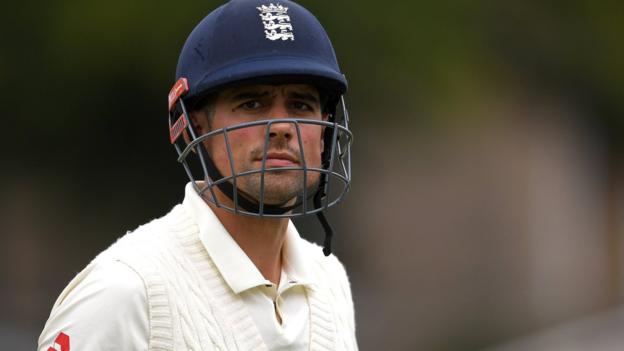
Alastair Cook made a century on his Test debut in 2006
England v India, fifth Specsavers Test
Venue: Kia Oval Date: 7-11 September Time: 11:00 BST
Coverage: Ball-by-ball Test Match Special commentary on BBC Radio 5 live sports extra, Radio 4 LW, online, tablets, mobiles and BBC Sport app. Live text commentary on the BBC Sport website. Full tour details

Alastair Cook says he cried as he told England team-mates he was to retire from international cricket, a decision he had been considering for six months.

The opener, 33, will step down from England duty after the final Test against India, which starts on Friday.

Cook, who averages 18.62 in 2018, said he had lost his “mental edge”.

“I was a couple of beers in, otherwise I would have cried more than I actually did,” said Cook, who told the team after the fourth-Test win on Sunday.

“At the end of the game I said, ‘It might be good news, it might be sad for some, it might be happy for others, but it’s time and I have done my bit. I will play one more game’.

“There was a little bit of silence, then Mo [Ali] said something, everybody laughed and it was forgotten about.”

Cook told captain Joe Root before the fourth Test at Southampton – which England won to take an unassailable 3-1 lead in the series – and informed head coach Trevor Bayliss during the game.

“Over the last six months there have been signs in my mind this was going to happen,” said Cook, who is England’s highest Test run-scorer.

“I had always been mentally tough and had that edge to everything I’ve done – and that edge had kind of gone.”

‘I was not the most talented cricketer’

Cook has scored 12,254 runs and made 32 centuries in 160 Tests – all England records.

He said the highlights of his 12-year career were being named man of the series in in Australia in 2010-11 and India in 2012.

Cook scored 766 runs in England’s Ashes triumph in Australia in 2010-11, and made three successive centuries to help England win in India for the first time in 27 years.

“I can look back and say I became the best player I could have become and that means a lot to me,” said Cook, who is sixth on the all-time list of Test run-scorers.

“I was never the most talented cricketer, but I definitely got everything out of my ability.”

Pietersen and pressure

Cook said the fallout from Kevin Pietersen’s sacking in 2014 after the 5-0 Ashes defeat was among the lowest periods of his England career.

Pietersen later made allegations of a bullying culture in the England squad.

In 2015, England and Wales Cricket Board (ECB) director of cricket Andrew Strauss said Pietersen would not be considered for selection.

“The KP affair was a tough year,” said Cook, who was captain at the time.

“I was involved in a decision without being the bloke who made the final decision. It could have been handled differently.

“The moment when Strauss came on board and said he made the decision was the best thing that happened. There is regret over it – it wasn’t great for English cricket.”

Cook struggled for form during 2014 and survived calls for him to be replaced as captain before leading England to a home Ashes win the following summer.

“When it was tough I didn’t throw the towel in,” Cook said. “I was the best man for the job.”

Read More

from Trusted eNews https://ift.tt/2oFmBol
via IFTTT

Design a site like this with WordPress.com
Get started