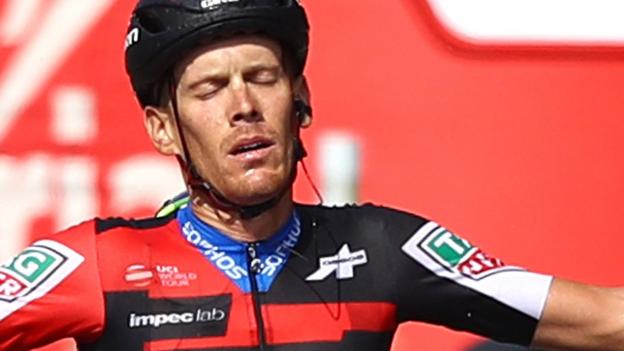
Vuelta a Espana: Alessandro de Marchi wins stage 11 as Simon Yates retains red jersey

news image

De Marchi pushed clear of fellow breakaway rider Restrepo in the final stages

Italian Alessandro de Marchi rode to a solo win on stage 11 of the Vuelta a Espana as Britain’s Simon Yates retained his overall lead.

BMC rider De Marchi, 32, pushed clear of Jhonatan Restrepo as heavy rain fell in the final stretches of Wednesday’s 207.8km run from Mombuey to Ribeira.

Mitchelton-Scott’s Yates, 26, finished level with his main rivals to once again defend his red jersey.

He maintains a one-second advantage over Movistar’s Alejandro Valverde.

Spaniard Valverde’s team leader Nairo Quintana of Colombia stays third, 14 seconds back.

It was de Marchi’s first grand tour stage win since victory on stage 14 of the 2015 Vuelta, although he also won a team time trial at last year’s Vuelta.

“If I had waited for the sprint, for sure I’d have finished second,” said De Marchi, who is known for breakaways and was named the most combative rider at the 2014 Tour de France.

“The only option I had was to try everything on the last climb. Honestly, I didn’t have my best legs, but it was just in the head. At one moment today I just said that I just had to keep trying because it was a real battle.”

Thursday’s 12th stage is a 177.5km hilly ride from Mondonedo to Punta de Estaca de Bares in Galicia.

Stage 11 result

1. Alessandro de Marchi (Ita/BMC) 4hrs 52mins 38secs

2. Jhonatan Restrepo (Col/Katusha-Alpecin) +28secs

3. Franco Pellizotti (Ita/Bahrain-Merida) +59secs

4. Nans Peters (Fra/AG2R La Mondiale) +1min 24secs

5. Dylan Teuns (Bel/BMC) +1min 45secs

Overall standings

1. Simon Yates (GB/Mitchelton-Scott) 45hrs 57mins 40secs

2. Alejandro Valverde (Spa/Movistar) +1sec

3. Nairo Quintana (Col/Movistar) +14secs

4. Ion Izagirre (Spa/Bahrain-Merida) +17secs

5. Tony Gallopin (Fra/AG2R La Mondiale) +24secs

Read More

from Trusted eNews https://ift.tt/2M40LUG
via IFTTT

Afghanistan: Deadly blasts target Kabul sports club

news image

Twin bombings at a sports club in Kabul on Wednesday killed at least 20 people and wounded 70 others, the latest in a spate of deadly attacks in the Afghan capital.

No immediate claim of responsibility was made for the blasts in Dasht-e-Barchi, home to many members of the mainly Shia Muslim Hazara ethnic minority that has been targeted in the past by members of Islamic State of Iraq and the Levant (ISIL).

Images taken at the scene showed young men in torn wrestling kit helping the wounded onto vehicles to be taken to hospital.

The first explosion was triggered by a suicide bomber and was followed by a car bomb shortly after, said interior ministry spokesman Najib Danish.

Afghan President Ashraf Ghani condemned the bombings. An attack on civilians and media workers of the country is an attack on freedom of speech and crime against humanity,” he said in a statement.

A reporter and cameraman from Afghanistan’s largest broadcaster, Tolo News, were killed in the second blast and four other local television crew were wounded, according to NAI, a group supporting open media in Afghanistan.

Kabul police spokesman Hashmat Stanekzai said the second explosion hit as police were helping victims and a number of officers were wounded.

Al Jazeera’s Jennifer Glasse, reporting from Kabul, said the second bomb appeared to target first responders and journalists.

“It has been a very deadly year here for journalists and for Afghans alike,” Glasse said.

On April 30, twin explosions in Kabul killed nine media workers and 16 other people.

‘A lot of dead’

Social media users who purportedly witnessed the attack said the bomber killed the guards at the club before blowing himself up inside.

He “detonated inside where a large number of athletes had gathered. There are a lot of dead and wounded”, Mohammad Hanif said on Facebook.

Wednesday’s attack underlined the danger in Kabul as elections approach next month, as well as the threat facing the Hazaras – a Persian-speaking minority that has long faced discrimination.

In mid-August, at least 34 people were killed in a suicide attack in front of an education centre in Dasht-e-Barchi, west of Kabul.

ISIL – which has established a brutal reputation and which both the Western-backed government and the Taliban consider an enemy – claimed responsibility for that bombing.

SOURCE: Al Jazeera and news agencies

Read More

from Trusted eNews https://ift.tt/2NlQ98m
via IFTTT

Monica Lewinsky set to appear in Bill Clinton impeachment docuseries

news image

Two decades after the Bill Clinton sex scandal dominated headlines, filmmaker Alex Gibney is set to explore the subject like never before.

Gibney’s new three-part A&E docuseries will delve into Clinton’s affair with 21-year-old White House intern Monica Lewinsky, which led him to become the second president in U.S. history to be impeached by Congress.

The Impeachment of Bill Clinton (working title), will feature never-before-seen footage and interviews, as well as a candid sit-down with Lewinsky. Paula Jones, Kathleen Willey, and Juanita Broaddrick, who accused Clinton of raping her 1978, will all go on record for the show.

Directed by Blair Foster, the six-hour series will be released by Alex Gibney’s Jigsaw Productions on Nov. 18 and air over the course of three nights consecutively.  

Elaine Frontain Bryant, executive vice president and head of programming at A&E, refers to the show as “a real-life political thriller and the most in-depth and intimate account of how one of the biggest scandals in our nation’s history unfolded, forever changing the landscape of American politics.”

Lewinsky’s appearance in the series comes as her story takes on new meaning as part of the #MeToo movement. The 45-year-old has become an important figure in the discussion around sexual misconduct in the workplace, recently speaking out on the subject in an essay for Vanity Fair.

“To be blunt, I was diagnosed several years ago with post-traumatic stress disorder, mainly from the ordeal of having been publicly outed and ostracized back then,” she wrote in March. “My trauma expedition has been long, arduous, painful, and expensive. And it’s not over.”

Though Lewinsky has chosen to discuss the scandal as part of the renewed interest in the case in the wake of the movement, she publicly drew a line on Monday, cutting short a TV conference in Jerusalem when she was asked if she was still seeking an apology from Clinton.

“There were clear parameters about what we would be discussing and what we would not,” Lewinsky later said in a statement on Twitter of the event, which was intended to highlight social media bullying. 

Lewinsky also noted the moderator was told beforehand that discussing Clinton was off limits. “When she asked me it on stage, with blatant disregard for our agreement, it became clear to me I had been misled.”


Read More

from Trusted eNews https://ift.tt/2NSwkm6
via IFTTT

Brett Kavanaugh: His views on key issues he could face as a Supreme Court justice

news image

CLOSE

Supreme Court nominee Brett Kavanaugh says he believes the first thing that makes a good judge is “independence.” Amid constant disruptions from protesters, Kavanaugh is answering questions in front of the Senate Judiciary Committee. (Sept. 5)
AP

WASHINGTON – Supreme Court nominee Brett Kavanaugh answered senators’ questions Wednesday on high-profile issues ranging from abortion to gun control to presidential power.

Kavanaugh, an appeals court judge nominated for the Supreme Court by President Donald Trump, refused to discuss hypothetical cases that he may have to help decide if he is confirmed. However, he told members of the Senate Judiciary Committee his views on some of the high court’s most important cases.

Here’s a look at what the judge had to say on some of the most controversial issues:

Presidential power

Kavanaugh could become the deciding vote on whether Trump can be indicted or forced to testify as part of special counsel Robert Mueller’s investigation of Russian interference in the 2016 election.

“Can a sitting president be required to respond to a subpoena?” Sen. Dianne Feinstein, D-Calif., asked the judge. 

Kavanaugh replied: “I can’t give you an answer on that hypothetical question.” He noted that Justice Ruth Bader Ginsburg and other justices – when they were nominees –refused to answer hypothetical questions because they didn’t want to prejudge future cases.

However, Kavanaugh praised the Supreme Court’s landmark 1974 decision in United States vs. Nixon. The court ruled unanimously in that case that President Richard Nixon had to turn over tape recordings and other evidence related to the Watergate scandal.

Kavanaugh called that ruling “one of the greatest moments in Supreme Court history” because the court stood up at a “crisis moment” and showed its independence.

He refused to answer a question about whether the president can pardon himself, as Trump has said he has the right to do. Kavanaugh called it a “hypothetical question that I can’t begin to answer in this context as a sitting judge and nominee.”

Autoplay

Show Thumbnails

Show Captions

Abortion

Kavnaugh is a devout Catholic and some abortion rights advocates fear he might try to overturn Roe vs. Wade – the landmark 1973 case that decided women have a constitutional right to an abortion.

“It has been reported that you have said that Roe is now settled law,” Feinstein said to the judge. “What do you mean by settled law? Do you believe it is correct law?”

Kavanaugh said the case “is an important precedent of the Supreme Court that has been reaffirmed many times.”

He said the 1992 case of Planned Parenthood vs. Casey had created “precedent upon precedent” by clearly reaffirming Roe in ruling that “matters, involving the most intimate and personal choices a person may make in a lifetime … are central to the liberty protected by the Fourteenth Amendment.”

Kavanaugh also told Judiciary Chairman Chuck Grassley, R-Iowa, that “my personal beliefs are not relevant to how I decide cases.”

Guns

Kavanaugh defended his dissent in a key 2011 gun control case before the Court of Appeals for the District of Columbia Circuit.

The majority of judges upheld Washington, D.C.’s, gun registration law and its ban on semi-automatic weapons, which the city classified as assault weapons.

Kavanaugh said he based his dissent on a Supreme Court ruling that “dangerous and unusual weapons” – such as machine guns – could be banned. But he said he didn’t see semi-automatic rifles as “unusual.”

“Handguns and semi-automatic rifles are weapons used for hunting and self-defense,” he said. “That’s what makes this issue difficult.”

More: Supreme Court nominee Brett Kavanaugh highlights independence in hearing: ‘No one is above the law’

More: Brett Kavanaugh: Top takeaways from first day of Supreme Court confirmation hearings

Autoplay

Show Thumbnails

Show Captions


Read or Share this story: https://usat.ly/2M379vH

Read More

from Trusted eNews https://ift.tt/2oJ3ry1
via IFTTT

Sen. Marco Rubio to Alex Jones: ‘I’ll take care of you myself’

news image

Share This Story!

Let friends in your social network know what you are reading about

Sen. Marco Rubio to Alex Jones: ‘I’ll take care of you myself’

An interview with Sen. Marco Rubio devolved into a schoolyard taunts Wednesday when conspiracy theorist Alex Jones interrupted the Florida Republican.

Loading…Post to Facebook

Posted!

A link has been posted to your Facebook feed.

WASHINGTON – An interview with Sen. Marco Rubio outside a hearing focused on social media devolved into schoolyard taunts Wednesday when far-right conspiracy theorist Alex Jones repeatedly interrupted the Florida Republican and patted him on the shoulder. 

“Don’t touch me again, man,” Rubio told Jones, who runs the conspiracy site Infowars.”I’m asking you not to touch me again.”

“I was just patting you nicely,” Jones responded. “What, you want me to get arrested?”

Rubio fired back: “You’re not going to get arrested. I’ll take care of you myself.” 

Video of the exchange was captured by several news cameras, including NBC, and was widely shared on social media. Before the exchange, Jones was heard repeatedly interrupting Rubio’s answers to reporters’ questions.  

Jones attended a Senate Intelligence Committee hearing focused on whether Facebook and Twitter have done enough to counter the influence of foreign actors on their websites, including Russia, who are attempting to influence U.S. elections. The tech execs also faced questions about whether the companies are attempting to silence conservative voices on their platforms.   


Read or Share this story: https://usat.ly/2NeMSYD

Read More

from Trusted eNews https://ift.tt/2PGirYW
via IFTTT

Listen: US Open – Cilic, Nishikori & Osaka in quarter-finals action

news image

Listen to live US Open tennis commentary – Marin Cilic, Kei Nishikori and Naomi Osaka in quarter-finals action – BBC Sport


<!–


<!–

<!–
<!–

<!–
<!–

<!–

<!–

<!–


Summary

  1. Quarter-finals continue at Flushing Meadows
  2. Japan’s Naomi Osaka takes first set 6-1 v Ukraine’s Lesia Tsurenko
  3. Followed by Marin Cilic v Kei Nishikori
  4. Commentary of both matches on Radio 5 live sports extra
  5. Get Involved: #bbctennis or 81111 (UK only)


Read More

from Trusted eNews https://ift.tt/2oK2CF6
via IFTTT

UN envoy positive ahead of Yemen peace talks – despite no rebels

news image

The UN’s special envoy to Yemen expressed confidence ahead of the first day of peace talks between rebels and the internationally recognised Yemeni government – despite the Houthis failing to arrive in Switzerland.

Speaking at press conference in Geneva on Wednesday, Martin Griffiths said despite delays in the arrival of the Houthi delegation, he was confident representatives will attend Thursday’s UN-sponsored discussions to help end the three-year war that has killed thousands.

Griffiths said he hoped to see both parties in the same room. Previous reports suggested there wouldn’t be face-to-face meetings with intermediaries used for communication.

The meeting will be the first UN-led peace talks in two years, although chances of anything more than an agreement to further discussions are slim. 

Do reports on atrocities serve any purpose?

The rebels said they were stranded in Yemen’s capital, Sanaa, on the eve of the peace talks, unable to “secure authorisation” from the Saudi-Emirati-led military coalition for a plane to transport its delegation and wounded fighters out of the country, according to the Houthi’s Al-Masirah TV. 

Houthi spokesman Mohammed Abdulsalam tweeted on Tuesday the UN “made promises on facilitating the transport of the wounded … abroad”, and accused the world body of stalling. 

Griffiths said talks with the Yemeni government will start Wednesday night, and efforts were being made to ensure the Houthis’ presence.

“We are working at it. I think this issue will sort itself out. Yemen talks have always had a delay to begin. We are going to make it happen,” he said.

Turning the page

The UN envoy told reporters in Geneva there was no military solution to the Yemeni conflict.

“It has been a process in Yemen. This is an opportunity for that page to be turned. We are talking about consultations – this is not a negotiation – this a process. We want to understand the issues of both parties,” Griffiths said.

“This is a Yemeni-Yemeni discussion, it’s not for other countries to determine.”

Griffiths will act as the intermediary between government officials and Houthi representatives.

While the Houthis control Sanaa and much of northern Yemen, the Saudi-Emirati-led coalition controls its airspace.

In 2014, the Houthis seized Sanaa and drove the government of Abd-Rabbu Mansour Hadi into exile, marking a major turning point in Yemen’s long-running conflict. 

The following year, Saudi Arabia and allies formed the regional military coalition to back Hadi’s government in its fight against the rebels.

More than 10,000 people have been killed since 2015 – a death toll that hasn’t been updated in years and is likely much higher. The UN describes Yemen as the world’s worst humanitarian situation with millions on the brink of famine because of the war. 

The last round of peace talks collapsed in 2016 when 108 days of negotiations in Kuwait failed to broker a power-sharing agreement.

The Houthi delegation was then grounded in Oman for three months on its way back to Yemen, blocked from returning by the coalition.

UN: Possible war crimes in Yemen committed by all sides

SOURCE: Al Jazeera and news agencies

Read More

from Trusted eNews https://ift.tt/2PGUCQB
via IFTTT

It’s Always Sunny stars talk Glenn Howerton’s absence, openly gay Mac

news image


It’s Always Sunny in Philadelphia

type
TV Show
Genre
Comedy
Airs
Wednesdays at :
run date
08/04/05
performer
Rob McElhenney, Charlie Day, Glenn Howerton, Kaitlin Olson, Danny DeVito
broadcaster
FXX
seasons
13
Current Status
In Season

It’s Always Sunny in Philadelphia star, writer, and executive producer Glenn Howerton’s presence on season 13 might be a mystery, but his costars never had a doubt that they could go on without him.

The season 12 finale of the FXX comedy ended with Dennis (Howerton) leaving Philadelphia to go be a father in North Dakota. The character’s departure coincided with the actor going to headline his own NBC comedy A.P. Bio. In an interview earlier this year with EW, Howerton said it was a “creative decision” and made it clear that he was still creatively involved with the show that he had helped turn into a comedy mainstay.

But ahead of Wednesday’s season 13 premiere, the cast (noticeably minus Howerton) talked to EW about their reaction to Howerton’s decision. “We were bummed,” admitted McElhenney, who developed the show with Howerton. “But we sat down and talked about it and we feel like we can make the show without him, so that’s what we’re doing.”

And what they’re doing in season 13 is finally pairing Charlie (Day) and the Waitress (Day’s wife, Mary Elizabeth Ellis), but Day says “be careful what you wish for.” He adds, “There’s always the possibility for a pregnancy, but this guy has huffed a lot of spray paint, so I don’t think those suckers are swimming too well.”

Another story a long time coming is Mac (McElhenney) fully embracing his sexuality, which was the focus of last season’s standout episode “Hero or Hate Crime?” “An openly gay Mac will be exactly like the Mac that we know,” says McElhenney. “I don’t think he’s really going to change at all.” Cracks Day, “An openly gay Mac will be just as annoying as a closeted Mac.”

It’s Always Sunny reopens Wednesday at 10 p.m. ET on FXX.

Read More

from Trusted eNews https://ift.tt/2NjZxcE
via IFTTT

Dad’s freak boating accident caused Florida boy to fall under propeller, suffering fatal injury

news image

CLOSE

Officials across the nation respond to thousands of boating accidents every year. Stay safe this summer with these boating-safety tips.
Wochit

A 15-year-old Alva, Florida boy was fatally struck in the head by a boat propeller in the Florida Keys on Sunday after he fell overboard when his father lost his balance and accidentally hit the throttle.

A report from the Florida Fish and Wildlife Conservation Commission on the accident said Jason Schreyer, 48, was piloting a 25-foot Dorado watercraft that was adrift about three miles north of Cudjoe Key in the Kemp Channel of the Lower Keys when he lost his balance and fell on the throttle.

The craft suddenly lurched forward, the report said, causing Hayden Schreyer, his son, to fall overboard and be struck by the propeller.

The accident caused fatal head and body trauma to Hayden Schreyer. Jason Schreyer suffered a broken tibia.

Six others aboard the craft were not hurt.

Hayden Schreyer was taken to Lower Keys Medical Center on Stock Island where he was pronounced dead.

The incident happened in or near Kemp Channel on the bayside. Kemp Channel separates Cudjoe Key and Summerland Key.

Loved ones remember the teen known as Blueberry 

Hayden Schreyer was known as a quiet but funny 15-year-old who loved fishing, gardening and 4-H activities.

Schreyer’s family, friends and schoolmates took to social media to pray, offer comfort and positive observations about the teen who was known to them as Blueberry.

“He had a great personality,” said Cathy Suggs, a Lee County 4-H official. “He was a nice kid. Hard working. If you got to know him he was funny.”

Autoplay

Show Thumbnails

Show Captions

“A bunch of kids got together at the school today, all wearing blue” said Sally Gulmy, a 4-H leader whose daughter knew Schreyer well. The blue-clad group’s memorial at Riverside High School, she said, played off Schreyer’s love of the color blue and his nickname, “Blueberry.”

Schreyer was a sophomore at Riverdale.

His nickname came about, Gulmy said, because he often wore a blue fishing shirt to school. One day a friend called him blueberry and the name stuck, something she said Schreyer was proud of.

Previously: Fort Myers teenager dies after being struck by boat propeller

More: Woman suffers leg injury from prop as motor accidentally started

How to help

A GoFundMe account created Sunday had raised nearly $8,000 in two days and drew words of sympathy and shock at the teen’s fatal accident.

The Lee County 4-H Club, which Schreyer was a member, posted a request for prayers on its Facebook page on Sunday.

Suggs said she knew Schreyer through his 4-H activities, mainly swine and poultry. While a student at The Alva School, she said, he took agriculture classes.

“He loved gardening and working with poultry,” she said, adding that he had showed swine at the Southwest Florida & Lee County Fair for several years and had been a member of the 4-H Roundup Club where he had been active in community service.

In case you missed it: Coast Guard sweeps SWFL waters for illegal charter vessels

Gulmy said Hayden took part in a collection of sneakers and socks for a boy’s home in Punta Gorda, helped pack goody boxes for U.S. servicemen overseas and collected blankets for local children.

“He was a super nice kid,” she said. “He was always helping others.”

Suggs said his skill in showing swine translated into officials using him to mentor younger 4-H members just getting into the activity.

His love of fishing could be seen on many posts on Facebook showing him, friends and family members with their catch during the recent spiny lobster season in the Keys. On such page, In loving Memory of Hayden Schreyer aka Blueberry, asked for photos and videos to help commemorate the Alva teen.

Connect with this reporter: MichaelBraunNP (Facebook) @MichaelBraunNP (Twitter)

CLOSE

When boating wear life jackets! Emergency responders say. Members of the Bonita Springs Fire and Rescue demonstrate the importance of wearing a life jacket in partnership with the Coast Gaurd Auxilliary and Coast Guard.
Andrew West / news-press.com


Read or Share this story: https://ift.tt/2CjmWql

Read More

from Trusted eNews https://ift.tt/2NQwv1q
via IFTTT

6 signs we’re closer to the next recession than you think

news image

Chances are that if you invested at any point during the Great Recession, you’re sitting pretty right now, assuming you’ve held onto your positions. The U.S. economy is in the midst of its second-longest economic expansion in history, going back 161 years.  And since the market bottomed out in March 2009, investors have witnessed all three major stock indexes at least quadruple in value at one point. It’s been a truly unique ride — and chances are it’s going to come to an end sooner rather than later.

To be perfectly clear, trying to predict when recessions will occur is pure guesswork. Top market analysts have called for pullbacks in the market, unsuccessfully, in pretty much every year since the Great Recession ended. But the economic cycle doesn’t lie: recessions are inevitable. And in my estimation, we’re probably closer to the next recession than you realize.

How can I be so certain? Well, I can’t. Remember, I just noted there’s virtually no certainty when it comes to predicting when recessions will occur. There are, however, six warning signs that suggest a recession could be, in relative terms, around the corner.

A forklift operator having a discussion with his boss.

Image source: Getty Images.

1. The unemployment rate will struggle to push lower

Since the unemployment rate peaked at 10% in October 2009, it’s been on a pretty steady decline. As of May 2018, it hit 3.8%, which tied the lowest unemployment rate recorded since April 2000 and would have been a 39-year low had it ticked one-tenth of a percent lower.  A low unemployment rate is usually a sign that the U.S. economy is in good shape.

The issue is this: It’s incredibly difficult to improve upon an unemployment rate of 4%. People changing jobs makes it difficult to generate enough job growth to continually push the unemployment rate lower than 4%. What’s more, a smaller pool of unemployed workers could make it difficult for companies to filled skilled positions. If employers can’t fill positions, then their production capacity becomes constrained.

Additionally, an environment in which unemployment rates are low puts the ball into the workers’ courts. If businesses are required to parcel out higher wages to lure in new workers and retain existing talent, it could result in a significant increase to inflation, which would be bad. I’ll be covering inflation in more detail in an upcoming point. 

Fanned hundred-dollar bills lying atop fanned Treasury bonds.

Image source: Getty Images.

2. The yield curve is flattening

Another growing concern is the flattening of the yield curve.

The yield curve is nothing more than a depiction of the interest rates paid by various maturities of U.S. Treasury bonds. Traditionally, we’d expect to see short-term bonds, such as 1- and 3-month notes, pay a considerably lower interest rate than long-term bonds, such as 10- and 30-year notes. A flattening of the yield curve happens when the gap between short-term and long-term rates shrinks. An inversion, whereby short-term rates are higher than long-term rates, has preceded each and every recession since the Great Depression.

Why’s this a big deal, you ask? The reason is that banks borrow at short-term lending rates and lend at longer-term rates. The greater the difference between the two, the more profitable it is for banks to lend money. However, when this gap shrinks, it becomes less enticing to lend. And when it inverts, banks have virtually no desire to lend money, leading to a halt in growth and a recession.

To be clear, the 10-year and 3-month notes aren’t inverted at the moment – these two specific maturity lengths are often good measures to examine when looking at the yield curve. However, the gap in yield between these two notes has been shrinking, and that could be a warning sign. 

A young couple concerned by high prices on their store receipt.

Image source: Getty Images.

3. Inflation has begun picking up

Don’t overlook the fact that inflation — i.e., the rising price of an identical basket of goods and services — has begun to pick up since the beginning of the year. According to data from the Bureau of Labor Statistics, the Consumer Price Index for All Urban Consumers, less food and energy, hit 2.4% in July 2018. That’s its highest reading since September 2008. 

As the price of goods and services rises, likely a result of a strong labor market and wage growth, it forces the Federal Reserve to get more aggressive with its monetary policy. And by monetary policy, I’m talking about its ability to influence interest rates via the federal funds target rate. If interest rates begin to climb rapidly, it could constrain lending and increase individual and/or corporate interest rates on variable-rate loans.

In short, while some inflation is good (the Fed typically targets 2%), too much can be bad news.

Two businessmen shaking hands, with one holding a miniature house in his left hand.

Image source: Getty Images.

4. Home sales are beginning to decline in key markets

During the Great Recession, housing was a leading indicator of the trouble that lay ahead. It’s possible that we could be seeing similar warning signs (without insanely high mortgage default rates) this time around.

As noted by CNN Money earlier this month, home sales have declined in four of the past five months, despite the fact that home prices and wages are on the rise. This could signal that homeowners simply aren’t able to afford new homes or that they don’t see the market properly reflecting the price of homes in their respective areas. 

More specifically, in June 2018, we witnessed an 11.8% year-over-year decline in new and existing home and condominium sales in California, according to CoreLogic. California’s housing market is often a leading indicator to the industry as a whole. Seeing sales dip by a double-digit percentage should be a warning that Wall Street and investors pay attention to. 

A worried consumer holding a credit card in his right hand and looking at his laptop.

Image source: Getty Images.

5. Credit card debt and late payments are on the rise

Credit cards are a bit of a push-pull for the U.S. economy. Heavy usage suggests heightened purchasing activity, which is a good thing since U.S. GDP is largely consumer driven. Then again, delinquencies and significant credit card debt can come back to haunt the U.S. economy during recessions.

A report released by credit-reporting agency TransUnion as of February 2018 found that three key credit metrics were all heading higher.

  • The number of outstanding credit cards climbed from 364.2 million to 418.6 million between 2014 and 2017.
  • The average debt per cardholder increased from $5,329 in 2014 to $5,644 as of 2017.
  • The percentage of accounts that were 90 or more days delinquent had jumped from 1.48% in 2014 to 1.87% in 2017.

The issue here is that as interest rates rise, servicing this debt is going to become more difficult, likely resulting in higher delinquency rates. As we witnessed with the housing crisis in 2008–2009, rising delinquency rates can create a bad domino effect for the companies behind these loans. 

A woman closely examining data in a financial newspaper.

Image source: Getty Images.

6. The economic cycle suggests a contraction

Finally, while the stock market and the U.S. economy don’t adhere to averages, Wall Street and investors would be wise to pay attention to the current and historic economic expansion cycles.

As noted, we’re currently in the second-longest economic expansion of the past 161 years (109 months and counting). The only longer expansion was the 120 months leading up to the dot-com bubble. This would suggest that we’re more than likely closer to the latter stages of our current expansion, based on historical expansion length, than to the middle. 

Though averages alone don’t provide enough concrete evidence that a recession is near, they are another piece of a growing puzzle that implies a recession is closer than you probably realize.
Read More

from Trusted eNews https://ift.tt/2MSgLyi
via IFTTT

Design a site like this with WordPress.com
Get started