Prolific producer Kathleen Kennedy will be the first woman to receive the Irving G. Thalberg Memorial Award from the Academy of Motion Picture Arts and Sciences.
The Academy’s board of governors voted Tuesday night to present the honor to Kennedy and her producing partner, Frank Marshall (who is also her husband), at the 10th annual Governors Awards on Sunday, Nov. 18.
Additionally, publicist Marvin Levy, composer Lalo Schifrin, and actress Cicely Tyson will receive honorary Oscars for their work in the industry, the board voted.
“Choosing the honorees for its awards each year is the happiest of all the board of governors’ work,” Academy President John Bailey in a statement Wednesday. “And this year, its selection of five iconic artists was made with universal acclaim by the Academy’s 54 spirited governors.”
The honorary Oscars are given “to honor extraordinary distinction in lifetime achievement, exceptional contributions to the state of motion picture arts and sciences, or for outstanding service to the Academy.” The Thalberg Award, a bust of the motion picture executive, is presented to creative producers “whose body of work reflects a consistently high quality of motion picture production.”
Kennedy and Marshall established the Kennedy/Marshall Company in 1991, generating Best Picture nominations for The Sixth Sense (1999), Seabiscuit (2003), Munich (2005), and The Curious Case of Benjamin Button (2008). Other Kennedy/Marshall productions include Congo, all five Bourne films, and The Diving Bell and the Butterfly. Before forming their own company, the duo cofounded Amblin Productions with Steven Spielberg and shared a Best Picture nomination for The Color Purple (1985). On her own, Kennedy was nominated in the same category for E.T. The Extra-Terrestrial (1982), War Horse (2011), and Lincoln (2012).
She became the president of Lucasfilm in 2012, after Disney acquired the company for more than $4 billion, and has been involved in the making of more than 60 films, which have collectively grossed more than $15 billion worldwide.
Bill Sternberg, USA TODAY Editorial Page editor, hopes that talking about his son’s death can help others and shed light on flawed system. USA TODAY
Our son Scott fatally overdosed last November. Nothing can bring him back, but I’ve learned some things that might help others cope with this affliction.
Whenever I meet someone new at a social gathering, the question typically comes up within a few minutes of casual conversation: How many children do you have?
Until nine months ago, this innocent question had a simple answer. Now it triggers a rapid and painful mental calculation.
I could say two. My daughter is in New York and my son is in Philadelphia. That’s the easy answer, I suppose. But it doesn’t feel right. No, that doesn’t feel right at all.
Or I could say three. Yes, that feels better. Much better. But do I want to discomfort this person I just met? And how much do I really want to share?
A phone call at halftime
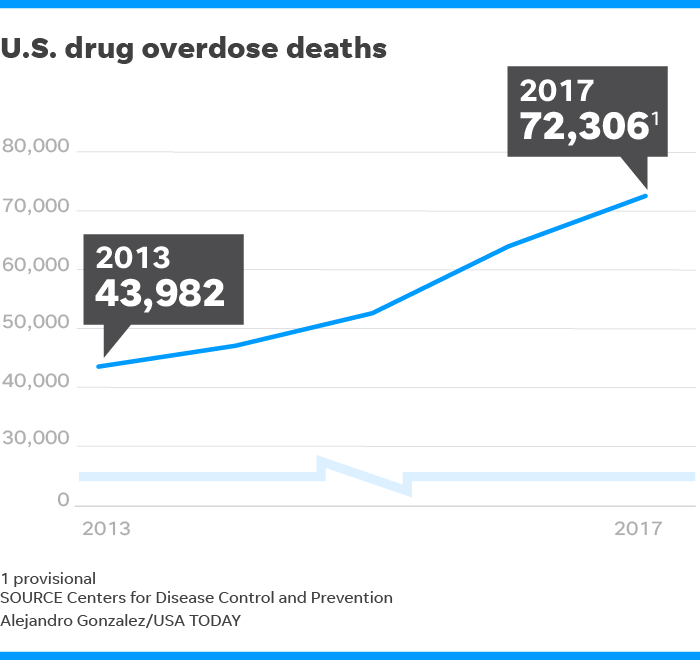
Picture an NFL stadium holding a capacity crowd of 72,000.
That number, according to a preliminary estimate by the Centers for Disease Control and Prevention, is about how many Americans died last year from drug overdoses. An entire stadium full of people.
Our son Scott was one of those people. After a lengthy battle with opioid addiction, he suffered a fatal overdose Nov. 30.
It was a Thursday night. My wife, Ellen, and I were watching the Redskins-Cowboys game from our home in the suburbs of Washington, D.C.
Scott had been staying in a sober-living apartment complex in Dallas after spending time at an inpatient drug-treatment program outside the city. We hadn’t heard from him all afternoon or evening, which was unusual but not unprecedented.
I could tell that Ellen was growing concerned. Maybe Scott had scored a ticket to the big game, I said. Maybe he was somewhere in the crowd we were watching on TV.
At halftime, my cellphone rang. An unfamiliar number from Texas. It was a psychiatrist from Scott’s treatment program.
Had I heard about Scott? Something in her voice made me suspect the worst, that this could be The Call every parent dreads. “Is he alive?” I asked. Hesitation. “No,” she replied. I shook my head sideways. Ellen screamed.
Scott was 31 years old.
No ‘magic conversation’
As a parent, your natural inclination is to fix your children’s problems or, better yet, teach them how to fix their problems themselves. And when the kids are little, you mostly can. But as they grow older, the problems get bigger and more complicated.
There’s no “magic conversation” that can keep adult children out of harm’s way or turn their lives around. There’s no bright, clear line between supportive and enabling.
I’m far from an authority on addiction. But I know the emotional and financial toll it can take on a family. Having lived through the nightmare and having talked to some of the leading experts in the field, I’ve learned a few things and formed a few opinions that might be helpful to others struggling to cope with this insidious, infuriating affliction:
This epidemic does not discriminate. No family is immune from the scourge of the opioid crisis. About 2 million people in America, from all walks of life, are addicted to opioids. The epidemic is evolving but not improving.
You can think of the epidemic as a tragedy in three acts. In the first act, drugmakers, distributors and doctors flooded the United States with prescription painkillers that were far more addictive than the manufacturers claimed. (We think Scott’s first exposure to opioids came during college when he was prescribed painkillers after an incision to remove his appendix became infected.)
In the second act, many people addicted to OxyContin and similar drugs switched to heroin, which was cheaper and gave a better high. In Act III, the pain pills and heroin were increasingly spiked with illicit fentanyls – powerful synthetic opioids manufactured mainly in China and Mexico. The lethality of these fentanyls explains why deaths involving opioids increased 16 percent last year, even as prescriptions for painkillers were going down.
Overcoming addiction isn’t merely a matter of willpower. Until about four decades ago, addiction was regarded as a character flaw or moral failing. The treatment for it – the AA, 12-step, Big Book model – grew up disconnected from the medical profession. Today, addiction is recognized as a chronic brain disorder marked by people losing control of their drug use and then losing control of their lives. They can’t stop using, despite the harmful consequences.
The roots of addiction can be biological (a genetic predisposition), psychological (self-medication for an underlying condition such as depression) or social (everyone around you is using). What makes addiction more pernicious than many other diseases, however, is that the patients actively conspire against, and constantly lie to, those who want to help them recover. The stigma and shame get in the way of honesty. And addicts don’t want anything or anybody to get between them and their drugs, their false best friends.
“Hitting bottom” is not the answer. If addiction is an illness, it should be treated like other illnesses. We don’t talk about letting heart patients or diabetics hit bottom before giving them treatment. Nor should we talk that way about people battling addiction. Yes, some addicts will tell you that finding themselves homeless, jobless, penniless or friendless is what prompted them to seek help or recover on their own. And yes, tough love can be necessary to get a drug abuser into treatment. The problem is, the bottom is recognizable only in hindsight. Particularly with so many fentanyl-laced drugs on the street, relapsing on opioids or dropping out of treatment needs to be regarded as a life-threatening emergency. Too often, hitting bottom means dead.
Medication-assisted treatment (MAT) holds promise but is no cure-all. The Food and Drug Administration has approved three medications for opioid-use disorder: methadone, naltrexone and buprenorphine. Like any medical treatment, each has downsides. Heroin dealers lurk outside methadone clinics. You have to be off opioids for a week to start on naltrexone. Buprenorphine can be easily sold or diverted. But the evidence shows that MAT, combined with social support and counseling, is far more effective than talk therapy alone.
Medication-assisted treatment isn’t just substituting one drug for another. Without meds, people addicted to opioids have an 80 percent to 90 percent relapse rate a month after detox, according to Dr. Marc Fishman, medical director at Maryland Treatment Centers in Baltimore. With meds, the relapse rate is more like 50 percent to 60 percent at six months. Long-acting injectables, available for naltrexone and buprenorphine, appear to hold considerable promise, because they don’t rely on the addicted person taking a pill or film each day. Unfortunately, in many places it’s still easier to get heroin than it is to get medication-assisted treatment. Only about one-quarter to one-third of treatment centers even offer MAT.
The state of addiction treatment is a national disgrace. When Scott overdosed the first time and ended up in an emergency room in Austin, Texas, we were handed a piece of paper with the names and phone numbers of about three dozen detox and treatment centers. No indication of which were any good. No indication of which were still in business or accepting new opioid patients. No indication of which took Scott’s insurance. No indication of which offered medication-assisted treatment. As a journalist, I’m trained to find credible information in a hurry. But I was overwhelmed.
The fact is, addiction treatment in the USA is in many ways the Wild West. There are some decent guides on how to pick a treatment center and what questions to ask. But there are no easy ways for people to navigate the system and get reliable, consumer-friendly information about specific programs and providers.
When you dig behind the flashy websites and implausibly high claims of success, you discover that some treatment programs are essentially scams set up to harvest the 30 days of treatment that many insurance policies cover. (Never mind that it takes at least several months to heal the addicted brain.) Some programs are run by recovering addicts who are well-meaning and have credibility with the patients but are unqualified to dispense medical advice. (Does being a cancer survivor qualify you to treat or cure cancer?)
Sometimes, an “accredited” program means little more than that the fire alarms work. And sometimes, as we discovered, even the top treatment centers – those staffed by board-certified medical professionals who can prescribe medication and deploy other state-of-the-art techniques – are no guarantees of success.
A hole in our hearts
Two months before he died, Scott came home for the weekend. Sunday was a beautiful autumn day. Scott went to visit his grandmother in the nursing home and spent quality time with Duncan, the aging cockapoo he loved like a brother. We bought a laptop computer to celebrate his five months of sobriety and to help him find a better job.
That afternoon, Scott and I played golf. He drove the ball long and straight. He beat me by a stroke on the last hole and I lost $5 to him, and I was fine with that. We went to dinner at one of his favorite restaurants, with one of his best friends from growing up. Then we came home and watched the season premiere of “Curb Your Enthusiasm” and we all laughed together.
On that perfect day, we dared to imagine a happy ending to Scott’s troubles. But it was not to be. Addiction is cruel. As one therapist put it to us, it hijacks your brain. The longer you are clean, the more your tolerance changes. If you relapse, a dose you used to be able to handle can be fatal.
Scott’s death left a hole in our hearts and a void in our lives. Our family will never be the same. The stages of grief aren’t a linear progression, and we’re still going through a sort of parental PTSD.
Last month, instead of celebrating with Scott on his birthday (Aug. 8), we participated in International Overdose Awareness Day (Aug. 31). Later this month, we’ll be back at the cemetery, unveiling his headstone.
How many children do we have? The answer is three. We’ll always have three. One of them is no longer with us.
Bill Sternberg is the editor of the editorial page. Follow him on Twitter: @bsternbe
How to find help
Reliable information about specific drug treatment programs and providers is hard to come by, but several useful guides can help families understand addiction, ask the right questions and find reputable treatment:
►The Partnership for Drug-Free Kids offers overviews of treatment options, how to find a provider and getting treatment for your child.
►The National Institute on Drug Abuse provides a research-based guide to treatment principles, with answers to frequently asked questions.
►The American Board of Preventive Medicine provides a physician look-up site, and the American Society of Addiction Medicine offers information about board-certified addiction specialists and how to find one.
Facebook and Twitter executives defended their companies on Capitol Hill, saying they are aggressively trying to root out foreign influence as the November elections near. (Sept. 5) AP
WASHINGTON – Twitter’s top executive acknowledged Wednesday that it took the company too long to take down a doctored image of Meghan McCain that was tweeted as her father was being memorialized.
“That was unacceptable,” Twitter chief executive Jack Dorsey told members of the House Energy and Commerce Committee. “We did take way too many hours to act.”
Rep. Michael Burgess, R-Texas, asked Dorsey if he’s apologized to the McCain family.
“I haven’t personally, but I will,” he said.
“I think you just did,” Burgess added.
On the same day Arizona held memorial services for the late Sen. John McCain, a Twitter user posted a doctored image that appeared to threaten to shoot Meghan McCain as she wept over her father’s casket.
By that night, Ben Domenech, Meghan McCain’s husband, was blasting Dorsey for allowing the threatening post to stay up.
“Tell me why this is cool by you,” Domenech wrote on Twitter.
Midday Friday, the account that posted the image had been suspended, and Domenech deleted his original tweet – “so no one has to see it,” he wrote.
But he complained about the slow reaction to the apparent threat. “No one should have to raise a ruckus or highlight this sort of thing publicly to get their attention,” he wrote.
The photo appears to be a doctored version of a photo taken Aug. 29 at a private memorial service at the Arizona Capitol. During the emotional service, Meghan McCain wept over the casket holding her father’s body.
The edited image shows a pair of hands holding a semi-automatic handgun, clearly trained at the grieving woman’s chest.
“America,” the tweet accompanying the photo reads, “this ones for you.”
Dorsey said Twitter needs to build an algorithm to find such images so the company isn’t relying on complaints like Domenech’s.
“We can’t place the burden on the victims,” he said. “We are using that as a lesson in order to help improve our systems.”
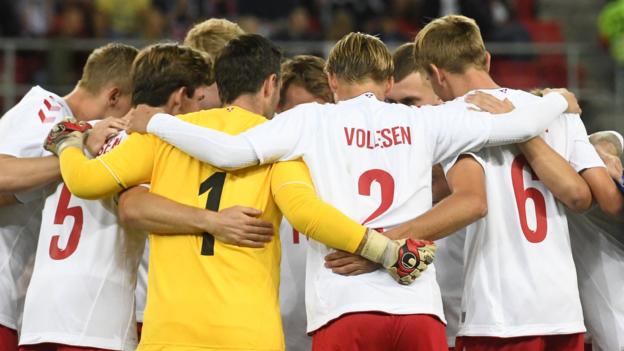
Denmark’s unfamiliar starting line-up: Back row (from left): Christoffer Haagh, Christian Bannis, Kasper Kempel, Daniel Nielsen, Nicolai Johansen, Christian Offenberg. Front row: Mads Bertelsen, Oskar Hoybye, Simon Vollesen, Rasmus Gaudin, Rasmus Johansson
Denmark were forced to field a starting 11 which included a salesman, a student and an internet star for Wednesday’s 3-0 friendly defeat in Slovakia.
The national team is involved in a commercial rights dispute with the Danish Football Association (DBU).
Players from Denmark’s top two divisions and those based overseas were unavailable and will likely not play in the Nations League against Wales.
Danish futsal players also featured in the makeshift starting 11.
Christian Offenberg, who led the attack for Denmark on Wednesday, is a part-time salesman who also plays for Danish third-tier side Avarta.
Right-back Simon Vollesen, who plays in the Danish fifth tier, is also a student while Rasmus Johansson – a midfielder who plays in Denmark’s third tier – is best known as an internet freestyle footballer, with tens of thousands of followers on Instagram and Youtube.
In comparison, Slovakia fielded former Liverpool defender Martin Skrtel and Napoli playmaker Marek Hamsik.
Two goals in the first half from Adam Nemec and Albert Rusnak gave the hosts a commanding lead before an own goal from Danish futsal player Adam Fogt, on as a substitute, made it 3-0.
Denmark registered only one shot on target during the 90 minutes and had 27 per cent possession.
Professional futsal goalkeeper Christoffer Haagh did manage to save seven of the 10 shots he faced on the night.
Denmark’s next fixture is in the new Nations League on Sunday against Wales in Aarhus – and if the dispute is not sorted out, then the emergency stand-ins are likely to find themselves up against Gareth Bale and Aaron Ramsey.
Rasmus Johansson (left) plays in the Danish third tier for Hellerup IK, but is better known as a futsal player and an internet football freestyler
As you might expect from a man who a couple of years back wrote a lengthy tribute for EW about the monster movie Pumpkinhead, director Corin Hardy knows his stuff when it comes to horror movies. But which films influenced his own new project, the Conjuring universe-set The Nun, which is released Sept. 7?
“Whenever I put a movie together, I’m prepping it, and I’m watching movies, putting together like a lookbook or a bible,” says the British director. “I felt the script [reminded me of] a bunch of movies. Hammer horror. Christopher Lee’s Dracula and also Coppola’s Dracula in that there was a gothic quality to the movie. There was also a story element that felt like Name of the Rose. The Exorcist is very obvious — it’s probably a reference for all the Conjuring movies really and just one of the best films ever made, one of my favorite films — but also The Exorcist III, which doesn’t ever really get talked about, but I think is a really great solid scary movie.
“This is a very bold statement to make, but my favorite Indiana Jones movie is Indiana Jones and the Temple of Doom — I don’t care what anyone says about that — and there was a Temple of Doom vibe that inspired me when I thought about The Nun. And then I’m always inspired by Sam Raimi’s films and felt like there was a little opportunity to exploit a bit of demonic activity, so a bit of Evil Dead II. I always try to slip that in there, but this felt justified. What else? Italian horror movies. Dario Argento movies and those sort of striking compositions. So, a combination of those movies.”
Set in early-’50s Romania, The Nun is the origin story of the inhuman spirit, also known as Valak, that tormented ghost-hunters Ed and Lorraine Warren (Patrick Wilson and Vera Farmiga) in the 1977-setThe Conjuring 2.
The film stars Demian Bichir as a priest named Father Burke and Taissa Farmiga as a novitiate, Sister Irene. “She had a difficult and isolating childhood,” Farmiga says of her character. “She experienced these visions that set her apart from her peers and eventually led her to a life in the church.” The pair are tasked by the Vatican to investigate a mysterious death at an abbey in Romania where, Farmiga reveals, “there’s some sort of presence that shouldn’t be there.”
President Donald Trump is labeling a tell-all book from journalist Bob Woodward a “work of fiction.” (Sept. 5) AP
WASHINGTON – In the more than 50 years since the Constitution was amended to create a way to remove a president unable to do his job, the process has never been triggered.
But the 25th Amendment has gotten renewed attention in the wake of a new book by veteran Washington reporter Bob Woodward that depicts the West Wing as “Crazytown,” and because of an opinion piece published Wednesday from a senior Trump official that mentions the amendment.
What is the 25th Amendment?
The amendment, ratified in 1967, created a legal mechanism for designating a head of state when the president is disabled or dead. It also formalized the historical practice for the vice president to permanently take over if the president dies or resigns, and gives the president and Congress shared power to replace a vice president.
Why was it written?
John F. Kennedy’s assassination brought renewed interest to presidential succession questions. Lyndon B. Johnson’s ascension to the presidency meant that — for the 16th time — the country had no vice president. And there was no tested way of dealing with a severe presidential illness. Johnson previously had suffered a heart attack and the next two people in line to be president were the 71-year-old speaker of the House and the 86-year-old president pro tempore of the Senate.
Has it been used before?
Gerald Ford followed the first two sections of the amendment when becoming Richard Nixon’s vice president after Spiro Agnew resigned, and when becoming president after Nixon’s resignation. The amendment’s third section, which allows for a president to temporarily cede power and duties to a vice president, was used once after Ronald Reagan was shot and twice when George W. Bush underwent surgery under general anesthesia. The fourth section, a process for removing a president when others believe he is “unable to discharge the powers and duties of his office,” has never been used.
When did the author intend the 4th section to be invoked?
“You know, fellows, we’ve talked about this problem a hundred times,” Bayh recounted telling his aides when they were in the final stages of negotiation. “The only time it would present itself — the only time the president would say ‘I’m well and able’ and the vice president and cabinet would disagree — would be if the president was as nutty as a fruit cake.”
Why is it being talked about now?
The amendment got new attention after President Trump’s inauguration and has reemerged as a top talker after some of Trump’s controversial comments and actions, or because of inside reports about the workings of the White House.
Last year, Trump triggered questions about his stability when he tweeted he has a bigger “nuclear button” than Kim Jong Un of North Korea.
Michael Wolff’s “Fire and Fury,” published in January, painted a picture of a president not up to the job.
“It’s not unreasonable to say this is 25th Amendment kind of stuff,” Wolff said in NBC’s Meet the Press appearance.
In Woodward’s book, White House Chief of Staff John Kelly calls Trump “an idiot.”
“It’s pointless to try to convince him of anything,” Kelly said, according to The Washington Post’s account of Woodward’s book.”He’s gone off the rails. We’re in Crazytown.”
In an opinion piece published by The New York Times, the anonymous author writes that senior Trump officials are “working diligently from within to frustrate parts of his agenda and his worst inclinations”.
The vice president and a majority of the cabinet could declare the president unable to “discharge the powers and duties of his office.” If the president disputes that determination, two-thirds of both the House and the Senate must vote to put the vice president in charge.
In addition, lawmakers can designate an alternative group — other than the cabinet — that the vice president could work with to declare a president unable to serve.
Is it likely to be used?
The anonymous senior official who wrote the opinion piece said there were early whispers within the cabinet of invoking the 25th Amendment.
“But no one wanted to precipitate a constitutional crisis,” the author added. Instead, officials are trying to to “do what we can to steer the administration in the right direction until — one way or another — it’s over.”
Plus, Vice President Mike Pence has given no indication that he questions Trump’s ability to be president.
Is the amendment clear on what qualifies as an inability to serve?
No. And Jay Berman, one of the Bayh aides who worked on the amendment, said that was intentional.
“It didn’t settle the issue of what it is,” he said in an interview. “It provided a mechanism for addressing the issue.”
Would a psychiatrist or other doctor need to weigh in?
Bayh assumed the vice president would consult with medical experts, but the drafters never felt comfortable that the decision would be made solely by a group of doctors, according Berman. Section four was not intended to overturn the verdict of the electoral system, or to be a substitute for impeachment, Berman said.
“It was certainly on our mind that the impeachment proceeding was still something that was available in the case of a president that had violated his oath or hadn’t performed his duties,” he said. “That truly should be the first line of defense in any case where there’s an issue about removing the president.”
Actor and sobriety campaigner Christopher Lawford, son of Peter Lawford, nephew of President Kennedy and member of the sprawling Kennedy clan, has died at age 63.
The news was posted by his cousin, human-rights activist Kerry Kennedy, a daughter of Robert F. Kennedy, on Twitter.
It was confirmed by Max Burns, a spokesman for the Robert F. Kennedy Human Rights advocacy group in Washington, which Kerry Kennedy leads.
Another cousin, former U.S. Rep. Patrick Kennedy, told the Associated Press that Lawford died of a heart attack on Tuesday in Vancouver, Canada.
“We mourn the loss of my cousin Christopher Lawford, Rest in Peace,” Kennedy tweeted, with pictures of a busload of Kennedys at the 2004 Democratic Convention and Lawford with one of his three children, son David.
We mourn the loss of my cousin Christopher Lawford, Rest in Peace.
Pictured here with our family at the 2004 Democratic Convention and with his wonderful son, David. pic.twitter.com/GLlCvN7xkv
Patrick Kennedy credited Lawford with helping to rescue him from his own problems with substance abuse.
“He was the absolute cornerstone to my sobriety, along with my wife,” Patrick Kennedy said Wednesday. “He was the one who walked me through all the difficult days of that early period.”
Lawford was the first child of Patricia Kennedy Lawford, sister to JFK and RFK, and Peter Lawford, the British-born actor and member of Frank Sinatra’s 1960s-era “Rat Pack” gang of cool-entertainer pals. Lawford’s father died in 1984; his mother in 2006.
Christopher Kennedy Lawford, who strongly resembled his father, was born in Santa Monica, Calif., in 1955, the only son of his parents’ four children.
He was an actor with a long list of credits but may be best known for roles on soaps “General Hospital” and “All My Children” and a role in one of the “Terminator” movies starring his cousin-in-law, Arnold Schwarzenegger.
He also was a writer, having authored a best-selling memoir in 2005, “Symptoms of Withdrawal: A Memoir of Snapshots and Redemption,” about his near-fatal addiction to alcohol, opioids and heroin and how he got sober.
He also published another book in 2009, “Moments of Clarity: Voices from the Front Lines of Addiction and Recovery,” a collection of essays by various celebrities about their struggles with substance abuse.
As a political activist Lawford worked on multiple Kennedy political campaigns, including those of his uncle, the late Sen. Ted Kennedy of Massachusetts.
A graduate of Tufts University in Massachusetts and Boston College Law School, he received a master’s in clinical psychology from Harvard University where he gained an academic appointment as a lecturer in psychiatry.
Lawford battled a drug-addiction problem from the late 1970s until the early 1980s, becoming addicted to heroin. In 1980, he was arrested in Aspen, Colo., for impersonating a doctor in order to get prescription medication. The charges were later dropped when Lawford completed his probation.
He was inspired to kick his drug habit after April 1984 when his cousin David, another son of Robert F. Kennedy, died of a drug overdose. Later, Lawford helped set up a clinic to treat opioid dependency in Boston.
The win gives Nishikori a third US Open semi-final appearance
2018 US Open
Venue: Flushing Meadows, New York Dates: 27 August-9 September Coverage: Live radio coverage on BBC Radio 5 live sports extra; live text commentaries on the BBC Sport website
Kei Nishikori overcame seventh seed Marin Cilic in a gruelling five-set match to reach the US Open semi-finals.
Both players struggled in an error-strewn encounter with high temperatures in New York again a factor.
Cilic made a dominant start to lead by a set and a break before his level dropped to allow Japan’s Nishikori to take a 2-1 lead.
Cilic recovered to force a decider but Nishikori edged through 2-6 6-4 7-6 (7-5) 4-6 6-4 in four hours eight minutes.
He will play either Serbia’s Novak Djokovic or Australian John Millman in the last four.
There was a subdued atmosphere on Arthur Ashe Stadium with the crowd struggling to get into the match.
Both players hit comfortably more unforced errors than winners with Cilic making 70 unforced errors to 57 winners and Nishikori 45 to 29.
The momentum swung throughout the match with 2014 champion Cilic looking in control when leading 4-2 in the second set before losing six games in a row.
He also lead with a break in the third-set tie-break before hitting two consecutive double faults to gift Nishikori the advantage.
Even in the final set Nishikori looked comfortable with a 4-1 lead before Cilic levelled, only for the Croat to lose the final two games.
Qatar will soon be the first Arab Gulf nation to allow some of its long-time foreign residents to become permanent residents.
Issuing a new law, Emir Sheikh Tamim bin Hamad Al Thani directed the government on Tuesday to grant permanent residency to 100 expatriates every year. The law also allows most migrant workers to leave the country without an exit visa.
The new permanent residency law gives priority to children born to a Qatari mother, as well as foreign nationals who have lived in the country for more than 20 years and are considered “valuable” for their skills.
About 2.7 million foreign residents live in Qatar.
Under the new law, permanent residents are entitled to the same social security as Qatar’s citizens, including free healthcare and education in government schools. They will also be given priority in government jobs.
‘Gesture of appreciation’
As permanent residents, foreign expatriates investing in Qatar will no longer be required to have a Qatari citizen as their partners. The new law also allows them to own real estate in the country.
Once the new law is implemented, permanent residents will be able to enter and leave the country without permission from their employers, as is required for other residents.
The landmark law also allows expatriates serving in the Qatari armed forces to apply for permanent residency.
A Sudanese citizen, serving in the Qatari army for decades, told Al Jazeera on condition of anonymity that he received an application to become a permanent resident.
This law would serve as a gesture of appreciation to many of our Arab brothers who have lived among us for decades and made an honorable stand supporting Qatar against the siege by the neighbouring countries
Abdallah al-Athbah
Vision 2030
Analysts say the new law is part of Emir Sheikh Tamim bin Hamad Al Thani’s ambitious Vision 2030, which aims to create a sustainable and modern Qatar in the next 10 years.
“This law would serve as a gesture of appreciation to many of our Arab brothers who have lived among us for decades and made an honourable stand, supporting Qatar against the siege by the neighbouring countries,” Abdallah al-Athbah, chief editor of Qatari newspaper Al Arab, told Al Jazeera.
In June 2017, Bahrain, Saudi Arabia, the United Arab Emirates, and Egypt cut off diplomatic ties with Qatar, accusing it of funding “terrorism” and fomenting regional instability – allegations Doha denies.
Athbah said the new law is a “first step” in Qatar’s “investment in human capital”, which will benefit the state in vital areas such as medicine, science and engineering.
“The pioneering new law is part of a national strategy of modernisation and sustained development,” a senior Qatari official, who declined to be identified, told Al Jazeera.
On plans to grant just 100 permanent residencies a year, Athbah said the move will allow the government to evaluate its policy and revise it as needed in the years to come.
Qatar is one of the richest countries in the world with an average income of nearly $124,000 per year, a figure that surpasses many Western countries, including the United States.
The woman who took Geoffrey Owens’ photo at Trader Joe’s is full of regret.
In an interview with NJ.com, Karma Lawrence apologized for any pain she caused the 57-year-old Cosby Show alum after the Daily Mailand Fox News published her photos of him bagging groceries in New Jersey last week.
“I don’t know why I snuck a picture,” said Lawrence, 50. “I figured everybody does it. I don’t know what possessed me. I just did it. I didn’t even think about it. I just kind of did it on impulse and it was a bad impulse.”
“I actually wanted to go up to him and say something, but I thought, you might embarrass him,” she continued. “But then I did something that actually embarrassed him more. I didn’t go with my first instinct, and I should’ve.”
Lawrence — who said she wasn’t paid for the photos — said she had no idea that they would spark such furor over job-shaming. (Actors and fans alike have jumped to Owens’ defense on social media.)
Once she realized the photos had gone viral, with many passing cruel judgment on Owens for earning an honest living, Lawrence said she cried.
“It wasn’t malicious,” she said. “That’s on my kids, my grandkids, my parents. I’m not that type of a person. I’m not the monster they’re making me out to be.”
“When I saw him working there I thought maybe because of everything with Bill Cosby that his residuals got cut,” she continued. “And people have to take a normal job. But I didn’t think anything bad about it. I work a normal job.”
Lawrence said she’s thought about reaching out to Owens, though she isn’t sure how.
“I would tell him, ‘I am extremely, extremely apologetic about what has happened,’ ” she said. “And if I could take it back, I would.”
Paula Lobo/ABC/Getty images
Appearing on Good Morning America on Tuesday, Owens, who was proudly wearing his Trader Joe’s name tag, said he was “really devastated” at first — until he began to realize how much support was out there.
“The period of devastation was so short because so shortly after that, the responses, my wife and I started to read [them] … and fortunately the shame part didn’t last very long,” he said. “It’s amazing.”
Owens, who worked at the grocery store for 15 months, said he first took the job because he wanted “flexibility” in order to stay in the entertainment business, but he’s since quit over the attention. (He’s been acting, teaching and directing for over 30 years.)
Above all, the actor — who played Elvin Tibideaux on The Cosby Show from 1985 to 1992 — said he hopes his experience will reshape “what it means to work, the honor of the working person, [and] the dignity of work.”
“There is no job that’s better than another job,” he said. “It might pay better, it might have better benefits, it might look better on a resume and on paper. But actually, it’s not better. Every job is worthwhile and valuable.”
“No one should feel sorry for me,” he added. “I’ve had a great life. I’ve had a great career. I’ve had a career that most actors would die for. So no one has to feel sorry for me. I’m doing fine!”
And in fact, he might be doing even better now: Fimmaker Tyler Perry has since offered Owens a job.
“#GeoffreyOwens I’m about to start shootings OWN’s number one drama next week! Come join us!!!” Perry tweeted Tuesday. “I have so much respect for people who hustle between gigs. The measure of a true artist.”








 trustedenews