Brett Kavanaugh faces third day of Supreme Court confirmation hearings

news image

CLOSE

Supreme Court nominee Brett Kavanaugh is declining to answer questions about the extent of the president’s pardon power. (Sept. 5)
AP

WASHINGTON – Democrats seeking to put hurdles in Brett Kavanaugh’s path to the Supreme Court get another chance Thursday following a 12-hour marathon hearing that the 53-year-old judge survived largely unscathed Wednesday.

The 11 Republicans and 10 Democrats on the Senate Judiciary Committee will get 20-minute rounds of questions, during which Kavanaugh is sure to be asked once again about his views on presidential power and a number of hot-button social issues such as abortion, civil rights, health care and gun control.

MoreKavanaugh claims independence in hearing

President Donald Trump’s second nominee to the high court followed the example set by the current justices Wednesday by sidestepping pointed questions about Supreme Court precedents and potential future cases. He was similarly evasive on issues involving the president, such as Trump’s attacks on the Justice Department and special counsel Robert Mueller’s investigation into Russian meddling in the 2016 election.

Here is a look at three things that happened on Wednesday

Autoplay

Show Thumbnails

Show Captions

Did he discuss the Mueller probe?

As the hearing neared the 12-hour mark Wednesday night, he seemed taken aback when Sen. Kamala Harris, D-California, asked if he had discussed Mueller’s probe with anyone at a law firm headed by Trump lawyer Marc Kasowitz. “Be careful with your answer,” Harris said.

“I don’t know everyone that works at that firm,” Kavanaugh ultimately responded. 

“You don’t want to tell us,” Harris said.

The protests continued 

The late-night showdown between Kavanaugh and Harris prompted another vocal outburst from protesters in the hearing room, and Capitol Police hauled about 20 people out. Over the past two days, close to 150 people have been removed after shouting objections to Kavanaugh’s nomination.

A coalition of groups opposing Kavanaugh’s Supreme Court nomination urged activists across America to travel to Washington to disrupt his Senate confirmation hearings this week, and many answered the call. 

Capitol police arrested 70 people for outbursts and disruptions during Kavanaugh’s hearing Tuesday – and the protests continued during his testimony Wednesday.

The protests were so constant frequent at times that Wednesday’s hearing assumed a decidedly halting cadence, and Republican senators expressed frustration at the interruptions. Police temporarily closed off the hearing from additional spectators at one point, leaving some seats empty. 

‘No one is above the law…’ 

Kavanaugh sought to show independence from the president who nominated him, telling members of the Senate Judiciary Committee that his loyalty would be to his battered copy of the Constitution. He refused to say whether a president must respond to a subpoena, a question that could come before the Supreme Court based on special counsel Robert Mueller’s investigation into Russian interference in the 2016 election.

When asked if he still believes a president can fire an independent prosecutor, as he wrote 20 years ago, he said only, “That was my view in 1998.”

“No one is above the law in our constitutional system,” Kavanaugh said at the beginning of what promised to be a 12-hour day. “No matter who you are in our system … it’s all equal justice under law.”

More: Brett Kavanaugh: Top takeaways from first day 

More: Supreme Court confirmation hearing marred by public protests 

More: Trump administration withholds 100K Kavanaugh pages


Read or Share this story: https://usat.ly/2MRcfQB

Read More

from Trusted eNews https://ift.tt/2wNaN87
via IFTTT

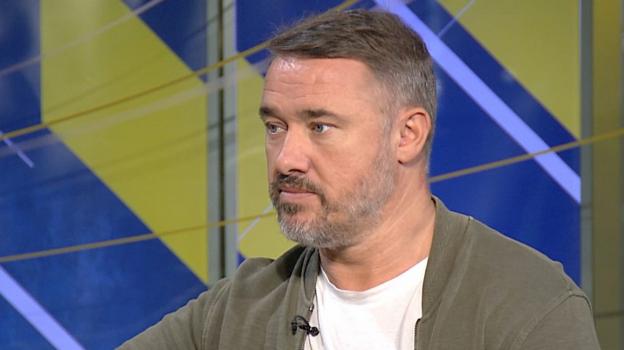
Stephen Hendry on how the ‘yips’ ended his snooker career

news image

Seven-time world champion Stephen Hendry tells BBC Sport about how the ‘yips’ was the “main reason that he retired” from snooker because he found it “totally debilitating”.

The ‘yips’ is a condition, usually associated with golf, that involves the freezing or involuntary movement of the hands when attempting shots.

Read More

from Trusted eNews https://ift.tt/2PIctXh
via IFTTT

Refugees, crime, environment in spotlight as Swedes head to polls

news image

Swedes will head to the polls on Sunday in elections which are expected to see the far-right Sweden Democrats make historic gains.

The current government, formed as a coalition between the centre-left Social Democrats and Green Party after the 2014 elections, could be unseated owing to the growing popularity of the Sweden Democrats and right-wing Moderate Party.

Headed by incumbent prime minister Stefan Lofven, Social Democrats is Sweden’s oldest party. While some polls suggest that it could remain the largest, challenges are mounting.

After months of rising support, Sweden Democrats is currently polling at 24.8 percent, making the anti-immigration party the largest in the field, according to a recent YouGov tally.

The party system in the country has undergone change and is undergoing change. For decades, the whole of that period has been about left against right.

Nicholas Aylott, associate professor of political science at Sodertorn University

While confidence in the Social Democrats has slumped, the Left Party has reached nearly 10 percent in the polls and hopes to enter a potential coalition of left-leaning and progressive parties.

With anti-migrant, far-right and populist parties garnering strong performances across the European Union thus far in 2018, refugees have again become a central issue for voters.

How does voting work?

The Riksdag, Sweden’s parliament, has 349 seats, which are decided through a proportional vote. Of that total, the country’s 29 constituencies will decide 310 seats, while the remaining seats are divvied up to match each party’s share of the total national vote.

A party must receive at least four percent of votes to be assigned a seat.

Representatives from eight parties currently have the 349 seats – Social Democrats, Moderate Party, Sweden Democrats, Green Party, Centre Party, Left Party, Liberals and Christian Democrats.

While the centre-left is represented by Social Democrats and the Greens, a centre-right political alliance comprises the Moderates, Centre Party, Liberals and Christian Democrats. Both blocs are polling around 40 percent, with the left slightly in lead.

Sweden has had a historically high voter turnout, with more than 85 percent of eligible voters casting their votes during the 2014 elections. That year, more than 2.4 million people voted early.

Centre Party leader Annie Loof casts her vote in advance, at a polling station in central Stockholm, Sweden [Janerik Henriksson/TT News Agency/via Reuters]

This year, according to a preliminary tally, upwards of 7.6 million people – slightly more than half of them women – are registered to vote in the Riksdag elections.

Of that total, around 161,000 Swedes living abroad are eligible to vote.

But unlike many European countries, residents without Swedish citizenship are entitled to vote in municipal elections.

Where does Sweden stand on refugees?

Sweden absorbed 163,000 asylum seekers in 2015, the onset of the refugee crisis, which saw upwards of a million refugees and migrants reach Europe.

Sweden’s long-held reputation as a liberal bastion in Europe has been challenged by the recent rise of anti-refugee sentiment, which has prompted the current coalition to impose stricter measures on the asylum process and border control.

In May, the government announced plans to cut, almost by half, the number of refugees and migrants entering the country.

At the time, Immigration Minister Helene Fritzon said Sweden should accept between 14,000 and 15,000 refugees a year, as opposed to the 27,000 it took in last year.

“Even if the number of asylum seekers has dropped significantly in Sweden, it is significantly higher than [what it should be given] our population share in Europe,” she told reporters at the time.

Is the far right going to succeed?

The Sweden Democrats, established in 1989, took just under 13 percent of the vote in 2014 and currently hold 42 seats in the Riksdag.

Campaigning on anti-refugee positions and a pledge to crack down on crime, the party’s popularity has swelled during the lead-up to this year’s elections.

In the past, critics have lambasted the Sweden Democrats’ links to neo-Nazi and white nationalist groups, something its leader, Jimmie Akesson, has argued is no longer an issue.

Protestors demonstrate against Sweden Democrats leader Jimmie Akesson during his campaign visit to Gothenburg on August 28 [Adam Ihse/TT News Agency/via Reuters]

In its official platform, the party says its anti-migrant policies are driven by “love and confidence in our country”.

“If we are the second biggest or biggest party in parliament and the other parties still believe we can be ignored, and pretend we don’t exist, then we must flex our muscles,” Akesson told Reuters in an interview earlier this year.

While hardline calls to freeze migration drew fresh support, Sweden Democrats’ promise to hold a potential EU referendum has been less popular.

Former Prime Minister Carl Bildt described the proposed referendum as “the biggest single danger to Sweden’s future prosperity”.

Nicholas Aylott, an associate professor of political science at Sodertorn University, said the rise of the Sweden Democrats reflects a “disruption” of the country’s political tradition.

“[The] party system in the country has undergone change and is undergoing change,” he told Al Jazeera. “For decades, the whole of that period has been about left against right.”

Speaking of the Sweden Democrats potentially entering a coalition, he added: “It would be an absolutely enormous change, a huge event in the country’s political history.”

How has crime become a campaign theme? 

A wave of crime has impacted the election discourse, especially after the August 13 torching of some 80 vehicles in Gothenburg and other towns.

“Society will always act hard against this and we must continue to do so … We will do what needs to be done to take care of it and go in hard against this crime,” Lofven, the prime minister, told Swedish radio at the time.

In the last two years, dozens of people have been killed in what was described as gang violence in Stockholm and other large cities.

Swedish Left Party leader Jonas Sjostedt meets with voters during an election campaign visit [Adam Ihse/TT News Agency/via Reuters]

According to official statistics, 129 shootings took place in Stockholm in 2017 and 19 people were killed, nearly twice the number of those who died in similar incidents the year before.

The government responded by calling for harsher punishment for gun crimes and sexual assault.

In early July, political leaders announced “crisis talks” with police over the escalating violence.

With fears of violence spreading, Sweden Democrats seized the opportunity to link immigration and crime, arguing migrants are responsible for the rise.

In its online platform, the party argues that “serious crimes should [receive] severe punishment and that foreign citizens who commit crimes in Sweden should be expelled”.

Why is climate change a central issue?

Climate change thrust into the public discourse after the country endured wildfires and record temperatures throughout the summer.

The Green Party, which entered a coalition with the Social Democrats after the 2014 elections, has pushed for environmentally friendly policies and measures against climate change during the last four years.

A firefighting helicopter drops water over the fire in Ljusdal, Sweden on July 18, 2018. The fire was one of 40 wildfires in Sweden due to dry weather [Maja Suslin/EPA]

By 2050, Sweden hopes to create a society with no net greenhouse gas emissions, and the country leads the EU in climate ranking, according to an international survey published in June.

The Sweden Democrats expressed scepticism, and its leader, Akesson, criticised other politicians for calling for extensive measures after what he described as “one summer” of hot weather.

The far-right party has also vowed to introduce cheaper petrol prices.

Other key issues in the election include healthcare, education and the country’s social welfare system.

Read More

from Trusted eNews https://ift.tt/2wNaMB5
via IFTTT

China says it will retaliate if US tariff hikes go ahead

news image

Share This Story!

Let friends in your social network know what you are reading about

China says it will retaliate if US tariff hikes go ahead

A Commerce Ministry spokesman said Thursday that “necessary countermeasures” are ready if 25 percent penalties due to be announced as early this week on a $200 billion list of Chinese products take effect.

Loading…Post to Facebook

Posted!

A link has been posted to your Facebook feed.

BEIJING – China’s government says it is ready to retaliate if U.S. President Donald Trump goes ahead with a tariff hike on Chinese goods and expressed confidence it can maintain “steady and healthy” economic growth.

A Commerce Ministry spokesman said Thursday that “necessary countermeasures” are ready if 25 percent penalties due to be announced as early this week on a $200 billion list of Chinese products take effect. The Chinese measures target $60 billion of American goods.

The two governments already have imposed penalty duties on $50 billion of each other’s exports in their dispute over U.S. complaints that Beijing steals or pressures companies to hand over technology.

The spokesman, Gao Feng, said, “China is confident, capable and able to maintain steady and healthy development of the Chinese economy.”

More: Tariffs on imported cars, parts could harm U.S. economy and auto industry, experts warn

More: Ford cancels plan to import Focus crossover from China, blames trade war


Read or Share this story: https://usat.ly/2NMUn5Y

Read More

from Trusted eNews https://ift.tt/2Q9yPlv
via IFTTT

County Championship – Surrey bidding to win eighth game in a row

news image

There has been actual cricket at Canterbury today between Kent and Northants, and Northants are all out for 105 in reply to Kent’s first innings total of 137. Paceman Matt Henry claimed career-best figures of 7-42.

Derbyshire’s Tony Palladino has taken three early wickets to leave Glamorgan 33-4 chasing a target of 302.

Middlesex have added 12 without loss to their overnight total and are 194-7 in reply to Gloucestershire’s 296.

Ben Raine has taken his 51st wicket of the season for Leicestershire against Sussex, who are 124-7 and lead by 364

Warwickshire’s Olly Stone claimed his sixth wicket as he bowled out Durham’s Paul Collingwood for 32 with his first ball of the morning. Durham trail by 66 runs with two wickets remaining in reply to Warwickshire’s 310.

Read More

from Trusted eNews https://ift.tt/2M2lw3j
via IFTTT

India decriminalises gay sex in landmark verdict

news image

New Delhi, India – India’s Supreme Court has decriminalised gay sex in a landmark ruling.

The court heard petitions challenging the constitutional validity of Section 377 – a colonial-era law under which same-sex relationship is an “unnatural offence” punishable by a 10-year jail term.

“Any discrimination on the basis of sexual orientation violates fundamental rights,” Chief Justice of India Dipak Misra, who was head of the five-judge bench, said in Thursday’s ruling.

“The constitution is a living organic document … pragmatic interpretation has to be given to combat rigorous inequality and injustice. Social morality cannot be used to violate the fundamental rights of even a single individual. Constitutional morality cannot be martyred at the altar of social morality.”

Thursday’s judgement is a shot in the arm for India’s gay community.

“We become equal citizens with the removal of Section 377. Equal rights are accessible for us with this decriminalisation,” one of the petitioners in the case, Ashok Row Kavi, told Al Jazeera.

Hundreds of LGBTQ campaigners, who had gathered outside the Supreme Court in New Delhi, broke into loud cheers as news of the ruling reached them.

Activists say the law banning homosexuality had been used to harass and target the community.

“This section 377 is a terrible colonial legacy,” Menaka Guruswamy, one of the lawyers representing the petitioners, had argued in court in July.

She had urged the judges to “emancipate a class of people who have not been given the promises of our Constitution”.

The ruling Bharatiya Janata Party (BJP), which has an overwhelming majority in parliament, has been silent on the issue of homosexuality so far. The government told the top court it would leave the decision to “the wisdom of the court”.

There are no official figures on the number of harassment cases as victims are scared to report crimes fearing section 377 will be used against them.

Activist Kavi’s Humsafar Trust,a charity that works with India’s LGBT community, included a crises data report in its petition to the top court.

It said less than 20 percent of those surveyed had publicly revealed their sexual identity while two out of every five homosexuals in the country have faced blackmail after the top court had recriminalised homosexuality in 2013.

Neighbouring China decriminalised homosexuality in 1997 and with this landmark ruling in India, a majority of Asians now will not face criminal charges for their sexual identities.

“It is indeed a historic moment for India, the world’s largest democracy and a global power on the rise. So the world is watching, and its neighbours are watching,” Lieu Anh Vu, Asia coordinator at the Geneva-based International Lesbian, Gay, Bisexual, Trans and Intersex Association (ILGA), told Al Jazeera.

“LGBTI communities in Sri Lanka, Pakistan and Bangladesh are also working to repeal similar remnant of British colonisation in their own country and the ruling from India will feed into more dialogues, at least among LGBTI civil society across these countries,” she added.

Homosexual acts are still illegal in most of India’s neighbours, including Sri Lanka, Pakistan and Bangladesh.

The ruling comes as a major respite but conservative Indians might not change their perception of the gay community, say activists.

Violence against homosexuals and transgenders in India in recent years have ranged from physical beatings, sexual assault, blackmail, bullying and extortion. Perpetrators of the violence have been family members, the general public and the police, say rights campaigners.

An anti-discrimination law would further boost efforts to fight homophobia in the deeply conservative nation, according to activists.

Activists such as Kavi advocate a more pragmatic approach.

“You can’t break the fortress in one go. Open the door. If the door gets opened, you are inside. Be inside and fight it out,” he said.

Gay-rights activists in India have been posting congratulatory messages on Twitter and Facebook with the court on Thursday ruling gay sex was not a crime.

The ruling is expected to have wide-ranging implications in the months to come, including its effect on the transgender community.

Lawyers arguing in the top court in July for the ban to be scrapped also referred to the rich heritage of the region in cultural and religious depictions of homosexual relations.

Visitors to the ancient temples of Khajuraho in southern India, built in the 10th century, would find homosexual couples immortalised in its stone carvings.

Many Indian scriptures and ancient rulers, according to some historians, did not criminalise romantic or sexual relations between members of the same gender. Transgenders held high positions in courts of Mughal rulers in the 16th and 17th centuries.

“There was no persistent homophobia in Indic [Indian subcontinent] faith systems. There were no ancient injunctions against homosexuals or transgenders, known as Hijras, here. Societal homophobia that we see now seem to have been injected by the introduction of this anti-homosexual law, Section 377, by colonial British rulers,” said Kavi.

Read More

from Trusted eNews https://ift.tt/2Q8MGsg
via IFTTT

England v Spain – after a summer of chaos, can Spain reign again?

news image

Guillem Balague will be writing a regular column throughout the season and also appearing every Thursday on BBC Radio 5 live’s Football Daily podcast, when the focus will be on European football.

You can download the latest Football Daily podcast here.

Spain play their first match since the World Cup when they meet England at Wembley in the Nations League on Saturday.

It will be the first game in charge for former Barcelona boss Luis Enrique, who took over as coach of the national team in July.

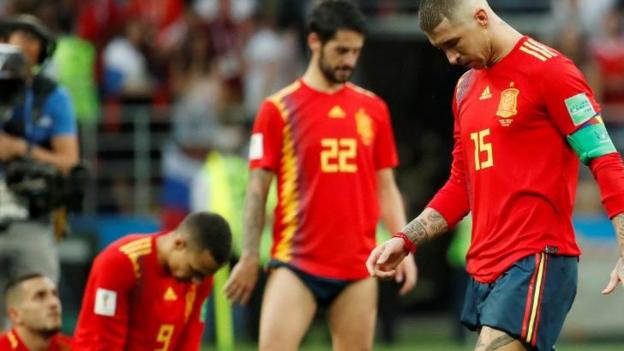
Spain’s World Cup in Russia was little short of a disaster.

Coach Julen Lopetegui was sacked on the eve of the tournament after it was announced that he would be resigning after the World Cup to take control of Real Madrid, with Fernando Hierro put in temporary charge.

The team were then knocked out by Russia on penalties in the last 16 after scraping through the group stage.

As Luis Enrique prepares to embark on a new era, many in Spain are still trying to work out what happened in those mad few weeks earlier in the summer – and what to expect from the new-look side.

Be careful who you blame

The assertion that everything that happened at the World Cup is somehow the fault of former coach Lopetegui is way off the mark.

Highlights: Spain 1-1 Russia (3-4 pens)

A hugely indignant Spanish federation president, Luis Rubiales, claimed he only knew negotiations were taking place between his coach and Real Madrid a matter of hours before the news became public – and that he had just five minutes’ notice before the official announcement.

The reality is quite different.

The federation – and consequently Rubiales – knew well before then because the matter of 2m euros compensation for the loss of Lopetegui had already been discussed and agreed with Real Madrid.

It is surely inconceivable that compensation talks should have been taking place and the president unaware of them.

Real Madrid went for Lopetegui not because he was their manager of choice but because the likes of Tottenham’s Mauricio Pochettino and Juve’s Massimiliano Allegri had turned them down.

In came agent Jorge Mendes suggesting Lopetegui for the role.

It was only when Rubiales started to receive a whole heap of criticism from all and sundry that the mood – particularly the president’s – changed.

Yes, Lopetegui could certainly have handled it better, perhaps telling Madrid to wait until after the competition before talking to them.

Madrid could hardly have handled it worse – except of course they could not care less because as far as they were concerned they were just doing what they wanted to in the best interests of the club.

President Florentino Perez did not want to appoint a failing national manager. Far better to have a sacked one before the tournament could evaluate his worth.

If this sounds to you like a football version of House of Cards, well, that’s because it basically is. Big personalities, secret conversations, sneaky behaviour, and so on.

Rubiales, who was only elected Spanish federation president in May, is nothing if not a political animal.

In his new role – and with a number of people effectively asking him if he was going to let Lopetegui get away with such blatant disrespect – he decided to show everyone how strong he was was, who was in charge.

In his view, strong leaders make strong decisions. I think that sometimes not making decisions is also a sign of a very good leader.

Enter Luis Enrique – a strong man for Spain

When Sergio Ramos donned the mantle of leader and spokesman during the Lopetegui crisis and urged Rubiales to stand by the coach it was not best appreciated by the federation chief.

What, in Rubiales’ mind, was needed was a manager as outspoken and volatile as he is, in order to bring everyone, most of all Ramos, in check.

Luis Enrique (left) is seen as a strong leader by federation president Rubiales (right) – one who can keep the players in check

Enter Luis Enrique – a similarly volatile, speak-your-mind type of person; a manager that Rubiales believes Spain needs; a hard hand on the helm.

One selection – or rather non-selection – in his first squad tells us a lot.

After Luis Enrique left Barcelona in June 2017, Jordi Alba said he felt happier under new coach Ernesto Valverde. Alba is a regular at Barcelona and ideal for the usual Spanish possession-heavy game, but Luis Enrique has left him out of his squad.

This appears to be more for personal than professional reasons, as they both clashed in Luis Enrique’s last few months at the Nou Camp.

Luis Enrique’s relationship with the press will be an interesting one.

Other than interviews he is contractually obliged to do he will not do anything else and he is not able to disguise his total contempt for the media.

The Spanish press like managers who are diplomatic and accessible, available for the midnight radio shows on the eve of games, and Luis Enrique will not play that game. Clashes will follow.

Expect a new style for Spain

After the retirement of the likes of Andres Iniesta, David Silva and Gerard Pique, this is a new era for Spain.

Personally, I think Luis Enrique wants to change the style completely – moving away from a possession-based game, playing between the lines, to a more direct approach – and we will see glimpses of this against England.

Players such as Atletico Madrid’s Rodri will ensure Spain always remain competitive – but can they guide La Roja to major tournament success?

He worked at changing the style at Barca in his last year there.

Iniesta was on the bench a lot of the time, as was Alba, and he would play defensive midfield players alongside Sergio Busquets.

But his distant relationship with the players dictated that his time was up at the Nou Camp after three very intense (and successful) years and he did not really get the chance to fully implement the changes.

And, funnily enough, if he does change the style there will not be many complaints because most of the media that follow Spain are from Madrid, and in the Spanish capital the possession-based style that made us champions and originated elsewhere was always seen with suspicion, as if La Roja had been invaded by a foreign hoard.

After three consecutive major tournament victories, at Euro 2008 and 2012 and the 2010 World Cup, Spain have now have gone through three successive competitions where they have not made the quarter-finals.

New players like Atletico Madrid midfielder Saul, 23, Chelsea goalkeeper Kepa Arrizabalaga, 23, Real Madrid’s attacking midfielder Marco Asensio, 22, and Atletico’s Rodri, 22, are the future and will almost certainly be very important to Spain and ensure they will always be competitive.

But I don’t see the experienced players of the past in this squad, absolute leaders in their teams, some of whom had travelled to foreign leagues and grown in the process.

We might never be as strong as we were for those extraordinary four years.

Maybe we need to begin to get used to the idea that we aren’t going to be winning for quite a while.

But I could be wrong. Former Spain coach Luis Aragones was not diplomatic and disliked the press. Yet he took an underperforming side, changed the style and created a winning machine.

Could Spanish supporters dare to dream that Luis Enrique could do the same?

Read More

from Trusted eNews https://ift.tt/2M4RPOZ
via IFTTT

Donald Trump calls for NYT to reveal identity of op-ed author

news image

US President Donald Trump has slammed an opinion piece in The New York Times in a series of tweets, and demanded the publication to reveal the author’s identity for national security purposes.

The op-ed was written by an anonymous senior administration official who claimed to be part of a “resistance” working “from within” to thwart Trump’s “worst inclinations”.

The president tweeted out the word “TREASON?” followed by: “I’m draining the Swamp, and the Swamp is trying to fight back. Don’t worry, we will win!”

He also appeared at an unrelated event on Wednesday at the White House, and lashed out at the Times for publishing the op-ed.

“They don’t like Donald Trump and I don’t like them,” he said of the newspaper.

Trump has been frustrated by the incessant leaking of information to the press within his own administration by anonymous White House aides.

White House press secretary Sarah Huckabee Sanders called on the “coward” who wrote the piece to “do the right thing and resign”.

In a statement, Sanders called the op-ed “pathetic, reckless, and selfish” and called on the Times to “issue an apology” for publishing the piece.

“This is just another example of the liberal media’s concerted effort to discredit the president,” she said.

‘Work of a steady state’

The writer of the Times op-ed said Trump aides are aware of the president’s faults and “many of the senior officials in his own administration are working diligently from within to frustrate parts of his agenda and his worst inclinations. I would know. I am one of them.”

“Many Trump appointees have vowed to do what we can to preserve our democratic institutions while thwarting Mr Trump’s more misguided impulses until he is out of office,” the author wrote.

“It may be cold comfort in this chaotic era, but Americans should know that there are adults in the room. We fully recognise what is happening. And we are trying to do what’s right even when Donald Trump won’t.”

The assertions in the column were largely in line with complaints about Trump’s behaviour that have repeatedly been raised by various administration officials, often speaking on condition of anonymity.

They were published a day after the release of details from an explosive new book by longtime journalist Bob Woodward that laid bare concerns among the highest echelon of Trump aides about the president’s judgment.

The writer also alleged “there were early whispers within the cabinet of invoking the 25th Amendment” because of the “instability” witnessed in the president. The 25th Amendment allows the vice president to take over if the commander in chief is “unable to discharge the powers and duties of his office.” It requires that the vice president and a majority of the Cabinet back relieving the president.

The writer added: “This isn’t the work of the so-called deep state. It’s the work of the steady state.”

The anonymous author wrote in the Times that where Trump has had successes, they have come “despite – not because of – the president’s leadership style, which is impetuous, adversarial, petty and ineffective”.

Rush to uncover the writer

A “House of Cards”-style plot twist in an already over-the-top administration, Trump allies and political insiders scrambled to unmask the writer.

Hotly debated on Twitter was the author’s use of the word “lodestar,” which pops up frequently in speeches by Vice President Mike Pence. Could the anonymous figure be someone in Pence’s orbit? Others argued that the word “lodestar” could have been included to throw people off.

The text of the op-ed was pulled apart for clues: The writer is identified as an “administration official”; does that mean a person who works outside the White House? The references to Russia and the late Senator John McCain – do they suggest someone working in national security? Does the writing style sound like someone who worked at a think-tank? In a tweet, the Times used the pronoun “he” to refer to the writer; does that rule out all women?

The newspaper later said the tweet referring to “he” had been “drafted by someone who is not aware of the author’s identity, including the gender, so the use of ‘he’ was an error”.

SOURCE: Al Jazeera and news agencies

Read More

from Trusted eNews https://ift.tt/2Nm6aLy
via IFTTT

The Nun isn’t your convent-ional Conjuring movie: EW review

news image


The Nun


We gave it a B

Thanks to horror movies, certain types of people are universally terrifying. Clowns, for one. Victorian children for another. Any child mournfully singing a nursery rhyme slowly. And now, thanks to the latest entry in the Conjuring universe, nuns. You’ll never be able to watch The Sound of Music the same way again.

Ostensibly, The Nun is a prequel to 2016’s The Conjuring 2, specifically an origin story of one of that movie’s most memorable scares, a demonic nun with deep glowing eyes and a terrifying grin. The movie begins two decades before Ed and Lorraine Warren’s paranormal investigations, in 1952 Romania where a nun is discovered gruesomely hanged outside of a remote castle monastery in an apparent suicide, and the Vatican investigates by sending a priest (Demián Bichir) and a young novice nun, Sister Irene (Taissa Farmiga, sister of Conjuring-verse star Vera Farmiga, though no explicit connection is made between the two characters).

Aiding them on their quest into the increasingly macabre is a young French-Canadian (Jonas Bloquet) living inexplicably in Romania, who had originally discovered the first nun’s apparent suicide. Bloquet looks a bit like Brendan Fraser, an effect aided by his wearing suspenders over a white shirt and holding a torch aloft for much of the movie, but he isn’t the only reason The Nun feels a bit like 1999’s The Mummy. When the third act descends into a quest to use the blood of Jesus Christ to seal a portal to hell (yes), it becomes something much closer to Fraser rollicking through Egyptian tombs than whatever Tom Cruise did in 2017.

Unlike the first two Conjuring movies, which exist in ether and anticipation, The Nun is a distinctly tangible movie. That corporeality is best understood during a scene in which a character walks through the woods when—jump scare!—a hanged nun’s dangling legs appear before him. The corpse drops, its face contorts to life into a bloody, fanged grin. The corpse roars like an animal and tries to bite his face off. Scary? Sure. But such a distinctly different scary than the grotesque horror of seeing a barefoot dead body inches from your face that the juxtaposition feels slapdash.

A screenplay by Gary Dauberman (It) jerks awkwardly between terse thriller and campy comedy. While watching The Nun, it’s possible to envision multiple versions of this film—slow-burning gothic thriller; bloody gore-horror; action-comedy—layered atop one another, like transparencies stacked on an overhead projector. Like the demon Valak, we never actually get to see this movie’s true shape, just whatever form it chooses to take on in any given scene.

For those whose top priority is a racing heart-rate, fear not: there are two or three jump scares where your devoted critic feared she broke the hand of the person sitting next to her. The last two thirds of the movie provide a cavalcade of scares, one after another. Nothing stands out as uniquely memorable or iconic (the nun-in-the-mirror bit, scary as it was, was already done in The Conjuring 2). But when it leans into its camp, (I.e. when the French-Canadian “Frenchie” is on screen), The Nun comes closest to its ideal form of go-to midnight-movie, the fun younger cousin of the Conjuring movies with less build-up but more of the money shots you’ll come to a theater to see. B

Read More

from Trusted eNews https://ift.tt/2PJwn4o
via IFTTT

President Donald Trump heads to Montana, Kavanaugh confirmation hearings, NFL season begins: 5 things to know Thursday

news image

Editors, USA TODAY
Published 3:28 a.m. ET Sept. 6, 2018

Trump travels to Montana amid Woodward book, NYT op-ed essay

Under fire from a new book by journalist Bob Woodward and a “New York Times” op-ed essay from a senior administration official, President Donald Trump on Thursday heads to Montana — a state that voted strongly for him in the 2016 election. Trump will attend a rally in Billings in support of Republican Senate candidate Matt Rosendale, the Trump campaign said. The trip comes two days after publication of excerpts from Woodward’s “Fear: Trump in the White House,” which portrays Trump as angry and paranoid, with top aides routinely hiding his papers in hopes of stalling rash action by the president. A day later, Trump responded to the anonymous op-ed — which attacked his leadership — and criticized the New York Times for publishing it.  

CLOSE

Shortly after a New York Times essay called, “I am Part of the Resistance Inside the Trump Administration” was posted by an anonymous senior administration official, President Trump responded from the White House.
USA TODAY

NFL regular season takes flight with Eagles, Falcons

The NFL regular season officially begins Thursday as the Super Bowl champion Philadelphia Eagles host the Atlanta Falcons (8:20 p.m. ET, NBC). The Eagles this week answered the big question lingering from the off-season: Nick Foles will start at quarterback, with regular starter Carson Wentz still recovering from torn knee ligaments. Fans will be curious to see the impact of new rules governing the use of the helmet in making a hit. But the bigger story may be what takes place off the field if there are player protests during the national anthem. And Nike plans to air its controversial “Just Do It” ad featuring Colin Kaepernick – which has already been condemned by President Donald Trump – during the game. Get set for the season with our power rankings for all 32 teams, and eight questions for Week 1.

Autoplay

Show Thumbnails

Show Captions

Kavanaugh returns for last round of questioning

Supreme Court nominee Brett Kavanaugh will return to the Senate Judiciary Committee Thursday, a day after he answered senators’ questions on high-profile issues ranging from abortion to gun control to presidential power. Kavanaugh, an appeals court judge nominated for the Supreme Court by President Donald Trump, refused to say whether a president must respond to a subpoena, a question that could come before the Supreme Court based on special counsel Robert Mueller’s investigation. Protests and outbursts, which resulted in 70 arrests Tuesday, occurred for a second straight day which prompted police to temporarily close off the hearing from additional spectators at one point, leaving some seats empty. 

CLOSE

Supreme Court nominee Brett Kavanaugh is declining to answer questions about the extent of the president’s pardon power. (Sept. 5)
AP

Britain takes nerve-agent poisoning case to the U.N.

British officials are set to present evidence Thursday on the poisoning of an ex-Russian spy and his daughter to the United Nations Security Council. Officials on Wednesday said they charged two suspects, Alexander Petrov and Ruslan Boshirov, with using the nerve agent Novichok on Sergei Skripal and his daughter, Yulia, in Salisbury last March. Prime Minister Theresa May told British lawmakers the two suspects were Russian military intelligence agents. The Skripals were taken to the hospital in critical condition, but survived. Moscow has denied any involvement in the case.

Powerful quake in northern Japan triggers landslides, blackout

A powerful earthquake rocked Japan’s northernmost main island of Hokkaido early Thursday, triggering landslides that crushed homes, knocking out power and forcing a nuclear power plant to switch to a backup generator. The magnitude 6.7 earthquake struck southern Hokkaido at the depth of 24 miles, Japan’s Meteorological Agency said.  The quake came on the heels of a typhoon that wreaked havoc in western Japan, leaving the main airport near Osaka and Kobe closed after a tanker rammed a bridge connecting the facility to the mainland. According to officials, at least two people have been confirmed dead after the quake hit the region. 

Contributing: Associated Press

Read or Share this story: https://usat.ly/2NjsIfV

Read More

from Trusted eNews https://ift.tt/2oMk4ZA
via IFTTT

Design a site like this with WordPress.com
Get started