Hunger as a weapon ‘on the rise’ in war zones

news image

One child could die every minute from extreme hunger in conflict zones this year, according to Save the Children, as it reported a rise in the use of starvation as a weapon of war around the world.

The UK-based charity said in a report published on Monday that 4.5 million children under the age of five in the world’s 10 worst war-torn countries, including Yemen, Syria, Afghanistan and the Democratic Republic of Congo (DRC), will need treatment for malnutrition.

That is an increase of nearly 20 percent over the last two years. 

Save the Children believes that between August and December, 590,000 of these severely malnourished children – 1,600 a day on average – are likely to miss out on much-needed treatment and die of starvation and disease.

“Time after time we are seeing starvation used as a weapon of war when deliveries of food are obstructed by the warring parties in places like Yemen, Syria and South Sudan,” said Helle Thorning-Schmidt, CEO of Save the Children. 

“We must stop this dangerous trend,” she added, urging all warring sides to allow humanitarian access under the obligations of international law. 

Among those at risk of death, 300,000 children are in the DRC, 106,000 in Sudan, 72,000 in Afghanistan and 35,000 in Yemen, among other countries in conflict.

‘Effective tool’

Civilians, especially women and children, have been bearing the brunt of Syria’s devastating civil war, now in its eight year. 

Some 2,372 children are expected to die this year from extreme hunger, according to the report, as warring parties block food and medicine leading to a humanitarian crisis.

WATCH: Syrians flee the Idlib offensive

Fears are growing over a seemingly imminent all-out government offensive against the densely populated northwestern Idlib province, the last rebel bastion in Syria. 

Al Jazeera’s Stefanie Dekker, reporting from Reyhanli, in neighbouring Turkey, said both sides are “complicit in using starvation as a “very effective tool to try and achieve their military and political aims”.  

“What they have done over the course of this war is that they would besiege certain areas, like Idlib, part of Yarmouk camp in the capital, Damascus, and Eastern Ghouta close to Damascus, and then either bombard or starve them into submission,” she said. 

“The government and rebel forces would also sometimes remove food, medical items and baby formula from the aid trucks, which led to a so-called surrender and a pattern of reconciliation deals.”

Humanitarian crisis

For three years, Yemen, the Arab world’s poorest country, has been wracked by a bloody war between the Houthi rebels and a Saud-UAE coalition backing Yemen’s internationally recognised government.

At the least 10,000 people have been killed and millions displaced, the United Nations has estimated.

Yemen, which stands on the brink of famine, is the world’s worst humanitarian crisis with more 22.2 million people in need of assistance, according to the UN. 


In July, Save the Children warned that thousands could be affected by a new wave of deadly cholera, which infected more than one million people in the country last year. 

A government-backed offensive to retake the strategic Hodeidah port – the main gateway for imports of relief supplies and commercial goods – from rebel fighters has trapped some 400,000 people in the city, according to aid groups.

Al Jazeera’s Andrew Simmons, reporting from neighbouring Djibouti, said the escalating offensive is a “crisis in the making”.

“So much aid comes in through this port,” he said. “If the city itself gets obliterated then the bridge between the port and the capital, Sanaa, will be cut, depriving civilians of food and aid supplies, particularly medicine for the injured.”

Read More

from Trusted eNews https://ift.tt/2Qk4DED
via IFTTT

Miss America 2019 praises the end of the swimsuit competition

news image

Miss New York Nia Imani Franklin wins the 2019 Miss America Pageant, the first in history without a swimsuit segment.

Image: ABC via Getty Images

Miss America 2019 has been crowned, and she’s thankful the bikinis have been ditched.

Representing New York, Nia Imani Franklin won the title in Atlantic City on Sunday night, in the first competition since the 98-year-old pageant scrapped the swimsuit segment, the Associated Press reports. 

After taking the crown and the $50,000 scholarship, Franklin, who is a classical vocalist, took the opportunity to tell reporters how glad she was that she didn’t have to don a bathing suit to win the competition.

“These changes, I think, will be great for our organisation,” she told reporters after the event, according to AP.

“I’ve already seen so many young women reaching out to me personally as Miss New York asking how they can get involved because I think they feel more empowered that they don’t have to do things such as walk in a swimsuit for a scholarship.

“And I’m happy that I didn’t have to do so to win this title tonight because I’m more than just that,” Franklin continued. “And all these women onstage are more than just that.”

“All these women onstage are more than just that.”

Gretchen Carlson, Miss America 1989 and chair of the Miss America Organization, was the champion behind the swimsuit scrap. Carlson said the aim was to reposition the pageant as a “competition,” and that women apparently wouldn’t be judged on their physical appearance. 

The swimsuit segment was fittingly replaced with an interview section.

“We’ve heard from a lot of young women who say, ‘We’d love to be part of your program, but we don’t want to be out there in high heels and a swimsuit,’” Carlson said on GMA at the time. “So, guess what? You don’t have to do that anymore.”

"I’m happy that I didn’t have to do so to win this title tonight because I’m more than just that," Franklin told reporters.

“I’m happy that I didn’t have to do so to win this title tonight because I’m more than just that,” Franklin told reporters.

Image: Tom Briglia/Getty Images

The decision wasn’t entirely met with enthusiasm by all. When the initial announcement was made in June, the bro community was quite frankly devastated. 

And AP reports that just before the national broadcast began, a comedian warming up the crowd mentioned the swimsuit segment’s omission and was met with loud boos by some of the audience.

But it’s not just the audience reacting like this. Many of the Miss America state pageant organizations are reportedly unhappy with the swimsuit decision, with 46 of the 51 organizations demanding Carlson and CEO Regina Hopper resign.

But frankly, what a necessary move. 

Without it, the Miss America pageant competition (judging and scoring womens’ bodies) would not survive the #MeToo era. Plain and simple.

Https%3a%2f%2fvdist.aws.mashable.com%2fcms%2f2018%2f6%2f2d09d35b 18ad f670%2fthumb%2f00001

Read More

from Trusted eNews https://ift.tt/2MgVbP5
via IFTTT

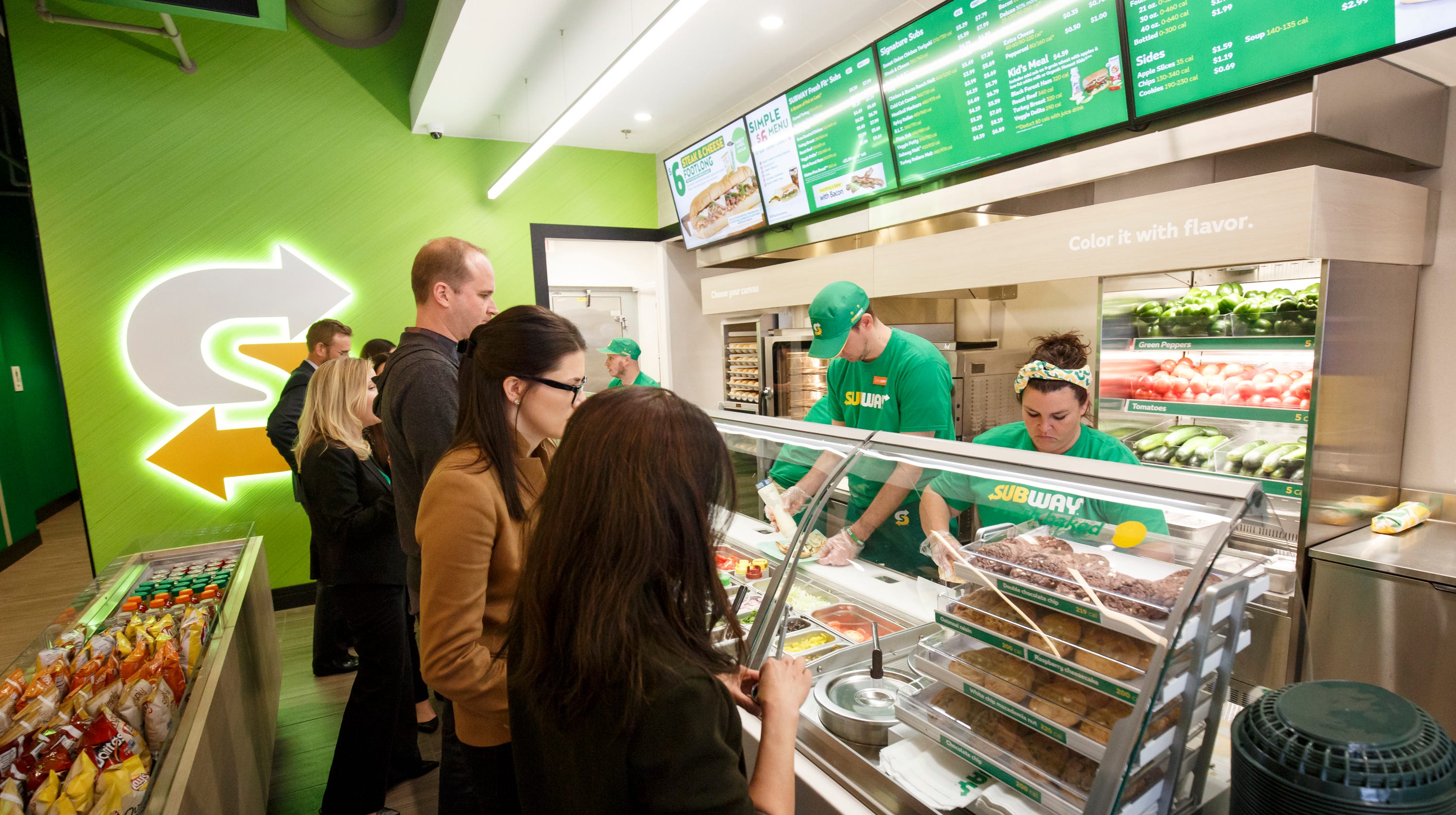
Subway $5 Footlong is going away, but paninis may be coming

news image

CLOSE

It wants to focus on store quality, not quantity.
Time

Subway Restaurants’ $5 Footlong jingle is the kind of ear worm that’d hard to get out of your head, but now you might have to.

The iconic sandwich may no longer be at your local restaurant. Trevor Haynes, the current CEO of the Milford, Connecticut, has told USA TODAY in an exclusive interview that starting this month, each franchisee will be allowed to decide whether to sell the sub that is so famous.

Or infamous.

When the chain brought the $5 Footlong back in winter after a yearslong absence, many franchisees were irate. They complained loudly of the slim margins they earned off of the discounted ‘wich; and according to Haynes, the company, whose restaurants are 100% franchised, listened to the gripes.

More: This week’s recalls and warnings: Ford F-150s, Toyota Prius and Honey Smacks

More: Why wages are finally picking up. And will it last?

More: Facebook, Twitter and other tech stocks swoon amid threat of government regulation

“How do we help our franchises with more of a regional value message, so they’re able to (have) a value proposition that fits with their economic model,” said Haynes. “If you look at California, there’s a very different cost of business than in Arkansas.”

The 53-year-old privately-held company, originally called Pete’s Super Submarines, had $16.8 billion in global sales in 2017, thanks to some 44,000 restaurants worldwide, including 25,000 in the U.S. Subway, which has put about 1,300 stateside locations on the chopping block in two years, declined to share growth percentages or customer traffic numbers. 

Haynes, 47, became CEO this summer after Suzanne Greco, sister of Subway co-founder Fred DeLuca, retired. The Australian has worked for the company for 12 years on three continents and inherited a brand still smarting by the sex and child-pornography scandal of former company spokesman Jared Fogle.

The demise of the $5 Footlong is just one of the differences customers will notice at Subway. Here are four other changes Haynes shared with USA Today.

Other cheap eats are available

Remember that some franchisees may choose to retain the $5 Footlong, but Subway is encouraging different markets to try their own value options. For examples, customers in San Francisco can now buy a $3.99 six-inch sub.

“Affordable food is what we’ve always stood for,” said Haynes. “It’s not just about one price point.”

Restaurant consultant John Gordon of the Pacific Management Consulting Group questions how low Subway can drop its prices, due to its main meats — ham, roast beef and chicken.

“Those are generally more costly on a per-pound basis than the ground beef that the burger guys use, so Subway has hard time discounting,” he said. “There’s a tremendous amount of franchisee disruption and negativity regarding this discounting… They take it in the shorts. Their average check goes down.”

So, what about wacky stunt foods, so beloved by other fast-food brands, like Starbucks and Taco Bell.

“Maybe off-the-menu-type products or Unicorn-type drinks at some time, but it needs to profitable and successful for our franchisees,” Haynes said.

New tastes are coming down the pike

The chain is testing some more exotic tastes. Haynes said they’re working on what’s been dubbed Firebird chicken, a spicier rotisserie-type poultry, and guajillo steak.

Plus, 200 San Diego locations are testing a quartet of new sandwiches, which the chain refers to as “regional flavors” — a Steakhouse Melt (shaved steak, American cheese, onions, green peppers, spinach and Sub Spice), a California Club (oven-roasted turkey, fresh avocado and Mustard Seed Spread), a Provencal Tuna Melt (tuna, cheese, tomatoes, spinach and Provencal herbs) and an Italian Grinder (pepperoni, Genoa salami, Black Forest ham, onions, Signature Herb Garlic Oil and cracked black pepper).

New beverages include Watermelon Agua Fresca and Passion Fruit Agua Fresca. 

And while the large, long rolls are a key part of Subway sandwiches, the company is now experimenting paninis in California.

They’re not the brand’s first foray into alternative breads. In March, Subway launched a line of wraps, which Haynes called “extremely successful for our brand.” Subway had tried this carb form in in 2004, followed by a tortilla option in select markets three years later.

Gordon doesn’t expect much from Subway’s move to new tastes, though, explaining, “Bold flavors and spices have been a big deal in restaurants for at least five years. They totally missed that. They were asleep at the switch.”

He said the $5 Footlong was a hit in 2007-2008 due to the recession and the healthy image the veggie-heavy subs had at a time when Americans began to care more about what they ate. Then, crickets.

“That was 10 years ago. Nothing has happened at Subway essentially in 10 years,” he said.

Gordon gives Subway a thumbs-up for its new wraps, but advises moving away from bread and starting to serve meats shaved and stacked deli-style, if the chain wants to avoid fellow sub chain Quiznos’s downward spiral.

You want how many pickles?!?

They key to Subway’s continued success is underscoring customers’ ability to pick precisely what they do and don’t want on their sandwiches, according to Haynes.

“With other brands, it’s very much packaged formats. We customize. You can add as many tomatoes or olives as u want,” he said. “We have millions and millions of combinations and flavors.”

Aaron Allen, founder of the Orlando-based eponymous global restaurant consulting firm, is unimpressed by Subway’s continued emphasis on customization.

“It’s certainly in the playbook of many more (fast-food) restaurants than it was previously,” he said, explaining that with an increasing number of chains focusing on self-ordering — both at in-store kiosks and online — the approach becomes even less unique to Subway.

Subway also is bumping up against increased competition from sandwich upstarts and their step-sibling, the hamburger joint.

“We need to stick to what we know and do it very, very well. We can’t be distracted,” Haynes said. “Burger chains are big competitors. We need to make sure we’re playing in that arena as well.”

The company records more than 7 million transactions globally every day, he added.

Don’t just Instagram the food

Subway restaurants are being redesigned. The bright, fresh, green palette is vegetable-inspired and the decor overhaul for everything from freestanding drive-thru locations to the kiosks will “start in earnest” next year, Haynes said.

The cost is about $40,000 for a typical 1,200-square-foot store.

But Allen wonders how many franchisees, more accustomed to makeovers every five to seven years, will be happy about spending money to spiffy up their stores.

“It’s one of the lowest price-point franchises to get into,” he said. “But it also makes it hard to refresh and modernize. It’s difficult get the franchisees to buy into that.”

CLOSE

Even though the U.S. is famous for its burgers and fries, you won’t have the same fast food experience in every state.
Time

Follow USA TODAY reporter Zlati Meyer on Twitter: @ZlatiMeyer

Read or Share this story: https://usat.ly/2N2dEEf

Read More

from Trusted eNews https://ift.tt/2QdS4KO
via IFTTT

32 things we learned from Week 1 of the 2018 NFL season

news image

CLOSE

SportsPulse: Should the Steelers be embarrassed? Is the Cowboys offense the worst in the NFL? Trysta Krick gives her overreactions for Week 1 of the NFL season.
USA TODAY

The NFL is back in full force. Finally. Here are 32 things we learned from Week 1:

1. So great to have Aaron Rodgers back. Then, so awful to lose him to another catastrophic injury. Then, so great to have the Leader of the Pack back again to remind us how much more fun the NFL is when he’s working his magic.

2. How sick must Jon Gruden and the Raiders have been watching Khalil Mack wreak havoc in a Bears uniform Sunday night? Mack may be gone from Oakland, but he won’t be forgotten, nor will the questions about the decision to ship him out.

3. We’re pretty sure Chicago hangs on to beat Green Bay if new coach Matt Nagy does the right thing and calls OT Charles Leno’s number on a pass play out of the slot.

4. Week 1 MVP? How about Buccaneers “backup” QB Ryan Fitzpatrick, who connected for four TD passes and a career-high 417 passing yards (still 22 fewer than New Orleans counterpart Drew Brees). But Tampa Bay pulled off the upset of the day with a 48-40 win on the road, and it just got a little more likely that suspended Jameis Winston may not have a job waiting for him when he returns in Week 4.

5. What dat? The Saints have not won their opener since 2013.

6. Alvin Kamara, Michael Thomas, Mike Evans and DeSean Jackson each went over 100 receiving yards in that game and had 585 collectively. The Bucs and Saints recorded 26 first downs apiece and combined for 1,004 total yards, 11 TDs … and one sack. The Buccaneers and Saints produced 88 total points, the most for a Week 1 game in the Super Bowl era, which dates to 1966.

7. The Titans and Dolphins combined to play a 7-hour, 8-minute game, the longest since the 1970 merger by nearly two hours. Lightning delays played havoc with a contest staged in South Florida.

8.The 21-21 tie between the Steelers and Browns was the NFL’s first on opening day since 1971.

9. We wish Ben Roethlisberger (5 turnovers) was not our fantasy quarterback.

10. We do wish we had Steelers RB James Conner (192 total yards, 2 TDs in his first NFL start). Le’Veon who?

More: Browns aren’t satisfied with tie, but stalemate with Steelers is sign of progress

11. Pittsburgh’s T.J. Watt had more sacks (4) than brother J.J. had tackles (3). Oh, and Chargers FB Derek Watt had 1 yard on one carry … equaling the number of game-saving field blocks T.J. had.

12. CB Denzel Ward (2 INTs) has jumped out to a nice lead over Baker Mayfield as front runner for Cleveland’s most valuable first-round pick of 2018 … in 2018 anyway.

13. Browns fans didn’t get any free Bud Light after Sunday’s tie. Feels like the Cleveland faithful earned at least 8 oz. mini cans, right?

14. Cleveland’s tie snapped a 17-game losing streak. But the Browns still own just one win in their past 36 outings. Truly surreal.

15. Adrian Peterson’s 96-yard rushing debut with Washington vaulted him past Marshall Faulk and Jim Brown into 10th place all-time. AD now has 12,372 career yards. (Peterson also had a 52-yard catch, his longest in nine years.)

16. Jimmy Garoppolo’s eighth NFL start produced his first loss and first three-INT day. But you get what you pay for, right? Garoppolo is only making $27.5 million annually. He was bested by Minnesota’s Kirk Cousins, who’s pulling down $28 million per year.

17. But Patrick Mahomes remains undefeated, the second-year passer moving to 2-0 after his four-TD debut as the man for the Chiefs, who have now beaten the Chargers nine straight. (The victory was even more impressive considering K.C. got shredded for 541 yards.)

18. Maybe Tyreek Hill was correct last month when he claimed Kansas City “will be the best offense in the National Football League.” Arguably the most electric player in the NFL, Hill did his part Sunday with 169 yards and two TDs courtesy of Mahomes’ arm and another 91-yard score on a punt return courtesy of his own blazing speed. Hill has 13 touchdowns of at least 50 yards since he entered the league in 2016. No other player has more than four in that span.

19. The Bolts are still missing field goals in September. You can’t hang L.A.’s loss on Caleb Sturgis, but his 48-yard misfire with 66 seconds to go cost the Chargers any shot at a comeback in their 38-28 loss. Still, Roberto Aguayo will probably remain on speed dial a while longer. … OR MAYBE JUST CALL DAN BAILEY AND FIX THIS!

20. Is 2018 when Broncos OLB Von Miller finally wins defensive player of the year honors? He got started by making seven tackles, three sacks, forcing two fumbles and recovering one.

21. The Seahawks began the post-Legion of Boom era by allowing 470 yards, 25 first downs and 27 points. Welcome back, Earl Thomas.

22. Any concern over lack of production from New England’s receivers remains legit. Just nine of Tom Brady’s 26 completions (for 83 yards) went to wideouts Sunday. (Suspended Julian Edelman is eligible to return against Indianapolis on Oct. 4.)

23. Any concern over the lack of production from Dallas’ receivers remains legit. Thirteen of Dak Prescott’s 19 completions went to wideouts Sunday, producing all of 135 yards. We wouldn’t want any part of this either, Dez.

24. Tyrann Mathieu’s move to Houston was one of the offseason’s less-heralded signings. But he seems to be back in Honey Badger form, picking off Brady and recovering a Patriots fumble in his Texans debut.

25. Those new “Titan blue” jerseys will take some getting used to. We suspect the navy jerseys will be more appealing combined with Tennessee’s new navy helmets. (It would also be nice if there was anything appealing about the Titans offense.)

26. Really nice to see Andrew Luck play well in his return, notching his first TD pass in 616 days. But it’s always been the 51 Colts not named Luck (or Vinatieri) that worried me.

More: Bills have epic blunder on their hands, especially at QB

27. Baltimore doused Buffalo 47-3, the second-worst loss in the Bills’ 59-year history … and salt in the wound of Ravens fans, who watched Buffalo advance to the 2017 playoffs instead of their team by virtue of a tiebreaker. Baltimore QB Joe Flacco tallied three TD passes for the first time since Dec. 4, 2016.

28. Buffalo QB Nathan Peterman has a 16.8 QB rating in three NFL starts. He hasn’t finished any of them (benched twice, injured once).

29. How soon is too soon to call for first rounders Josh Allen (Bills) and Josh Rosen (Cardinals) to start? Hint: it’s still too soon.

30. There were 26 penalties (for 236 yards) called in the Thursday night opener between Philadelphia and Atlanta, tying the high-water mark for any game in 2017. Too much laundry, refs … which Julio Jones and I can personally attest to after witnessing some of those highly dubious calls.

31. The Eagles are still about one play better than the Falcons, who should maybe try something else than “Julio bail us out” with the game on the line. (Of course, when Jones’ 180 total yards account for more than 60% of your offense, it’s probably understandable why struggling Atlanta QB Matt Ryan and struggling OC Steve Sarkisian weren’t looking elsewhere.)

32. Hey, @BortlesFacts, Blake Bortles is 2-0 all-time vs. the Giants. No wonder Tom Coughlin switched sides. (And how jealous is Tom Brady?)

***

Follow Nate Davis on Twitter @ByNateDavis

Autoplay

Show Thumbnails

Show Captions


Read More

from Trusted eNews https://ift.tt/2O71OVF
via IFTTT

Escape from Xinjiang: Muslim Uighurs speak of China persecution

news image

Istanbul, Turkey – In April 2017, Tarim, a 48-year-old businessman from Urumqi, the capital of China’s Muslim Xinjiang region, received a phone call from the police summoning him to their offices in Aksu prefecture, 900km to the southwest.

Tarim knew at once that he was in trouble and devised a getaway, keeping the details to himself. He had just a few hours to carry out his plan.

Two days earlier, he was in Aksu for an attempt to rescue his sister Zohra, who was sent to a “re-education camp”, after travelling to Turkey with him and their mother in 2016.

With a payment of 20,000 Chinese yuan ($2,900), he convinced officials to allow him to visit his sister. He had originally intended to use the money to convince local officials to let her out, but he was told that was impossible. 

What he saw inside his sister’s camp convinced him it was time for him to leave Xinjiang.

Tarim’s sister was detained with up to 3,000 others near a military base a few kilometres north of Xayar, a city in Aksu. 

A five-metre-high fence with barbed wire kept the camp secure and out of public view. Outside, a sign reads: “No Communist, No China.”

Tarim passed through two security gates to reach the main entrance, which was guarded by two uniformed men. About 30 metres from the entrance was another security checkpoint with about 25 soldiers and uniformed personnel standing next to armoured vehicles.

While waiting for his sister, Tarim said he saw a group of around 500 people squatting on the ground.

It seemed like they had just arrived, as they were changing from their regular street clothes, to the bright blue uniforms issued by the camp. All the men had clean-shaven heads. 

It was past seven in the evening when Tarim arrived at the camp but the sun was still up, so he managed to recognise some of the faces among the crowd from his old neighbourhood in Aksu. 

After about an hour, Tarim’s 33-year-old sister, Zohra, was finally brought to the waiting area, where they had a chance to talk for a “very short” period. 

He noticed that Zohra was not her usual self and said that she looked pale. Dark spots formed around her eyes, which welled with tears.

As they spoke, a female security guard and two men watched over them.

Tarim provided a handwritten map of the camp in Xayar, where his sister was ‘detained’ [Al Jazeera]

Zohra told her brother that she needed to complete some “lessons” and undergo a test afterwards. If she passed the test, she would be released.

She never said how long she would be staying in the camp, and Tarim never found out. After talking to her for 10 minutes, he was on his way out of the building. 

Flight to Astana

Tarim’s failed attempt at freeing his sister must have alerted other authorities. Two days later, the call from the police came. Fearing that his detention was imminent, he scrambled to find a way out.

The day after receiving the call, Tarim showed up at Urumqi’s Diwopu International Airport to fly to Aksu as requested by the police. 

With just a small piece of hand luggage and a plane ticket, he checked in for his domestic flight, which was scheduled for 9:55am. As proof, he took a photo of his boarding pass and sent it to the authorities waiting for his arrival.

Tarim had never gotten into trouble before, so he was not on any government “blacklist”, which would have alerted authorities. Failing to report to police headquarters in Aksu, would have automatically put him on that list. That’s why he complied with their request. 

For Tarim, Xinjiang is home, and he never thought that he would have to give up his lucrative business there. At 16, he started working as a fruit seller and textile vendor, and had since amassed considerable wealth.

But he was quick to act once he got the opening to leave.

While waiting at the airport, he called his office in Urumqi with an instruction to book him the earliest flight to Istanbul-Chinese passport holders can apply for a visa on arrival in Turkey.

The plane to Istanbul was leaving at 10:40 am via Astana, the capital of neighbouring Kazakhstan.

Instead of taking his flight to Aksu, Tarim proceeded to a different gate to board a plane that would take him to Istanbul. Between his original flight and the boarding time to Astana, he only had few minutes to spare.  

As he waited for his getaway flight to take off, Tarim told Al Jazeera that he shook with the fear that he might get caught.

“I could not believe how I did it. I was trembling.”

HRW report

Tarim’s testimony about what’s happening to the Uighurs in Xinjiang, and interviews with two Uighur women in Istanbul, line up with Human Rights Watch’s (HRW) latest report on the region.

The rights group accuses China of “conducting a mass, systematic campaign of human rights violations”, against the Turkic-speaking Muslim minority group. 

The report released on Monday said as many as one million people are being held in “camps” across China’s western region.

Turkic-speaking Muslim Uighurs make up eight million of Xinjiang’s 19 million population [File: AP].

It also corroborates recent UN findings detailing a “mass surveillance” programme “disproportionately targeting” the Uighurs and other Muslim minorities.

For its report, HRW interviewed at least 58 former residents of Xinjiang, including five former detainees. Al Jazeera interviewed Tarim and the two other Uighur women separately.

China has rejected the latest UN report. It said tough security measures in Xinjiang were necessary to combat “extremism and terrorism”, but added it did not target specific ethnic group or restrict religious freedoms.

Beijing also said that people with “minor offences were provided with assistance and education to assist them in their rehabilitation and reintegration“.

According to conservative estimates, there are an estimated eight million Uighurs in Xinjiang, out of a population of 19 million.

Tarim now lives in Turkey with his family, who had fled earlier [Ted Regencia/Al Jazeera]

Years of migration by the Han Chinese have turned the Uighurs into a minority in their own region. Since then, they have complained of more discrimination against their culture, language and religion.

‘Counter extremism training centres’

Reports of mass detentions at “re-education camps” in Xinjiang started to filter out of China in 2017.

According to an earlier HRW report, forcible detentions of “thousands of Uighurs and other Turkic Muslim minorities” started in April 2017, around the same time Tarim’s sister was detained.

State-backed media referred to the camps as “counter-extremism training centres”, while critics call them “concentration camps”.

Scenes similar to what Tarim had described were repeated across Xinjiang in early 2017, as the Chinese government stepped up security efforts in the region, following unrest in 2016 and in previous years.

Belkez said authorities took her three-and-a-half-year-old daughter in 2017 [Ted Regencia/Al Jazeera]

Human Rights Watch said the “level of repression increased dramatically” after Communist Party Secretary Chen Quanguo relocated from the Tibet Autonomous Region to assume leadership of Xinjiang in late 2016.

“The Chinese government is committing human rights abuses in Xinjiang on a scale unseen in the country in decades,” Sophie Richardson, China director at Human Rights Watch, said in the report.

Ramadan ban

Belkez, a 38-year-old Uighur who now lives in Istanbul, said Chinese authorities took her mother, father and husband to a re-education camp in April 2017.

She does not know the whereabouts of her three-year-old daughter, who was also taken by authorities.

Belkez, who was a former local government employee in Urumqi, and her five children left for Egypt in September 2016.

She was hoping her husband and youngest child would join them shortly after. Like Turkey, Egypt also offers visa on arrival for Chinese citizens.

But her husband and their infant daughter never got their passport. The last time she spoke to her husband was on April 1, 2017, just days before his detention. 

“I never thought that it was the last time that we would speak to each other,” Belkez told Al Jazeera, as she tried to hold back her tears.

Years of government repression, including the prohibition of the hijab and fasting during Ramadan, pushed her family to finally leave Xinjiang, she said.

Belkez and her five children stayed in Egypt for nine months, before deciding to move to Turkey.

China has also been accused of carrying out political indoctrination on Muslim Uighurs [File: AP]

Rebiya, a 43-year-old former resident of Urumqi, left with her two children, aged 12 and three years on January 28, 2017. Four months later, she expected that her husband would follow. But he was held at Urumqi’s airport and later sent to prison.

She has not heard from her family since October 2017 and has since stopped trying to make any contact to avoid putting them into more trouble with the Chinese authorities.

Rebiya also recalled the riots in 2009, when she said she witnessed a Muslim Uighur couple and their four-year-old child being killed during a knife attack.

“The pain and anguish of families torn apart, with no knowledge of what’s happened to their loved ones stands in stark contrast to Beijing’s claims that Turkic Muslims are ‘happy’ and ‘grateful,’” said Richardson of HRW. 

New life in Istanbul

Like Rebiya’s husband, Tarim, the Uighur businessman, could have encountered the same fate at Urumqi’s international airport, but he managed to slip out. 

Tarim’s hands started to fidget as he recalled to Al Jazeera those crucial minutes of his escape.

He shook his head repeatedly in disbelief.

Even after arriving in Astana for his connecting flight to Istanbul, Tarim was still fearful of being sent back to China.

The Kazakh government has been accused of deporting Uighurs to Xinjiang, according to the US-funded Radio Free Asia and the Uyghur Human Rights Project.

For Tarim, the hours spent in Astana during his layover were a torment.

“What if the Chinese authorities suddenly call Kazakhstan and ask that he be deported,” he wondered nervously.

He arrived in Istanbul on April 11, 2017, to start a new life, joining his wife and children, who had already fled to Turkey earlier.

Tarim said he still fears for his safety, and that of his family members who are left behind, that’s why he hesitated for a long time before talking about his experience.

“But the world has to know what the Chinese government is doing to the Uighurs. Even the dogs have more rights than the Uighurs in China.”

Read More

from Trusted eNews https://ift.tt/2O43orB
via IFTTT

Sphero BOLT review: Ingenious upgrade to the app-enabled robot

news image

8×8 LED Matrix gives it a personality • A very customizable experience through SpheroEDU • Three distinct modes to engage with BOLT • Fully redesigned hardware leads to impressive breakthroughs • A long term product you can grow with

Slow 6-hour charging time • No internal speaker

BOLT is the most refined product from Sphero yet, compete with hardware that finally matches a great app experience that merges fun, creativity, and learning. Most importantly, BOLT will last a while and can grow with the user.

Licensing deals don’t last forever, but product iterations do. Sphero’s latest robot keeps the original ball design, but BOLT has even more technology than the original.

It is a refinement of a design, as it’s still the same core base inside, mixed with new hardware that enables new features.

BOLT is launching today for $149, as both a playful fun toy and a STEAM (Science, Technology, Engineering, Arts, and Math) device. Combining the aspects of play from previous robots, like the Disney ones and the Sphero Mini, with better hardware, it aims to refocus the company on the original app-enabled ball.

It hits a sweet spot regarding price robots, undercutting Anki’s forthcoming Vectors and Mattel’s Alpha Training Blue. But it does represent a price increase for Sphero. 

The extra $20 isn’t going into thin air — BOLT has IR sensors, a bigger battery, an LED matrix, and an upgraded charger. It also moves the see-through design of SPRK+ into the mainstream, which nerds like myself will love. 

So at $149, can Sphero’s BOLT survive in a home and a classroom alike? 

You can see what’s inside

It still looks like a Sphero on the outside, but redesigned internals steal the show.

It still looks like a Sphero on the outside, but redesigned internals steal the show.

Image: ZLATA IVLEVA/MASHABLE

Not only is the Sphero BOLT see-through, but the team labeled all of the tech inside to a painstaking degree. It’s the attention to detail like this and the openness of the product, that is still intact with the young company, that makes it extra-cool for geeks. 

At first glance, you can tell something is different with BOLT. Not only has the entire inside, meaning the physical hardware inside the clear ball, been redesigned but most notably the main center mast is gone. This allows for the battery to be bigger and one solid piece, along with the rest of the technology inside being redesigned to fit this new mold. The other big difference is a white screen of LEDs, which is an 8×8 LED Matrix. This is the first screen on a core Sphero app-enabled robot ball. Facing outward on the four corners at the top of the hull, you will see four black sensors and these are IR or Infrared. This allows the Sphero to map out the room to an extent and provide some sight.

You still have an accelerometer and gyroscope inside, along with a motor that can go up to 4.5 miles per hour. More importantly, Sphero has added a compass which can deliver a long wanted feature, but more on that in a bit. What you won’t find with BOLT is an internal speaker, an area of weakness for previous Sphero’s as well, but the company is not solving this as of yet. I imagine its exclusion has to do with the keeping the design sealed, as well as achieving a 2-hour battery life.

Even with all the new technology, sensors, and even a simple screen, Sphero has kept the size the same. Bolt is 73mm in height and width, with a weight of 200 grams. If you can hold a baseball, you can hold BOLT, as it is roughly that size. If you want something smaller, look towards the Sphero Mini, but it won’t be as advanced.

That polycarbonate outer layer is durable. During a briefing with founder Adam Wilson he slammed BOLT down on a table several times, and in my testing, I had it roll down a flight of stairs and even fall off a table. With each drop, I got a little nervous, but then remembered that it’s designed to take a beating. BOLT is a road warrior destined for education and rough terrain at times. So, don’t drop it from high distances on purpose, but if it happens, the damage will likely only be cosmetic.

Spotlight turns to coding

The BOLT works hand in hand with SpheroEDU, giving you three distinct modes to code and program-- BUT you now have an LED matrix built-in.

The BOLT works hand in hand with SpheroEDU, giving you three distinct modes to code and program— BUT you now have an LED matrix built-in.

Image: ZLATA IVLEVA/MASHABLE

Even with the licensed products like BB-8 and R2-D2 that brought their companion apps and delightful experiences, Sphero was still focusing on STEM and STEAM. Since the original Sphero and the iterations that followed, especially the SPRK+, a software development kit (SDK) was made available. Moreover, there was also SpheroEDU, which is how this robotics company can allow people of all ages to learn to code. 

This isn’t a dry experience, but rather a fun and collaborative one— I’ve spent the past few weeks playing with SpheroEDU and the BOLT. The experience is pretty powerful, and I’ve already learned quite a bit. Sphero doesn’t take the approach of having you learn a made up coding language that is only exclusive to this robot. Rather the strategy is built in a way that BOLT can grow with you.

You can chose between Draw, Block, or Text for ways to program.

You can chose between Draw, Block, or Text for ways to program.

Image: screenshot by jake krol/mashable

The core block system makes for users of all ages to design a program.

The core block system makes for users of all ages to design a program.

Image: screenshot by jake krol/mashable

From a student perspective, through the Draw control tool for coding, a kindergarten student could start with BOLT switch to the Blocks tool in 5th grade, and then move to the Text (aka Javascript) tool for high school. SpheroEDU lets you see how the code translates from one another, even though it starts pretty basic you begin to get a feel for it. In Draw mode, I could learn geometry by drawing different triangles and have a visual representation by BOLT mapping it out in front of me.  For learning styles, this is crucial, as BOLT engages the user with the process— from telling it what to do and then seeing it come to life. 

Moving into Blocks, Sphero isn’t reinventing the wheel with this drag and drop based interface. However, the organization of each block category and the color representations, make it intuitive. For instance, you can set up a distance to travel within a loop block that makes Bolt repeat it. However, thanks to the new technology within BOLT, some blocks let you have text appear on the LED Matrix or ones that allow you to draw emojis on it. You can even customize what graphics for games and activities. 

Https%3a%2f%2fvdist.aws.mashable.com%2fcms%2f2018%2f9%2f779dc0bf b3d4 108f%2fthumb%2f00001

In a demo with Sphero’s team, I was able to play duck duck goose with BOLT, which had some neat graphics appear. But through SpheroEDU I can create my program and run it, or pull from the community of creators. A lot more will populate post-launch, but in the meantime, you can have it become a magic 8 ball, deliver a surprise greeting, or even play tic tac toe. The last one makes use of the board on the screen, with x’s and o’s, but you place each one by tilting BOLT and shaking it to confirm. Once you’ve progressed through Blocks, you can move to Text and bring your code with you. It allows you to see the work you’ve done in real Javascript code. It’s pretty remarkable and part of what makes BOLT and Sphero as a whole a unique offering. This isn’t some one-off toy robot, but rather a fun and compelling one that won’t soon grow old.

BOLT auto senses direction thanks to a compass

A compass inside will let BOLT auto aim, but it doesn't work everywhere.

A compass inside will let BOLT auto aim, but it doesn’t work everywhere.

Image: ZLATA IVLEVA/MASHABLE

A significant pain since the beginning of the Sphero was telling it the direction to travel in. You would turn the motor on the inside, and Blue light would appear, this would point towards the direction that Sphero would move in. 

With BOLT though, a compass is now onboard, and it works the same way that the one inside your iPhone does. It uses magnetic north to sense the correct direction of travel and this feature is called “auto aim.” In areas with a lot of signals and metal, it likely won’t perform that well, but Sphero is taking a novel step forward in the direction of making the product more comfortable to use for everyone. Plus, it’s easier than ever to get a Sphero rolling.

The core fun Sphero experience doesn’t go away

The BOLT still strikes as a lightning bolt of fun like previous Spheros.

The BOLT still strikes as a lightning bolt of fun like previous Spheros.

Image: ZLATA IVLEVA/MASHABLE

You can put auto-aim to more use, as BOLT still does a core thing; generate fun through use. If anything that fun and joy that this app-enabled robot gets heightened thanks to the new technology and the coding aspect. Sphero has many games that will be available at launch, including bowling that you can use with household objects. But you can also just drive BOLT around, while it goes slightly slower than previous models, 4.5 miles per hour is still pretty good for a robot of this size.

Even better, that core Sphero experience mixed with the app enabled coding one doesn’t impact the battery life too much. In fact, BOLT can last around 2 hours on a full charge thanks to that larger battery inside. This gives you plenty of time to drive it around and have a dog chase it, in addition to spending some an ample amount of time coding the next big program. It gives you times to develop the code, test it, and make adjustments without the need to take breaks for a charge in the middle. Sphero is still using wireless charging, but this larger battery is working in conjunction with a faster charger.

While the charger isn't a fast one, seeing the large coil might give you the feeling it is working better.

While the charger isn’t a fast one, seeing the large coil might give you the feeling it is working better.

Image: ZLATA IVLEVA/MASHABLE

The base has the same clear design language which lets you see what is going on, and the new charging coil is quite larger. You plug the charging base in with the included micro USB cable which can deliver a full charge in about 6 hours, so this isn’t really fast charging, but one can hope it arrives with future updates. It would also be nice to see Sphero switch to USB-C.

BOLT sets the course for the future

You won't be disappointed with Sphero BOLT.

You won’t be disappointed with Sphero BOLT.

Image: ZLATA IVLEVA/MASHABLE

I am thoroughly impressed with Sphero BOLT. It beats out other connected robot toys in its price range for the sheer fact that the company has a track record of software updates, has an innovative STEAM approach, and the fact that it is a joy to use. 

The addition of an LED Matrix provides some visual cues to BOLT itself and rather than focusing on a character personality, Sphero put the focus on hardware and software for experiences that can be built upon. It is not the type of product that will be thrown away after a year; instead, BOLT shows this merge of creativity and education that results in an experience that you want to interact with. 

Inside the hardware, processors, motors, and sensors speak for themselves. The specs themselves don’t matter so much here; it is what you can do with it. The application unlocks the power of BOLT through three innovative modes that teach you to code. The community is also invested in a consumer and education experience, as people like to share what they have managed to make this robot do.

A key element is the price; at $149 the Sphero BOLT is great value. For the money, you get a cool little robot that might also inspire you to build something yourself. 

Https%3a%2f%2fvdist.aws.mashable.com%2fcms%2f2018%2f8%2f682bd0e6 6ac6 cc5b%2fthumb%2f00001

Read More

from Trusted eNews https://ift.tt/2x1vhsL
via IFTTT

Power creator on season 5 finale and the future of the Starz drama

news image


Power

type
TV Show
run date
06/07/14
performer
Omari Hardwick, Joseph Sikora, 50 Cent
broadcaster
Starz
seasons
5
Current Status
In Season
Genre
Crime, Drama

Two weeks after killing off Kanan (played by 50 Cent), Power delivered another major blow in its season 5 finale. But first, a SPOILER ALERT! Don’t keep reading if you haven’t seen the episode.

In the final moments of episode 10, Tommy (Joseph Sikora) shot Angela (Lela Loren) in the presence of Ghost (Omari Hardwick). That wound didn’t look so great, either. We asked executive producer Courtney Kemp to talk about her decision to stack up the body count this season, whether Angela will survive, and whether this means we’re coming up to the final episodes of her popular Starz drama.

ENTERTAINMENT WEEKLY: At the beginning of the season, I asked you about potential deaths, and your quote was, “We have to maintain the standard that everyone is vulnerable at times. Everyone, no matter what actor, and I really mean that.” So that must have meant that you went into this season knowing you wanted to kill Kanan and shoot Angela, right?
COURTNEY KEMP: No. I knew that this was going to be the last season for Kanan, for sure. But I didn’t, in terms of the Angela thing, Angela’s not dead. She’s just shot. And so, yeah, we knew some big stuff was going to happen, for sure.

Was 50 Cent ready to go?
We had a series of conversations about how the story was going to play out, and because 50 is expanding — he’s producing more, he’s going to direct next season, he has a feature film career ahead of him. There’s a lot going on in his career. So yeah, we talked about a lot of different things. But also, again, this show is not going on forever. It’s not procedural, it’s not CSI, it’s actually just a close-ended story that is a long-form.

So it kind of feels like next season will be the last. Is that it?
I can’t say any such thing.

When you say 50 will direct, he is going to direct an episode or two of Power next season?
Yes. People never knew how incredibly invested he is. It still has his name on it.

I understood Tommy’s anger, but should we really believe that Teresi wasn’t going to turn on his son?
Teresi did rat, but if you remember what he ratted about was the one thing that Tommy had nothing to do with, which was the killing of the Charlie Murphy character. He didn’t rat Tommy out at the end of the day.

You have to admit that Ghost was right when he said Teresi couldn’t be trusted. So was is it really a bad call to have Teresi killed?
It’s not a bad call to have Teresi killed. It’s hard for Tommy to have to be the one who did it. Remember Vincent and Ghost said he’s a rat, and Vincent said, ‘Okay, I’ll have him killed.’ And Ghost says, “No, have Tommy do it.” That was a specific thing.

And how did that benefit Ghost?
Because if someone else kills Teresi, then Tommy will be on a rampage to get revenge. If Ghost kills Teresi, Tommy will be on a rampage to get revenge on him. If Vincent does it, Tommy will be discombobulated and go after Vincent, which will get Tommy killed. So what Ghost has done is arrange a situation where the only person who could kill Teresi and have everything stay status-quo is Tommy himself.

So, Ghost was working in Tommy’s best interest, don’t you think?
That’s how Ghost would see it; that’s not how Tommy sees it.

Why couldn’t Ghost tell Angela the truth about whether he killed Terry? I feel like if he had admitted it, Angie would have stayed with him. Right?
Do I think Angie would stay with him? I don’t know, she’s forgiven a lot of other things, but I think her point was not about why. Silver didn’t need to be killed for the scheme to work. He didn’t need to be dead. So the actual issue is, the only reason to kill him had to do with Ghost still having feelings for Tasha. In episode 7, Angie asks him, “Why are you upset about this? Are you upset because of Tasha, or are you upset because it affects Tariq?” And he says, “Oh, blah, blah, it doesn’t affect me at all.” But when he’s watching Tasha have sex with Silver, he’s not mad because she lied to him about meeting up with the guy. He’s not mad about that. He has a visceral reaction to someone else putting their hands on his wife. And that’s something that he can’t confess to Angela in that moment.

I used to think he was vulnerable when it came to her, but it just feels like he’s changed for the worst. He’s getting really bad.
Well, I mean, if there’s a question in there, I guess the question is, has the character changed? And the answer is, the character hasn’t changed in terms of his selfishness, but his daughter is dead, so he’s a little bit more serious these days.

Why can’t anyone manage to kill Dre? Why can’t all these stupid men shoot straight?
If you think about the show, it’s a chessboard. Dre is a useful piece, unfortunately. So it’s hard to kill him off because he’s useful.

What does the DEA agent want with Dre?
Because if Dre testifies about the Jimenez [operation], the Jimenez [operation] will go down, the Lobos murder will be a solved, a lot of things are going to happen.

How do you feel about this season?
There were people in the audience who were like, “This is the worst season ever, it doesn’t feel like the show.” And I was like, “Well, Raina’s death changed the show.” It had to. You could not go back to the tone of the earlier seasons once that child was killed. So in terms of the plotting and juggling all these different elements and bringing them all together, that’s what we do best as a show. I think people who watch the show who just like to see guns and drugs, that’s always going to be an element. But it isn’t really what the show is about, nor has it ever been.

I’m sad about 50 Cent. I’m going to miss his white teeth.
Amen, sister.

Are you going to go to Bora Bora for a little vacation now?
I’m sitting in my office in New York because production starts Sept. 17. Where else would I be? The truck keeps moving.

Read More

from Trusted eNews https://ift.tt/2NAB2YK
via IFTTT

Exclusive: Black executives’ PAC backs 14 candidates in quest to boost economic might

news image

WASHINGTON – A new political organization launched by African-American business executives is expanding quickly and will endorse 14 House, Senate and gubernatorial candidates on Monday, as it seeks to push black economic issues to the forefront of November’s midterm elections.

The Black Economic Alliance is putting its financial clout and connections behind candidates in high-profile races. That includes Democrat Mike Espy, the former congressman and U.S. agriculture secretary now in a three-way battle for a U.S. Senate seat from Mississippi, the state with the highest percentage of African-American residents in the nation.

Other candidates the alliance is endorsing: former Nevada congressman Steven Horsford, who is running for an open Las Vegas-area U.S. House seat and Texas Democrat Colin Allred, a lawyer and former Tennessee Titans linebacker hoping to oust 11-term Rep. Pete Sessions in a Dallas district Democrat Hillary Clinton won in 2016.

The endorsements, provided first to USA TODAY, focus on competitive contests playing out mostly in districts and states where the black population is significant and African-American turnout could be the decisive factor in November.

Tony Coles, the group’s co-chairman, said the alliance represents the first time that black business leaders have joined together to build their own political action committee.

“This is an important moment in time because we recognize that back Americans haven’t been able to participate as fully and as completely in the American Dream” as other groups, said Coles, who is chairman and CEO of Yumanity Therapeutics, a Massachusetts-based biotech company.  

While black unemployment dropped to historic lows this year, he noted that the rate –which hit 6.3 percent in August – still trails the white unemployment rate, which stands at 3.4 percent.

Electing officials who will advance workforce development and other economic issues the alliance cares about will help all Americans, regardless of race or ethnicity, Coles said. “This will be a pebble that will create a ripple in a very big pond.”

The alliance’s organizers, a mix of professionals from the worlds of finance, high-tech, politics and media, have met informally in the past through their philanthropic work and have donated individually to politicians. But Coles said they decided to pool their money into something bigger to make a “durable” impact.

Its leaders include Charles Phillips, the CEO of software firm Infor and former president of Oracle; Marva Smalls, global head of inclusion strategy for Viacom; and Fred Terrell, a senior adviser at Credit Suisse.

Mellody Hobson, the president of Chicago-based investment firm Ariel Investments, donated $250,000 to the group in June, according to its Federal Election Commission filings.

The group’s board also is expanding to include some bold-faced political names: former Republican National Committee chairman Michael Steele; Ron Kirk, the former U.S. trade representative; former Michigan governor Jennifer Granholm and Bakari Sellers, a former state representative in South Carolina.

Black power in politics

The alliance’s action comes as a growing number of political action committees focus on boosting black political power. The 2-year-old Collective PAC, for instance, spent nearly $2 million supporting Andrew Gillum’s upset victory in last month’s gubernatorial primary in Florida. Should the Democrat win in November, he would become Florida’s first black chief executive.

More: How upstart groups helped Andrew Gillum’s quest to become Florida’s first black governor

Stacey Abrams tests new approach to politics in Georgia with historic bid for governor

Political organizations run by African-Americans also are working to aid Georgia Democrat Stacey Abrams in her quest to become the nation’s first black female governor.

Even if their candidates falter in November, these organizations “are building capacity and building institutions that can be used in the future to make sure that people of color turn out at rates that are commensurate with their numbers in the population,” said Andra Gillespie, an assistant professor of political science at Emory University in Atlanta.

So far, the alliance has raised about $3.5 million – a tiny sum when compared to the nearly $100 million collected by the Congressional Leadership Fund, a super PAC tied to Republican leaders in the House. (Contributions from one couple, billionaire casino executive Sheldon Adelson and his wife Miriam, account for nearly third of the leadership fund’s donations through June.)

Coles said that by focusing narrowly on driving turnout in competitive contests, “we hope to deploy the dollars in a way in which a difference can be made.” The alliance is working with local groups to drive turnout beyond what Cook called the “cliche” of last-minute visits by politicians to black churches on get-out-the-vote weekends.

The group, which began formulating its plan last summer, hasn’t wasted time.

It now has hybrid political action committee, which can donate directly to federal candidates and raise and spend unlimited amounts on candidates’ behalf through a super PAC arm. It also has a nonprofit branch and another political committee that that can focus on down-ballot contests in the states.

The endorsements coming Monday are the first House contests in which the group has engaged. Democrats need to flip 23 Republican-held seats in the House to seize control of the chamber.

Coalition building

The organization bills itself as nonpartisan and is not just backing African-American candidates. Monday’s endorsements include Democrat Rep. Beto O’Rourke, who wants to oust Texas Republican Sen. Ted Cruz, and Phil Bredesen, a former Tennessee governor battling Republican Rep. Marsha Blackburn for an open Senate seat now held by a Republican, Sen. Bob Corker.

“You need a coalition to get anything done in politics,” said Akunna Cook, the alliance’s executive director. She and Coles say they want to help candidates who will champion issues that matter to the alliance, such as increasing home ownership and boosting wages.

Some of its endorsed candidates, including O’Rourke, have vowed not to take PAC money. Cook said the alliance’s backing, even without direct financial contributions, could improve these candidates’ standing with African-American voters.

Chris Evans, O’Rourke’s communication director, said his boss already is talking about maternal health, education and greater access to small business loans as he campaigns across Texas. O’Rourke’ recent hourlong interview via Skype with the PAC’s endorsement team helped him delve more deeply into the topics the alliance cares about, Evans said.

“The conversation was more important than any kind of PAC check,” he said. “We want to work with everyone and take their ideas and see how they fit into Texas.”

The group made its first set of endorsements last month, one day after the one-year anniversary of the white nationalist rally in Charlottesville, Virginia.

It backed four Democrats in that round, including Abrams in Georgia and Maryland’s Ben Jealous, who is vying to become his state’s first black governor. The group also endorsed Richard Cordray in his quest to succeed Republican John Kasich as Ohio governor and Virginia Sen. Tim Kaine, the 2016 Democratic vice-presidential nominee, who is running for re-election.

In this week’s round of endorsements, it is backing 10 House candidates, three Senate hopefuls and one gubernatorial contender, Democrat James Smith in South Carolina.

Other candidates getting the alliance’s nod Monday include: Democrat Antonio Delgado, a Harvard-educated lawyer and former rapper hoping to unseat freshman GOP Rep. John Faso in New York’s competitive 19th Congressional District; Democrat and retired naval officer Elaine Luria, who is running for the U.S. House from Virginia; and Democrat Joe Cunningham, who is competing in a closely watched U.S. House race in South Carolina against Republican Katie Arrington.

Arrington, who has aligned herself closely with President Donald Trump, knocked off GOP Rep. Mark Sanford in the state’s Republican primary in June.

Read or Share this story: https://usat.ly/2CC2y3N

Read More

from Trusted eNews https://ift.tt/2x1uVlV
via IFTTT

Don’t want an iPhone? Here are some of the best Android alternatives

news image

With Apple’s next big September event looming, the eyes of the tech world, not to mention consumers looking to upgrade, are on what new iPhones the company will introduce. 

Those of you looking for a new iPhone should, for any number of reasons, wait until then. But what about Android users? You should likely wait, too, if only to see the deals the other companies offer in response.

If you can’t wait, however, you should know that there are plenty of great options available, particularly in some of last year’s top phones.

The bargain deal

One of the big benefits of Android devices is their affordability. Whereas Apple’s new iPhones generally start above $600, a number of capable Android phones are priced well below that price. 

Motorola’s Moto X4 is one such phone. At $299.99 unlocked (or $249.99 if you have Amazon Prime), it offers a large 5.2-inch HD display, has dual cameras on the back, fast charging, water resistance and comes with 32GB of built-in storage. It works on any of the four major wireless carriers. 

While it was released last year, its Qualcomm 630 processor is still solid, and Motorola has a good track record of updating its phones. The company has already promised to update the phone to the latest version of Android, called Pie, this fall.

One other plus: The X4 still has a headphone jack. 

Runner-up: Now as low as $309.07 on Amazon, last year’s Essential Phone is an interesting option. It has a faster processor than the X4, a sharper 5.71-inch screen and 128GB of storage. While it lacks the X4’s water resistance and headphone jack, it does have a beautiful edge-to-edge display (with a small notch for the front-facing camera) that rivals the iPhone X.

While the phone didn’t do much to distinguish itself from the iPhone or Galaxy at its initial price of $749.99, at this level, it’s a compelling choice. As for why it doesn’t push the Moto X4 out of the recommended list?  The company has struggled, its very survival is up in the air. It was said to be up for sale earlier this year.

For now, though, Essential is still around and is even one of the first phone makers to roll out Android Pie to its phones.

The best value

When it comes to value, the OnePlus 6 is currently the best mix of price and performance. With the latest Qualcomm Snapdragon 845 processor, a modern 2018 design with a 6.28-inch edge-to-edge display (with a notch), solid cameras, headphone jack and 64GB of storage make for an all around, speedy and impressive device that stacks up nicely to Apple and Samsung’s latest.

At a starting price of $529 unlocked (a model with more RAM and 128GB of storage is $50 more, one with 256GB of storage is $629), it also is significantly cheaper than those phones. 

Yes, it has drawbacks such as no wireless charging, headphone jack or water resistance. And as with earlier OnePlus phones, carrier support is limited to AT&T, U.S. Cellular or T-Mobile’s networks. But for those who want to save money and get a top-of-the-line device, the OnePlus 6 is hard to beat.

Runner-up: Samsung’s Galaxy S8 may not have the improved camera and processor of the latest Galaxy S9, but it still is a great phone. On Samsung’s site, you can get it for between $450 and $672 (the price varies based on carrier discounts).

The S8 has an impressive 5.8-inch edge-to-edge display, water resistance, great cameras, headphone jack, as well as wireless charging. 

The phone is slower and its camera doesn’t do all the same fancy tricks as its S9 successor. But it costs $120 less, making it one of the best deals for those looking to get a Samsung phone and still save money. 

The iPhone XS Max competitors

With Apple rumored to be introducing the iPhone XS Max, an iPhone with a massive 6.5-inch screen, those looking for a monster-sized Android option should consider the Samsung Galaxy S9+ and Note9. 

The two phones are fairly comparable. Each has a similar water-resistant design with massive, edge-to-edge displays, the latest Qualcomm Snapdragon processors and Samsung’s improved camera optics for low-light pictures. Both also feature wireless charging, headphone jacks and support for the latest 4G LTE networks. 

More: Why the Samsung Galaxy S9, S9+ are the best Android phones

More: Samsung’s Galaxy Note9 review: Samsung’s best phone yet is impressive, if not exciting

What’s different? The S9+ has a 6.2-inch display compared to the Note9’s 6.4-inch screen and starts at 64GB of storage as opposed to 128GB. The Note9 also adds support for Samsung’s S Pen stylus and has a larger battery. 

Both phones are some of the best Android devices on the market today, with the biggest difference between the two devices coming down to price. Like the iPhone X, the Note 9 is expensive with starting price of $999.99.

The S9+, while not as jam-packed feature-wise, at $839.99 it is around $160 cheaper than the Note9. Both phones get a bit more affordable if you’re willing to trade in your old phone, assuming  it’s in relatively good condition. 

But if you’re looking for the best Android phone currently out there, it is hard to top Samsung’s latest. 

What’s coming

The new iPhones aren’t the only new smartphones coming this fall. In addition to Samsung’s recently released Note9, a few other companies are rumored to be introducing new phones in the not-too-distant future. 

Most notable amongst this group is Google, which according to numerous leaks will be introducing updated versions of its Pixel line of phones at its event on October 9. Google’s Pixel 3 and Pixel 3 XL have been splattered all over the internet in recent weeks, most recently with the XL variant popping up in the back of a Lyft

Google’s Pixel devices are known for their excellent cameras, fast updates to new versions of Android and all-around impressive performance. The biggest change expected on this new model is a redesign on the XL to include an edge-to-edge display with a notch and dual front cameras.

If it weren’t for the new devices’ imminent arrival, the Pixel 2 XL would be one of the recommended options alongside the Galaxy Note9 and S9+. 

Beyond Google, new phones are also rumored to be coming from OnePlus and Samsung, which is said to be announcing a foldable phone later this year. RED, the popular high-end camera, also will be selling a “holographic” smartphone on Verizon and AT&T this year, though how well the phone will work remains to be seen. 

Follow Eli Blumenthal on Twitter @eliblumenthal


Read or Share this story: https://usat.ly/2wXFrf5

Read More

from Trusted eNews https://ift.tt/2NwQ16b
via IFTTT

Design a site like this with WordPress.com
Get started